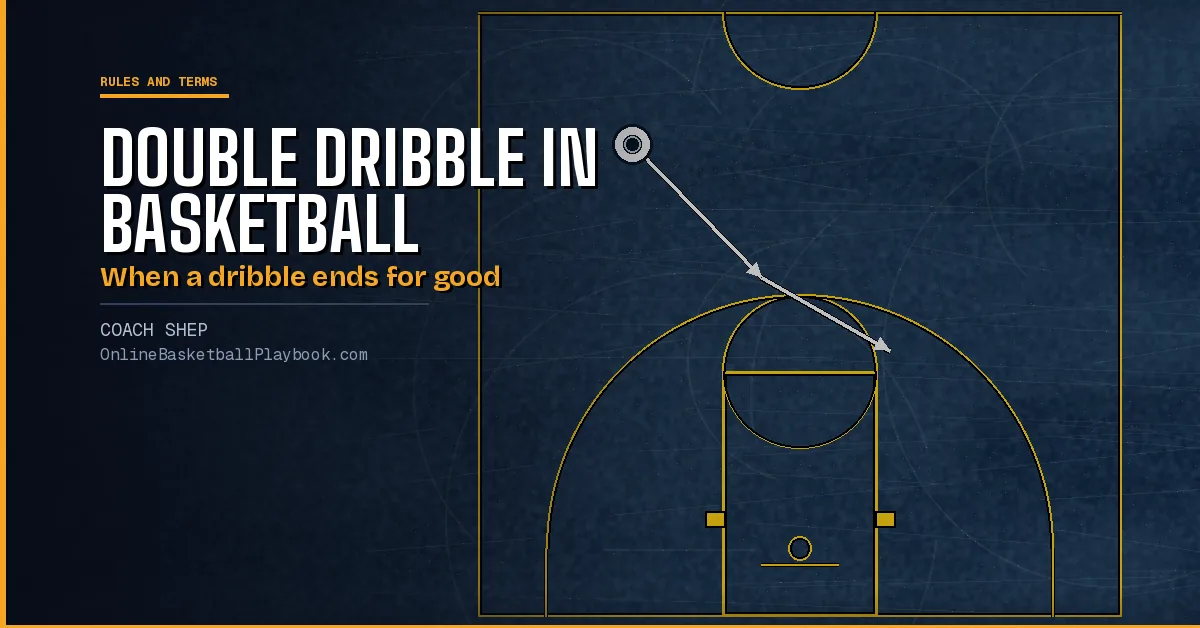
A double dribble is a violation for dribbling a second time after the first dribble has ended. The dribble ends when a player catches the ball, lets it rest in a hand or puts both hands on it. After that the player may pass or shoot, and may not bounce the ball again unless a listed exception applies. The other team gets the ball. This guide explains the double dribble rule at each level (NFHS, NCAA, NBA and FIBA), the exceptions that let a player dribble again, the penalty, common youth examples and how to coach it.
Double Dribble in Basketball at a Glance
| Question | Answer |
|---|---|
| What is it? | A second dribble after the first dribble has ended |
| What ends a dribble? | The player catches the ball, lets it rest in a hand or touches it with both hands at once |
| Who gets the ball? | The other team, on a throw-in |
| Is there a foul or a free throw? | No. It is a violation |
| When may a player dribble again? | After control is lost to a try for a field goal, a touch by an opponent, or a pass or fumble that another player touches |

What Ends a Dribble
A dribble is movement of the ball by a player in control who throws, taps, rolls or bounces it on the floor. At NCAA a player may start it by pushing, throwing, tapping or batting the ball down, and may bat the ball in the air as long as it hits the floor before he touches it again. Each level ends the dribble in a slightly different set of ways.
- NCAA men and women: the dribble ends when the dribbler catches the ball, carries or palms it, lets it rest in a hand, touches it with both hands at once, an opponent bats it, or the ball becomes dead.
- NBA: the dribble ends when the player touches the ball with both hands, lets it rest, tries for a field goal, throws a pass, touches it more than once before it hits the floor, loses control or otherwise gathers it.
- FIBA: the dribble ends when both hands touch the ball at once or the ball comes to rest in one or both hands.
- NFHS: Rule 9-5 covers the illegal dribble. The exact current wording sits in the paid rule book, so check it with your state association.
The two-hands rule catches many youth players. A player who bounces the ball with both hands at the same time has ended his dribble. If he bounces it again, that is a double dribble.
When a Player May Dribble Again
A second dribble is legal when control was lost between the two dribbles for one of three reasons. The rule reads nearly the same at NCAA and FIBA. The NBA adds a condition to the first reason.
- A try for a field goal. At NCAA and FIBA any try counts. In the NBA the try must touch the backboard or the rim.
- A touch by an opponent. NCAA words this as a bat by an opponent. The NBA says an opponent touching the ball. FIBA says the ball touched by an opponent.
- A pass or fumble that another player touches. In the NBA the pass or fumble can also touch the player's own backboard or rim.
Suppose a player dribbles, shoots and misses, and gets his own rebound. At NCAA or FIBA he may dribble again. In the NBA he may dribble again only if his shot hit the backboard or the rim. FIBA adds that throwing the ball off an opponent's leg on purpose does not restart a dribble.

Fumbles and Loose Balls
A fumble is an accidental loss of control. At NCAA it covers a muffed pass between teammates as well, and any player may recover it. FIBA describes a fumble as accidentally losing and regaining control of a live ball.
NCAA also has an interrupted dribble. If the ball deflects off the dribbler or gets away from him, nobody has player control, and the dribble is not over. He can chase the ball down and keep dribbling. FIBA lists fumbling at the start or end of a dribble among the things that are not dribbles. Ask your state association how the NFHS book words fumbles and interrupted dribbles.
Officials decide whether the player ever gained control. A tap at a bouncing ball he never held does not end his dribble.
The Penalty for a Double Dribble
The call is a violation. There is no foul, no free throw and no warning. The ball goes to the other team for a throw-in.
- NCAA men and women: the ball is dead and the opponents throw it in from the designated spot nearest the violation.
- NBA: the opponents throw it in from the sideline nearest the spot, and no nearer the baseline than the free-throw line extended.
- FIBA: the opponents throw it in from the place nearest the violation, except directly behind the backboard.
- NFHS: the opponents get a throw-in. Since 2023-24 a violation that gives a team the ball in its frontcourt is thrown in from one of four set spots, so check the details with your state association.
Get the next coaching guide in your inbox
One email when a new guide or diagram set goes up. Free.
Rule by Level
| Level | Rule | Dribble again after a shot | Opponent touch | Throw-in spot |
|---|---|---|---|---|
| NFHS | Rule 9-5 | Ask your state association | Ask your state association | Nearest designated spot, one of four set spots when the ball is in the frontcourt (since 2023-24) |
| NCAA men | Rule 9-7-1 | Any try for a field goal | A bat by an opponent | Nearest designated spot |
| NCAA women | Rule 9-7-1 | Any try for a field goal | A bat by an opponent | Nearest designated spot |
| NBA | Rule 10, Section II | Only if the try touches the backboard or rim | Opponent touching the ball | Sideline, no nearer the baseline than the free-throw line extended |
| FIBA | Article 24 | Any shot | Ball touched by an opponent | Nearest place, not directly behind the backboard |
The biggest split is the shot. The NBA needs the try to touch the backboard or rim, and NCAA and FIBA accept any try. Rules checked against the current NBA, NCAA and FIBA rulebooks in September 2026. High school rules follow the NFHS book, so confirm the details with your state association.
Double Dribble Examples

- Dribble, stop, dribble again. A player dribbles into traffic, grabs the ball with two hands, sees an open lane and bounces it again. A violation at NCAA, NBA and FIBA, and under the NFHS illegal dribble rule.
- Two hands on the ball. A player dribbles, then pats the ball with both hands at once to keep it alive. At NCAA, NBA and FIBA the dribble ended when the second hand touched the ball. The next bounce is a violation.
- Catch a pass and dribble. Legal. No dribble has been used yet, so the player may start one.
- A defender knocks the ball away. The dribbler recovers and dribbles again. Legal at NCAA, NBA and FIBA because an opponent touched the ball.
- The ball gets away. A dribbler loses the ball off his foot or hand and chases it. At NCAA this is an interrupted dribble and he may keep going.
- Shot, rebound, dribble. A player misses and rebounds his own shot. Legal at NCAA and FIBA. In the NBA it is legal only if the shot hit the rim or backboard.
Double dribble is a different call from a carry and from traveling. A carry is a hand under the ball. Traveling is illegal footwork. Read what is a carry in basketball and traveling in basketball for those.
How to Coach the Double Dribble
Youth players commit this violation far more than older players, because they dribble without a plan and restart when they see a lane. The rule exists to keep the defense from facing a player who can dribble, stop and dribble again forever. Explain that to players, since it is easier to remember a reason than a rule.
- Call it every time in practice and in scrimmages from day one, even when the stoppages are annoying.
- Teach the decision first. A player who picks up the ball needs a pass or a shot in mind before he gathers it.
- Sort the turnover by cause. A forced pick-up is a decision problem that film fixes. A bad gather or a hand placed badly is a skill problem that a drill rep fixes.
- Drill starting and stopping the dribble, since jump stops and stride stops cause a large share of preventable turnovers.
- Use small groups of two or three so every player gets every rep and nobody hides.
- Teach the defender the other side of it. When the dribble ends, crowd the player with both hands up.
- Put defense on the drill quickly. Ball handling that only works against air breaks down in games.
Questions Coaches Ask About the Double Dribble
What is a double dribble in basketball?
A second dribble after the first dribble has ended. The dribble ends when the player catches the ball, lets it rest in a hand or puts both hands on it.
Is it a double dribble if you dribble with two hands?
Touching the ball with both hands at once ends the dribble at NCAA, NBA and FIBA levels. The player has not committed a violation yet. The next dribble is the violation.
Is it a double dribble if the ball gets away from you?
At NCAA, a ball that deflects off the dribbler or gets away is an interrupted dribble, and he may recover it and keep dribbling. For NFHS, check the current rule with your state association.
Can you dribble again after a missed shot?
At NCAA and FIBA, yes, after any try for a field goal. In the NBA, only if the try touched the backboard or the rim.
Is a double dribble the same as a carry or traveling?
No. A carry is a hand under the ball, and traveling is illegal footwork. Each has its own call.
What happens after a double dribble?
The other team gets the ball on a throw-in. There is no free throw. The spot depends on the level, as the table above shows.
More calls like this one sit under Rules and Terms and in the Basketball Rules and Regulations guide. Related pages: basketball violations list, basketball fouls list, backcourt violation, free throw rules, how to dribble a basketball, ball handling drills and basketball terms.
Want the printable playbook packs?
OBP Pro members get the premium playbook packs: the zone attack, out of bounds and practice plan PDFs, plus each new pack as it is finished. The membership page lists what is in each one. Or draw your own version free in PlayDraw.
See what OBP Pro includesMore Rules and Terms
Back to Basketball Rules and Regulations and every Rules and Terms page.
Keep Building
Related breakdowns
Illegal Screen in Basketball: Rule, Examples and Calls
Illegal screen basketball rules at the NFHS, NCAA, NBA and FIBA levels, with the stance, the one-step and two-stride distances, moving screens and the penalty.
Backcourt Violation in Basketball: Rule and Examples
A backcourt violation is sending the ball back across half court after gaining frontcourt control. Rule by level, exceptions, the 8 or 10 second count and examples.
Technical Foul in Basketball: Rule, Penalties and Calls by Level
What a technical foul is in basketball, what draws one, what it costs in free throws and when it ejects a player or coach, labeled by NFHS, NCAA, NBA and FIBA rules.