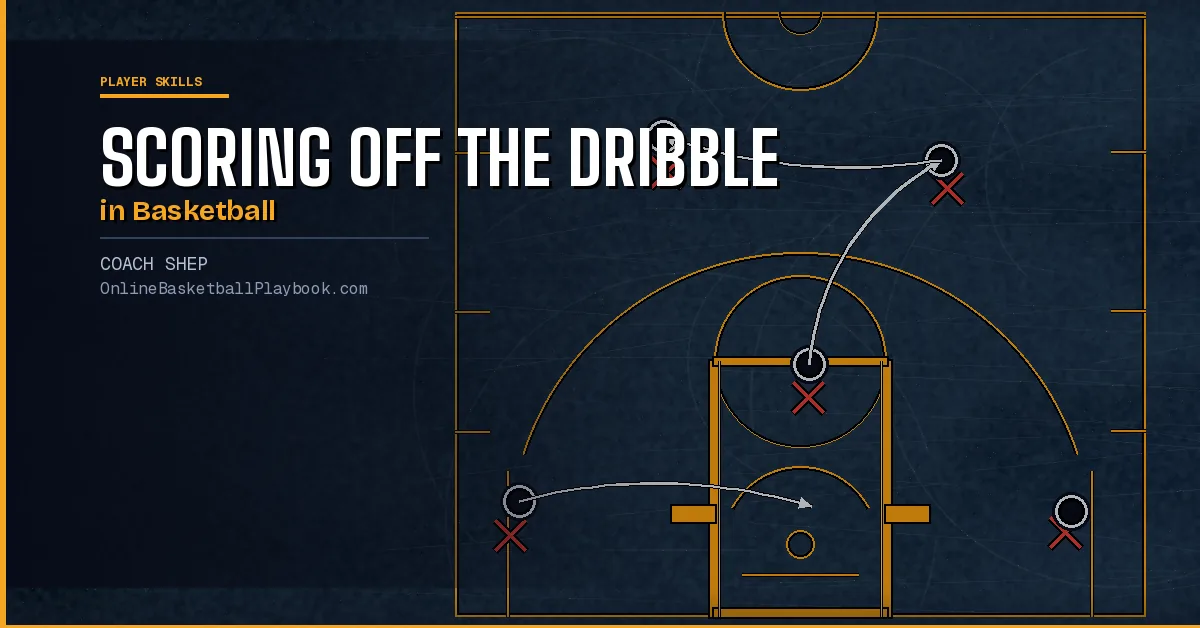
Scoring off the dribble separates players who can only shoot off passes from those who create their own shot. This guide covers the footwork, reads, and finishing moves that let any player attack a defense and convert at the rim.
Why Off-the-Dribble Scoring Matters
Every team needs players who can manufacture a bucket when the offense stalls. Catch-and-shoot players are valuable, but they depend entirely on getting an open look delivered to them. A player who scores off the dribble forces the defense to close out harder, which opens up passes, cuts, and spacing for everyone else on the floor.
Think about what happens inside a motion offense: the system creates movement, but there will always be moments when the ball handler has a step on their defender and must make a decision in real time. If that player cannot finish off the dribble, the defense recovers and the possession resets. If they can convert, the defense must scramble and the entire offensive scheme becomes easier to run.
Off-the-dribble scoring also keeps defenses honest in transition. When a defender knows an opposing guard can pull up off two dribbles or attack the rim from the wing, they cannot drop back and clog the paint without consequence. That single threat changes defensive positioning and creates better looks for shooters all over the court. Developing this skill is a central piece of any serious basketball player development program.
At the youth and high school level, this skill is frequently undertaught. Coaches spend time on set plays and offensive systems but rarely dedicate structured practice reps to the individual technique of creating and finishing off the dribble. Players who receive that focused attention are separated from their peers almost immediately.
The Footwork Foundation
Footwork is the part of off-the-dribble scoring that most players skip, and it is the reason they miss shots they should make or pick up charges they should avoid. Before any finishing move becomes reliable, a player needs to own three foundational footwork patterns: the two-foot jump stop, the one-two step, and the reverse pivot.
The Two-Foot Jump Stop
The jump stop is the most underrated tool in individual offense. A player attacks, collects off the dribble with both feet landing simultaneously, and can now pivot off either foot. Defenders hate it because there is no obvious tell about which direction the attacker will go. The jump stop also allows a player to absorb contact and still finish rather than getting knocked off balance at the moment of collection.
Practice the jump stop without a ball first. Sprint at half speed, call out "stop," and land simultaneously on both feet with knees bent and weight centered. Add the ball once the landing pattern is automatic. Then add a finish: layup left, layup right, pull-up, or kick-out pass. The jump stop becomes a decision point, not just a stopping mechanism.
The One-Two Step
The one-two step is the standard gather for driving layups. The ball is collected on the first step, and the second step pushes off toward the rim. This footwork pattern generates upward momentum and lets the player absorb contact while maintaining body control. Sloppy one-two steps (where the gather is late or the first step drags) result in travel calls and missed layups that should be makes.
The key coaching point is early collection. Players should secure the ball on or before the first step, not after it. A late gather collapses the body and kills elevation. If you find players consistently dragging the gather, back up the drill to a slow walk-through until the timing clicks.
The Reverse Pivot
When a driving lane closes and the ball handler picks up their dribble, the reverse pivot creates separation and reset options. Pivot away from the pressure, find the open teammate, or create enough space for a pull-up. Players who know how to use the reverse pivot after attacking live on the ball rather than panicking when the drive is cut off.
Reads and Decision-Making
Footwork without reads produces a player who attacks regardless of what the defense gives. Reads without footwork produces a player who sees the right play but cannot execute it. Both pieces must develop together.
The primary read for any off-the-dribble attack is the defender's position and momentum. If the defender is flat-footed and standing still, the ball handler has a live dribble advantage and should attack the space immediately. If the defender is backpedaling, the pull-up jumper is available. If the defender is leaning to one side, the counter move to the opposite direction (usually a crossover or between-the-legs dribble) creates the opening.
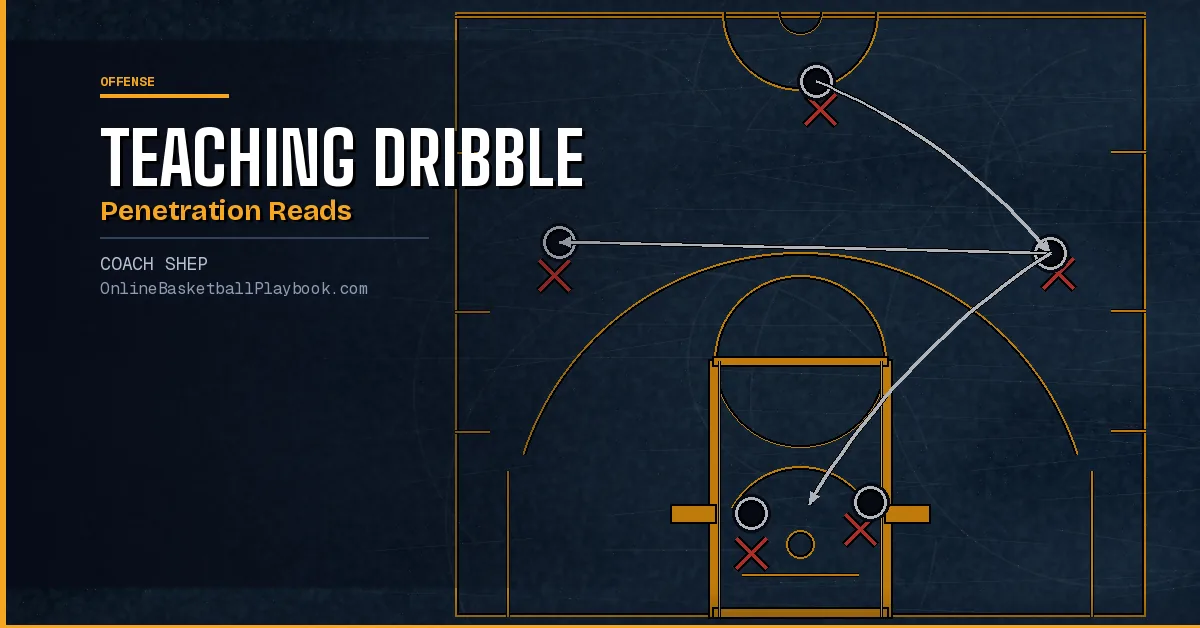
Secondary reads happen when the attack draws help defense. This is where basketball IQ development becomes critical. A ball handler who drives baseline and draws a weak-side helper must recognize the kick-out option before the helper fully closes out. That decision (keep driving or pass to the open shooter) must be made in under a second. Reps in live drills build that processing speed faster than any chalk talk.
The read also changes based on where the attack originates. Driving from the wing toward the middle of the lane is different from driving baseline. Middle drives often encounter help from the weak side; baseline drives often produce either a corner kick-out or a runner in the lane. Knowing which situation you are in before you put the ball on the floor reduces decision time mid-attack.
The Hesitation Read
One of the most useful off-the-dribble tools is the hesitation dribble paired with a read. The ball handler slows, sells a gather, and watches the defender's feet. If the defender stops moving, that is the green light to accelerate. If the defender keeps retreating, the pull-up is open. The hesitation is a probe, not a move. Its value is in the information it provides.
Finishing Moves at the Rim
Getting to the rim is only half the job. Finishing through traffic, around shot-blockers, and against physical defenders requires a set of reliable moves that hold up under pressure.
The Floater
The floater (sometimes called the runner or teardrop) is the answer to the rim protector who camps in the paint. Instead of attacking all the way to the glass, the ball handler releases the ball early on a high arc that peaks above the outstretched hand of a help defender. The touch-based shot requires hours of repetition to make automatic, but it becomes one of the most efficient shots in basketball once mastered. Guards who finish at the rim and shoot reliable floaters are nearly impossible to defend because the big man cannot commit to either look.
The Reverse Layup
The reverse layup uses the backboard and the body as shields. When attacking from one side of the lane, the ball handler drives under the rim and finishes on the opposite side, placing the backboard between the ball and the chasing defender. This is especially effective against shot-blockers who are committed to the straight-line block. The reverse approach changes the angle and takes away their timing.
The Euro Step
The Euro step is a two-step gather that changes direction at the rim. The first step goes one way; the second step plants and goes the other. Used correctly, it freezes a help defender who reads the first step and commits too early. The Euro step is most effective from the wing baseline drive and from the middle of the lane against a retreating big.
The Pro Hop
The pro hop is a jump stop version of the Euro step. Instead of a lateral two-step, the ball handler gathers into a two-foot landing with lateral displacement. It achieves a similar defensive freeze but gives the attacker more body control at the end of the move, which is valuable when finishing against larger defenders or when contact is likely.
Teach finishing moves in a specific sequence: layup first, then floater, then reverse, then Euro step. Players who skip the fundamentals and jump straight to advanced moves develop showy footwork they cannot execute under pressure because the base layer is missing.
The Mid-Range Pull-Up
The pull-up jumper off the dribble is a weapon that modern analytics have called into question, but it remains one of the most difficult shots to guard in the right hands. When a ball handler can pull up reliably from 12 to 18 feet, the defense is forced to stay attached through the entire attack, and that pressure creates driving lanes.
The pull-up requires the same early collection principles as the driving layup. The ball must be gathered before the penultimate step, the shooting hand must get under the ball during the gather, and the upward momentum from the last step must translate into elevation rather than forward lean. A pull-up with too much forward lean turns into a flat, long shot that misses short.
The most common pull-up scenarios are the two-dribble attack from the wing, the pick-and-roll pull-up at the elbow, and the transition pull-up in the middle of the court. Each has slightly different mechanics because the gather angle differs, but the principles of early collection and vertical elevation stay constant.
Coaches should incorporate pull-up work into their basketball practice plan as a standalone segment, not just as part of full-court or 5-on-5 work. Isolated repetitions (player attacks off a pass, two dribbles, pull-up) build the muscle memory that holds up in live situations. Aim for 50 to 100 pull-up reps per session when the skill is being developed.
The Step-Back
The step-back is a pull-up variation that adds a backward gather to create separation. The ball handler attacks, the defender commits to the drive, and the offensive player steps back into a jump shot with the defender moving the wrong direction. It is a high-difficulty move that requires good balance on the backward step and a consistent shooting release despite the change in momentum. Reserve it for players who already have a reliable standard pull-up. The step-back on top of an unreliable pull-up produces a lot of off-balance misses.
Drills to Develop the Skill
Skill without repetition is theory. The moves and reads described above only become reliable under game pressure after hundreds or thousands of quality practice reps. The following drills build off-the-dribble scoring in a structured progression.
Mikan and Reverse Mikan
The Mikan drill (alternating layups from each side of the rim without dribbling) builds the footwork and touch for finishing close to the basket. Adding the reverse Mikan, where every layup is a reverse finish, develops the ambidextrous finishing ability that allows a player to attack from either side of the rim and always have an answer. Do 25 to 50 makes on each variation before moving to more complex drills.
Two-Dribble Pull-Up Series
Start at the elbow. Receive a pass, take two hard dribbles toward the baseline or middle, and pull up. Repeat from both elbows and both wings. The constraint of exactly two dribbles trains the early collection habit and eliminates the extra bounces that cost players time against live defenders. Progress to one dribble once two feels automatic.
Attack and Finish: Live Closeout
This drill introduces a live defender. The defender starts in a help position and closes out to the ball handler who has already caught the pass. The ball handler reads the closeout and attacks (drive baseline, drive middle, or pull up) based on the closeout angle. This is where footwork and reads integrate into one action. Run it at three-quarter speed initially and push to full speed as players improve.
Three-Man Continuous Attack
Three players work in sequence: the first attacks from the wing, finishes or creates a kick-out, and goes to the back of the line. The second catches the kick-out and attacks immediately. The third rotates in. The continuous nature of the drill trains decision-making under fatigue and keeps pace high. Add a help defender in the paint once the basics are solid.
Consistent work on these individual skills within your basketball footwork drills routine will accelerate development faster than any other single investment. Footwork is the multiplier that makes every other offensive skill more effective.
Partner Mirroring
Two players face each other in a small space. One attacks; the other mirrors laterally without fouling. The attacker must use hesitations, direction changes, and body fakes to create separation before finishing at a cone or marker. This drill trains the on-ball skill of reading a single defender's momentum and using it against them. The same read that applies every time a player drives in a game.
- Collect early: Secure the ball on or before the first step, never after. Late gathers kill elevation and create travel calls.
- Fake before every move: A direction fake, shot fake, or hesitation before every attack buys a half-step of separation from even disciplined defenders.
- Read the defender's feet: Flat feet mean attack now; backpedaling feet mean pull up; leaning feet mean counter to the opposite direction.
- Use the backboard on reverses: Finishing on the opposite side of the rim puts the backboard between the ball and the shot-blocker. Use it deliberately, not accidentally.
- Floater first when help is present: If a rim protector is in the lane, release the floater early rather than trying to finish over them at the glass.
- 50+ isolated pull-up reps per session: Pull-up reliability requires volume. Build it in standalone drill work, not only in scrimmage situations.
Get free play diagrams, drills, and coaching guides delivered weekly.
Draw this play free in the play drawer →
Membership: the full library, playbook packs, and Pro drawing tools →
Keep Building
Related breakdowns
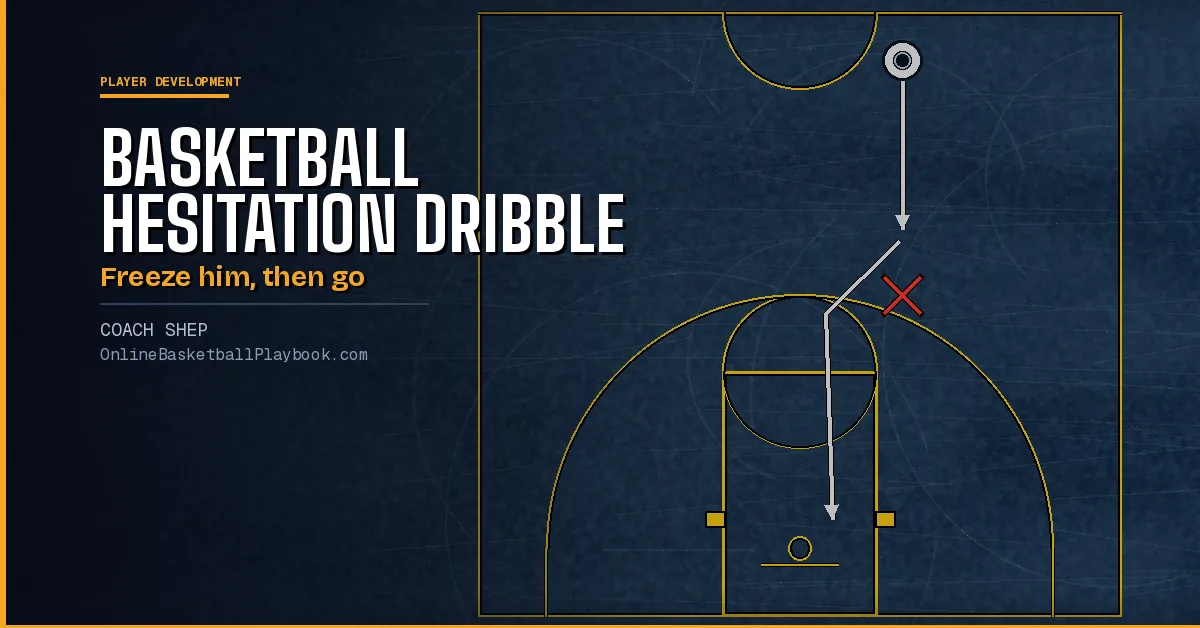
Basketball Hesitation Dribble: How to Do the Hesi Move
The basketball hesitation dribble step by step: the stop and rock back, selling it, when to use it, its crossover and pull-up counters, the hedge read and drills.