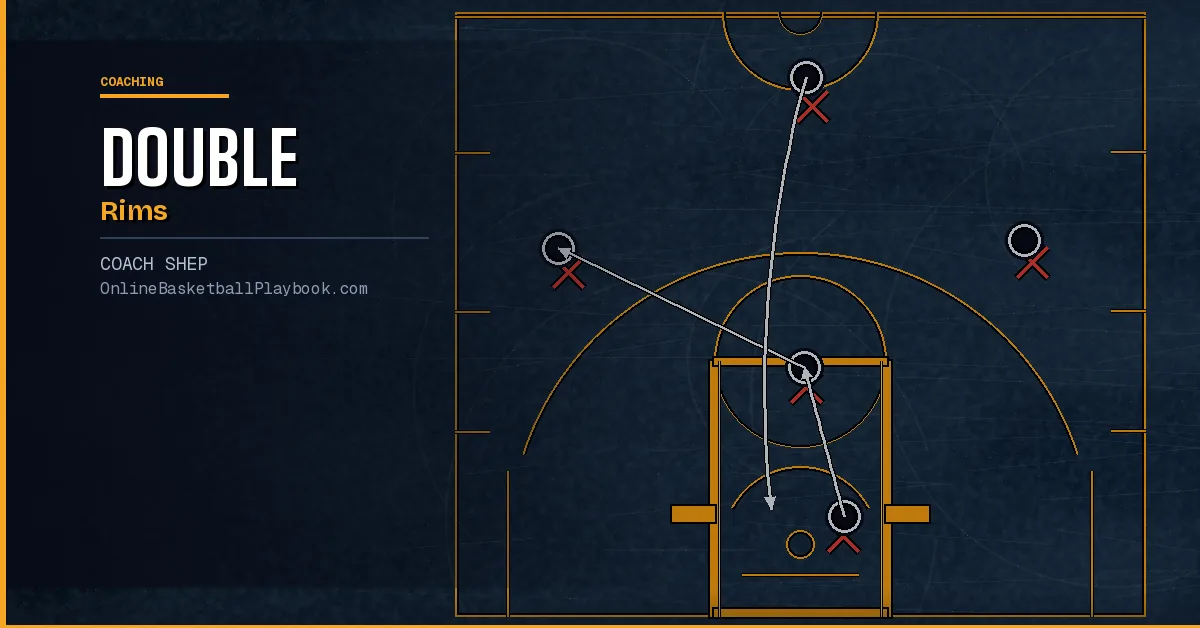
Double rims are stiffer, heavier, and far less forgiving than standard rims. If your players can shoot well on a double rim, they can shoot well anywhere. Here's what you need to know.
What Is a Double Rim?
A standard basketball rim is a single-piece orange ring, 18 inches in diameter, attached to the backboard at 10 feet. A double rim, technically called a double-welded rim or breakaway double rim, has two concentric steel rings welded together, one on top of the other. The result is a rim that is roughly twice as thick as a standard rim, measuring close to an inch in total width where the ball makes contact.
You find double rims overwhelmingly on outdoor courts: parks, recreation centers, schoolyards, and community courts. The reason is pure durability. Outdoor conditions (weather, temperature swings, heavy use, and the occasional dunk from someone hanging too long) punish a standard rim. Double rims are nearly indestructible. They take the punishment and keep working. Indoor courts at the high school, college, and professional level almost universally use single rims, which is part of why so many players struggle when they show up to an outdoor run and the shots won't fall the same way.
The double rim's design also means the basket opening is effectively smaller in practice. The rim diameter does not change (it is still 18 inches) but the thicker steel walls narrow the margin for error on any shot that grazes the rim. A ball that finds a soft landing on a single rim may bounce away on a double. That unforgiving quality is the defining characteristic coaches and players need to understand.
Why Double Rims Are Harder to Score On
The difficulty comes down to three factors: mass, rigidity, and bounce behavior.
Mass. A double rim is heavier than a standard rim. More mass means more resistance when the ball makes contact. On a single rim, a shot with some arc and backspin that hits the back of the rim has a chance to deadens, lose energy, and drop through. On a double rim, the same ball bounces back harder and farther. Players who depend on "lucky" bounces (shots that kiss the rim and fall) quickly discover those shots simply do not fall on a double rim.
Rigidity. Modern breakaway single rims flex slightly on contact, especially on hard layups and dunks. That flex absorbs energy. A double rim has far less give. The ball's kinetic energy has nowhere to go except back into the ball, which means more aggressive kick-outs on off-center shots.
Bounce behavior. On a single rim, a ball that hits flat (little arc, little backspin) still has a chance. On a double rim, flat shots are punished severely. The ball bounces high and long, often completely off the backboard. Coaches watching their players for the first time on an outdoor double rim will notice immediately: shots that look good off the hand still miss, and they miss badly. That disconnect is frustrating for players and revealing for coaches. It exposes every flaw in the shooter's arc and backspin.
There is one underappreciated advantage of the double rim, though: it tells the truth. No shot gets a gift. If a player makes shots consistently on a double rim, their mechanics are sound. Coaches who regularly practice on outdoor courts with double rims report that their players' indoor shooting improves over the course of a season because the double rim has essentially forced corrected technique.
The Shooting Mechanics That Beat a Double Rim
Three mechanical adjustments make the biggest difference on a double rim: arc, backspin, and follow-through depth.
Arc
The single most important adjustment is higher arc. A flat shot on a double rim is almost always a miss. The ball needs to enter the basket at a steeper angle (roughly 45 degrees or higher) so that it is arriving downward rather than sideways when it contacts the rim. A steeper angle gives the ball a better chance to pass through the interior of the 18-inch opening even if it grazes the rim on the way.
Coaches can cue this with "shoot over the top of the backboard" or "shoot at the top of the square." The mental target changes the approach angle. Players who think they are shooting at the rim tend to aim at the front of the rim. Players who think they are shooting at or just above the back of the rim tend to produce the steeper arc the double rim rewards.
Backspin
Backspin causes the ball to deaden on contact rather than kick away. A ball with proper backspin hitting the double rim loses energy and tends to drop downward. A ball with no spin (or worse, topspin) explodes off the rim. This is not new shooting advice, but the double rim makes it more consequential. Players who have passable backspin on a single rim find out quickly whether it is actually consistent when they move outdoors.
Finger-tip release is the key teaching point. Coaches should watch the last point of contact on the shot. If the ball rolls off the pad of the index finger rather than the fingertips, the backspin will be inconsistent. The shooting hand should finish palm-down, wrist fully snapped, fingers relaxed and pointing toward the basket. That full follow-through is the mechanical driver of consistent backspin.
Follow-Through Depth
A common habit is to release the ball and drop the shooting hand immediately. On a forgiving single rim, this doesn't cost you much. On a double rim, partial follow-through tends to correlate with early release, which tends to produce flat shots. Teaching players to hold the follow-through ("hold it until the ball hits the net") trains both the mechanical completeness of the shot and the mental discipline that carries into pressure situations.
Finishing at the Rim: Adjusting Your Layup Menu
The double rim is unforgiving on layups too, but for slightly different reasons than jump shots. On a layup, the ball's angle of approach matters as much as it does on a jumper, and the double rim adds an extra obstacle on shots that hit the backboard and then the rim.
The most common layup failure on a double rim is the high-speed, low-angle drive where the player releases the ball too flat against the backboard. The ball bounces hard off the board, hits the front of the double rim, and kicks out. Players who rely on a fast-twitch, low-bank layup, which works fine on a single rim with its slight give, need to adjust.
The adjustments that matter:
Use the backboard more intentionally. A high, soft angle on the backboard (aiming for the top corner of the painted square) gives the ball time to deaden before it contacts the rim. Players who have drilled "paint the square" on layup work will find this translates directly to double-rim performance.
Power layups are more reliable than speed layups. A two-foot power stop into a high-angle layup contacts the rim with less horizontal velocity, which means less kick-out energy when the ball glances the double rim. Teach the power layup early in the season. It works on every rim, but it is particularly valuable on double rims and in traffic where contact disrupts a one-foot stride finish.
Expand the finish menu. The finishing family (regular, opposite-hand, power, reverse, floater) exists precisely because different defenders and different angles demand different finishes. On a double rim, the reverse layup and the floater become even more valuable because both shots naturally approach the rim at a higher arc and with more deliberate touch than a straight-line drive layup. A player who only owns one finish will be exposed on a double rim court far more quickly than on a single rim.
How to Train Players on Double Rims
The best approach to double-rim training is deliberate exposure with an emphasis on the mechanical corrections, not just volume shooting.
Sending players to shoot on an outdoor court and hoping they figure it out produces frustration, not improvement. The key is structured work where players know what they are correcting and can feel the feedback loop: better arc, better backspin, better follow-through. Shots start to fall.
A productive double-rim shooting session has three phases:
Phase 1: Spot shooting from close range. Five to seven feet from the basket, shooting with full follow-through, counting made shots out of 20 attempts. The goal is to isolate arc and backspin at a distance where the mechanical errors are clearly visible and correctable. Players who struggle to make 12 of 20 from five feet on a double rim have a mechanics problem, not a range problem.
Phase 2: Catch-and-shoot from wing spots. Standard game-speed catch-and-shoot from the wing and corner, tracking makes and misses, with a coach or partner identifying the miss pattern. Shots that bounce straight back indicate backspin problems. Shots that kick hard to the side indicate arc problems. Shots that are on-line but short indicate follow-through cutoffs.
Phase 3: Off-the-dribble finishing. Live-ball moves into the paint (jab-and-go, crossover drive, jump-stop into the paint) followed by a finish choice from the menu. The jump stop is particularly useful here because it forces players to gather their footwork before the finish decision, which naturally produces higher-arc, more controlled layup attempts.
Run these sessions periodically throughout the season, not just as a novelty. Players who shoot on double rims two or three times per month will adapt their mechanics in ways that carry back to indoor shooting.
Double Rims and Mental Toughness
There is a psychological dimension to double rims that coaches underestimate. Players who have only ever practiced on indoor single rims often respond to early double-rim misses by concluding the rim is broken, the court is bad, or they are having an off day. They externalize the miss. That attribution pattern ("it's the rim, not me") prevents them from making the adjustments that would actually solve the problem.
The better mental frame, and the one coaches should install early, is: a double rim punishes bad shots and rewards good ones. Period. This frame is empowering rather than discouraging because it gives players agency. The rim is not arbitrary. It is not unlucky. It is specific. Fix the arc, fix the backspin, hold the follow-through, and the ball goes in.
This mental recalibration also has a direct competitive benefit. Road games, park runs, and open gyms will put players on double rims. A player who has been trained to think "adjust my mechanics" rather than "complain about the rim" will adapt faster, stay focused, and continue competing when their teammates are rattled. That composure is a competitive edge that is earned in practice.
The double rim is also a useful tool for mental toughness work in a broader sense. Running players through high-pressure shot-making drills on a double rim ("make 5 in a row or we restart") creates a high-stakes practice environment without any external opponent. The rim itself provides the resistance. Players who can lock in and make consecutive pressure shots on a double rim are demonstrating exactly the kind of focus under pressure that coaches are always looking for.
Pair this kind of drill with explicit debrief: what did you do differently when you finally strung together the makes? Players rarely answer "I tried harder." They answer "I focused on my follow-through" or "I slowed down and got my feet set." Those are the mechanical cues the coach has been teaching all along. The double rim just made them feel them.
Before taking your team to an outdoor court with double rims, tell them explicitly what a double rim is and why it behaves differently. Players who know what to expect and why make better mechanical adjustments and recover from early misses faster than players who are just confused about why the ball keeps bouncing out.
- Raise the arc first. Steeper entry angle gives the ball a better path through the opening even on rim contact. Cue "shoot over the top of the square."
- Demand a full follow-through on every rep. Partial follow-through correlates with flat shots; hold it until the ball hits the net to build the mechanical habit.
- Drill power layups, not just speed layups. Two-foot power stop into a high-angle finish reduces horizontal velocity at the rim and produces far fewer kick-outs on a double rim.
- Teach backspin as fingertip release. The ball rolls off the fingertips, not the palm, to produce consistent backspin that deadens on contact instead of kicking away.
- Use the double rim as a diagnostic tool. Track miss patterns: straight-back bounces mean backspin problems; hard side kicks mean arc problems; short shots mean cut-off follow-through.
Want more basketball coaching strategies and drills?
Join the Online Basketball Playbook newsletter →
Draw this play free in the play drawer →
Membership: the full library, playbook packs, and Pro drawing tools →
Keep Building
Related breakdowns
Double Dribble in Basketball: Rule, Examples and Calls
A double dribble is a second dribble after the first has ended. Rules by level (NFHS, NCAA, NBA, FIBA), what restarts a dribble, examples and how to coach it.
Basketball Positions: What Each of the 5 Positions Does
The point guard, shooting guard, small forward, power forward and center, what each one does on offense and defense, and when to ignore the numbers.
Basketball Game Clock Rules: When It Stops and When It Starts
Basketball game clock rules by level: when the clock stops, when it starts on a throw-in or a missed free throw, made baskets late and the last-two-minute rules.