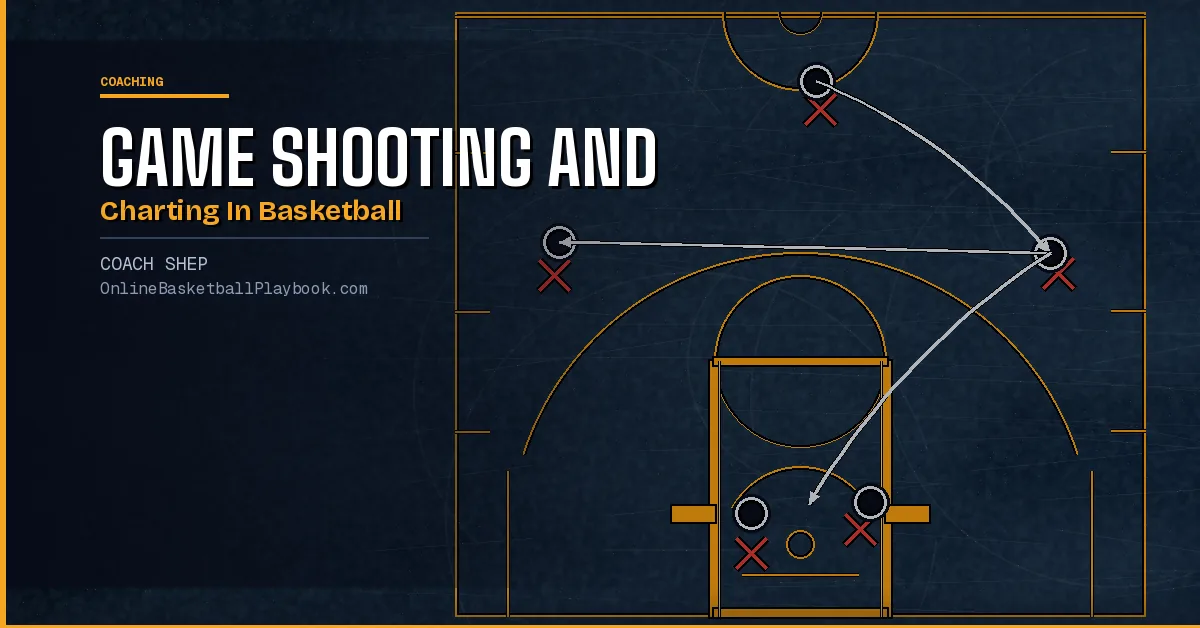
Most teams track score. The best teams track shots: where they came from, how contested they were, and whether they matched what practice built. That gap is where games are won and lost.
Why Shot Charting Changes How You Coach
Before a coach can improve a team's shooting, they need an honest picture of what shots the team is actually taking. Memory and impression are unreliable. A player who makes three big threes late in a game feels like a great shooter, even if he shot 3-for-14 from the field. A post player who looked clunky in the first half might have drawn six free throw attempts that never show up in your impressions of the game. Charting forces objectivity.
Shot charting is not a modern invention. Coaches have kept tally sheets on clipboards since the 1960s. What has changed is the sophistication of what gets tracked and how quickly that data feeds back into practice decisions. At its most basic, a shot chart tells you where shots came from and whether they went in. At a more advanced level, it tells you the shot quality, defined as whether the shot was open, off-the-catch, in rhythm, or forced under defensive pressure.
Rick Pitino demonstrated exactly why this matters when he documented that his Louisville team shot 22% on contested shots, compared to the NBA baseline of roughly 42%. That 20-point gap is enormous. His response was a practice rule: if a shot would be contested, pass it back and restart the action. No exceptions. He turned a chart number into a coaching mandate. That is the real value of charting. It converts opinion into action.
What to Chart: The Four Numbers That Matter Most
You do not need a $500-per-month analytics subscription to get useful shot data. A clipboard, a half-court diagram, and four categories are enough to build a meaningful picture over the course of a season.
1. Shot Location
Mark the spot on the floor where each shot originates. Divide the court into zones that match your offensive system. If you run a lot of Princeton-style offense, your primary zones are the high post, the elbow, the short corner, the corner three, and the wing three. If you run more dribble-drive, you add mid-range pull-up zones at the charge-circle extended area. The goal is to see whether your team is actually getting the shots your offense is designed to create.
2. Shot Type
Label each shot as catch-and-shoot, off-the-dribble pull-up, post-up, or transition. This matters because different shot types have different baseline make rates, and a team that forces its catch-and-shoot players into off-the-dribble situations is leaving efficiency on the table every game.
3. Contest Level
Mark each shot as open (defender 4+ feet away), lightly contested (1-3 feet), or heavily contested (hand in the face / blocked). This is the most important column on the sheet. A team shooting 35% overall can be doing fine if 80% of those shots are open. A team shooting 40% overall might be underperforming badly if most of those makes came from a handful of fortunate heavily-contested shots.
4. Shot Origin
Track how the shot was created: off a set play, off secondary break, off offensive rebound, or off broken-play improvisation. This tells you whether your half-court actions are actually generating the shots you planned, or whether most of your offense is degenerating into improvisation by the third quarter.
Shot Quality vs. Shot Volume: Reading the Data Right
Once you have two or three games charted, the first instinct is to count makes and misses by zone. Resist that. A small sample of makes by zone is almost meaningless. One hot shooting night distorts a zone's efficiency number completely. What you are looking for in the early stages of a season is a pattern in shot selection, not shooting percentage.
Ask these questions of your chart data:
Are we getting the shots our offense is designed to create? If your system is built around wing threes off skip passes and you are charting 40% of your threes as contested corner heaves in the shot clock's final five seconds, your offense is not running, it is surviving. The chart tells you that before the losing streak does.
What percentage of our shots are contested? This is the Pitino question. If your contested-shot rate climbs above 35-40% in any given game, your players are making poor shot-selection decisions, or your offense has broken down and left them without better options. Either way, it shows up clearly on the sheet before it shows up in the final score.
Where are we getting our best looks, and are we getting enough of them? Charting will often reveal that a team's most efficient zone (open catch-and-shoot threes off motion cuts, for instance) generates only 8 or 10 shots per game when it could generate 18 if the players attacked it intentionally. Showing players the chart number ("we shot 6-for-8 from that spot when we got the ball moving, let's get there 12 times tonight") is more powerful than any motivational speech.
How to Build a Shooting Culture Around Real Numbers
Game charting has a mirror image on the practice side: scored, recorded, competitive shooting drills. The philosophy is identical. You are making the invisible visible by attaching a number to every rep.
Shaka Smart's Texas program built a drill bank of 18 named, recorded, moving shooting drills with records posted for players to chase. The "3-Minute" drill had a target of 100 makes and a team record of 157. The "Evans" drill had a record of 219. Players were not just shooting. They were competing against a posted standard that carried social weight. Somebody signed that record. It has a name on it. That is a shooting culture.
The record board is the cheapest culture-building tool in basketball. Put one up for each team with three or four named drills. Let players sign their best scores. The first time a 10th-grader breaks a record set by a senior, the entire gymnasium knows it and that player will shoot more confidently in the next game because there is evidence that they can make shots under pressure.
Jay Hernandez's approach adds another layer: every shooting block needs a winner. Not a participation sticker. A winner. Run "Quarters" (one-handed form shots progressing to full jumpers) with a partner and keep score. Run "Around the Horn" with a time limit and a posted target. The moment a drill has a scoreboard, players practice differently. Their feet get set faster. Their release gets quicker. The contested-shot rate in games drops because they have trained under competitive pressure rather than comfortable open looks.
John Beilein's Michigan standard puts a precise number on what game-ready shooting looks like: 7 makes out of 10 attempts in 30 seconds, coming off a down screen and flare screen sequence. Three players run if they fail to hit the standard. The screener is exempt because they know their job was to set a good screen, and the outcome is on the shooter. Fail to hit 7-for-10, and there is a sprint consequence. That standard is not arbitrary. It maps directly to game pace and game pressure. If a player can hit 70% under a 30-second clock after running through a real screening action, they are ready for that shot in the fourth quarter.
Connecting Game Charts to Practice Reps
The feedback loop between game charting and practice design is where most teams lose the thread. A coach charts a game on Friday, puts the sheet in a folder, runs the same practice schedule on Monday, and wonders why the problem persists in next Friday's game. Charting only works when it drives the drill selection for the following week.
Here is a simple system that closes the loop:
After each game, identify the single biggest shot-selection failure from the chart. If 11 of your 14 long twos were heavily contested, that is your target. Design one drill for Monday's practice that trains players to reject that shot and find a better option. Larry Brown's SMU system is built exactly on this principle. Every drill in his practice includes an action before the shot (zipper cut, baseline drive, drag screen) so players are always responding to a read before they pull the trigger, never standing still and catching. When your game chart tells you players are standing still and catching then forcing contested shots, you fix it by drilling the action that gets them moving first.
The Kevin Eastman framework ("game shots, game spots, game speed") gives you a three-part test for every practice shooting drill. Does this drill produce a shot a player would actually take in a game? Is it taken from a spot on the floor where that player will see the ball in a game? And is it performed at the speed it will happen in a game? If your drill fails any of the three, it is not building the habit you think it is, and it will not show up as improvement on your next game chart.
Free throws deserve their own charting note. Most teams shoot free throws fresh. Two clean looks at the start or end of practice. But free throws in a game happen when players are exhausted, fouled in traffic, and carrying the emotional weight of the score. Beilein baked free throws into workouts after physical stress. Chart your team's free throw percentage in the fourth quarter separately from the first three quarters. The gap between those two numbers tells you whether your free throw practice is actually game-realistic or just target shooting.
After each game, pull three numbers from your shot chart before you watch any film: contested shot rate, zone that generated your most open looks, and how many of your shots came off a designed action versus improvisation. Those three numbers tell you what to fix before you watch a single clip.
Diagnosing Shooting Breakdowns with a Chart in Hand
When a team goes cold (three or four games with a field goal percentage that drops ten points below their season average) the instinct is to run more shooting drills in practice. That is usually the wrong diagnosis. A cold stretch is almost always a shot selection problem before it is a shooting mechanics problem. The chart will tell you which one it is.
If your team's shot locations look normal but the makes disappeared, that is a mechanics issue and Dr. Hal Wissel's error-correction diagnostic is the right tool. Work backward from what you see: a rash of short shots means the release point dropped, not that the players forgot how to shoot. Prescribe the specific correction (high-extension finish, hold the follow-through until the ball lands) and track whether the make rate recovers in two or three games. Do not cycle through four different coaching cues simultaneously, one correction, one measurement window.
If the shot locations on your chart shifted (more contested mid-range shots, fewer corner threes, fewer catch-and-shoot opportunities off cuts) that is an offensive-structure breakdown. Your motion is not creating the looks it is supposed to create. That is a different problem requiring a different fix: revisit the actions, not the mechanics.
The pull-up jumper is worth tracking separately because it often disappears from a team's game chart without coaches noticing. Rumjahn called the pull-up and hesitation "lost arts". A player who can take one or two dribbles and shoot accurately around the free-throw line extends your half-court offense dramatically because it collapses help defense and creates drive-and-kick opportunities. If your chart shows zero pull-up attempts over three games, your offense is readable: defenders can sag and crowd the three-point line because they know you will not attack in between. Add the pull-up back into your drill rotation and watch the chart change within two weeks.
Finally, track the origin of your offensive rebounds and second-chance points alongside your shot chart. A team that misses a high percentage of shots from poor shot-selection zones and retrieves a low percentage of those misses is not just shooting poorly. It is in a compounding efficiency hole. Teams that take quality shots from quality spots tend to miss in predictable rebound zones, which means your offensive rebounding can be organized around your charted shot zones rather than just sending five players to scramble.
- Chart contested shot rate every game: if it climbs above 35%, pause your offense film session and go straight to shot-selection clips. That number is the leading indicator of offensive breakdown before the scoreboard makes it obvious.
- Post the record board before the first practice of the week: name the drills, post the top three scores for each, and let players sign their marks. It costs nothing and compresses weeks of motivational work into a single sheet of paper on the gym wall.
- Shoot free throws tired, not fresh: bake at least two sets of free throws into the middle and end of competitive drills when players are winded, game free throws happen under fatigue, and practice free throws should match that reality every single day.
- One correction per cold stretch: when makes dry up, pick one mechanical cue from the Wissel diagnostic, run it for two games, then measure. Cycling through multiple cues simultaneously confuses players and makes it impossible to isolate what worked.
- Run the Purdue drill weekly: four threes in one minute with a rebounder and passer, sprinting baseline to half-court between shots. Players run for each point below four. It combines game speed, competitive pressure, and fatigue in under 90 seconds and directly mirrors what your shot chart is trying to capture.
Want more basketball coaching strategies and drills?
Join the Online Basketball Playbook newsletter →
Draw this play free in the play drawer →
Membership: the full library, playbook packs, and Pro drawing tools →
Keep Building
Related breakdowns
Basketball Shooting Form: Step-by-Step Mechanics
Basketball shooting form step by step, from the ready stance and grip to release and follow-through, with drill progressions and where coaches disagree.
Free Throw Shooting: Routine, Form and Drills
Free throw shooting starts with a routine the player never changes. Form cues, the mental side and drills that copy the fatigue and pressure of a game.
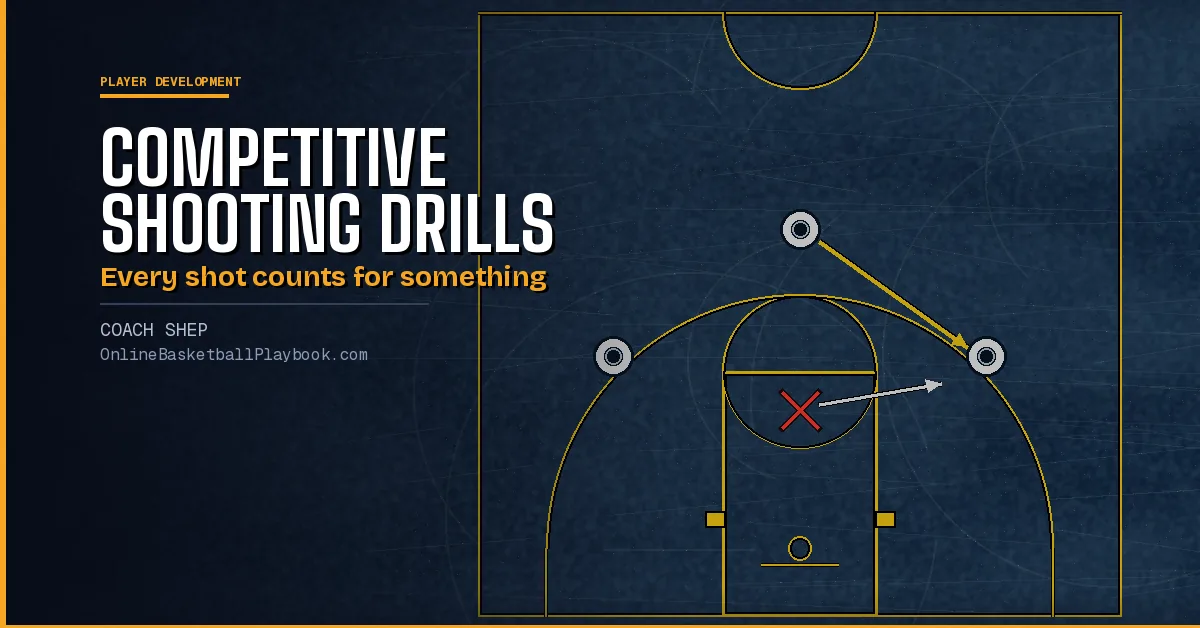
Competitive Shooting Drills: Scored Games and Records
Competitive shooting drills with a score on every shot: streak games, timed targets, Beat the Pro, plus and minus, 2-on-1 shooting and record boards.