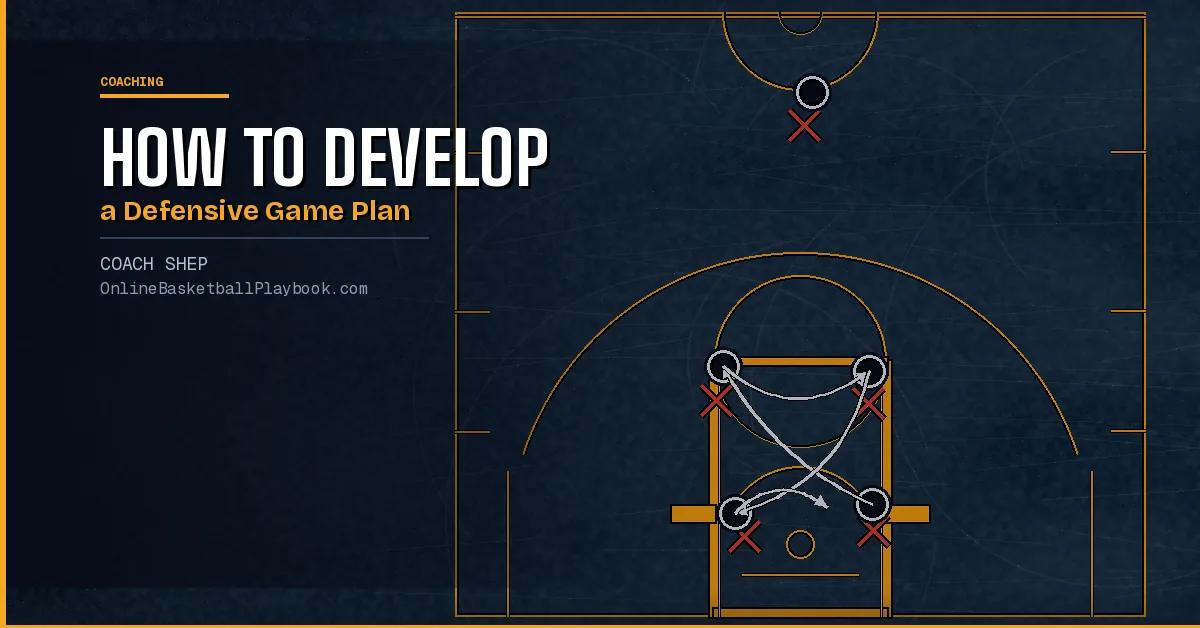
A strong defensive game plan separates prepared teams from reactive ones. This guide walks you through scouting, scheme selection, drill installation, and competitive validation. Everything you need to build a defense your players actually execute.
Scouting the Opponent Before You Draw a Play
Defensive game planning starts with scouting, and scouting means knowing exactly what actions you will see on game night. Without that foundation, you are just running your system into the dark.
Begin with the opponent's most frequent actions. What are their best three plays? Where do their top scorers receive the ball? Do they attack the ball screen with a specific handler? Which shooters need a tight close-out and which can be played off? Answers to these questions determine your scheme, your coverages, and which breakdown drills you run that week.
Organize your scouting into categories: on-ball tendencies, off-ball movement patterns, ball-screen actions, transition habits, and post-entry sequences. A one-page scouting report that your players can study (not a 20-slide deck) is more useful in a film session. Identify two or three defensive priorities and communicate them as a simple phrase your players will remember on the floor.
Effective scouting also means knowing which matchup you want to protect. Identify the opponent's primary scoring option and build your defensive assignments around containing that player. Sometimes the right call is to invite the weaker ball-handler to be the initiator. Sometimes it means switching all ball screens to deny your opponent's best shot creator. These decisions come from watching film, not from instinct.
The closeout label system is one practical tool coaches use to communicate coverage decisions. A "Curry" label tells your defender to sprint off the three-point line and stay attached. No giving ground. A "Wade" means close hard and contest on the rise. A "Rondo" tells your defender to play off and bait the pull-up. Assigning these labels to the opponent's shooters before the game gives your players a simple vocabulary that travels onto the court without a timeout.
Choosing Your Defensive Scheme
Once you understand what the opponent wants to do, you choose a defensive scheme that takes it away or at minimum, makes them work harder for what they like.
Man-to-man defense is the foundation for most programs. It demands individual accountability, develops on-ball and off-ball habits year-round, and gives you the flexibility to adjust coverage matchup by matchup. The most common man-to-man decisions are: how you play ball screens (hedge, drop, blitz, or switch), whether you deny wings or play help-side, and how you handle post entry. These are not one-time decisions. They are weekly choices that depend on the opponent.
Zone defense works best as a change-up, not a primary scheme. Mixing a 2-3 zone into a game that your opponent has not prepared for can disrupt rhythm and create turnovers. But players who only know how to play zone have limited individual defensive development. The best programs teach man-to-man mechanics first and use zone as a tool, not a crutch.
Press defenses require specific personnel and conditioning. Full-court pressure can be devastatingly effective when your team is faster, deeper, and better-conditioned than the opponent. But it also carries risk. A team that cannot trap with proper footwork and trap-and-release mechanics will give up easy buckets. Choose press based on personnel match-up, not desperation.
The single most important scheme decision is clarity. Players execute what they understand. A simple, well-installed man-to-man scheme executed with energy and awareness beats an elaborate zone run half-heartedly. As coaches say at every level of the game, "defense is not a scheme. It is a standard." Pick a scheme your players can master and hold them to that standard every possession.
Installing Defense with Breakdown Drills
The clearest model for defensive installation is the whole-part-whole method. You show players the complete defense (what it looks like at game speed) then break it into individual and small-group parts, drill those parts at high intensity, and reassemble the whole. Every elite defensive program follows this structure. NKU, Donovan, Iisalo, and Clifford all use a daily two-segment block: an 8-to-15 minute breakdown period, followed by 5-on-5.
Footwork is the first building block. You cannot install any defensive system without players who know how to stay in front of the ball. The basic footwork ladder starts with a boxer stance, moves to half-squat step-slides with hands overhead to enforce a low body position, and progresses to the "one-step / two-step" big-step technique to cut off the first dribble drive. Run-and-recover mechanics (sprinting to beat the ball to a spot) complete the footwork foundation. Once players have these habits in a daily warm-up context, you can layer coverages on top of them.
On-ball defense drills give players repetitions at guarding the live dribble, the pull-up, and the drive. The 1-on-1 driving-line drill is one of the most transferable: close out top-side, put your chest on the offensive player's shoulder, beat him to the spot, and send him on a pre-designed driving line with no middle. Players who practice this drill daily stop taking wild reaching fouls because they have learned that the body position, not the hand, is what creates a stop.
Off-ball defense drills train what happens away from the ball, which is where most defensive breakdowns actually occur. Jump-to-ball mechanics ("move on the pass, not the catch") need to be taught slowly and precisely before being run at game speed. The jump-to-ball principle is universal: every defender takes one big step off the line of the ball on every pass, hand above the ball, gap position maintained. Drill it with a passer moving the ball, reward the first defender who gets to position before the catch, and you will eliminate the lazy off-ball habits that lead to open threes.
Drilling Specific Coverages: Ball Screens, Closeouts, and Help
Ball-screen defense is one of the most drilled and most frequently broken defensive actions in basketball. The reason is simple: ball screens happen on nearly every possession in modern basketball, and a single wrong coverage choice (or a poor execution of the right choice) creates a wide-open shot or a layup.
The best installation method for ball-screen defense is 2-on-2 reps at 60 to 70 percent speed. Iisalo's approach (offense at reduced intensity while the defense works at full attention with full talk) ensures the defensive reads are clean before the speed goes up. You teach the choice (drop, hedge, blitz, or switch) at half speed first, so both defenders know what to do, then you add pace. Running 5-on-5 ball-screen defense before the 2-on-2 read is clean is a common coaching mistake that buries confusion inside volume.
Closeout drills are non-negotiable in any game-plan preparation. The sprint-and-chop mechanics (sprint the first two thirds of the distance to the shooter, then parachute into choppy steps with hands up) must be drilled so they become automatic. A single long-stride closeout on a shooter who is ready to shoot is one of the most preventable mistakes in basketball. Run closeout drills daily and label your closeout assignments against each opponent's shooters using the coverage vocabulary from your scouting process.
Help-side defense and shell drill work builds the off-ball rotations that make your scheme cohesive. The 4-on-4 shell drill is the single best tool for this. Run it with movement (give-and-go cuts, flash cuts, skip passes) and hold every defender accountable to gap position and jump-to-ball mechanics on every pass. Scott Nagy's four-stage shell progression offers a clean install ladder: start with jump-to-ball only, add give-and-go cuts, then flash cuts, then live-to-the-paint. Advancing through these stages gives players a structured progression instead of throwing them into a fully live shell before the reads are automatic.
Contest-without-fouling drills are where defensive identity gets built at the rim. The wall-up drill and the verticals drill train players to jump straight up, not into the offensive player, when a drive reaches the paint. These two drills alone (run daily for ten minutes) address the single most common foul problem on younger teams. Players learn to use their height, not their reach, to contest shots. Programs that commit to this habit can lead their conference in defensive free throw rate, which is one of the clearest and most undervalued metrics in team defense.
Validating Your Defense with Competitive Practice Formats
Drilling the right mechanics is necessary but not sufficient. Defense only transfers to games when players have proven they can execute it under competitive pressure, when something is on the line, when they are tired, and when the offense is trying to score.
Competitive validation formats are the bridge between breakdown drills and games. The best ones embed accountability in the structure so that coaches do not have to enforce intensity. The competition does it. Messina's Defensive Validation drill is one of the most elegant: a team's score only counts if they get a stop on the next possession. Players compete to win a game and defensive accountability follows automatically. Run it to five points with any group.
The Stop-Score-Stop format pairs stops and scores in sequence. A team must chain a stop, a score, and another stop before they can win the segment. This trains players to value defensive possessions the same way they value offensive possessions, which is one of the hardest mental habits to build in younger players who identify primarily as scorers.
Bruce Weber's Cut Throat drill (three teams competing 3-on-3 or 4-on-4 with the ball returning to a coach after each possession) forces teams to win on defense (three consecutive stops) or win on offense (first to score three times). The structure rewards whichever team can sustain their standard. Perfection Cut Throat adds a twist: the coach designates one fundamental (jump to the ball, closeout hands up, deny the wing) that must be executed on every possession. Any defender who fails that fundamental means defense is out of the drill. This is one of the best ways to embed a single weekly habit under genuine competitive pressure. Name one habit before the drill starts. Do not add a second one mid-drill.
Toughness drills complete the validation layer. Knight's Zig Zag drill (run every day, three to five minutes) is a daily toughness diagnostic. As Knight put it, tough kids go hard at zig-zags; soft kids do not. The 3-on-3 Blockout drill forces a four-count hold before players pursue a rebound, building the physical contact habit that prevents passive box-outs. Weber's Gut Check (twelve minutes, one point per stop, a sprint after every score) is a tournament-prep closer that conditions the body and the will simultaneously without a single conditioning lecture.
When installing a new coverage or habit, name it once before the drill and do not correct anything else during the rep. Players can only absorb one focus at a time under competitive pressure. Run the drill, stop on a whistle, correct the named habit specifically, then go again. After two or three sessions with one focus, the habit starts to transfer.
Making In-Game Defensive Adjustments
A game plan is a starting point. What separates good defensive coaching from great defensive coaching is the ability to read what is happening in the game and adjust before it is too late.
The first adjustment tool is your timeout. Use your first timeout to correct a specific breakdown, not to run through the entire scheme. Identify one or two possessions where the defense broke down, name the specific mistake ("We are late on the jump-to-ball after a skip pass") and give players a clear correction. Generic halftime speeches about "wanting it more" do not change defensive behavior. Specific corrections to specific breakdowns do.
Ball-screen coverage is the most common mid-game adjustment. If the opponent's ball-screen handler is killing your hedge with a pull-up jumper, switch to a drop. If the drop is giving up corner threes on the roll-and-kick, switch to a blitz. Have your players repped at least two coverages in practice so the switch does not require a complete re-install on the sideline. A one-word signal ("drop" or "blitz") should be enough to change the scheme if the work has been done in practice.
Transition defense is where games are lost most often in the second half when teams are tired. Your game-day adjustment plan needs a transition component: how many players you send to the offensive glass, who sprints back first, and what your rules are on disadvantage situations. Teams that give up transition layups in the fourth quarter usually have not drilled the get-back discipline enough to make it automatic when legs are tired. The 4-on-4 get-back drill (sprint and set at a disadvantage) is Mike Young's most frequently practiced drill for exactly this reason.
Finally, personnel matchups shift during a game. A player who was struggling to guard the opponent's primary ball-handler in the first quarter may need a switch. Your defensive game plan should include a pre-planned alternate matchup for your top one or two coverage assignments, so a mid-game switch is a prepared decision, not a panicked one. Write it in your plan before tip-off and pull it out when you need it.
- Scout the opponent's top three actions and assign a one-word closeout label (Curry, Wade, Rondo) to every shooter before the game. This vocabulary travels to the court without a timeout.
- Install ball-screen coverages 2-on-2 at 60 to 70 percent speed before running them 5-on-5; clean reads first, then full pace.
- Run wall-up and verticals drills daily for ten minutes to build contest-without-fouling habits (the single highest-leverage defensive block for foul-prone younger teams).
- Use Messina's Defensive Validation format (score only counts if you get a stop next possession) at least once a week to embed competitive defensive accountability without a single lecture.
- Name one defensive focus before each competitive drill (jump to the ball, sprint on the pass, hands up on the closeout) and correct only that habit during the rep.
- Pre-plan your ball-screen coverage adjustment (hedge to drop, drop to blitz) before tip-off so a mid-game switch is a prepared call, not a reaction to a crisis.
Want more basketball coaching strategies, drills, and tools?
Join the Online Basketball Playbook newsletter →
Draw this play free in the play drawer →
Membership: the full library, playbook packs, and Pro drawing tools →
Keep Building
Related breakdowns
Basketball Defensive Game Plan: How to Build One
Basketball Defensive Game Plan: How to Build One
The Complete Team Basketball Defensive Game Plan
The Complete Team Basketball Defensive Game Plan
Defensive Basketball Drills: Slides, Closeouts, Shell and Games
Defensive basketball drills in teaching order, from stance and defensive slide drills to closeouts, pass denial, shell and scored games, with the versions coaches split on.