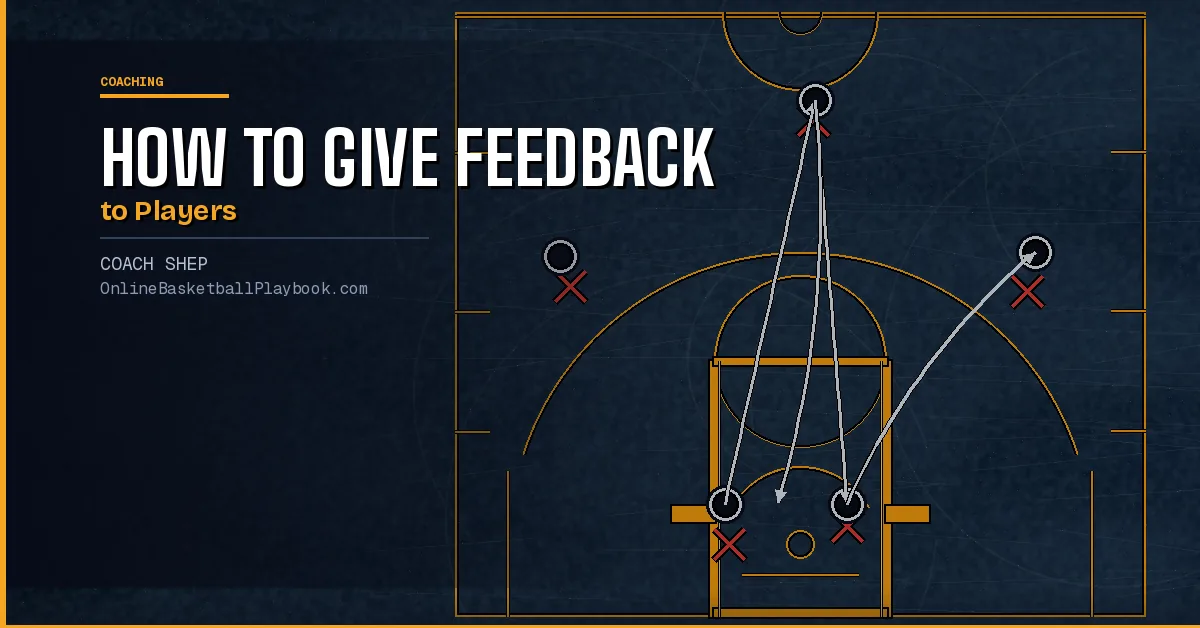
Feedback is the fastest lever a coach has. Done well, it sharpens skill, raises effort, and builds trust. Done poorly, it shuts players down. Here is how to get it right every time you step on the floor.
Why Feedback Is a Coaching Skill
Most coaches understand strategy. They know their sets, they know their defense, and they have practiced their rotations. What separates the good coaches from the great ones is almost never X's and O's. It is the ability to communicate information to a player in a way that actually changes what they do. That is the essence of feedback: transferring a correction or a confirmation from your brain to a player's body, in a form they can use.
Feedback is not criticism. Criticism evaluates a person. Feedback evaluates a behavior. The distinction is enormous. A player who hears "you are not trying" receives information about their character. A player who hears "your feet were set before the catch, but your elbow drifted left on the release. Push it toward the rim" receives information they can act on immediately. One closes a player down. The other opens them up.
The research on skill acquisition is consistent: specific, timely, actionable feedback accelerates learning faster than almost any other variable. A well-structured basketball practice plan creates the conditions for repetition, but feedback is what transforms repetition into improvement. Without it, players can repeat the same mistake hundreds of times and call it practice.
The other thing feedback does is signal relationship. When a coach notices what a player is doing (right or wrong) and tells them about it directly, the player knows the coach is watching. That attention is motivating. Players want to be seen. A coach who gives zero feedback is often interpreted as a coach who doesn't care, even when the opposite is true.
Timing Your Feedback Correctly
The window for feedback to land is shorter than most coaches think. During a drill or live play, the ideal moment for a correction is immediately after the rep (within two or three seconds if possible). The player's body is still in the movement pattern, their working memory is still holding the action, and they can connect your words to what they just felt. Wait five minutes and that connection degrades rapidly.
In practice, there are three reliable windows to use.
During Reps (Stop-and-Correct)
Blow the whistle, stop the drill, address the specific behavior, and resume. This is highest impact for technical corrections: footwork, shot mechanics, defensive positioning. Use it sparingly. Stop-and-correct too often and you kill the energy of practice. The rule of thumb: stop for things that will keep repeating wrong if you don't, let smaller things ride until a natural break.
At Natural Breaks
Water breaks, transitions between drills, halftime. These are the windows for broader feedback. Not play-by-play. A theme: "We've been rotating late to the corner all day. Watch the ball through the skip pass and move on release, not on catch." One clear point, tied to what they just experienced, directed at the group or an individual.
Post-Practice or Post-Game
This is where you deliver feedback that requires context and reflection: leadership behavior, effort patterns, coachability. Not technical. Not something that needed to be fixed in the third quarter. Post-game is not a debrief of everything that went wrong. It is one or two themes that matter most for next time.
One pattern coaches should avoid is delivering critical feedback in the emotional heat of a bad play. If you are frustrated, the feedback will be about your frustration, not about the player's behavior. Take two seconds. Lock in on the specific, observable action you want to address. Then speak.
Types of Feedback and When to Use Each
Not all feedback is the same. Understanding the different types, and choosing the right one for the moment, is what separates reactive coaching from deliberate coaching.
Positive Feedback (Reinforcement)
Positive feedback tells a player what to keep doing. It is most powerful when it is specific. "Good job" is noise. "That's it, you jumped to the ball and took away the middle" is information. Specific positive feedback tells the player exactly what behavior produced the good result, so they can repeat it intentionally rather than accidentally.
Use positive feedback generously, especially early in learning a new skill. Players in the early acquisition phase need to know when they are doing it right because right and wrong often feel similar before the body has calibrated. Positive reinforcement acts as a directional signal.
Corrective Feedback
Corrective feedback tells a player what to change. The most effective format is: observe what happened, describe what you want instead, and let them try it. Avoid the word "don't" wherever possible. "Don't reach" gives the brain a target it cannot execute. "Stay vertical and trust your positioning" gives it something to do.
Corrective feedback should be about one thing at a time. Stacking corrections ("your footwork is off, your elbow is out, and you're not following through") is overwhelming and leads to paralysis. Pick the highest-leverage correction and deliver that. Trust that fixing the root issue often resolves the secondary ones.
Prescriptive Feedback
Prescriptive feedback is forward-looking. Instead of addressing what just happened, it sets up what you want on the next rep: "On this next possession, I want you to attack the hip of the screener before they set. Let's see it." This is useful when a player has already heard the corrective version multiple times and needs a clear intent cue rather than another description of the error.
Questioning as Feedback
Sometimes the best feedback is a question. "What did you see on that play?" forces the player to analyze their own decision, which builds basketball IQ far more effectively than telling them the answer. This is especially effective with older, more experienced players who already have the knowledge and just need to develop the habit of applying it under pressure. If a player can self-diagnose, they can self-correct, which means they don't need you on every rep.
How to Deliver Feedback That Sticks
The content of feedback matters. But so does the delivery. A technically correct correction delivered in a way that shuts a player down is worse than no correction at all.
Stay Specific and Behavioral
The more specific you are, the more actionable the feedback. "You were late" is vague. "Your rotation to the corner was happening on the catch instead of on the skip pass" is specific and tells the player exactly where in the sequence the error occurred. Specific feedback is also less likely to feel personal, which protects the relationship.
Separate the Person from the Behavior
Players internalize coaching messages. When a player hears constant criticism, they don't just hear "your shooting form needs work". They hear "I am a bad shooter" or worse, "my coach doesn't believe in me." Build the habit of keeping your feedback pointed at behaviors and decisions, not at character or effort (unless effort genuinely needs to be addressed, which requires a separate, private conversation).
Match Your Tone to the Moment
A high-energy drill in the middle of practice calls for sharp, rapid feedback delivered with energy. A one-on-one conversation about a player's development calls for a slower, calmer voice. Tone carries emotional information. When the tone doesn't match the context, players spend mental energy processing the mismatch instead of the content.
Public vs. Private
Public corrections, delivered in front of the team, are appropriate for tactical and technical errors that affect the whole group and that the player is mature enough to handle publicly. Public praise is almost always appropriate. Criticism of effort, attitude, or personal behavior should be private. Embarrassing a player in front of teammates damages trust and triggers defensiveness, neither of which helps development. This is especially critical when working with younger athletes, as outlined in coaching youth basketball resources.
Follow Up
Feedback without follow-up is a wish. When you correct something, watch for it on the next rep. Acknowledge when the player makes the adjustment. That loop (correction, attempt, acknowledgment) is what locks in the change. Without the close of the loop, the player doesn't know if the adjustment worked.
Adjusting Feedback by Age and Level
Feedback that works perfectly for a high school varsity player can overwhelm or discourage a nine-year-old. The principles are the same, but the application changes significantly based on where the player is developmentally.
Young and Beginner Players
With beginners, especially youth players, the primary job of feedback is to keep the player in a success mindset. Guarantee success. Give simple, one-part corrections. Use encouraging language even when correcting. Avoid stacking multiple corrections. Demonstrate rather than describe whenever possible, because young players learn from watching more effectively than from processing verbal instruction.
Keep the ratio of positive to corrective feedback heavily tilted toward positive. A common guideline is a 5:1 or higher ratio, five specific affirmations for every one correction. That is not about false praise. It is about building the foundation of confidence and enjoyment that makes players want to come back tomorrow. Basketball player development at the youngest levels is almost entirely about long-term retention. Keeping kids engaged in the sport long enough to develop real skill.
Middle School and Early High School
Players at this level can handle more technical depth in feedback. They are capable of multi-part corrections if delivered one at a time across multiple reps. They are also entering a stage where peer perception matters enormously, which means public correction needs to be handled carefully. Build trust privately before correcting publicly.
Start introducing the questioning method at this stage. "What were you looking at on that play?" builds analytical thinking alongside skill. These players are ready to begin learning how to coach themselves.
High School Varsity and Advanced Players
With advanced players, feedback can be more direct and more complex. These players have the context to hear "your footwork in ball screens is giving ball-handlers too much cushion. We need to stay tighter through the hedge" and immediately understand what it means and what to do about it. They can also handle more direct critical feedback as long as the relationship and trust are in place.
At this level, questioning becomes a primary tool. The goal is to develop players who can self-evaluate during games, who can read a situation, identify what went wrong, and self-correct without a timeout. That is the highest form of basketball IQ, and it is built through years of feedback that asks rather than tells.
Common Feedback Mistakes Coaches Make
Even experienced coaches fall into feedback patterns that undermine their own intentions. Here are the ones that show up most often.
Feedback by Volume
Some coaches believe that constant feedback means high standards. In practice, a coach who speaks after every single play, with corrections, observations, and commentary, creates noise. Players begin to filter out the voice because it is always on. Selective feedback, delivered with purpose, carries far more weight than continuous commentary.
Vague Praise
Generic praise ("good job," "nice hustle," "way to go") is nearly useless for development. Players cannot extract any information about what they did well or why it mattered. Replace vague praise with specific praise: "You beat your defender off the dribble because you attacked his outside foot. That's exactly how we want to get downhill."
Correcting Under Emotional Arousal
When a coach is visibly frustrated or angry, the feedback is contaminated. Players receive the emotional signal louder than the technical one. If you are correcting from a place of frustration, the player experiences shame or defensiveness, not learning. The correction can be delivered, but the relationship takes damage. Build the habit of a two-second reset before speaking after a mistake that frustrates you.
Ignoring Process and Rewarding Only Outcome
If feedback is only ever tied to results, scoring, winning, making the shot, players learn to protect results rather than develop skill. A player who makes the right read but throws a bad pass deserves positive feedback for the read and constructive feedback on the execution. Rewarding only outcome punishes the risk-taking and decision-making that actually leads to development.
No Private Channel for Individual Development
Team feedback and individual feedback serve different purposes. A player working on basketball shooting form needs specific, sustained individual feedback over weeks, not general team reminders about shot mechanics. Build individual feedback into your practice structure: pull players aside for one or two reps of specific correction as often as you can. That individual attention is one of the most powerful signals of investment a coach can send.
After every practice, identify one player you gave zero individual feedback to that day. Make a point to give that player one specific, genuine piece of feedback before they leave. Over a season, this habit closes the gap between the players who feel seen and the ones who don't.
- Give feedback within 2–3 seconds of the rep for maximum retention and connection to the movement
- Use specific language tied to observable behaviors: not character, not effort, not personality
- Correct one thing per rep; stacking corrections leads to paralysis and frustration
- Positive feedback should be specific too: "you jumped to the ball on the pass" beats "good job"
- Use questioning with older players to build self-correction habits and game-level IQ
- Keep critical feedback private when it involves effort, attitude, or personal behavior
- Close the loop: watch the next rep after a correction and acknowledge the adjustment
Get free play diagrams, drills, and coaching guides delivered weekly.
Draw this play free in the play drawer →
Membership: the full library, playbook packs, and Pro drawing tools →
Keep Building
Related breakdowns
Cutting Players: What to Say and How to Say It
Cutting players: what to say on day one, in the meeting and to parents, the words to use and avoid, what to hand the player, and how to keep the door open.
Coaching Communication: How to Explain Basketball to Players
Coaching communication for basketball: the teaching order, fewer and clearer words, how to correct a mistake, one team vocabulary and calls taught inside the drill.
Teaching Players to Adapt to Different Playing Styles
Teaching Players to Adapt to Different Playing Styles