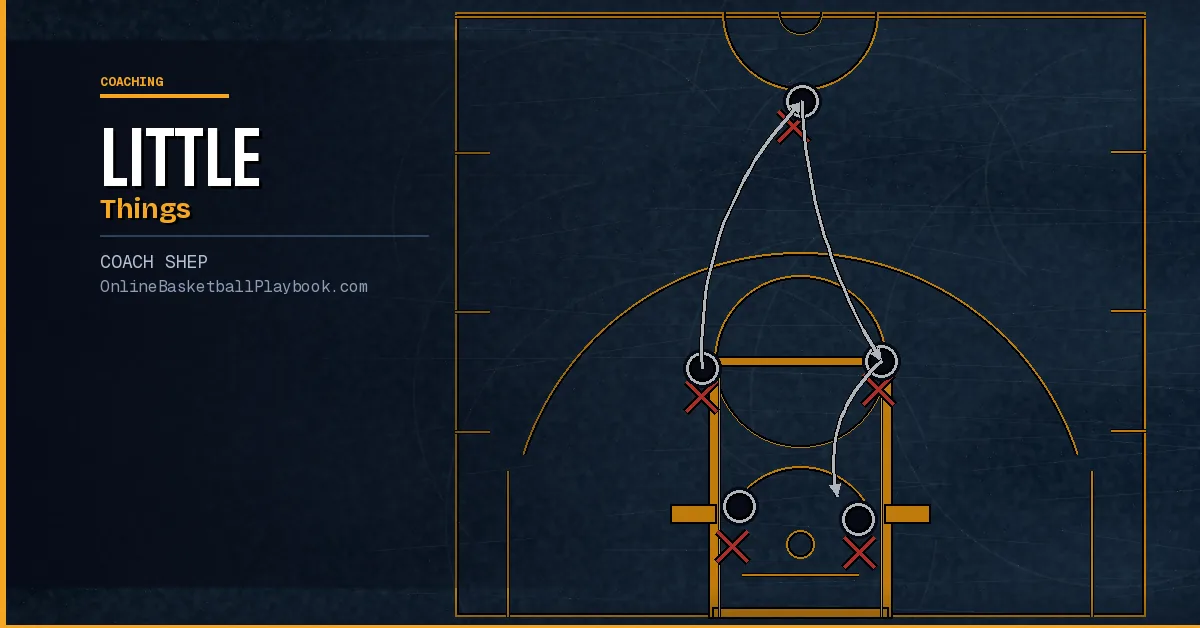
Talent fills highlight reels. The little things (taking a charge, talking on defense, sprinting back in transition) determine who wins at the end of the fourth quarter. Here is what those things actually are and how to coach them.
Communication: The Easiest Free Points on the Floor
Walk into any gym where a team is clicking and you will hear noise before you see anything impressive. Screens are called. Cutters are warned. Help rotations are announced before they are needed. None of that requires elite athleticism. It requires a habit, and habits get built at practice, not during games.
Communication on defense means every player knows where the ball is and where their help responsibilities lie. When a guard drives and the big calls "I've got ball!" the weak-side wing does not collapse and leave an open corner shooter. That word, spoken early, spoken loudly, makes a rotation function like a system instead of five people guessing.
Communication on offense is less discussed but just as valuable. A screener who says "screen left" gives the ball handler a chance to read the action before it happens rather than reacting to it. A cutter who says "ball" when they are open gives the passer confirmation instead of forcing a guess. The result is fewer turnovers, more clean looks, and a team that is harder to scout because its reads are sharper.
The way to build this is repetitive and unglamorous: stop practice every single time a player is silent during a live rep. Not to lecture, but to reset and run the play again with talking this time. Within a few weeks the silence disappears because players associate communication with the drill moving forward, and silence with starting over.
Defensive Positioning Before the Ball Moves
Most defensive breakdowns happen before the help is needed. A player caught flat-footed in the wrong spot cannot recover in time regardless of how fast they are. The breakdown was not their athleticism. It was their positioning in the half-second before the drive.
Good defensive positioning is a function of where you are relative to three things simultaneously: the ball, your man, and the basket. Ball-you-man is the classic framework, and it works because it forces every player to solve a spatial problem continuously rather than reacting only when the ball moves. A player standing in true ball-you-man alignment with their head on a swivel is already in a position to help before anything happens. A player staring at their man with their back to the ball is going to be a step late. Every time.
What makes this a "little thing" is that it costs nothing athletically. You do not need to be faster to be in the right spot. You need awareness and the discipline to do it even when the ball is two passes away and your mind wants to rest. Coaches who track this, not just who makes the big defensive play, but who is already in help position when the drive starts, find a direct correlation between positioning discipline and points allowed per possession.
The drill is simple: call a freeze during any live defensive sequence and have every player draw an imaginary line from ball to basket. Where are they on that line relative to their man? The freeze takes ten seconds. Run it four or five times a practice for a month and positioning becomes automatic.
Transition Effort Is a Skill, Not a Mood
Most teams run in transition when they feel like it. Winning teams run in transition because it is non-negotiable, the same way a catcher does not take a half-hearted path to first base. Sprinting back on defense after a missed shot is not about energy management. It is about the team's standard, and whether that standard applies to everyone or just the players who feel good that day.
There are two moments in transition that separate competitive teams from average ones. The first is the sprint back after a turnover or missed shot. How quickly does every player reverse and get between the ball and the basket? The second is the sprint forward after a defensive stop. Does the team push tempo before the defense can set, or does it slow down and let them recover?
Both of those moments are won or lost before the coach draws up anything. They are conditioning habits. They are sprint habits. And they are effort habits that players develop when coaches hold the standard consistently enough that running becomes part of identity (what this team does) rather than an instruction delivered on a possession-by-possession basis.
Tracking sprint-back percentage in practice (what percentage of missed shots does every player sprint back on?) and posting it on a whiteboard creates accountability without a speech. Numbers do the work. Players who see they are at 60% when their teammates are at 90% make the adjustment on their own. It stops being about motivation and starts being about not being the player who holds the team back.
Ball Security in Traffic
Turnovers are not random. Analyze any team's turnover log and you will find a pattern: most of them happen in the same two or three situations: baseline drives to the weak side, passes across the key against pressure, or middle penetration with two defenders waiting. The problem is rarely a bad decision in the moment. It is a bad habit formed over hundreds of unguarded repetitions where players held the ball loosely, put it in dangerous positions, or skipped the chin-and-pivot discipline that keeps the ball safe.
Ball security in traffic means three specific things. First, two hands on the ball when you pick up your dribble. A player holding the ball with one hand at their hip has just handed the defense an invitation. Second, ball protected at chin height when reading the defense. Not low, not extended, chin. Third, a pivot that keeps the body between the defender and the ball rather than spinning into a trap.
None of these are advanced concepts. They are all coachable at every age level. The reason most teams still turn the ball over on them is that coaches drill offense in open space and then put players into game-speed traffic without the muscle memory to protect the ball under pressure. The fix is to add a token defender to every finishing drill, every post entry, and every half-court set, not to play hard defense, but to require the ball handler to solve the basic security problem at game speed.
The Habit of the Right Pass
The best pass is not the hardest pass. It is the pass that is on time, on target, and to the correct decision. Players who hunt for the flashy skip or the behind-the-back bounce in traffic are not running the offense. They are entertaining themselves at the team's expense. The right pass is a boring pass that arrives when the receiver can catch it, shoot it, or drive before the defense can close.
On-time means the pass leaves the passer's hands at the moment the receiver is open, not a beat later when the defender has recovered, and not a beat earlier when the receiver is still mid-cut. Coaches who slow their film down to single frames and show players the specific moment a pass was due will see eyes light up. The concept of timing is abstract until you see a frame where the defender's feet are still moving and the receiver is open, and then the next frame where they are already closing.
On-target means chest height to a moving receiver, above the reach of a help defender, and never behind a cutter. A pass that arrives at the receiver's knee may be technically accurate but it breaks the cutter's rhythm, forces an adjustment dribble, and costs the team the advantage the cut created.
The correct decision means reading whether to pass at all. Some of the most valuable passes in a game are the ones that go backward to reset (recognizing a dead end, keeping the ball alive, and trusting the next action). That kind of unselfishness is a decision, and decisions improve when players understand why, not just when a coach yells "no" from the sideline.
When you correct a bad pass in practice, name exactly what was wrong and give one clear replacement cue ("left hand, step to your target, hip height") then run the rep again immediately. Correction without a practice rep is just commentary. The player needs to feel the right decision at game speed before it becomes a habit they can access under pressure.
How Coaches Build a Little-Things Culture
Little things do not happen because a coach asks for them before the season starts. They happen because the coaching staff notices them, tracks them, names them, and rewards them consistently enough that players understand this is what the program values. That kind of culture is built one practice at a time, not with a speech, but with what you stop play to correct and what you celebrate when it happens correctly.
The first tool is specificity. When a player makes a great defensive rotation that does not result in a steal or a blocked shot (just a good decision that closes a gap) call it out by name. "Marcus, that was the right rotation. You saw the drive, you gave up your man, you took the charge angle. That's the play." The player who gets that feedback will make that play again. The four teammates who heard it understand what earns recognition on this team.
The second tool is tracking. When you put numbers to the little things (sprint-back percentage, screen calls heard, deflections, charge attempts) they stop feeling invisible. Players are competitive. When they can see a number next to their name, they compete to improve it. You do not need sophisticated technology. A manager with a clipboard counting the right things in practice is enough.
The third tool is consistency. Holding the standard on a Tuesday in November when the team is winning scrimmages is easy. Holding it in March when you are down twelve in the third quarter is what separates programs. If players have only ever seen the little things enforced when it was convenient, they will abandon them when the game is hard. The standard has to be real before the game matters.
Finally, build a short team language around what you value. Three or four words that represent the program's standard (repeated at the start of every practice, called out in the moment, used in film review) become shorthand for the entire culture. When a player hears a teammate call out the standard cue in a game without a coach saying anything, that is when you know it has taken hold.
- Call screens on every rep: Screener names the direction, ball handler adjusts before the contact. No silent screens allowed in practice.
- Freeze and check positioning: Pause any live defensive possession and have each player verbalize their ball-you-man alignment. Run this drill four times a practice until it is automatic.
- Sprint-back standard: Every player sprints back on every missed shot, every turnover, every change of possession. Track it, post it, enforce it without exception regardless of score or practice intensity.
- Ball security with a hand in the face: Add a token defender to every finishing rep so players practice chin-and-pivot ball protection at game speed, not just in open air.
- Name the right pass out loud: When a player makes the correct decision to pass back or reset rather than forcing a bad look, call it out specifically so the team learns that unselfishness earns the same recognition as a made basket.
- One cue, one rep, no lecture: Correct mistakes with a single short cue and an immediate re-run. Correction without a follow-up rep is commentary. The rep is where the habit forms.
Want more basketball coaching strategies and drills?
Join the Online Basketball Playbook newsletter →
Draw this play free in the play drawer →
Membership: the full library, playbook packs, and Pro drawing tools →
Keep Building
Related breakdowns
How to Become a Basketball Coach: Paths, First Jobs and Steps
How to become a basketball coach: where coaches start, youth, school, club and college paths, entry jobs, coaching education, networks and mentors.
Basketball Scouting Report Template and How to Fill It Out
A printable basketball scouting report template with team, offense, defense, player and game plan sections, the questions to ask and how to brief players.
Basketball Tryouts: Sessions, Drills, Scoring and Cuts
A coach's guide to basketball tryouts, with session plans, drills and scrimmages, evaluation forms, what to look for, and how to tell players the decision.