One-game championships strip away every excuse and every buffer. Your preparation, your defensive identity, and your players' ability to execute under pressure. All of it gets settled in forty minutes. Here is how to build for that moment.
Why One-Game Championships Are Different
Every season has games that matter more than others: rivalry games, home openers, the first road test of the year. But a one-game championship format operates on a completely different psychological and tactical plane. There is no tomorrow. There is no "we'll get them back next week." The season ends or continues in a single forty-minute window, and every coaching decision carries that weight.
The first thing coaches get wrong in single-elimination settings is treating the game like a regular-season contest with a bigger crowd. It is not. Your opponent has done the same math you have. They know the pressure. They are going to lean on their most trusted actions: the sets they've run all year, the defensive alignment they fall back on when the game is tight, the one or two players who have earned the ball in clutch moments. Your job is to attack those predictable tendencies before the game starts.
The second thing coaches get wrong is overloading their players with information. A team that was loose and decisive in February becomes paralyzed in March because the coaching staff handed them twelve pages of scouting notes at shoot-around. Champions narrow the focus. You pick three things your team will do better than the opponent, not twenty-three things, and you drive those three home until they are automatic.
Single-game championships also punish passive coaching. In a series, you can absorb an early loss and adjust. In a one-game format, sitting back and seeing what the opponent gives you in the first quarter is a losing strategy. Establish your identity early, make them respond to you, and force them to beat a game plan that is already working. The team that dictates the tempo of a championship game wins it more often than the team with the superior talent.
Scouting and Game Planning in 48 Hours
Most championship brackets give you between one and three days to prepare for the next opponent. That is not much time, and most of it is spoken for: travel, practice, recovery, team meetings. The coaches who maximize that window are the ones who have a reliable preparation process they can execute quickly, not a perfect process they can execute when they have a week.
Start with your opponent's most recent three games, not their season averages. Tendencies calcify late in the year. A team that ran man-to-man defense in November and switched to a 2-3 zone in February is going to run that 2-3 zone against you. A player who went from the starting lineup to a bench role in week eight is probably not going to suddenly start in the championship. Recent film tells you who they actually are, not who they were trying to be at the start of the season.
Build your scouting report around three questions. First, what does their best offensive action look like, and what position requires the ball to execute it? Second, what defensive alignment do they fall back on when the game is tight and they need a stop? Third, where do their best players catch the ball when they want to score, and what triggers those catches? If you can answer those three questions clearly, you have enough to build a winning game plan. Everything else is noise.
Present the scouting report to your players in under twenty minutes. Use clips, not words. Show them the exact action, show them the correct coverage, and move on. Trust that your players have been practicing sound principles all season. Championship preparation is application, not education. They already know how to guard a ball screen; you are just showing them this team's specific ball screen and where it tends to appear on the floor.
Defensive Identity: Your Non-Negotiable Edge
Offense is the side of the ball that gets the attention: the fast break, the deep three, the shot in the final seconds. Defense is the side that actually wins championships. The teams that consistently advance in single-elimination tournaments are the ones that have a defined defensive identity they refuse to abandon when the game gets hard.
Defensive identity is not a scheme. It is a shared standard. It is your team knowing, without being told, what a good defensive possession looks like from tip to whistle. It is your point guard knowing exactly what the baseline defender needs to hear when the ball enters the corner. It is your post players contesting every interior touch, regardless of the score. Schemes come and go based on the opponent; the standard stays constant.
The teams that collapse defensively in championship games almost always do so in one of two ways. Either they stop rotating when the pressure mounts, one defender gives up on a play, and the breakdown becomes contagious, or they begin gambling for steals rather than executing their assignments. The first type of collapse happens when players are tired and not mentally locked in. The second happens when players feel like they need to make something happen instead of trusting the system to create opportunities.
Championship defensive preparation should include a "red light" moment in practice (a drill where the defense is down three in the final three minutes and must execute four consecutive stops to win). The point is not to simulate the exact score; it is to train your team to execute their defensive principles when the emotional stakes are high. Players who have practiced that moment handle it better when it arrives in a real game.
Deploying the 1-3-1 Zone in Championship Situations
One of the most effective tools in a championship game context is a well-timed zone change. If your team has been playing man defense all season, showing a 1-3-1 zone for the first time in the postseason can disrupt an opponent who has not spent a single practice rep attacking it. Used correctly, a zone change in a championship game is a tempo weapon as much as it is a defensive scheme.
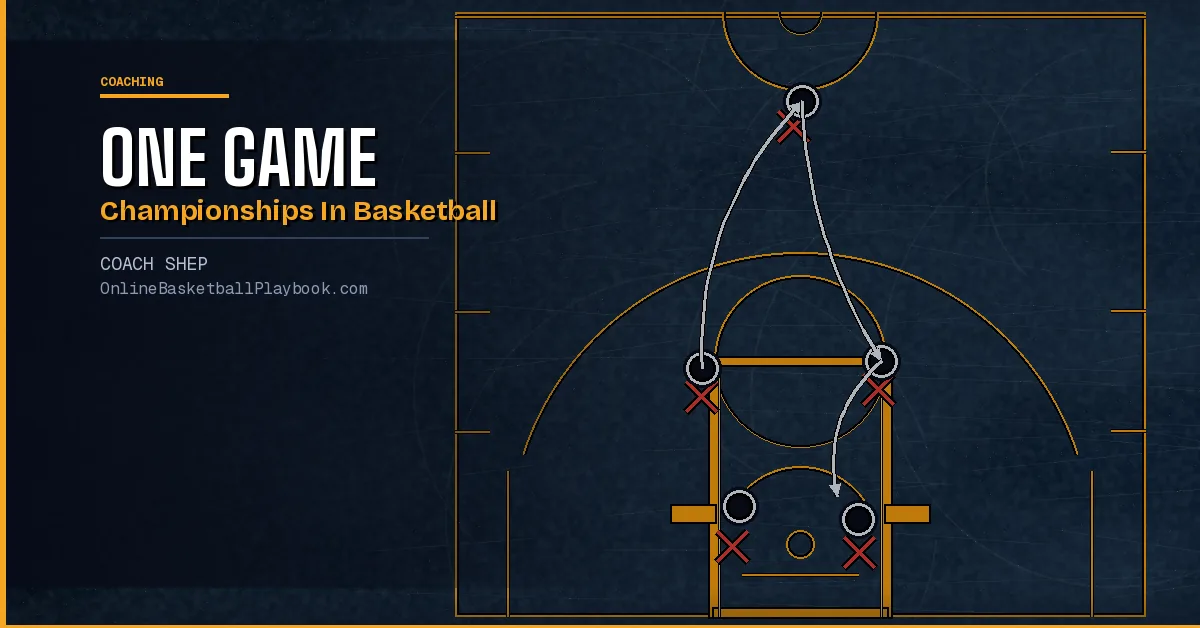
The 1-3-1 zone is built to deny perimeter reversal, force the offense into uncomfortable angles, and trap the corners and wings. Its structure, one at the top of the key, three across the middle, one on the baseline, pressures the offense into areas where they are least comfortable passing and least likely to generate high-percentage looks. The primary trap is corner entry: the ball enters the corner, the ball-side wing and the baseline defender close hard, arms up, cutting off the easy pass line.
What makes the 1-3-1 particularly dangerous in a one-game championship is its dual nature. The half-court 1-3-1 and the full-court 1-3-1 look identical to the offense at the start of each possession. An opponent who has prepared to attack the half-court zone discovers at the worst possible moment that they are suddenly in a full-court press. An opponent who has prepared for the press finds themselves in a half-court trap instead. Running both versions in the same game creates maximum confusion, and confused offenses in championship situations make exactly the kind of errors, rushed reversal passes, blind lobs, forced entries into traffic, that produce the momentum shifts that decide close games.
The highest-danger moment in the 1-3-1 is the corner-to-elbow skip pass. Every defender on the floor needs a single clear thought when the ball is trapped in the corner: "Who is covering the elbow?" The elbow is the escape valve. A clean catch there produces an open mid-range look or a quick post entry before the defense recovers. Train the roamer (your middle defender) to anticipate that skip by reading the ball-handler's eyes, not just the ball. Pre-positioning beats reaction every time.
Choose your personnel for the 1-3-1 based on role requirements, not traditional position labels. Your point defender needs length and a quick first step. Your baseline defender needs to be your best communicator on the floor. Athleticism matters less than floor-reading and vocal output. Running corner-to-corner for extended stretches is exhausting; plan your rotation so this player stays fresh.
Managing Momentum and Making In-Game Adjustments
Momentum in a championship game is real, and it moves faster than in a regular-season contest. A three-possession run that would feel inconvenient in January can feel catastrophic in March. Championship coaches recognize momentum shifts early and respond with concrete actions (a timeout, a substitution, a defensive change) rather than waiting for the run to stop on its own.
The most important in-game adjustment tool you have is tempo. If the opponent is on a run, slow the game down. Take every second of the shot clock, be deliberate in transition, and force them to stay in their half-court defense for extended possessions. Uptempo teams hate grinding. If you are the one generating the run, do the opposite: push in transition, attack before they can set their defense, and keep the pressure constant.
Timeouts in a one-game championship should be rationed deliberately. Use one early if you need to stop an opponent's momentum in the first half. A 7-0 run before halftime can dictate the emotional tenor of the entire second half. Save at least two for the final four minutes. A timeout with the ball and two seconds of composed execution is more valuable than any adjustment you could have made in the third quarter.
Defensive adjustments in-game should be small and clear. Do not call three new coverages at halftime. Pick the one offensive action that hurt you most in the first half, explain exactly how you are changing the coverage, and execute that one adjustment with full commitment. Players who are asked to process too much at halftime execute nothing cleanly in the third quarter. One adjustment, executed with conviction, is worth more than five adjustments run at fifty percent.
Preparing Your Players Mentally
The physical and tactical preparation for a championship game is only half the work. The other half is ensuring that your players walk into that gym with a mental posture that allows them to execute what they have spent the season building. Tight muscles, over-anxious decision-making, and the urge to do something extraordinary instead of something disciplined. These are the enemies in a championship setting, and they are all internal.
The most effective mental preparation is the simplest: remind your team what they are good at. Not what they need to avoid, not what the opponent does well, not the size of the moment but what your team is good at, specifically. Championship teams have a clear identity. The coach's job in the final twenty-four hours is to reinforce that identity until it crowds out the anxiety. "We are the best defensive team in this bracket. We protect the paint. We communicate. We sprint every rotation." Specific and true beats inspirational and vague every time.
Walk your players through a mental rehearsal of the opening five minutes. Have them close their eyes and see themselves executing the first defensive possession perfectly. Research on athletic performance is consistent on this point: mental rehearsal activates the same neural pathways as physical execution, and players who have mentally rehearsed a scenario perform more confidently when it arrives. This takes three minutes of meeting time. It is worth every second.
Establish a team standard for how you respond to adversity in the game. Not if adversity arrives but when. Tell them before tip-off: "When they hit a big shot, here is what we do. We get the ball in, we run our offense, and we get a stop on the other end. We do not stand around. We do not look at the bench. We respond." A team that has been told how to respond to adversity responds better than a team that is figuring it out on the fly in a championship moment.
Resist the urge to expand your game plan in the final 24 hours. If your team has not drilled a specific coverage or set all season, introducing it before a championship game creates hesitation, and hesitation at the wrong moment costs possessions. Build on what your players already do well, sharpen the details, and trust the preparation you have already done.
- Narrow the focus to three things: Pick the three areas where you hold a clear advantage over this opponent and drive those home in every practice rep, film session, and pre-game talk leading up to tip-off.
- Use recent film, not season averages: Your opponent's last three games reveal who they actually are right now: their go-to actions, their defensive default when the game tightens, and which players are playing with confidence.
- Introduce the 1-3-1 zone as a tempo weapon: A half-court 1-3-1 and a full-court 1-3-1 look identical at the start. Running both keeps the offense permanently off-balance and forces the kind of rushed decisions that create championship-defining turnovers.
- Cover the elbow on every corner trap: The corner-to-elbow skip pass is the most dangerous action against the 1-3-1; every defender must know who covers that elbow before the ball enters the corner, not after.
- Ration your timeouts deliberately: Stop a first-half momentum run early, then protect two timeouts for the final four minutes. Composed execution with the ball in hand is the highest-value use of a timeout in a one-game format.
Want more basketball coaching strategies and drills?
Join the Online Basketball Playbook newsletter →
Draw this play free in the play drawer →
Membership: the full library, playbook packs, and Pro drawing tools →
Keep Building
Related breakdowns
How to Become a Basketball Coach: Paths, First Jobs and Steps
How to become a basketball coach: where coaches start, youth, school, club and college paths, entry jobs, coaching education, networks and mentors.
Basketball Scouting Report Template and How to Fill It Out
A printable basketball scouting report template with team, offense, defense, player and game plan sections, the questions to ask and how to brief players.
Basketball Tryouts: Sessions, Drills, Scoring and Cuts
A coach's guide to basketball tryouts, with session plans, drills and scrimmages, evaluation forms, what to look for, and how to tell players the decision.