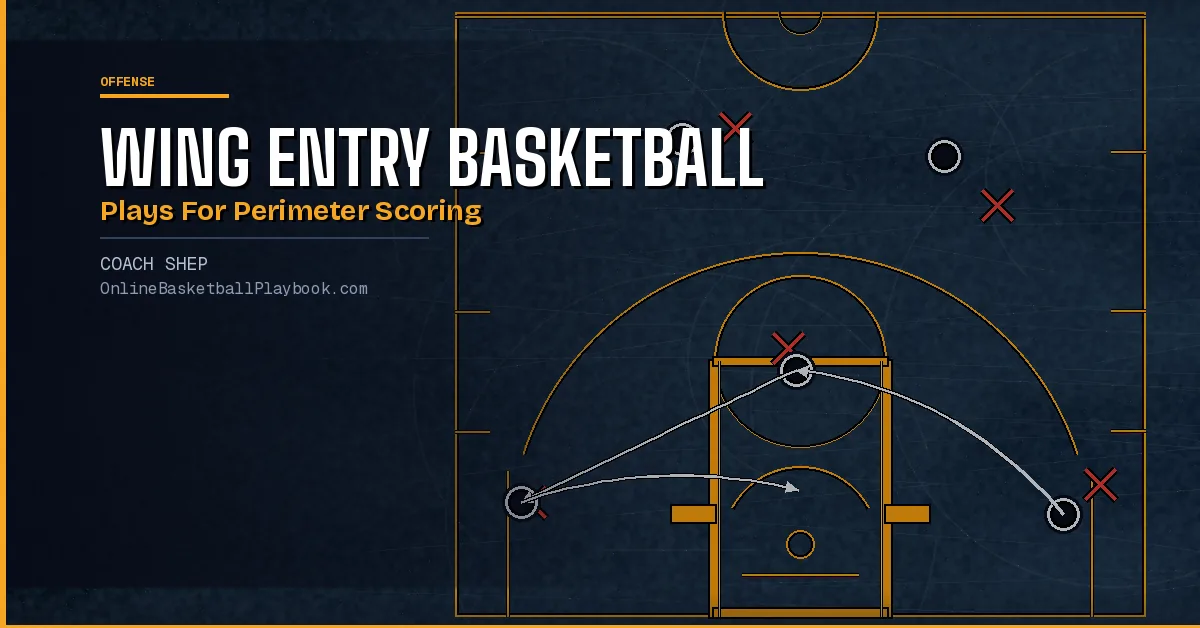
Wing entry is where perimeter offenses live or die. Get the ball to the right spot with the right footwork and your guards become threats. Miss the details and every entry collapses before a shot goes up.
What Makes a Wing Entry Work
A wing entry pass is one of the most common actions in all of basketball. The point guard swings the ball from the top of the key to a guard or forward stationed on the wing. Simple. Except that most teams run it without any real structure on the catching end, and that is where points disappear.
The entry itself is just a pass. What matters is what happens in the half-second before the ball arrives. The wing receiver must be moving, not standing. A stationary wing is easy to deny and easy to help on. The cut to get open (a V-cut, a basket cut, a curl off a screen) sets the defensive angle before the catch happens. That angle determines every option the offense has.
Spacing is the second factor. The wing receiver needs to be deep enough on the wing that the corner is a genuine threat. If the receiver catches at the elbow, the corner is only 10 feet away and a help defender can cover both. When the catch happens at the true three-point wing (roughly 22 to 24 feet from the basket), the defense must make a real decision: stay home on the shooter, or fly to the drive lane. That is the spacing tax that wing-based offenses collect on every possession.
Third: the receiver's pivot foot must be established before the ball arrives, not after. Catching flat-footed with no plan is the source of most wing turnovers at the youth and high school level. Coaches who solve this one problem unlock a significant portion of their perimeter offense immediately.
The Catch-and-Shoot Wing Set
The simplest and most effective wing action in basketball is the catch-and-shoot off a skip pass. Run it off any ball reversal: top to corner, corner to wing, or direct skip from the point guard after penetration. The goal is to get the ball to a shooter whose feet are already set or whose momentum off a cut naturally squares them to the basket.
The footwork rule here comes from the inside-heel pivot principle taught by skills coaches: when a shooter catches moving toward the basket at an angle, they pivot off the inside heel of the foot closest to the basket at the moment of the catch. Driving that heel down hard stops the lateral momentum. The outside foot then swings through to complete the square-up. When it is drilled correctly, the shooter is already squared and loaded by the time the ball is in the shooting hand.
The read off this action is straightforward. If the defender is in the passing lane, anticipating the wing catch, the backdoor cut is open. If the defender is sagging to help on penetration, the wing catch leads directly to a spot-up three. Teach your players to read the defender's position before the pass leaves the point guard's hands, not after.
One coaching note: the skip pass must be thrown to the receiver's outside shoulder, not the inside. A pass thrown to the inside shoulder forces the receiver to rotate toward the paint to catch, which kills the shot momentum and gives the closing defender time to recover. Outside-shoulder skip passes arrive in the shooting pocket and eliminate that recovery window.
Wing Entry into the Dribble Drive
A wing entry does not have to end with a shot. Some of the best perimeter offenses use the wing catch as the trigger for a dribble-drive series, with the rest of the team reading and spacing off the penetration.
When the wing receiver catches and faces a defender who is giving space (heels back, no pressure on the ball), the live-ball move is available. The receiver has not dribbled yet, so every jab-and-go, jab-and-shoot, and crossover drive option is still on the table. This is the triple-threat position, and coaches should spend practice time on it explicitly, not assume players understand their options from the catching position.
The drive itself follows one coaching principle worth memorizing: drivers step north, not east or west. A guard who drives laterally gives the defender recovery space. A guard who attacks the defender's lead foot directly (driving straight at it and then scraping off the shoulder) cuts off the angle of pursuit entirely. This is the difference between penetration that creates and penetration that gets cut off at the charge circle.
Off the drive, the spacing rules are simple. The two corners stay wide and low. The weakside wing lifts to the three-point line. The big rolls or spaces based on whether the screen was used. The key is that every player on the floor has a predetermined read. Nobody freelances on wing-entry penetration, because freelancers create traffic in the drive lane and eliminate the kick-out option.
The kick-out itself should arrive at a teammate who is already set to shoot. If the corner receiver is moving when the ball arrives, the momentum rotates the shot away from the basket. Stationary catch in the corner, feet pointed at the rim, hands ready. That is what turns a drive into a three-point possession.
Triple Threat Reads off the Wing
Triple threat is not a position. It is a decision-making framework. From a balanced catch on the wing, every receiver has three options: shoot, drive, or pass. The goal is not to do all three. It is to read the defense and select the right one instantly, without telegraphing the decision in advance.
The jab step is the primary tool for creating that read. A short, sharp jab toward the defender's lead foot forces an immediate reaction. If the defender rocks back, the shoot-fake-and-step-through option opens. If the defender holds ground, the jab-and-go drive is available. If the defender jumps the jab, the shot is open because the defender has shifted their weight. Three reads, one jab, no dribble used.
The key coaching point: the jab must be believable. A soft jab that barely reaches the defender's space is ignored. A jab with the head down and the weight transferred (as if a drive is genuinely coming) creates the defensive reaction that the offense needs. Teach this explicitly. Most players jab out of habit, not conviction, and get nothing from it.
Dead-ball moves apply once the dribble is used. The sequence is jump stop to preserve the pivot, then shot-fake, step-through, or a skip pass to the weakside. Players who dribble before they read the defense eliminate their own triple-threat options. The sequence is always: catch, read, then decide. Not catch, dribble, then figure it out.
Footwork Drills for Wing Receivers
Most wing-entry breakdowns trace back to the receiver, not the passer. Coaches fix the pass first because it is more visible, but the real problem is usually the footwork on the catching end. Three drills address this directly and can be added to any practice plan.
The Circle Footwork Drill
Put three or four players around each free throw circle. Players jog clockwise. On a whistle, each player tosses the ball to themselves, pivots off the inside heel of the foot closest to the circle's center (simulating the basket), squares up to that center point, and pauses in a loaded shooting stance. No shot is taken. The drill is entirely about the pivot and the square-up. Switch direction after one minute to train the opposite foot. A coach standing in the center can watch every player's footwork simultaneously, which makes this one of the most efficient footwork drills available.
The Wing V-Cut and Catch Drill
A line of players starts at the wing, each cuts hard to the baseline (the low part of the V), plants off the inside foot, and cuts back up to the wing at a sharp angle. The coach or a partner delivers a pass timed to arrive as the player's foot plants on the second cut. The receiver catches, establishes pivot foot, reads an imaginary defender, and executes one of three live-ball moves: shoot, jab-and-go, or jab-and-shot. The goal is that the pivot foot is decided before the ball arrives, not after the catch.
The Wing Entry 3-on-3 Read Drill
A point guard, wing, and corner play 3-on-3 against live defenders. The only rule: the ball must enter the wing before any drive or shot. This constraint forces the offense to execute the wing entry correctly under defensive pressure, and it forces defenders to pick their coverage: deny the wing, sag to help, or switch. Run it for five possessions per group and rotate. Everything the offense learns in the two drills above gets pressure-tested here.
Putting It Together: Sample Wing Entry Sequences
Here are three complete wing-entry sequences that can be run from any half-court offensive set. Each is built around the principles above (spacing, footwork, and a clear read hierarchy) rather than a complicated play diagram that falls apart under defensive pressure.
Sequence 1: Wing Catch into the Jab-Series
Point guard enters to the wing off a V-cut. Wing receiver catches in triple threat with the defender at one step of distance. Jab toward the baseline: if the defender rocks back, shoot. If the defender holds, jab-and-go baseline drive. Corner lifts on the drive; weakside wing holds the three-point line; big spaces to the short corner. The point guard trails to the top of the key for a reset if the drive does not score.
Sequence 2: Wing Catch into the Skip
Point guard dribbles the defender to one side, creating pressure. Ball is reversed to the wing. Wing immediately reverses again (skip pass) to the weakside corner. Corner catches in a set position, feet already pointed at the basket. The defense must close out across the lane, which opens the drive if the corner shot-fakes. This action works especially well against teams that trap ball reversals. The skip gets behind the trap before the defense recovers.
Sequence 3: Screen-and-Wing-Entry
A down screen is set for the wing receiver, who uses it to curl to the wing. The catch comes off the curl with momentum moving toward the basket. The receiver lands in a jump stop (two feet simultaneously), which preserves the choice of pivot foot and keeps all triple-threat options live. If the curl is over-played, the receiver fades behind the screen for a catch-and-shoot from the wing. If the curl is under-played, the receiver catches and drives the gap the screen created. The screener either pops for a three or dives to the rim based on the defender's reaction to the ball.
Start every wing-entry installation with a jump-stop-only rule: receivers can only finish layups off a two-foot jump stop for the first two weeks. This forces players to gather their footwork under defensive pressure before any drive, and it builds the habit of dealing with help defense rather than floating around it into the teeth of the charge.
- Pivot foot first: Wing receivers must decide their pivot foot before the catch. Front pivot off inside heel for instant shooters, reverse pivot off outside foot for drivers and passers.
- Drivers go north: Attack the defender's lead foot directly, scrape off the shoulder. Stepping east or west gives the defense recovery space and neutralizes the drive.
- Live-ball before dribble: Read the defender, execute a jab series, and select the best option before using the dribble. The dribble burns every live-ball option the moment it is picked up.
- Skip to the outside shoulder: All wing skip passes should arrive at the receiver's outside (away-from-basket) shoulder so the ball lands in the shooting pocket without rotation.
- Corners stay wide: On any wing-entry drive, the corner must stay deep and stationary. A moving corner collapses the drive lane and eliminates the kick-out three-point option.
Want more basketball coaching strategies and drills?
Join the Online Basketball Playbook newsletter →
Draw this play free in the play drawer →
Membership: the full library, playbook packs, and Pro drawing tools →
Keep Building
Related breakdowns
Basketball Quick Hitters: 25 Sets by Action and Formation
Basketball quick hitters sorted by the action you want, catch-and-shoot to post feed, with each set's formation, diagrams, the read and the counter.
Princeton Offense Drills: Breakdowns, Shooting and Live Reps
Princeton offense drills that teach the reads: spacing, backdoor and hand-off breakdowns, 3-0 Chin and wave drills, Point shooting, a drive drill and an install.
Four Corners Offense Basketball: Roles, Rules and Versions
Four corners offense basketball: the set, the chaser, the corner and post rules, three versions, when to run it, the shots it hunts and shot clock limits by level.