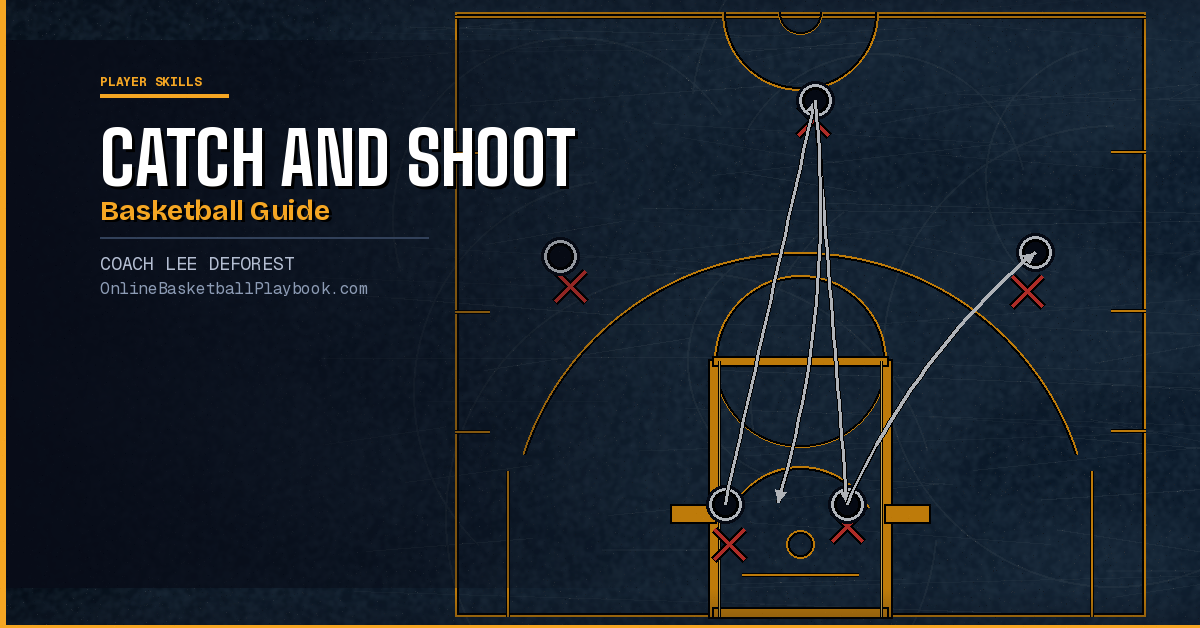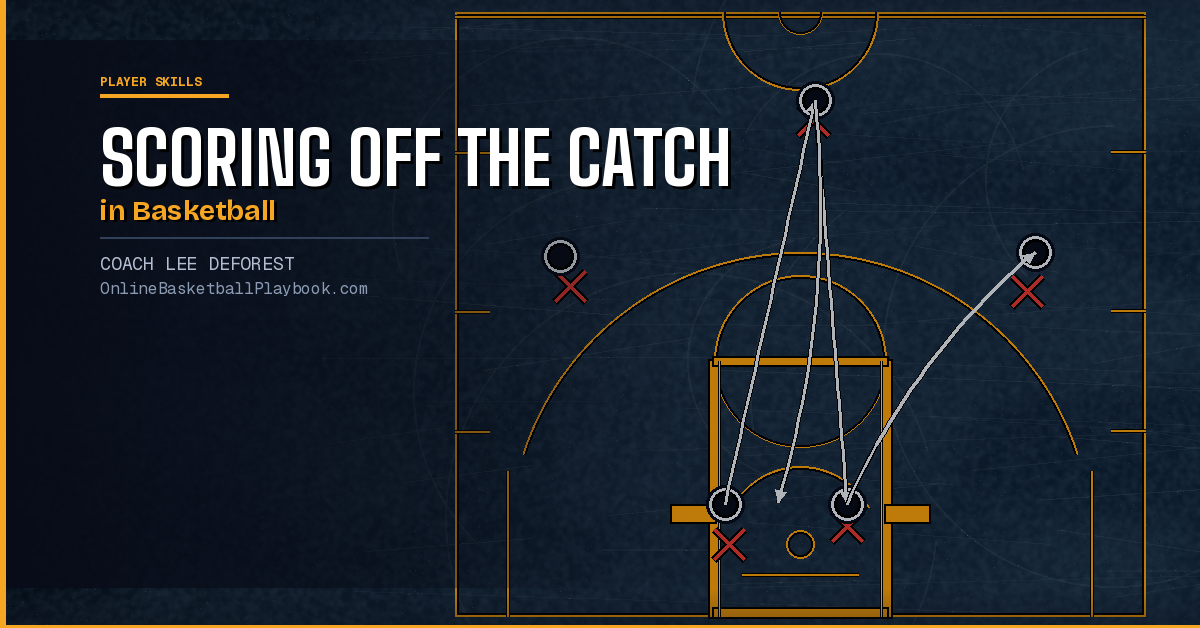

The moment you catch the ball is when defenders are most vulnerable. Players who arrive ready to attack — feet set, eyes on the rim — turn a simple pass into an instant scoring advantage before any defender can recover.
Why the Catch Moment Matters
Most scoring opportunities in basketball are not created by dribble penetration or isolation moves. They are created by a well-timed pass to a player who is already set and ready. The window between when the ball arrives and when a defender can close out is typically less than a second. Players who spend that half-second fumbling with footwork or looking down at the ball give defenders time to recover. Players who arrive catch-ready threaten the rim immediately.
This is the foundation of every effective motion offense in basketball. The entire system depends on players who can punish the defense the instant they receive a pass. When you run a 5-out motion offense, five players are spaced across the perimeter — but that spacing is worthless if none of them can score when they catch. A defense that knows you will always put the ball on the floor before attacking has an extra beat to recover. A defense that knows you might shoot immediately is a defense that cannot help.
The best catch-and-score players share a few common habits: they move to the ball on a straight line, they land with their weight balanced, they look at the rim first, and they make a decision before the defender arrives. These are trainable skills. They do not require elite athleticism. They require deliberate repetition and an understanding of what to look for.
The Footwork Foundation
Footwork is where most players lose the catch-and-score battle. They drift to the ball, land on one foot, spin, reset, and by then the defender has arrived. The fix starts with understanding how to land.
The Jump Stop
The jump stop is the most reliable footwork option for catch-and-score situations. You hop off one foot and land on both feet simultaneously, which gives you the option to use either foot as a pivot. This matters because it keeps the defense guessing. A player who always lands the same way with the same pivot foot is easy to overplay. A player who can pivot either direction off a jump stop forces the defender to honor both sides.
To train the jump stop, start with simple passes from a coach or partner at various spots around the arc. The receiver sprints to the spot, goes airborne slightly before the catch, lands two-footed on the catch, and immediately looks at the rim. The sequence should feel continuous — move, land, look — not three separate actions.
The One-Two Step
The one-two footwork (stepping with one foot then the other) is effective when a player is moving laterally along the perimeter and wants to establish a specific pivot foot. Right-handers moving right often prefer a right-left sequence so their right foot is the established pivot. Left-handers moving left prefer the opposite. The key is consistency: your footwork should be automatic so your mind is free to read the defense.
Good basketball footwork drills build this automaticity. The goal is for players to stop thinking about their feet and start thinking about the defender. That transition only happens through volume repetition.
Common Footwork Errors
The two most common errors are drifting into the catch and landing off-balance. Drifting means the receiver is still moving laterally when the ball arrives, making it impossible to read or react quickly. Landing off-balance means the player's weight is over their toes or heels rather than centered, making any first move slow and telegraphed. Both errors are corrected by arriving at the catch spot before the ball does — getting there early, setting your feet, and meeting the pass rather than chasing it.
Reading the Defense Before You Catch
Elite catch-and-score players make their decision before the ball arrives. They read the defender's position during the pass — while the ball is in the air — and know whether they are shooting, driving, or skipping to the next action. This pre-catch read is what separates players who need a dribble or two to process from players who are dangerous the instant they touch the ball.
There are three reads every receiver should make:
Read 1: Is the Defender Under the Line?
If the defender is below the level of the ball — giving you space — the answer is almost always to shoot. Do not take a dribble to "set up" the shot. The defender gave you a gift. Take it. This is the most underused skill in basketball at every level. Players who have been taught to drive first, shoot second leave enormous amounts of open offense on the table.
Read 2: Is the Defender Closing Hard?
If the defender is sprinting at you, the shot fake is your primary weapon. A hard closeout means a defender who is airborne or leaning forward. One shot fake freezes them long enough for one dribble into the paint or a kick-out pass to the next open shooter. The shot fake only works if it looks exactly like your shooting motion. A lazy pump fake that does not engage your legs and core will not move a disciplined defender.
Read 3: What Is the Help Doing?
Before catching, glance at the help side. If help defenders have left their assignments to load up on the ball, the skip pass is available. This is basketball IQ at its core — understanding that your job is not always to score, but to make the defense pay in the most efficient way possible. Players who develop this awareness become the hardest players to guard because they are never locked into one option.
"Spacing is offense, offense is spacing."
— Basketball Vault
The Shot Fake and One-Dribble Attack
The shot fake is the most powerful weapon in catch-and-score situations, and it is also the most misused. Most players fake and then take two or three dribbles before attempting anything. By then, all the advantage created by the fake has evaporated. The entire point of a shot fake is to create an immediate advantage — one that must be exploited in one move.
What a Real Shot Fake Looks Like
A real shot fake engages your legs. You bend your knees and rise as if shooting, bringing the ball up to your shooting pocket. Your eyes go to the rim. If you are a legitimate shooting threat — which you must be for any of this to work — the defender will respect it. A player who never shoots from the perimeter cannot fake anyone off their feet, which is why catch-and-score ability starts with developing a real shooting threat from your position on the floor.
After the fake, the attack is immediate. One hard dribble with the inside hand toward the basket. Keep your shoulder down and your head up. Read the help on the way in — you may be finishing, you may be kicking out to an open shooter on the weak side, or you may be drawing a foul. All three outcomes are wins. The decision is made at the free-throw line extended, not before you leave your spot.
The Mid-Range Attack
Players who only think about three-point catch-and-score opportunities miss a significant part of the floor. Mid-range catches — elbow catches, short-corner catches, high-post touches — create different geometries and different reads. An elbow catch with a defender in your space invites a shot fake and a drive to the lane for a floater or a pull-up. A short-corner catch against a flat-footed defender is often a straight catch-and-shoot opportunity that defenses forget to account for. Knowing your spots and your moves at each spot is a core element of basketball player development that does not happen by accident.
Spacing, Timing, and Off-Ball Movement
You cannot score off the catch if you never get open to catch. Off-ball movement is the other side of the catch-and-score equation, and it is the part most players neglect. Getting open is a skill. Standing and watching the ball is not movement — it is defense's best friend.
Reading the On-Ball Action
Off-ball receivers must read the on-ball action and respond to it. When the ball handler drives, the skip-pass receiver must be ready to catch and shoot. When the ball handler is under pressure, the safety valve receiver must give a clean target at a distance that protects the passer. When the ball swings to one side, weak-side players must relocate to spots that stress the defense — not remain stationary and let defenders help without consequence.
This is the foundation of what makes a high basketball IQ player so valuable. They understand that every on-ball action creates an off-ball opportunity, and they position themselves to exploit it.
Timing the Cut to the Catch
The best catch-and-score opportunities come from well-timed cuts. A V-cut — a sharp cut toward the basket followed by a redirect to the perimeter — creates the space needed to catch clean. A flat cut along the three-point line is easy for a defender to track. A V-cut forces the defender to choose: go under the cut toward the basket or fight over the top toward the perimeter. Either choice gives the receiver an advantage on the catch.
Timing the cut to coincide with the passer looking up is the advanced version of this skill. If you cut while the passer is still looking away, the pass is delayed and the defender recovers. If you cut a beat after the passer looks your way, the window closes. The best receivers cut when they see the passer's eyes, training this timing through repetition in live practice situations rather than pure catch-and-shoot lines.
Spacing Discipline
The 15 to 18 foot gaps that spacing requires are not automatic. Players drift toward the ball, bunch in corners, and collapse gaps without realizing it. Coaches who build spacing discipline run it in every drill, not just in scrimmage. When players are spaced correctly, the catch-and-score action is cleaner because defenders cannot help without leaving their own assignment exposed.
Run your catch-and-score drills from game spots at game speed. A player who looks sharp in slow isolation shooting lines may still struggle when a live defender is closing out and the clock is running. The pressure of the closeout is where the footwork, fake, and read must all execute together — and that only gets trained in competitive situations.
Drills to Build the Habit
The skills covered in this guide only stick when they are drilled at game speed with defensive resistance. Isolated shooting lines build form. Live situations build the habit of using the form under pressure. Both are necessary, but the sequencing matters: form first, then competition.
Catch-and-Shoot Corner Drill
Place a player in the corner with a passer at the wing. The receiver cuts up the lane line, plants, and receives a pass at the wing — then immediately reads: open look shoots, closeout fakes and drives. Add a live closeout defender after the receiver is comfortable with the two-foot landing and rim-first look. Run from all five spots around the arc.
1-on-1 Closeout Drill
A defender starts under the basket and tosses the ball to a receiver at the perimeter, then closes out hard. The receiver catches with set feet, reads the closeout, and plays 1-on-1 to a finish. This forces the receiver to make the fake vs. shoot decision in real time against a real body. It also trains the defender's basketball closeout technique, making it a dual-purpose rep.
3-on-3 Read Drill
Three offensive players and three defenders in a half-court shell. No dribble allowed except to attack off a fake. This forces all three offensive players to move, cut, and catch with purpose. When no one can dribble casually, catch-and-score reads become the only option and players develop them quickly. This drill also builds passing habits because every action must be resolved with a pass or a score — no ball-stopping allowed.
Building It Into Practice Plans
Catch-and-score skills should appear in every practice, not just in designated skill-work blocks. When running your basketball practice plan, embed catch-and-shoot and catch-and-attack reads into every 3-on-3 or 4-on-4 segment. The skill compounds when players make these reads hundreds of times per week across all of their competitive reps, not just in a ten-minute drill block.
- Arrive at the catch spot before the ball — early feet beat fast feet every time
- Land two-footed on a jump stop to keep both pivot options available against any closeout
- Eyes to the rim first on every catch — the pre-catch read happens while the ball is in the air
- A shot fake only works if you are a genuine shooting threat — develop your shot from your spots first
- Exploit the fake with one dribble immediately — delay and the advantage disappears before you use it
- Read the help defender before catching — a skip pass opportunity is often the highest-value play on the floor
- V-cut before every perimeter catch — a flat cut is easy to defend and gives you no advantage on the receive
Get free play diagrams, drills, and coaching guides delivered weekly.
Keep Building
Related breakdowns
Wing Entry Basketball Plays for Perimeter Scoring
Wing Entry Basketball Plays for Perimeter Scoring