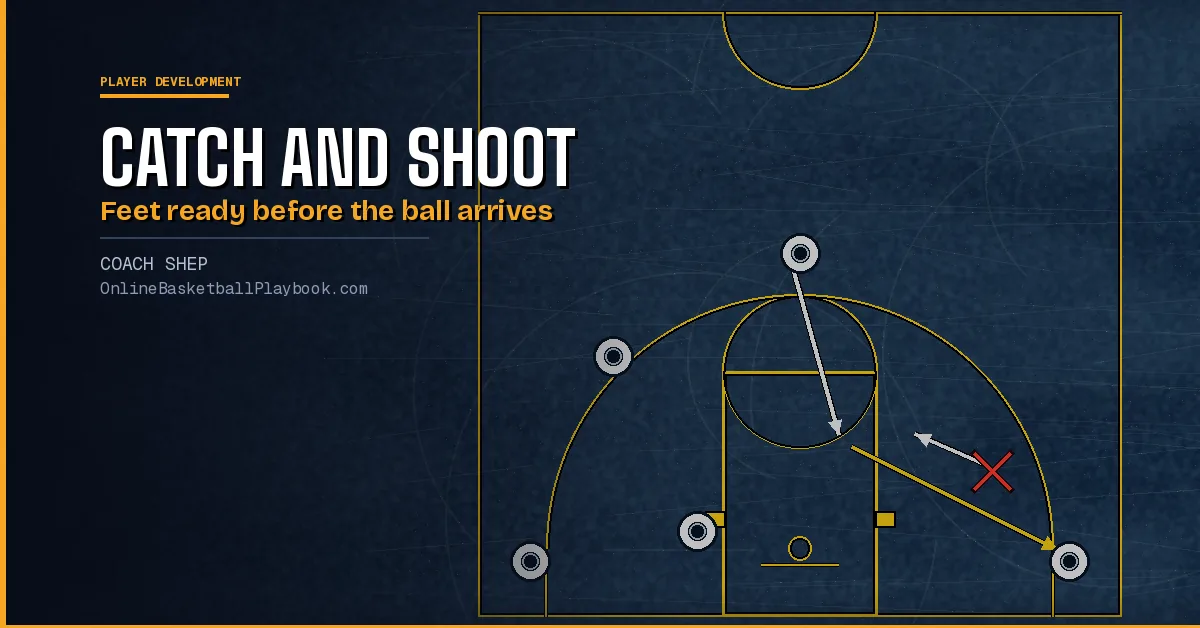
Catch and shoot basketball means shooting straight off the pass, with no dribble. The shot is won or lost before the ball arrives: the feet are set, the hands are a target and the shooter already knows whether he is shooting.
The release itself is on basketball shooting form and the jumper's lift on jump shot basketball. Fixing a miss is on how to fix common shooting errors, and every skill guide is under player development.
Get Ready Before the Ball Arrives
Footwork and hands, not shot volume, separate the players who make shots from the players who only take them. Everything that makes the catch-and-shoot quick happens before the catch.
- Beat the pass. Billy Donovan wants the shooter's feet ready and set before the ball arrives.
- Hungry hands. Show the passer a target with the hands and be fully ready to finish the catch. The release comes quicker.
- Get ready to shoot fast. The cue is "don't shoot fast, get ready to shoot fast."
- Face it, then jump behind it. Before the catch, face the basket with the hands above the shoulders and the knees slightly flexed, then jump behind the ball instead of reaching for it.
- A touch spot, then a shot spot. The player always moves into the shot from a touch spot. Catch the ball with the feet and step into the shot. There is too much stationary shooting in practice.
The passer has a job too. Donovan has players, not coaches, make the passes in shooting drills, to the shooter's inside shoulder to lead him into the shot, and as quickly as possible.

Be ready before the ball is, every time.
Catch and Shoot Footwork: Hop or 1-2
Coaches split on how to land the catch. Both landings are taught well, so pick one for the team, drill it the same way every day, and let a proven shooter keep what works.
- The hop. A jump stop lets the shooter catch and shoot in one motion, faster than stepping into the shot, which takes two, and easier to adjust when the pass is off. Rhythm and range come from a quick down-and-up motion of the legs, not from lowering the ball or stepping in, and keeping the ball high through the catch shortens the shot to one count. Which foot can pivot after a hop depends on how he lands. In NCAA men's play and the NBA, a player who jumps off one foot and lands on both together has no pivot foot. Check your league, and see traveling in basketball.
- The hop with a dip. A hop with flexed knees and a dip of the ball to the waist or thigh on the catch, for rhythm. Its teachers call "the 1-2 step is quickest" a myth.
- The 1-2, inside foot first. John Beilein's footwork plants the inside foot first coming off a screen, then steps in, 1-2. Players at Jay Wright's and Beilein's practices say the sequence out loud: 1-2, lift, follow through.
- Step in, don't jump in. The best shooters historically have step-up shots, so step into the shot rather than jump into it.
- One-two within two seconds. Feet under the shoulders, and the shot off one-two within two seconds of the touch.
- Train both. A self-toss catch-and-shoot drill lets players work the hop and the 1-2 step.
When the shooter is closely guarded and the pass comes to the outside hand, away from the defender, use the one-two stop: land on the inside foot, pivot into the defender and jab-step with the ball held high in triple threat.
Whichever landing you choose, rep it until the player never thinks about it.
The Pivot Foot and the Feet
The pivot foot sets how fast the shot gets off. Shooting off the inside pivot foot saves time on the release, and for many players it is the difference between a contested shot and an open one.
- Attack the catch and elevate. Attack the catch from every angle on the floor and rise into the shot without shooting it, over and over, until the footwork is a habit.
- Inside pivot to shoot, one pivot to attack. Use an inside pivot when you know you have a shot and a permanent pivot foot when you are attacking one on one.
- Toward the ball, away from it. Donovan's shooters pivot on the foot nearer the basket when they go to the ball. Going away from the ball, they use whatever footwork is most comfortable.
- The hot foot. Beilein's passing system catches on two feet with the shooting-hand foot, the "hot foot," down first.
The base matters as much as the pivot:
- Heel, toe, toe. Mark Few's Gonzaga workouts step into the shot heel-toe-toe and never shoot off the heels.
- Not on the line. Donovan does not want shots with a foot on or just inside the three-point line, and charts them in practice so players see their footwork.
Footwork drills are on basketball footwork drills.
Pick the pivot rule and the whole team uses it.
Read the Defender Before the Catch
Make the decision before the ball arrives. Read the defender with one eye on the ball and one eye on him, then catch into the answer.
- Defender far. Catch and shoot without a dip.
- Defender close. Leave with the lead foot, stop and shoot.
- Defender in between. Fake, go, and shoot.
- Defender in the passing lane first. Go back door.
Against a hard closeout, the shot fake has to look like the shot. Load, raise and stop, then attack if the defender jumps and pass if he does not. Bring the ball to the chin, not above the head, and stay low, since raising the hips on the fake costs the first step. The fake is covered on basketball shot fake, and the defense's side of the same play on closeout and recover.

A shooter who has already read the defender only has to catch.
Get the next coaching guide in your inbox
One email when a new guide or diagram set goes up. Free.
Catch and Shoot Off Screens
Off a screen, the cut is chosen by how the defender plays it. Set the defender up first, then read him over the inside shoulder.
- Straight cut. Walk the defender to the opposite lane line, reverse, and come up tight to the outside of the screen, squared to the basket on the catch. The three ways to ruin it: no setup, a looped cut instead of a flat one, and drifting back on the catch.
- Fade. If the defender jumps under the screen to cut the shooter off from the ball, plant the inside foot at the screen and fade to the wing or corner, with the shot still moving forward.
- Flare. Take a couple of steps toward the ball below the screener so the defender drops, then push off the inside foot and drift behind the screen. Shoot off the catch if the defender goes under, and catch and drive if he chases over the screen.
- The screener shoots too. In Wright and Beilein's two-ball shooting the screener and cutter go eyeball to eyeball, then shoulder to shoulder, and the screener becomes the second cutter thinking catch and shoot.


The full set of screen reads is on basketball shooting off screens, with the screens themselves on down screen and flare screen.
Let the defender pick the cut, and the shot stays open.
Catch and Shoot Basketball Drills
A catch-and-shoot drill needs a passer, movement into the shot and a score. Every drill below has a number to beat.
- 3-Minute Shooting. Six spots, 30 seconds each, back and forth, with a goal of 100 makes. Shaka Smart's Texas sheet lists a record of 157.
- 20 in 2. Five spots over and back, two rounds: 10 catch-and-shoot threes, then 10 shot-fake, one-dribble pull-ups from the same spots.
- 100 Makes. Catch-and-shoot threes around the arc and back, at the end of the workout when players are tired.
- The 30-second standard. Beilein's Michigan standard is 10 shots and 7 makes in 30 seconds coming off a down screen and a flare screen. If the group falls short, all three run, with the screener exempt.
- Close-out shooting. Three players, one ball, a live closeout on every catch, as in the diagram above.
- 2-on-1, 3-on-2 and 4-on-3 shooting. Coach Shep's teams play these with the defense always one player short, so it has to close out, contest and talk. Rounds run 3 to 4 minutes, a made three or a foul drawn is +1, and a stop flips possession.
- Layer the base drill. Once players own a spot-shooting drill, add a contest, a ball screen or a dribble handoff to it.

Post the records. Players erase the old mark and sign their own on a record board. More drills are on basketball shooting drills and three-point shooting drills.
If a drill has no score, add one before you run it again.
Game Shots, Game Spots, Game Speed
Train the shots the offense actually produces, from the spots it produces them, at the speed of a game.
- A read before every shot. Larry Brown's SMU drills put a zipper cut, a baseline drive, a ball screen or a drive-and-kick before every shot, so the shooter answers a read instead of a cold spot-up.
- A share off the team's actions. At least 30 percent of a workout's shooting comes straight off the team's own actions.
- Never the same spot twice. Smart bans shooting the same spot twice, so every shot needs movement.
- Chart every shot. Donovan charts every shot in individual work and posts the daily and season totals.
- Shoot tired. Put the catch-and-shoot volume at the end of the workout, when legs are gone.
Do not let the catch-and-shoot become the only shot. A workout of 400 catch-and-shoot jumpers builds a one-dimensional player. The pull-up is on shooting off the dribble. Spacing that creates the kick-out is on 5-out motion offense.
Practice the shot the way the game hands it to you.
Questions Coaches Ask
What is a catch and shoot in basketball?
A shot taken straight off the pass, with no dribble. The shooter has his feet set and hands ready before the ball arrives, so the catch goes straight into the shot.
Is a hop or a 1-2 step better for catch and shoot?
Coaches split. The hop catches and shoots in one motion and adjusts to a bad pass. The 1-2, inside foot first, steps into the shot off cuts and screens. Pick one, drill it daily, and let a proven shooter keep what works.
Which foot should you pivot on when you catch and shoot?
The inside foot, nearer the basket, when you know you have a shot. It saves time on the release. When attacking one on one, keep one permanent pivot foot.
How do you practice catch and shoot?
With a passer, movement into every shot and a score: 3-Minute Shooting, 20 in 2, a 30-second make standard off screens, close-out shooting and Coach Shep's 2-on-1 shooting.
Want the printable playbook packs?
OBP Pro members get the premium playbook packs: the zone attack, out of bounds and practice plan PDFs, plus each new pack as it is finished. The membership page lists what is in each one. Or draw your own version free in PlayDraw.
See what OBP Pro includesMore Game Day and Shooting Guides
- Basketball Substitution Patterns: Shifts, Fouls and Closers
- Game Day Routine for Basketball Coaches: Shootaround to Tip
- How to Fix Common Shooting Errors: Read the Miss, Fix the Cause
Back to Basketball Shooting Form and every Player Development page.
Keep Building
Related breakdowns
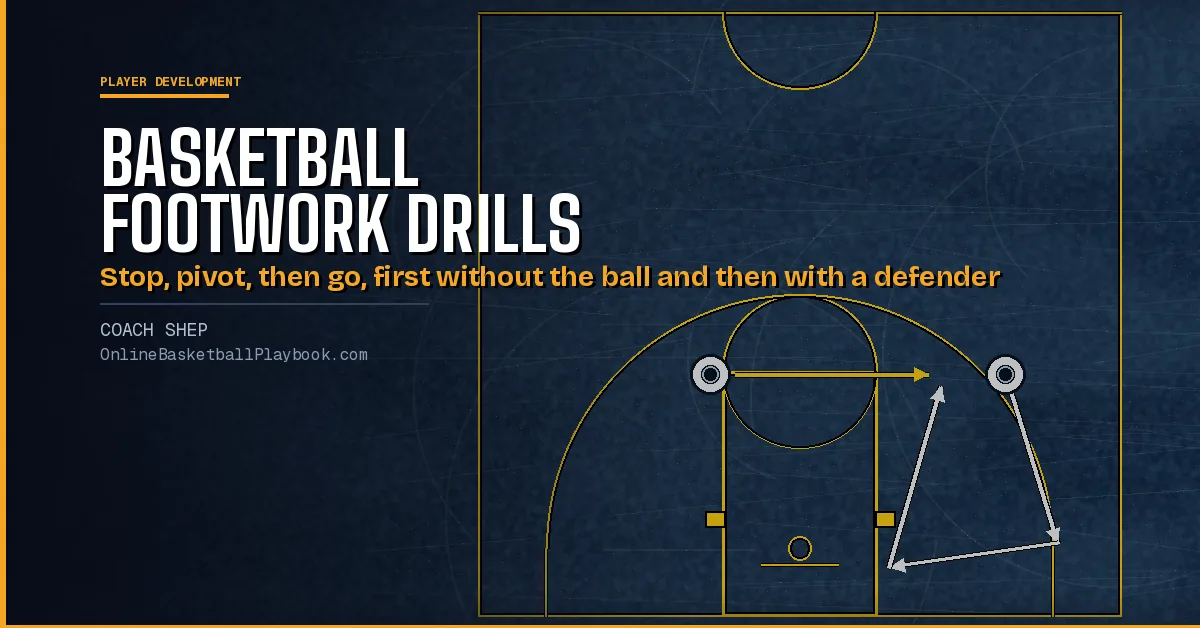
Basketball Footwork Drills for Teams and Individual Workouts
Basketball footwork drills for stops, pivots, cuts, jab moves and defensive slides, from the box drills to 30-minute workouts and where coaches differ.
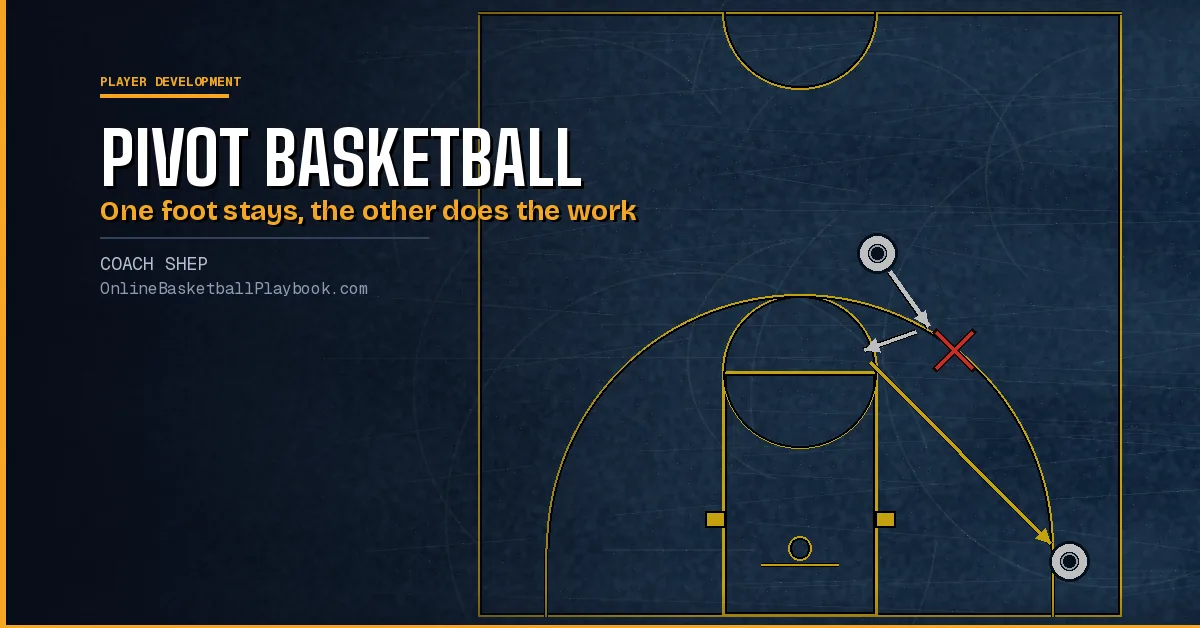
Pivot Basketball: Pivot Foot Rules, Footwork and Drills
What a pivot means in basketball, which foot is the pivot foot after each stop at every level, front and reverse pivots, the inside pivot on the move and the drills.
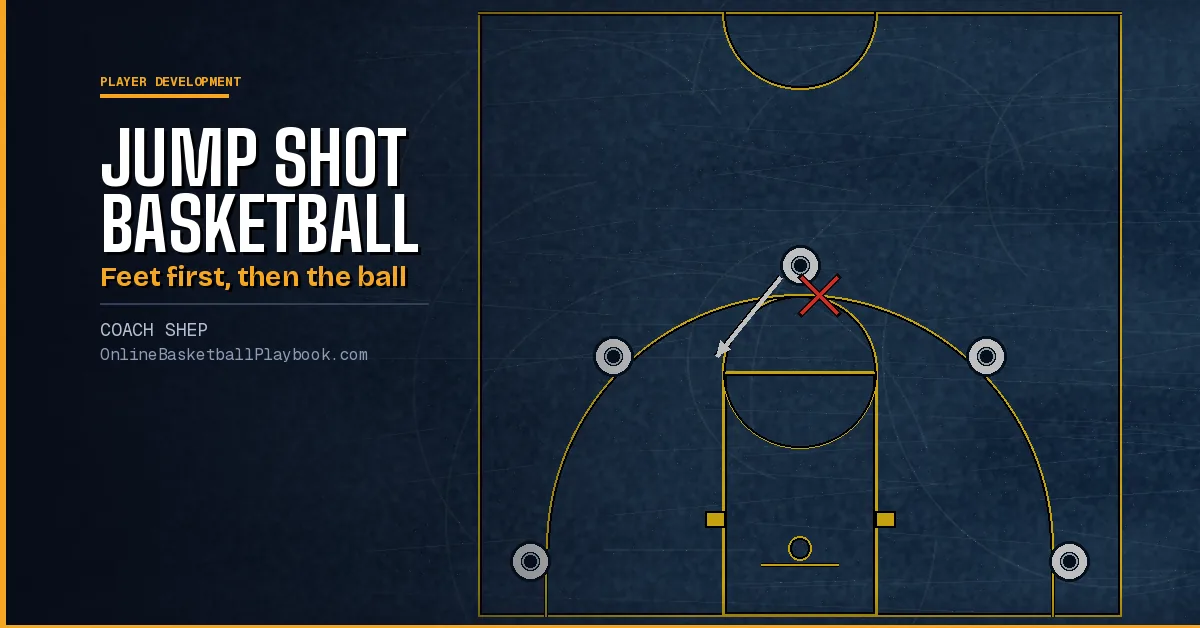
Jump Shot Basketball: Footwork, Release and the Step-Back Jumper
The jump shot in basketball from the feet up: catch footwork, the lift and release, shooting off the catch or the dribble, the step-back jumper and fixing a miss.