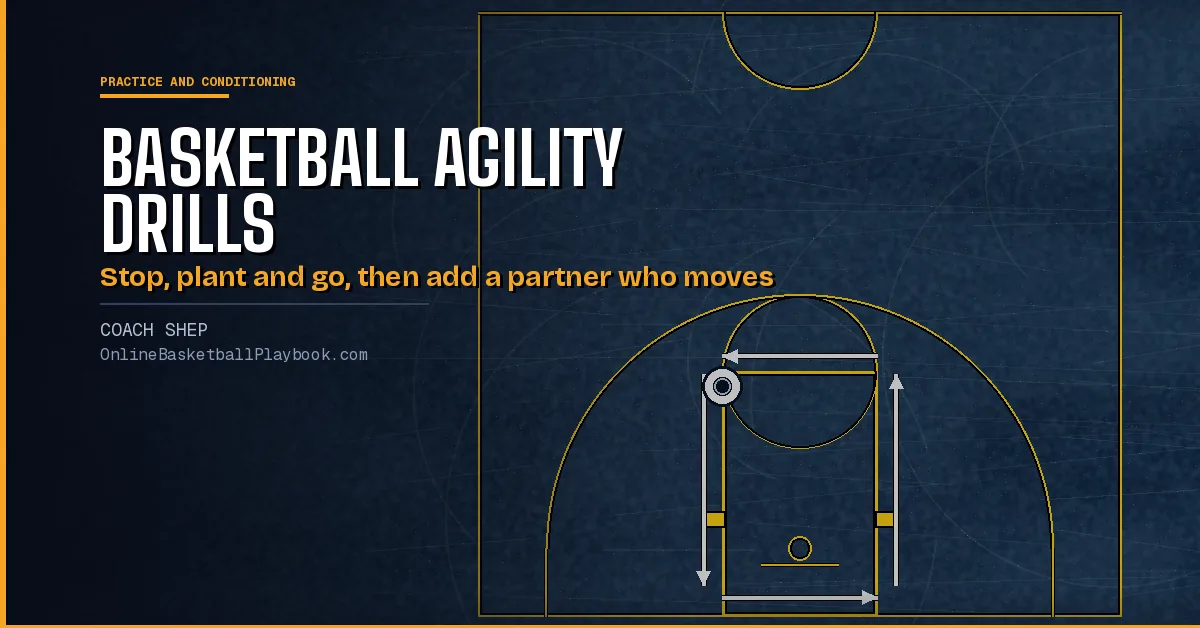
Basketball agility drills train a player to accelerate, stop and change direction under control. Speed is straight-line pace, quickness is the first step and agility is redirecting while doing either.
This page sorts the drills into timed cone tests, reaction drills, ladders and no-equipment work and defensive circuits, then lays out how programs schedule them and where they disagree. It sits beside the agility training guide and the speed and agility drills page.
Basketball Agility Drills at a Glance
| Type | Drills | Needs |
|---|---|---|
| Cone drills | Lane agility, pro agility 5-10-5, zig-zag sprint, figure 8 | Cones, a stopwatch |
| Reaction drills | Sprint to backpedal, cone reaction, partner mirror, closeout series | A coach or a partner |
| Foot-speed drills | Ladder patterns, line jumps, jump rope, foot-ups with a tennis ball | A ladder, a line or a rope |
| Circles | Lateral and linear circle drills | A circle on the floor |
| Defensive circuits | Slides, mirror work and six-point drill | Cones, a coach |
Cone Drills and Timed Tests
Lane Agility
The NBA Draft Combine uses this as its agility test. Four cones mark the key, one at each elbow and one at each baseline corner of the lane.
- Run the route. The player begins at the right elbow, faces the baseline, sprints to the baseline cone, slides across the baseline, backpedals to the left elbow and slides back along the free-throw line to the start. Then he reverses the whole pattern.
- Never turn the body to run. He plants the outside foot on each change of direction.
- Time every rep. The coach times every rep and posts the times.

Pro Agility, 5-10-5
Three cones sit in a line 5 yards apart. The player starts straddling the middle cone, sprints to one outer cone and touches the floor, sprints 10 yards to the far cone and touches again, then sprints back through the middle. The point is stopping and restarting twice in 20 yards.
- Run it both ways. Sprint through the final cone, stay low on the turns and run it in both directions, because most players are slower turning one way.
- Rest a minute. An off-season plan uses the T-drill or the 5-10-5 for three reps with a minute of rest.

Zig-Zag Sprint and Figure 8
- Zig-zag sprint. Six to eight cones run baseline to baseline. The player plants the outside foot at each cone, cuts toward the next and keeps going at full speed. A relay sets up two identical courses, and a dribbling course makes it a change-of-direction handling drill.
- Figure 8. Two cones stand 10 to 15 feet apart and the player sprints a figure 8 around the outside of both, eight times as fast as he can, then tries to beat his time. With a ball the figure 8 becomes a dribbling drill, which is fine as long as you know which one you are running.
Time the cone drills and keep the form clean.

Reaction and Mirror Drills
One distinction shapes the whole page. A cone course is planned and the player knows where the next turn is, so it trains change of direction and does not train reaction. The reaction drills add something that happens.
Sprint to Backpedal and Cone Reaction
- Sprint to backpedal. A player sprints 15 feet from the baseline to the free-throw line, plants with the hips down and backpedals to the start for six to eight reps. A variation replaces the plant with a jump stop and a held count, which helps younger players who struggle to stop under control. He leans slightly forward on the backpedal.
- Cone reaction. A player in a defensive stance stands in the middle of four cones about 10 feet apart. The coach points, the player sprints to that cone, touches it and returns to a stance, and the coach points again. It runs 20 to 30 seconds. Variations slide to the side cones and backpedal to the back cone, or number the cones and call numbers so players cannot watch a hand.

Partner Mirror
Two players face each other about 6 feet apart in a stance, between two lines 10 to 12 feet apart. The leader slides left and right at random and the mirror stays directly in front of him for 15 to 20 seconds, then they swap.
- Use a partner, not a cone. John Calipari's line is that a cone has no arms, since a partner fakes and changes his mind.
- Watch the hips. The mirror watches the leader's hips, because hips cannot fake, and it is the drill that carries over best to guarding the ball.
- Add a dribble. Or call "live" and let the leader attack the basket.
- Time the reps. Use 12 to 15 second reps and a start at half speed, or grow the mirror drill from 15 to 30 seconds over an eight-week plan.

Closeout Series
Players line up on the baseline and a coach stands at the free-throw line.
- Sprint and break down. The first player sprints at the coach and about two thirds of the way breaks down into short steps with one hand up and weight back.
- Answer the call. The coach calls left, right or shot. On left or right the player drop-steps and takes two slides in that direction. On shot he jumps to contest.
- Backpedal. Then he backpedals to the baseline.
The breakdown steps start earlier than players expect and the cue is a high hand and low hips. The closeout technique page goes deeper. Let the coach's call, not the cones, decide the movement.

Get the next coaching guide in your inbox
One email when a new guide or diagram set goes up. Free.
Ladders and No-Equipment Drills
Ladder drills are the most widely used agility drills and the most overused. They build quick, light, accurate feet, and they do not teach a player to change direction against an opponent or make him faster up the floor. The patterns:
- One foot in each box.
- Two feet in each box.
- A lateral two-feet-in pattern. It is closest to a defensive slide.
- In-in-out-out.
- The Icky shuffle.
- Single-leg hops.
Tape the ends down on hardwood because ladders slide. An 18-square ladder, 15 inches by 15 inches, has players imagine hopping over a pencil and every trip ends with a 5-yard burst. That list has single-leg hops, both feet in each hole, bunny hops, a hip twister, a zig-zag, a W and a slalom.
For players working alone:
- Line jumps. Jumps over a line or a piece of tape for 20 to 30 seconds.
- Jump rope. Two-foot, alternating, single-leg and side-to-side jumps.
- Foot-ups with a tennis ball. A player taps the top of a basketball with alternating feet while a partner tosses a tennis ball for him to catch and return, so the feet and hands work together.
- Circle drills. They need only a circle on the floor. In the lateral circle a player slides around the circle at full speed, stays on the line and plants and slides back the other way. In the linear circle he sprints. Both run five sets of 30 seconds and can be played as a chase.
Use ladders for light feet and reaction drills for everything else. See basketball specific agility training and basketball speed drills.
Defensive Agility Circuits
A defensive circuit lists:
- Active warm-up.
- Mirror drill.
- Speed skater movements.
- Lateral bounds. Down the court, landing on the opposite foot.
- Reaction drill. The coach points and players slide, rotate the hips or sprint.
- Parapet drill. It alternates running and sliding through cones.
- Barbell drill. It changes from a sprint to a slide.
- Defensive zig-zag. Full court, with and without a ball.
- Six-point drill. A defender moves through denying the wing, helping on the drive, fronting the post, helping again, denying a flash and closing out on a skip.
Practice technique drills at least every other day. A glide-run-glide and run step are on the defensive stance page and more defensive work is on defensive footwork and defensive drills. Keep the circuit moving and the form clean.
Coaching Points That Apply to Every Drill
There are eight:
- Stay low. A player who stands up to change direction has to sit back down before he can push.
- Plant the outside foot. Planting the inside foot costs a stumble step.
- Never cross the feet on a slide.
- Turn the hips first. The feet follow.
- Train the stop as much as the start.
- Get the pattern right slowly. Then add speed.
- Time the tests. Retest monthly. Full test batteries are on strength training for basketball.
- Remember that cones do not react.
The stop has its own mechanics:
- Land the outside foot wide enough. It stops the momentum but not so wide that it slips, with the ankle cocked, the knees inside the width of the plant foot and the hips level.
- Keep the head still. The shoulders stop swaying once the feet stop.
That teaching says some of the fastest straight-line athletes change direction poorly because they cannot decelerate, and calls the common "knee over toe" cue for a lateral stop dangerous. The main point is that the athlete should think about the change of direction and not the stop.
Long steady runs train the wrong energy system and sprint and agility work is the right one, and players must keep good form or the drill reinforces bad habits. Lateral movement and landings cause hip and thigh strains, and ankle sprains are the most common foot and ankle injury. See recovery and injury prevention. Keep the form clean on every rep.
How Programs Schedule Agility Work
Put a 10 to 15 minute block right after the warm-up, with two or three drills a session rotated across the week, two or three sessions a week in the off-season and about one a week in-season. Agility drills are not a fix for a defense that gets blown by, since reading and anticipating develop in live play. Do the block, then give most of practice to live small-sided play.
Schedules vary:
- An eight-week summer plan. Three days a week and almost no other work. Day one is footwork and agility, day two is straight-line and lateral speed and day three is jump rope, 3-cone and mirror drills and full-court up and backs. Rests are two to three minutes on the agility drills and the plan shows no warm-up, no strength work and no drill descriptions.
- Short stations. Keep agility circuits to 10 to 15 second stations with a set work-to-rest ratio of 1:2 or 1:4.
Keep the block short and early. Plans and warm-ups are on the practice plans hub, warm-up drills, conditioning drills and plyometric drills, and the footwork side is on footwork drills.
Where Coaches Differ
Coaches split on four questions.
Cones or reaction?
- Reaction first. Cones test change of direction, reaction drills matter more, and John Calipari says a cone has no arms.
- Cones beside reaction work. Cone courses (parapet, barbell) sit beside mirror and reaction work in a defensive circuit.
Where do ladders go?
- In individual workouts. Not team time.
- In the strength and conditioning session. Each trip ends with a burst.
How much rest?
- Two to three minutes. So quality beats fatigue.
- Work to rest of 1:2 or 1:4. Per station.
- One minute. Between three reps of the T-drill or 5-10-5.
How often?
- Two or three times a week in the off-season, once in-season.
- Three days a week. All speed and agility, for eight weeks.
Pick one answer to each question and write it into the practice plan.
Want the printable playbook packs?
OBP Pro members get the premium playbook packs: the zone attack, out of bounds and practice plan PDFs, plus each new pack as it is finished. The membership page lists what is in each one. Or draw your own version free in PlayDraw.
See what OBP Pro includesQuestions Coaches Ask
What are good basketball agility drills?
Lane agility, the 5-10-5, zig-zag sprints, the cone reaction drill and ladder patterns cover sprinting, sliding, backpedaling and reacting.
What is the 5-10-5 drill?
Three cones 5 yards apart. The player starts in the middle, sprints 5 yards one way, 10 yards the other and 5 back through the middle.
Do agility ladders help basketball players?
They build quick, accurate feet and do not teach changing direction against an opponent.
Can you do basketball agility drills at home?
Yes. A line of tape, a rope, a tennis ball and a ladder drawn in tape are enough.
How often should players do agility drills?
Short sessions two or three times weekly in the off-season and about one in-season.
What is the best agility drill for defenders?
The partner mirror drill is the one that transfers most directly to guarding the ball.
More Guides From This Batch
- Defensive Stance in Basketball: Weight, Feet, Hands and Drills
- Pack Line Defense: Rules, Post Coverage and How to Install It
- 1-3-1 Full Court Press: Roles, Traps and Rotations to Install
- Fun Basketball Drills for Kids: Team Games, Relays and Contests
Back to Practice Plans and every Practice and Conditioning page.
Keep Building
Related breakdowns
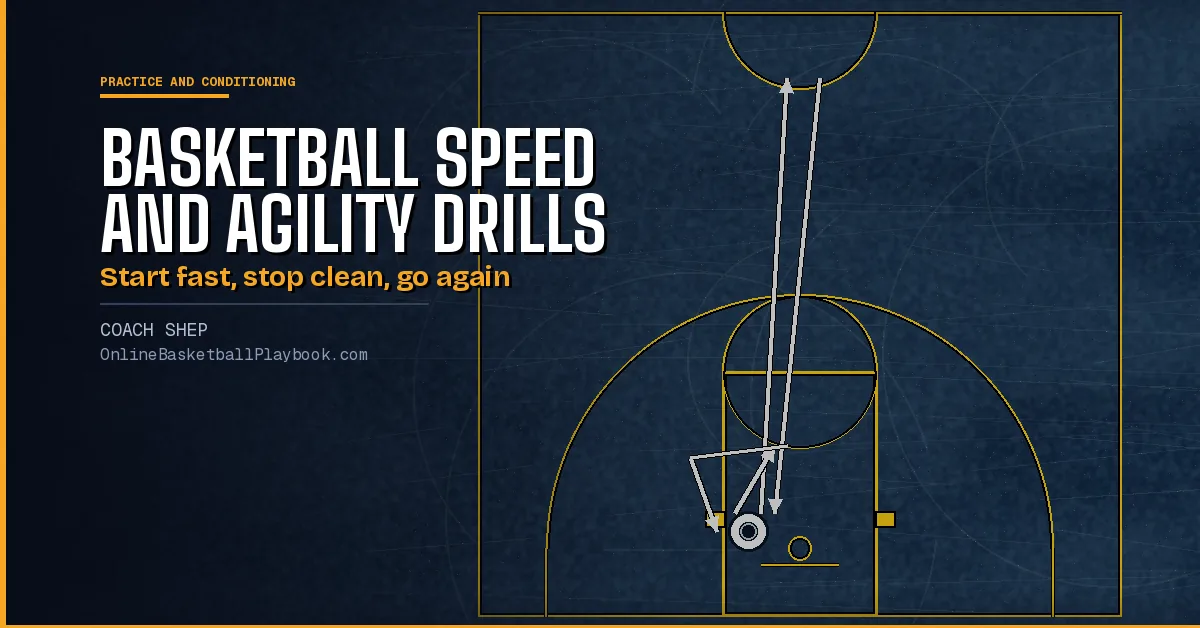
Basketball Speed and Agility Drills: Sprints, Starts and Stops
Basketball speed and agility drills for teams and players: short sprints, starts and stops, court drills with cones, an eight-week summer plan and how to dose rest.
Fun Basketball Games for Practice: Scored Games for Any Team
Fun basketball games for practice at any level: shooting games, defense-only scoring, rebounding contests and passing games, with scoring rules and records.
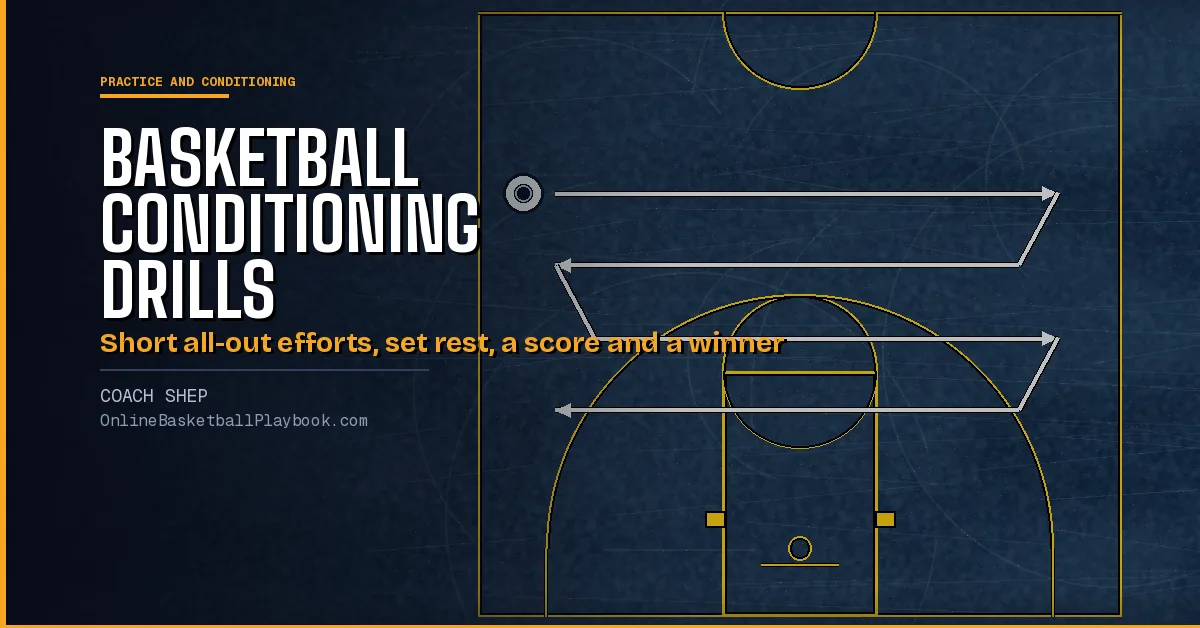
Basketball Conditioning Drills for Teams: Runs, Games and Tests
Basketball conditioning drills in three styles, timed runs, conditioning inside skill drills and scored games, with the tests and yearly plans coaches use.