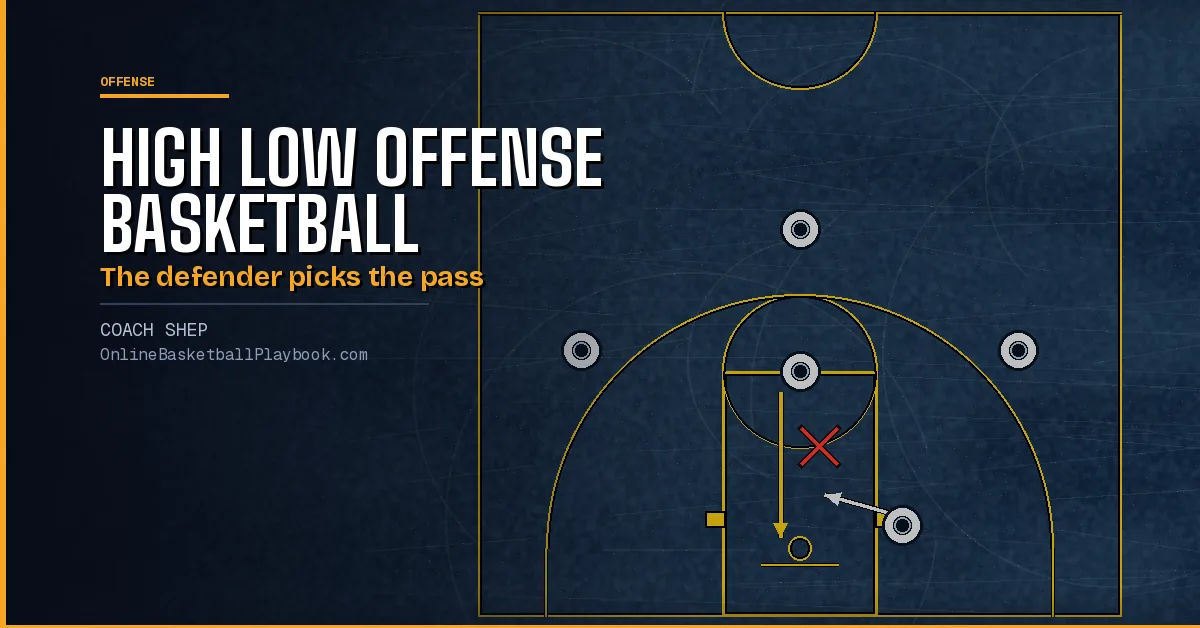
The high low offense in basketball is a 3-out, 2-in system built around two post players who work as a pair. One post sits high, at the elbow or the free-throw line, and acts as the hub. The other seals low, in a line between the ball and the basket. The low defender's position decides the pass: a lob over a front, a bounce pass when he plays behind, or a shot or drive by the hub.
A coach runs it when he has two posts who can score or pass inside and wants touches near the rim instead of an empty lane.
This basketball high low offense guide covers the shell, the reads, the answers to a fronted post, the weak-side screens, the named calls, the 1-4 low sets that end in a hi-lo pass and the zone rules. It sits with the other systems in the offense section.
The Basketball High Low Offense Shell
Three perimeter players and two posts on different levels. Start it one of two ways:
- One post at the elbow, one low. In a Kansas-style hi-lo motion, one post pulls to the elbow while the other seals low, and the offense starts from three entries: a pass from the top of the key to the wing, a pass from the top of the key to the high post, and a dribble from the top of the key to the wing.
- Both posts above the blocks. Start both posts slightly above the blocks on opposite sides, and the weak-side post slides to the elbow on a pass from the top of the key out to a wing so the pair stays opposite each other.

The Kansas-style case for running it: it controls tempo and plays off the pass, it does not care where the ball is entered, and it builds post isolations with spacing. It also serves as a break offense and as a pressure release.
Spacing numbers differ:
- Tighter spacing, with rules. A tighter 3-out, 2-in keeps 12 to 15 feet between players and adds rules: never pass and stand, never stand still more than three seconds, move to open space when a teammate drives, and back cut when denied.
- The dribble-entry rule. The Kansas-style dribble-entry rule keeps the floor balanced automatically: a guard who dribbles to a wing is followed by the corner player sprinting to the top of the key.
Keep the pair on different levels and the floor balanced. The general 3-out, 2-in motion is on 3 out 2 in motion offense.
The Direct Line and the Two Passes
With the ball at the high post, the low post sets up directly in line with the ball and the rim. Off that line, he is easier to defend. Bill Self has the 4 post up between the hoop and the ball. On the line, the defender has to commit: front, behind or side, and each choice opens a different pass.
Lob over a front.
- Lock and seal. The post locks and seals with a reverse pivot to make the angle, then waits until the ball is directly over his head before he releases.
- Throw it high. The passer throws it overhead toward the corner of the backboard.
- Ride the defender up. Ride the denying defender up the lane (the higher he goes, the easier the finish), raise the far hand, and do not release too soon or the pass gets tipped.

Bounce pass after a seal. When the defender plays behind or on the side, the post seals and waits for the first bounce, then grabs the ball with two hands and pivots to score. The passer puts it where the defense cannot reach.

The low defender's spot picks the pass. In the Kansas-style reads, a front means the lob, and a seal on a defender behind or on the side means the bounce pass.
Other systems map the same read their own way, so write the job next to the name:
- Baseline feed from the wing. The zone feed by angle uses it when the defender plays the high side.
- Cross-court skip. The zone feed by angle uses it against a front, and a basic high-low feed when he plays behind.
- Corner feeds. The triangle uses them against a half front from the high side.
- Pass to the slot, slot player feeds. The triangle uses it against a half front from the low side.
- Corner passes straight in. Dean Smith's T-Game uses it when the defender plays behind.
- Hold the elbow, corner lobs. Against a full front in the T-Game the elbow post holds his spot to keep the helper out and the corner lobs. If help cheats to the lob, the ball swings out for a three.
Three absolutes move the defender before the pass:
- Push him up. Push the defender up the lane if he fronts.
- Bury him. Bury him if he plays behind.
- Leg-whip. Leg-whip to seal for the dump pass.
Footwork for the seal is on how to post up in basketball. Let the low defender pick the pass.
Answers to a Fronted Low Post
There are several answers, and none is ranked.
- Lob from the hub. The seal and the overhead lob above.
- Move the defender up the lane. The low post pushes the fronting defender up the lane to make room for the entry, or rides him up the lane line and takes the lob from the top of the key.
- Flash the weak-side post. The fronted post holds the defender in front while the weak-side post flashes to the ball-side high post, catches and lobs. It is timing-dependent but essential.
- Reverse the ball. Move the ball away so the post seals and catches the high-low pass on the way back.
- Skip it. A fronting defender means a cross-court skip pass.
- Hold the elbow and lob from the corner. Dean Smith's T-Game, as above.
Pick your answer to a front before the game.

The Weak-Side Post and the Down Screen
The weak-side post moves by the coverage. Mike Krzyzewski's Duke motion gives the rule with both posts starting low.
- Fronted. If the ball-side post is fronted, the weak-side post flashes to the ball-side elbow for the hi-lo.
- Behind. If the defender plays behind, the weak-side post goes up the lane to the weak-side elbow.
- Three-quarters. If the defender plays three-quarters, the ball-side post screens for the weak-side post, and on a switch the screener steps back to the ball.
For post-to-post screens, the screener does the opposite of the cutter. If the cutter goes low, the screener pops high for the hi-lo, and if the cutter goes high, the screener seals low.
Flash to the high post. The flashing post takes a cheat step across his defender, and the passer throws to his outside hand.
The weak-side down screen. While the ball is on the strong side, a post sets a down screen for a guard on the weak side. The screen goes in around the elbow, where its location and angle take away help. Three reads:
- Straight cut. The guard looks for the shot off the screen.
- Fade cut. The defender plays inside the screen, so the guard fades away and gets a skip pass to shoot or drive the closeout.
- Curl cut. The defender is behind or tight, so the guard sets up wider, the post sets a hard screen and the guard curls into the lane for the pass.
A high-post split reads six ways:
- Chase and trail. Curl.
- A late chase. Curl all the way to the basket.
- A cheat over. Fade to the baseline.
- An early cheat over. Back cut.
- A switch. Screen and roll.
- Show and recover. Slip.

Down-screen technique is on down screen basketball. Move the weak-side post by the coverage.
The High Post's Menu
After the high-post catch the choices are few:
- Shot-fake set with a high guard. Shoot, shot-fake into a drive, or hi-lo to the low post, with a guard spaced very high above the arc late in the action so the lanes stay open.
- Shot, drive or dump. Shot, drive, or a hi-lo dump.
- Four-choice motion. Shot, shot-fake and drive, feed the low post, or reverse to the opposite wing.
- Feed, shoot or swing. Feed the low post, take the mid-range shot, or swing to a wing for a three or a drive.
- Play 1-on-1 in a 2-1-2. With a strong high post, the best read is often his own 1-on-1 from the elbow, since the help defenders are pulled wide when the ball sits at the top of the key.
In a 4-out set, a feed from the slot is harder to double than a feed from the wing, because the help side is not set yet. If the wing feeds and the post gets doubled, the post skips to the opposite wing where the help came from, then follows the pass and re-posts for a quick return feed.
The Kansas-style punch pass is a hard fake to the low post that baits the help defender, then the ball goes the other way. More on the high post as a hub is on attacking from the high post.
Get the next coaching guide in your inbox
One email when a new guide or diagram set goes up. Free.
Ball Screens and Named Calls
When the post-up is not there, run side ball screens as a second layer. Guards are interchangeable and posts are interchangeable, and screens come at three spots: the slot, the wing and the corner. The screener creates separation so the defense cannot hedge or double well, does not release early, changes the angle late and knows when to slip. Its quick actions:
| Action | What happens | When it is used |
|---|---|---|
| Double screen, first slips | Both posts move to the elbows and sprint to screen together. The first slips to the basket, the second sets the screen. | A hard hedge or a trap |
| Double screen, pass over the top | Same start. The second post fills the high post, catches a quick pass and throws over the top as the 5 slips to the rim, sometimes as a lob | A hard hedge or a trap |
| Circle-down lob | As the 5 sprints up to screen for the 1, the 4 circles down in front of him. The 3 back-screens for the 5, the lob goes to the 5, and the 4 seals the help defender. | Pressure |
| Step-out screen and dump | The first wing pass goes nearer the corner and the 1 cuts opposite. The 5 steps out to screen for the 3, the pass goes to the 4 high, and the 4 dumps to the 5 on the roll. | Starting with the 5 low and the 4 high |
| Back screen and down screen | The 1 passes to the 3 and back-screens for the 4 while the 5 down-screens for the 2, who cuts up to the top of the key | A quick layup or three before the ball-screen motion |
A standing rule from a 4-out quick hitter: whenever the 4 catches on the perimeter he looks at once for the hi-lo to the 5 posting up, and if it is not there he passes ahead and follows to set a ball screen. Bill Self has a matching follow: once the post gets the ball he zips it to the 1 and follows his pass with a ball screen.
Coaches disagree on order:
- Post first. Look to the post first and screen later.
- Drag first. Run a transition drag screen first with the hi-lo as the counter when the post is fronted.
- Ball screen first. Self's 3 Out Ball Screen runs a wing ball screen and roll before the other post shapes up for the high low.
More on the screen itself is on pick and roll. Pick the order and keep the post read first.
1-4 Low and 4-Out Low Looks
Not every hi-lo starts from 3-out, 2-in. Several plays get the same pass out of other alignments:
- 4-out low hi-lo. 1 passes to 4 at the top of the key while 5 posts hard, and 4 makes the quick hi-lo pass before a three-second call. If the post pass is denied, 2 back-screens for 1 as the second option.
- Back-cut counter. The counter once the defense denies the pass to 4: 4 back-cuts up the lane for a direct pass from 1, or 1 skips 4 and passes straight to 5.
- Down screen and swap. 4 down-screens for 5, who cuts up to the top of the key to catch it, and 4 posts for the hi-lo. It is meant for when 4 has the better post matchup or his defender is in foul trouble.
- 1-4 baseline cross (1-4 low stack). 2 and 3 run the baseline and cross to the opposite corner for a three. If neither corner pass is open, 1 dribbles right as 5 flashes to the free-throw line, and 4 cuts to the post for the hi-lo feed from 5.
- 1-4 scissors. 4 flashes to the high post for the entry, 2 and then 1 cut around him in a scissors for possible hand-offs, and if neither connects 4 can shoot, drive, or look for the hi-lo to 5 or either corner.
Bill Self also uses a fake screen to move into a 1-4 look. Choose the alignment that gets the pass you want.
Hi Low Basketball Offense Against a Zone
The high-low pairing is called effective specifically against zones, with the low post choosing between sealing and kicking back out. Against a 2-3, Bill Self starts both posts low.
- Flash on the wing pass. On a pass from the top of the key to the wing the opposite post flashes to the ball-side elbow, sealing for a lob if he is denied.
- Dive. When the wing feeds the low post, the elbow post dives down the lane.
- Move the ball. Good shots usually come on the second or third side, so the perimeter players move the ball quickly rather than dribble or hold it.
- Back-screen if denied. If the flash is denied, the post back-screens the low outside defender and the opposite wing slides to the corner for a skip three.

Where the low post lives against a 2-3 differs:
- Off the block. Do not post on the low block, because all three low defenders collapse there and the pass becomes a turnover. The low post moves along the baseline between the two short corners, and the high post sits in the gap between the high and low defenders. Want one post touch before any outside shot, except a transition kick-out three.
- Both low. Start both posts low and feed inside off the wing pass (Self).
Against a 1-3-1, Self moves to a 2-1-2 look so corner shots and middle flashes open up. Other zone rules: an elbow flash to freeze the middle defender, and a pass fake to the corner from the high post when the low defender cheats toward the corner shooter, then the hi-lo. The full zone picture is on how to beat a zone defense and zone offense vs 2-3 zone. Move the ball and let the posts read the zone.
Who the Two Posts Must Be
| Offense | The posts it is built for |
|---|---|
| Kansas-style | Posts who are not great perimeter shooters, so they never catch outside their range or take a defended shot outside the paint |
| 3-out, 2-in motion | Two posts who are smart and comfortable inside. They need not be scorers but must move, cut and pass, and high basketball IQ is required. |
| John Wooden's UCLA High-Low | A dominant low post, so the big catches near the rim |
| Dean Smith's T-Game | A single-post set for one dominant big, and a triple-post set for three good forwards and no true center |
| A flex continuity | Bigs who do not play well away from the basket |
| A UCLA high-post set | Teams with no true low-post scorer, run through a high post who can pass and shoot |
The costs are on record too. Two posts fill the paint, so the shell is a poor fit for a team that lives on dribble penetration. With only three players outside, long perimeter passes are a turnover risk at youth level, and without high IQ the posts run into each other.
Compare the opposite choice on dribble drive motion offense, which clears the post area, and on triangle offense, which shares the direct-line rule. Choose the two posts before you choose the offense.
Teaching It
Teach it in layers:
- Primary read first. Showing a play's full sequence trains players to force the last option, so teach the primary read until it is automatic, then add a counter.
- Post spots first. Dean Smith's T-Game install breaks down the three post spots first, then adds the guards for 5 on 5, against man and zone.
- A drill for each layer. The Kansas-style breakdowns are backcut layups, skip-pass shooting, the double down, a stagger screen drill, the wing down screen (pop, curl, fade), a high-low post drill, a zipper cut drill and a ball-screen breakdown.
The Duke motion gives a progression for the 3-out, 2-in:
- 5 on 2. Defense only on the posts.
- 5 on 3. Defense only on the perimeter.
- 5 on 4. One offensive player left unguarded and not allowed to score.
- 5 on 5. Limits such as a set number of passes or no dribbles.
Make the post read automatic before you add the counters. More breakdowns are on drills to teach motion offense and post play basketball.
Want the printable playbook packs?
OBP Pro members get the premium playbook packs: the zone attack, out of bounds and practice plan PDFs, plus each new pack as it is finished. The membership page lists what is in each one. Or draw your own version free in PlayDraw.
See what OBP Pro includesQuestions Coaches Ask
What is a high low offense in basketball?
A 3-out, 2-in offense with one post high at the elbow or free-throw line and one sealed low between the ball and the basket. The low defender's position decides whether the high post lobs, bounces it in, or plays himself.
How do you beat a fronted post in the high low offense?
Several ways: lob from the high post, push the defender up the lane, flash the weak-side post high, reverse the ball, skip it, or hold the elbow and lob from the corner.
Does the high low offense work against a zone?
Yes. Against a 2-3, flash the opposite post to the ball-side elbow on the wing pass, or keep the low post off the block and running short corner to short corner.
What is the difference between a 1-4 low and a high low offense?
A 1-4 low stack is an alignment for called plays. Several of them, such as the baseline cross and the scissors, finish with a hi-lo pass, while the high low offense keeps the two-post pair as its base.
Who should play the high post in a high low offense?
It depends on the system: posts who stay inside their scoring range, a high post who can pass and shoot, or in a 2-1-2 a high post with his own 1-on-1 from the elbow.
More Guides From This Batch
- How to Beat Man to Man Defense in Basketball: Reads and Drills
- Baseline Out of Bounds Plays: Sets vs Man, Zone and for Youth
- Four Corners Offense Basketball: Roles, Rules and Versions
- Princeton Offense Drills: Breakdowns, Shooting and Live Reps
Back to Offense and every Offense page.
Keep Building
Related breakdowns
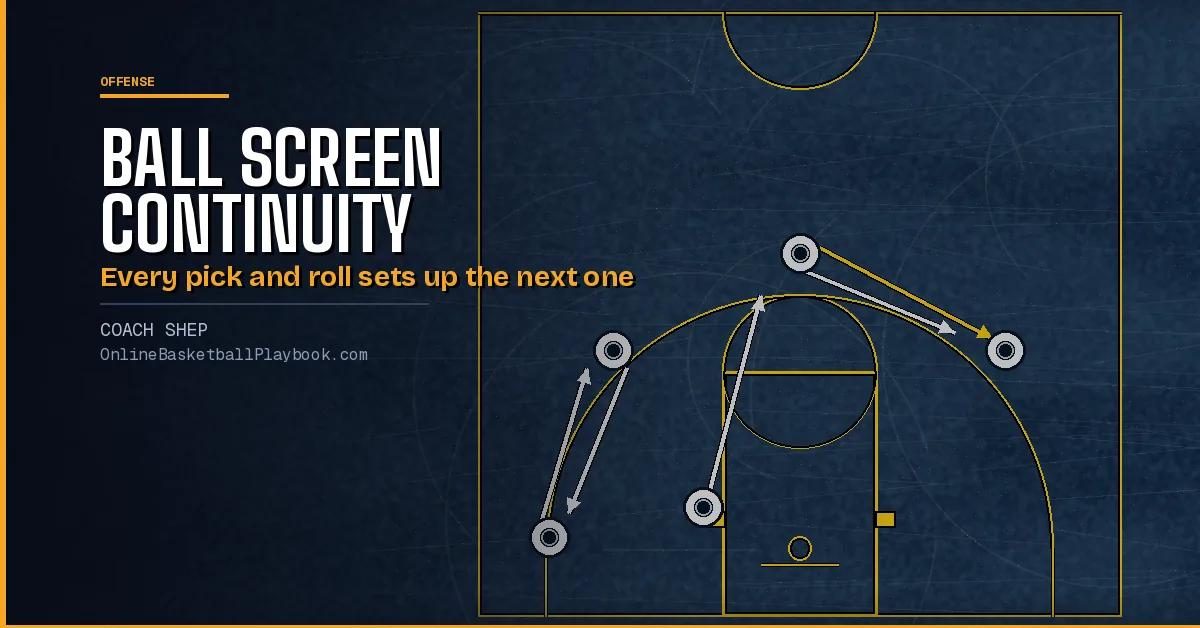
Ball Screen Continuity Offense: Pick and Roll Rules and Reads
Ball screen continuity offense in full: the 4-out and two-big engines, reload rules, spacing, angles, reads, counters, Spain, Ram, double drag and zone sets.
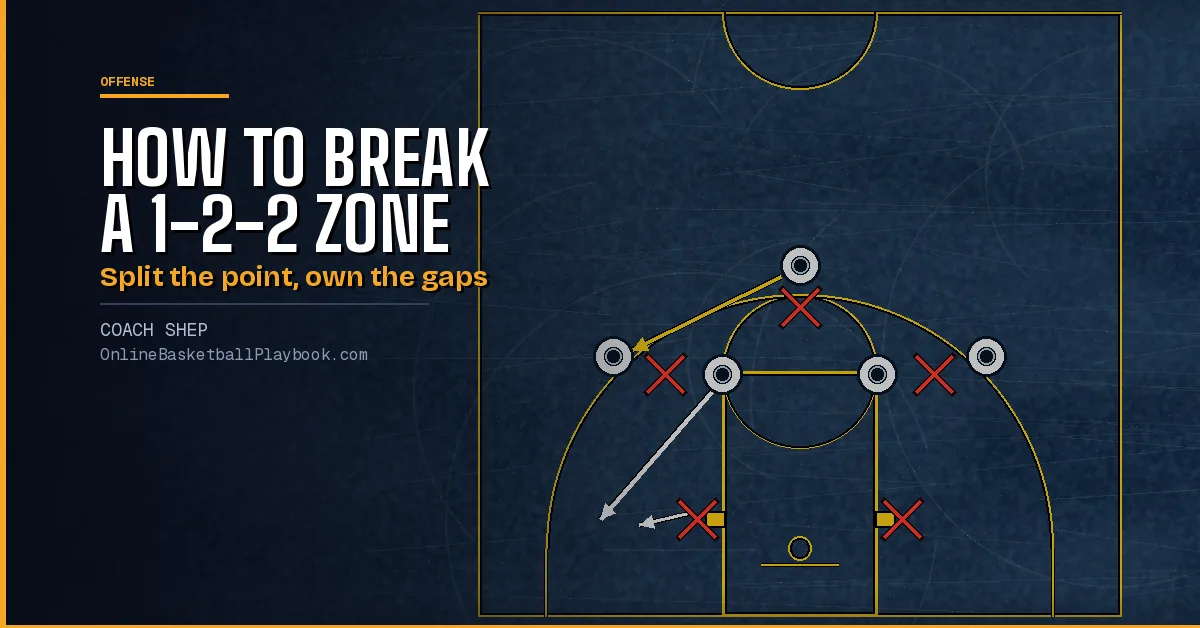
How to Break a 1-2-2 Zone Defense in Basketball: Sets and Reads
How to break a 1-2-2 zone defense: split the point defender, attack the middle and the short corners, and run a 1-4 high, 4-out, 1-3-1 or baseline runner offense.
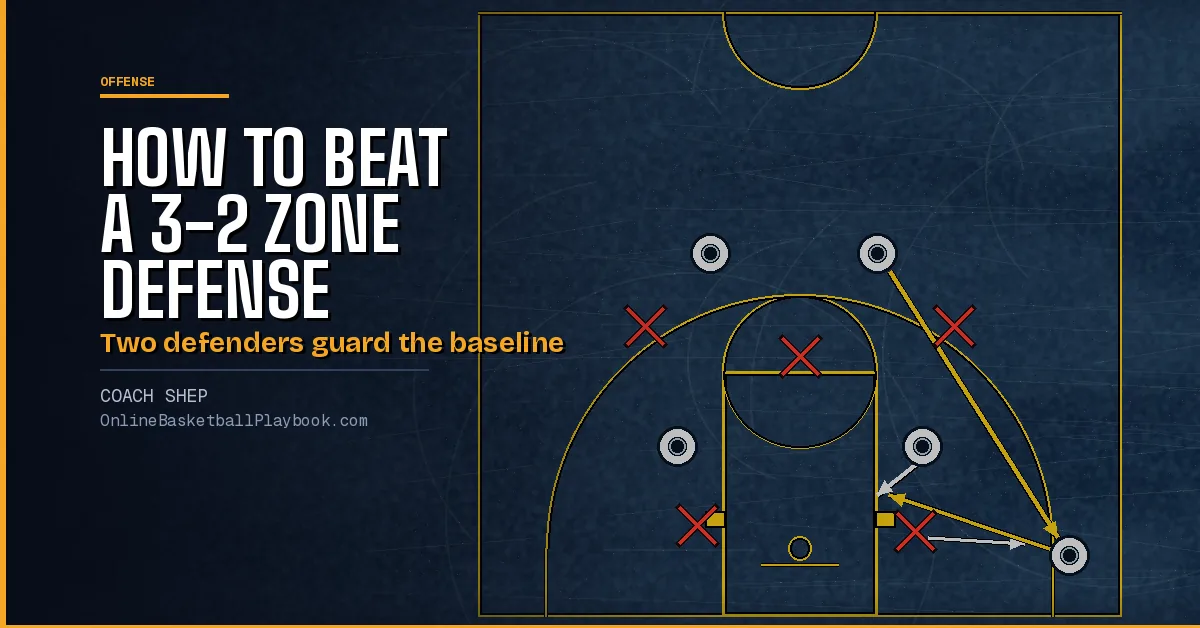
How to Beat a 3-2 Zone Defense: Sets, Screens and Reads
How to beat a 3-2 zone defense in basketball: alignments that split it, corner attacks, inside screens on the back line, the high post, skips, drives and rebounding.