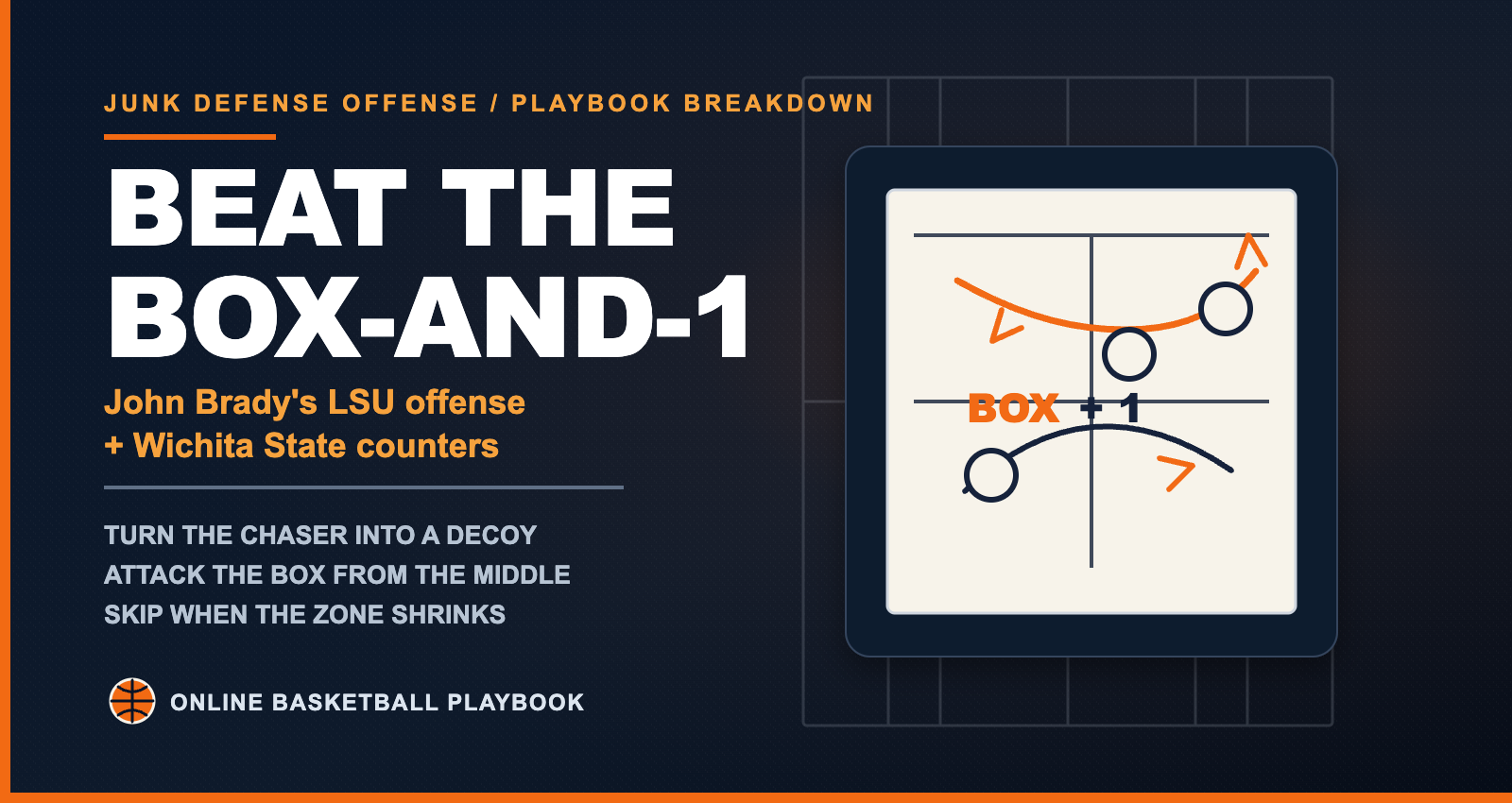
Most teams do not practice against a box-and-1 until it shows up in a game.
And then it's too late. Your best scorer is being chased through every screen by a kid whose only job is to deny him the ball. The other four defenders are sitting in a tight box around the lane, daring your role players to beat them. The offense you've spent six months installing? Useless. Your motion looks like five guys running into each other.
This is why every staff needs a box-and-1 attack in their back pocket. The Wichita State / Marty Gross playbook gives coaches exactly that — an offense John Brady ran at LSU specifically designed to break this junk defense. It's clean, it's simple, and it gives you four ways to score on every possession.
"Offense vs the Box and 1 (John Brady ran this at LSU)."
This guide walks through the structure of the offense, the four scoring options it creates, and how to layer it into your practice plan so your team is ready the next time a coach throws a box-and-1 at you in a tournament game.
Why Coaches Run a Box-and-1 (And Why It Works)
A box-and-1 only gets pulled out for one reason: you have a scorer the other team can't guard straight up. It's the ultimate compliment — and the ultimate disruption.
The defense is built on two ideas:
- Take away your best player. One defender chases your scorer through every action, denying the catch.
- Pack the paint. The four zone defenders form a tight box around the lane, eliminating drives and post touches.
It works because most offenses are built around a primary action that involves the star. Take him away, and the other four players don't know what to do. They've never been the option. They freeze, they pass it around the perimeter, the shot clock dies — and now you're forcing a contested 3 with five on the clock.
The mental hurdle: Your four "non-star" players have to believe they're going to get a great shot every possession. The whole offense is designed for them. If they don't trust that, you're cooked before you tip it off.
3 Principles for Attacking a Box-and-1
Before we get into the X's and O's, these are the rules to set before installing a box-and-1 offense. Marty Gross's notes on Page 62 list 12 zone principles — three of them are the foundation for everything in this guide.
1. PUP — Poise Under Pressure
Gross calls it "PUP" in his zone concepts. Don't speed up. The box-and-1 wants you panicked, swinging the ball quickly without purpose. Let the defense settle. Use the whole shot clock if you need to. Every cut and screen has to be set up.
2. Inside-Outside Theory
"Establish offense in the mini-lane/post first." Even with the box packed in, you have to give the bigs touches. A high-post flash or a duck-in changes the math of the box and forces a defender to commit. From there, kick-outs find shooters.
3. Use Your Star as a Decoy
This is the part most coaches miss. If they're chasing your best player with one guy, then your best player is the best screener and best decoy you have on the floor. Move him constantly. Make the chaser work. Use him to screen for shooters — the chaser won't switch and now you've got an advantage four-on-four against the zone behind him.
Tell your star scorer the night before: "Tomorrow, your job is to move so hard that the kid guarding you can't breathe. If you get a shot, great. If you don't, you're the most important player on the floor anyway because your movement is creating shots for everyone else." Their ego has to be in the right place.
John Brady's LSU Box-and-1 Offense
Here's where the Wichita State playbook gets practical. Page 43 labels the package plainly: "Offense vs the Box and 1 (John Brady ran this at LSU)." The source does not waste space on backstory. It gives you the diagrams and the structure. Treat it the same way in practice: a compact answer your team can rehearse before an opponent forces you into it.
The Setup
The base alignment is essentially a 1-2-2 with your star scorer (let's call him 2) starting on a wing, and the offense built around getting him moving while the other four operate against the zone behind. Your best decision-maker (1) initiates from the top. Your two posts (4 and 5) start at the elbows or mid-post to attack the seams of the box.
The Core Action
The basic action runs like this:
- 1 has the ball at the top. Star (2) is on the right wing being face-guarded.
- 4 and 5 set a stagger or cross-screen action for 2 — moving him from wing to opposite wing, or wing to top. The chaser fights through both screens.
- As the chaser navigates the screens, one of the screeners slips into the high post. The box has to decide: does the top defender of the box come up to take the slip, or does he stay home? Either way, somebody is wrong.
- If the box collapses on the slip, the weak-side shooter (3) is wide open on a skip pass.
- If the box stays home, the slip man has a free 15-footer at the elbow.
- If the chaser switches or gets tangled, your star (2) is suddenly free and you flow right into a normal action for him.
That's the beauty of Brady's design — every action has a built-in counter for what the defense does.
The Four Scoring Options
Don't try to memorize a play. Memorize the options. Brady's offense gives you four every trip down the floor:
Option 1: The Slip
The screener who frees your star slips into the heart of the box. This is the quickest hitter and usually the most open look. The top of the box is occupied with the ball, the bottom of the box is worried about post position — the slip splits them right down the middle.
Option 2: The Skip Pass
When the box collapses to take away the slip, the weak-side shooter (3) is wide open. Coach your 1 to look skip-first whenever he sees the box rotate. A skip pass to a set shooter on the wing is the highest-percentage shot a box-and-1 will give up.
Option 3: The Star Gets Free
If your screeners do their job and pin the chaser, your star comes off clean to the top or opposite wing. Now he's catching with momentum against a defender who's recovering. This is your best player getting a touch in space — exactly what the box-and-1 was designed to prevent.
Option 4: Post-Up After the Action
If nothing's there on the first action, the screener who didn't slip can duck-in or seal the back of the box. The defense has been busy chasing the perimeter action — now you have a deep seal at the rim with no help defender ready.
"Establish offense in the mini-lane/post first. Must give big men touches even if it is to reverse/fan the ball."
Wichita State's Counters & Wrinkles
One strength of how Gross compiled this playbook: he didn't just give you the base offense. He gave you counters from elsewhere in the book that apply directly to junk defenses. Steal these.
Counter 1: "Carter" from Page 20
Gross writes: "5 will fade after screening middle of zone. This is a counter to 'Three on a Side' screening the top and bottom of zone and sending a shooter to the corner." Against a box-and-1, the screen-the-middle-and-fade action by your 5 attacks the exact spot where the box is most vulnerable — the seam between the top and bottom defenders. Your 5 fades to a 15-footer at the elbow extended while the action below pulls the bottom of the box away.
Counter 2: "41 Iso" from Page 5
"4 screens the outside of the zone for 2." This is gold against a box-and-1 because it lets your non-star shooter (2 in this scheme — but it works for whichever player is open) get a clean look on the outside of the zone. The chaser is glued to your star elsewhere, so the outside screen creates a true 4-on-3 advantage in the screen action.
Counter 3: "Special / Box Split" from Page 50
Gross lists this on Page 50 as a play "vs 1-3-1 Trapping or Zone Defense" — but the box split action works just as well against a box-and-1. You split your two posts to opposite elbows, force the box to either expand (opening the rim) or stay tight (giving up two elbow jumpers). Either way you win.
Don't install all three counters. Pick ONE counter and rep it until your team can run it in their sleep. If you teach Brady's base offense + one counter, you've got more than enough to break any box-and-1 you'll see in a season. Volume of plays is the enemy of execution.
How to Practice This
Step 1: Walkthrough Without Defense (5 minutes)
Have your team walk through Brady's base action and identify all four options out loud as they go. "Slip... skip... star... post-up." Players need to name what they're reading.
Step 2: Air Reps vs Coaches Holding Spots (5 minutes)
Put your assistant coaches in the four box spots. They don't defend — they just stand there. Players run the action and see how the box is positioned. This builds spatial awareness.
Step 3: Live vs Scout Box-and-1 (15 minutes)
Now make your scout team run a real box-and-1. Tell your chaser to actually face-guard. Go live. Score on every possession or run it again. Reward the skip pass — make it the priority shot.
Step 4: Two-Possession Drill (10 minutes)
End every practice the week before a tough opponent with two box-and-1 possessions. Your team has to score on both or run. This builds the habit so when you see it in a game, your players just go execute.
Practice planning rule: If one player carries most of your scoring, expect a box-and-1 before the season ends. Often in a tournament. Often late in a close game. Don't be the coach who installs the counter the morning of.
Get Free Coaching Notes
Join the Online Basketball Playbook newsletter for new playbook breakdowns, drills, and practice-ready install ideas.
Get Free Coaching NotesDraw this play free in the play drawer →
Membership: the full library, playbook packs, and Pro drawing tools →
Final Thoughts
The box-and-1 is one of the few defenses in basketball that's specifically designed to mess with your team. It's personal. And that's exactly why you need a personal answer for it.
John Brady's LSU offense gives you that answer. It's not flashy. It's not complicated. It's four players executing a clear action while your star moves like a decoy — until he isn't, and suddenly he's catching the ball in space because the chaser got hung up on a screen.
Marty Gross kept this play in the Wichita State playbook for a reason: it works at every level. Install the base action this week. Pick one counter from the playbook (Carter, 41 Iso, or Box Split). Rep it until your team owns it. The next time a coach tries to take your best player out of the game, you'll have an answer — and a chance to put 8 quick points on the board before that coach has to call timeout and go back to playing straight-up.
That's how you beat junk defense, coach. Not by panicking. By having a plan.
Keep Building
Related breakdowns
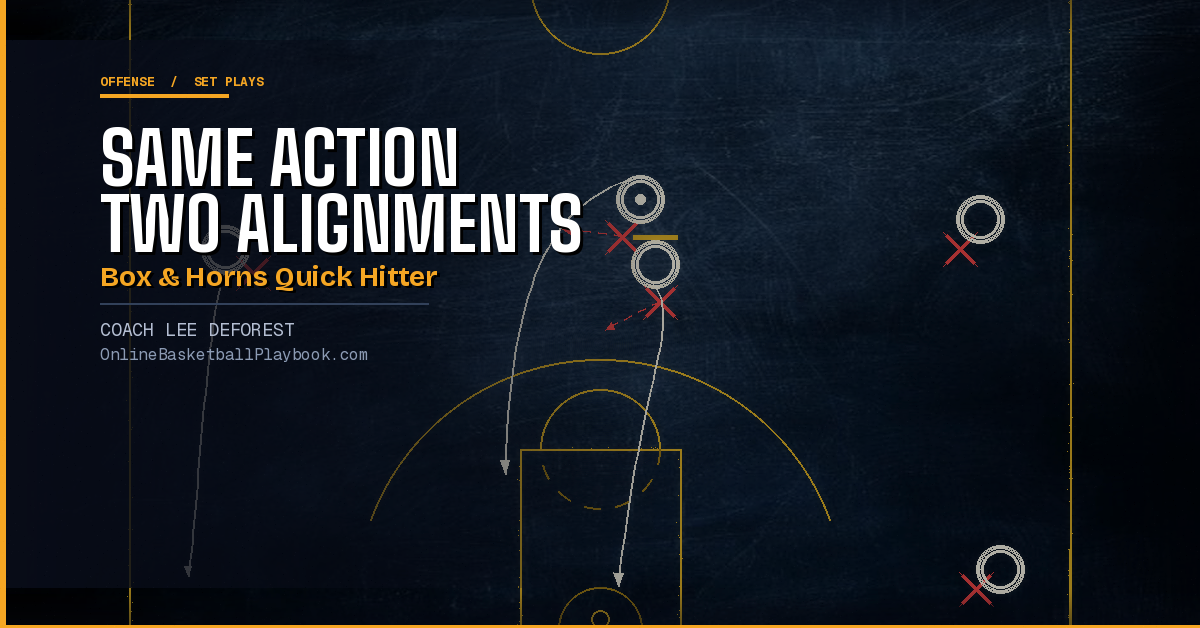
Same Action, Two Alignments: Wichita State's Box / Horns Quick Hit
One of the best teaching moments from Marty Gross's Wichita State playbook is a single page that shows you how to disguise the same action by running it out of two completely different sets.
More from Online Basketball Playbook
Counter Plays for Common Defenses
Set-play counters for the box-and-1 and other junk looks you see every week.
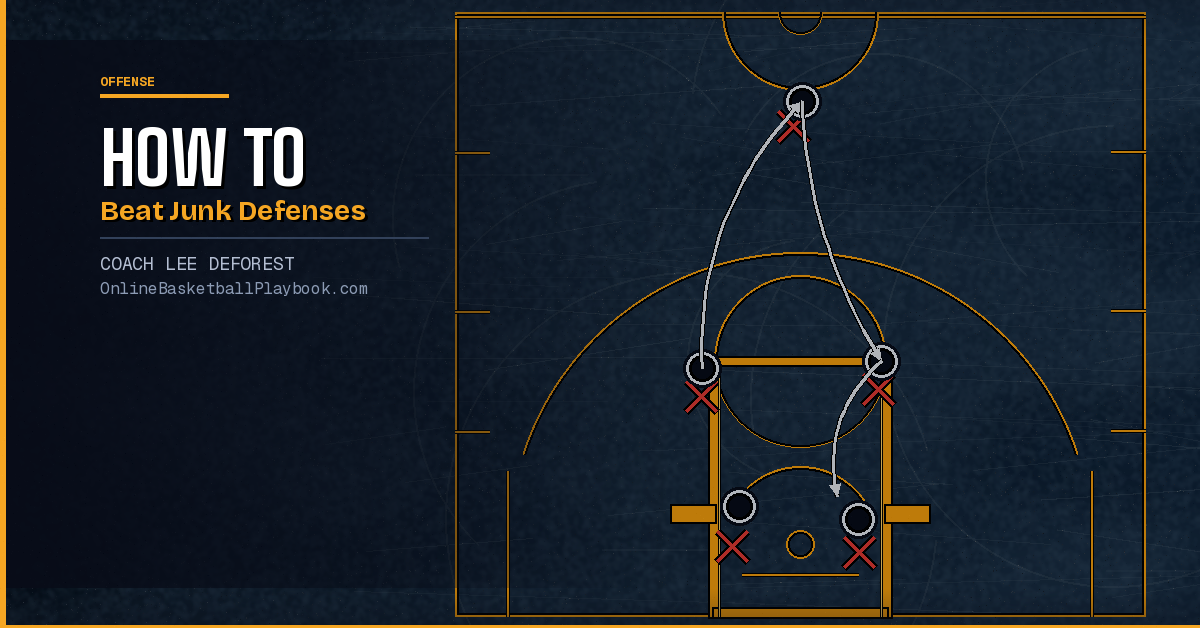
How to Score Against Junk Defenses
Junk defenses are designed to throw you off — here’s the systematic attack.
Taking Advantage of ATOs
After a timeout is the perfect moment to attack the box-and-1 with a set play.