Coaches, here's a problem we've all dealt with: you've got a great quick hit. You run it once and it works. You run it again next time down and the scout has it picked up. Now you've burned a play.
The fix isn't to install ten new plays every week. The fix is to run the same action out of multiple alignments. Different starting picture, same finishing action, same shot.
Page 6 of Marty Gross's Wichita State playbook is a one-line note that sums this up perfectly:
"Run out of a box set or horns set."
That's the entire coaching point. One sentence. And it's the kind of detail that separates coaches who collect plays from coaches who actually run an offense.
Why Run the Same Action From Two Sets
Think about this from the defense's point of view. Your wing defender hears the call, looks at the alignment, and starts cataloging what's coming. If you only ever run a certain back screen / down screen combo out of Box, the moment they see Box they're locked in on the screen — they're top-locking, they're switching early, whatever the scout said.
Now imagine you run the exact same action out of Horns. Same screens, same cuts, same shot. But the defenders' first read is "Horns." They're thinking ball screen, elbow series, slip. By the time the action unfolds, they're a beat late.
The Principle: Defenses scout alignments almost as much as they scout actions. Two alignments → two scouting reports → one play in your playbook. You get the disguise benefit of running two plays while only teaching one action.
The Quick Hit on the Page
Here's the diagram Marty Gross included in the playbook. Notice how compact the page is — just the alignment options and the action.
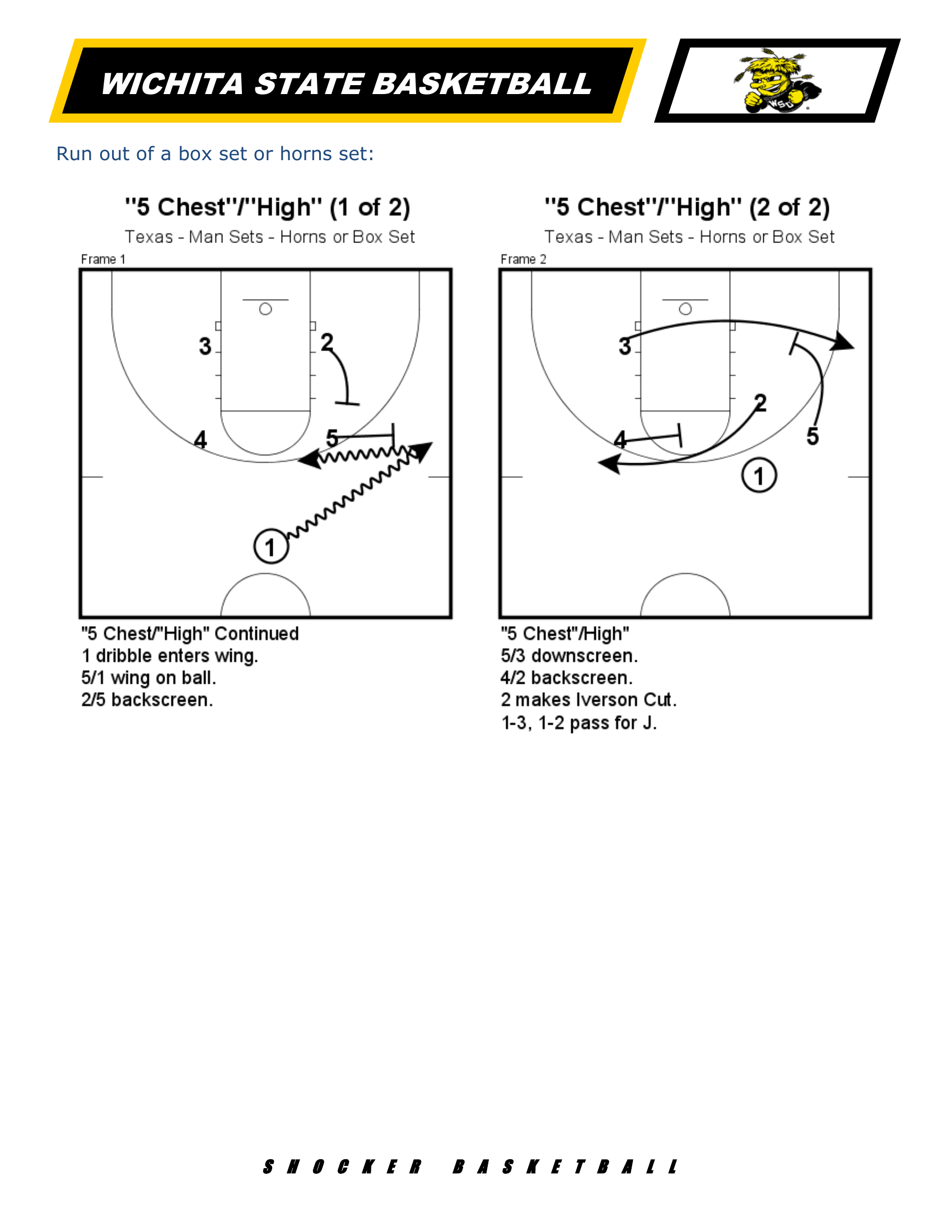
The takeaway here isn't a single specific cut — it's the methodology. Whatever screening action you love, the question this page is asking you is: can you start it from a different place?
Box Set Entry
When we initiate from a Box, here's what the defense sees pre-snap:
- 1 with the ball up top
- 2 and 3 on the elbows (low box) or block (high box)
- 4 and 5 stationed in the other two corners of the box
The Box alignment screams "set play." Defenders know the action is coming. But Box also gives you something Horns doesn't — two players already low, ready to step up into back screens, flares, or cross screens without telegraphing their movement up the floor.
From Box, the most disguising action is a player stepping up to screen. The defender's instinct is to relax when their man is low. The moment that low player sprints up to back-screen the opposite wing, you've got a half-step on the closeout.
Reading the Box Defense
Before you ever call the play, watch how the opponent guards a Box set in the first half. Two questions:
- Do they switch screens involving the two low players?
- Do they tag cutters from the box, or do they trust their on-ball matchups to fight through?
The answers tell you whether to keep this in your back pocket as a Box call or flip it to Horns.
Horns Set Entry
Horns gives you a completely different starting picture:
- 1 at the top of the key
- 4 and 5 at the elbows
- 2 and 3 in the corners
This is where Wichita State lived. Look at how much of Marty Gross's playbook is built around Horns — Spartan, 42, Argentina, Greece, Boca, Siena, Lob Clear, Z Action, Miami Ball Screen, Post Fade. They had a complete menu out of one starting alignment.
When you run the same quick hit from Horns instead of Box, you get three immediate advantages:
- The elbows are pre-loaded. Your screeners are already in screening position 17 feet from the basket — they don't have to travel to set the screen.
- The corners stretch the defense. Two shooters in the corners pull help defenders away from the action.
- Defenders are reading Horns triggers — high ball screen, elbow handoff, twist — not the back-screen action you're actually running.
When you initiate the action out of Horns, have 1 dribble at one elbow to start. This is a Horns staple, so defenders read ball screen. The elbow defender steps up to hedge — and that's exactly when your real action (the back screen or cross screen from the opposite side) springs free.
How to Install This With Your Team
This is the part most coaches mess up. They install the Box version one day and the Horns version a week later, treating them as two separate plays. Don't do that. Install them together so the players understand the action is the play, not the alignment.
Day 1 Install (30 minutes)
- Walk through the action with no defense, from Box. Five reps. Identify the primary shot, the second option, and the safety valve.
- Same action, walk-through from Horns. Five more reps. Players should see — "Oh, this is the same play."
- 5-on-0 at game speed, alternating Box and Horns calls. Coach calls "Box!" or "Horns!" before the ball is brought up.
- 5-on-5 live, 6-8 possessions. Run it both ways. Have your scout team adjust between possessions.
Common Install Mistakes
- Teaching the alignment before the action. Players need to understand what we're trying to get first. The alignment is just the costume.
- Letting Box and Horns finish differently. If the finishing shot is a wing curl in Box and a back-screen lob in Horns, you don't have one play — you have two. Keep the finish identical.
- Skipping the "why" with your players. Tell them: "We're running this both ways because the scout will pick up one alignment but not both." Players who understand the reason execute the detail.
Tagging the Call for Game Use
Once your team has both versions in, you need a clean way to call them. Here's how I'd organize it:
Call structure: Use one word for the action, then the alignment as a tag. Example — if the action is "Curl," you call "Box Curl" or "Horns Curl." The players know what action is coming the moment they hear "Curl." The first word just tells them where to start.
This terminology approach scales. As you add more shared actions, your playbook stays small while your menu of looks grows. Two actions × two alignments = four plays to the defense, two installations to your team.
Get Free Coaching Notes
Join the Online Basketball Playbook newsletter for new playbook breakdowns, drills, and practice-ready install ideas.
Get Free Coaching NotesDraw this play free in the play drawer →
Membership: the full library, playbook packs, and Pro drawing tools →
Final Thoughts
The reason I love this page from the Wichita State playbook is that it's the kind of detail you only get from a coach who's actually run an offense for 162+ possessions a game. Marty Gross isn't saying "here's a play." He's saying "here's how to make your existing plays harder to scout."
Every coach has too many plays and not enough execution. If you can take your three best quick hits and run each one from two different alignments, you've doubled your playbook without adding a single new action. That's not collecting plays — that's coaching offense.
Box or Horns. Same action. Different problem for the scout. That's the whole lesson.
Keep Building
Related breakdowns
How to Beat a Box-and-1: John Brady's LSU Offense + Wichita State's Counters
When a team face-guards your best scorer with four defenders in a zone behind him, you need a plan — not a prayer. Here's the LSU offense Marty Gross kept in his Wichita State playbook for exactly that moment.
More from Online Basketball Playbook
Basketball Pace & Tempo Strategy
Two alignments from the same action lets you control pace while keeping the defense guessing.
How to Teach Basketball Decision-Making
Players need to read which alignment the defense is in — teach the recognition first.
How to Run Productive Basketball Scrimmages
Install both alignments in scrimmage before you run them in games.