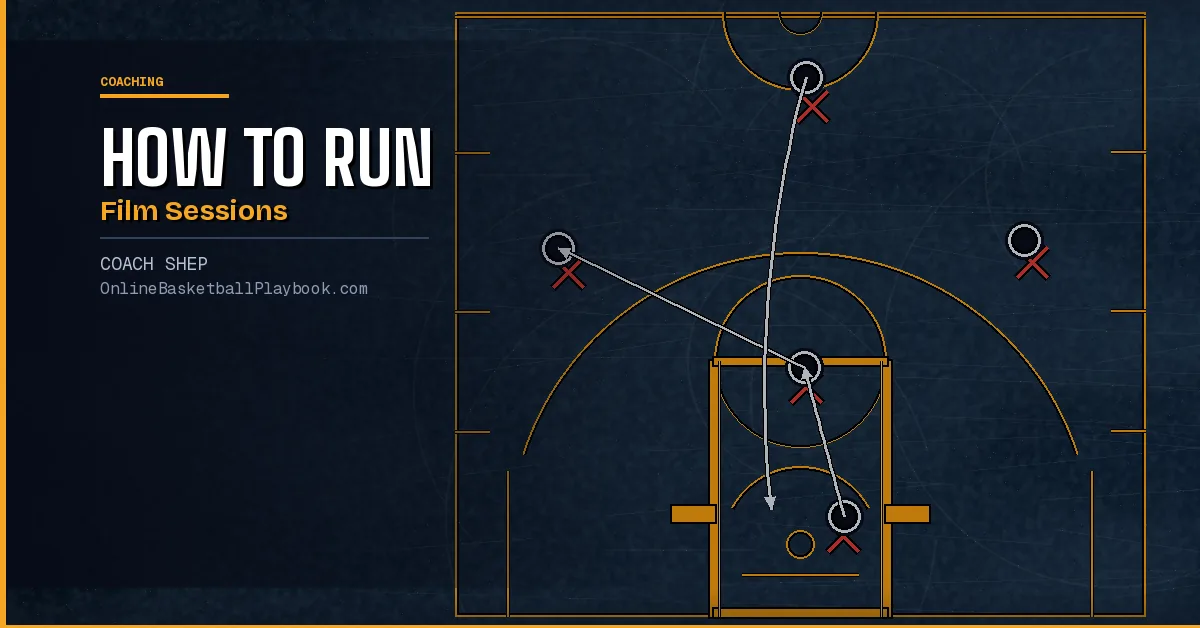
Film sessions are the fastest way to build basketball IQ, but only when coaches run them with purpose. Most players sit through film and forget it by warmups. This guide shows you how to change that.
Why Film Sessions Matter More Than Extra Reps
Coaches often reach for the practice schedule when a team struggles, more reps, more drills, more conditioning. But a player who can't read the game won't fix that problem by running more layup lines. Film is different. It teaches players to see the game at a level that physical repetition alone never reaches.
When a player watches film of a defensive breakdown, they're not just learning what went wrong. They're training their eyes to recognize situations before they happen. They learn the cues (the offensive player's hip angle, the screener's foot position, the ball handler's eyes) that trigger correct decisions at game speed. That's basketball IQ development, and film is its most direct accelerant.
The research on skill acquisition backs this up. Deliberate review of performance (particularly when paired with immediate application) accelerates learning faster than volume alone. Elite programs at every level have known this for decades. The question isn't whether to show film. It's whether you're showing it in a way that actually sticks.
There's also a motivational case for film. Players who watch themselves on video develop sharper self-awareness. A point guard who sees himself turn the ball over on an ill-advised drive is far more likely to self-correct than one who only heard the coach yell from the sideline. Video makes the abstract concrete. It removes the argument. It replaces "you did this wrong" with "look, here's what happened."
Done right, a 20-minute film session can accomplish what two hours of drilling can't because it rewires the mental model, not just the muscle memory. That's where real improvement lives.
How to Prepare Before the Film Session
The quality of a film session is almost entirely determined by the work done before players walk into the room. Coaches who pull up raw game footage five minutes before the session and scroll through looking for moments waste everyone's time. Players disengage. The session drags. Nothing transfers.
Start with a clear objective. What is this session for? You might be reviewing last night's game, scouting an upcoming opponent, or studying a specific defensive concept you've been installing. Whatever the focus, write it down in one sentence before you touch the footage. "Today we're fixing our rotation breakdowns on the weak side in the half-court" is a session. "Let's watch the game" is not.
Next, clip your footage. Don't ask players to sit through 40 minutes of unedited video to find the five possessions that matter. Pre-cut your clips to the 8–12 plays you actually plan to use. Label them by concept or moment: "good rotation," "ball doesn't move," "we gave up a corner three." This prep takes 20–30 minutes but saves twice that in the room, and keeps the session tight.
Have a question prepared for each clip. The difference between passive film watching and active learning is whether players are searching for something specific. "What should number 4 have done when the ball reversed?" puts every player in the problem before you show the answer. Questions first. Answers second.
Set the room. Players slouched in the back row of a dark gym aren't learning. Arrange seating so everyone can see the screen clearly. Keep the lights low enough to see video well but not so dark that players fall asleep. Some coaches use a whiteboard alongside the screen to diagram concepts in real time, a smart habit when you want players to connect video to X's and O's.
Finally, decide on your tone. Film sessions can either build confidence or tear it down. Both have a place, but you should decide in advance which this session calls for. A blowout loss calls for a different energy than a tight win. Show your preparation, not your frustration.
How to Run the Film Session Itself
Open every session with a brief frame. Tell players what they're about to see, what the focus is, and what you want them to look for. Two sentences maximum. "We're looking at our half-court defense from Saturday. I want you to watch where the weak-side help is (or isn't) when the ball gets driven." That's all you need to prime their attention.
Then play your first clip. Let it run to completion before you comment. Players need to see the full action before they can evaluate it. Stopping too early biases their interpretation. Let the play finish, then pause and ask your question.
Call on players by name, not by position. "Marcus, what did you see?" is more engaging than "what did the two-guard do?" It puts individuals on the hook to be watching and thinking. Rotate through different players. Mix your stars with your backups. Everyone should expect to be called.
Use the pause and rewind liberally, but purposefully. Don't freeze-frame every second. Pick the two or three moments in each clip that matter most and focus there. Rewind to show the cause before you show the effect. "Let's back up 10 seconds and look at where the help rotates before the drive starts. Now watch what happens." Teaching cause-and-effect is the most important structural move in a film session.
Keep your teaching tight. Two or three points per clip, maximum. If you cover more than that, players stop retaining. Pick your priority. Say it clearly. Move on. The best film sessions feel compressed (like every minute mattered) because the coach edited ruthlessly both before the session and during it.
End with a teaching moment that points forward. The last clip or the last minute of the session should answer the question: "what do we do differently?" Not a vague call to improve, a specific, actionable behavior. "When the ball drives baseline, the weak-side forward drops to the lane line. Every time. Let's say it together." Verbal reinforcement of the correction increases retention. So does immediate practice. If you have floor time after film, rep the corrected behavior the same day.
What to Cover: Offense, Defense, and Situations
The most effective film sessions are thematic. They don't bounce between offensive plays, defensive rotations, and out-of-bounds situations in random order. Pick a lane and go deep. Mixing too many themes in one session dilutes attention and makes it hard for players to connect insights into a coherent picture.
On the defensive side, film is most valuable for fixing help defense, rotation habits, and closeout technique. These are team behaviors. They break down when one player is out of position, and they're nearly impossible to correct without video evidence. When you can freeze the frame and show a player exactly where they were standing when the shot went up, the argument ends. Work through your help defense principles clip by clip, and players begin to see the system as a whole rather than as a list of rules.
On offense, film reveals spacing problems, ball movement habits, and shot selection patterns that coaches often feel during games but can't pinpoint precisely. Does your motion offense stall because players aren't reading the defense? Are cutters timing their cuts before the ball arrives? Film shows it. Overlay the play diagram with the actual footage and the gap between what you drew and what happened becomes visible instantly.
Special situations deserve their own film sessions. End-of-game scenarios, press breaks, inbound plays, and free-throw alignments are areas where preparation beats athleticism. Most opponents under-prepare them. Coaches who deliberately install and review these moments in film sessions build a situational edge that pays off in close games. Save a handful of fourth-quarter clips from key games (moments where your execution was sharp or fell apart) and use them to build situational awareness over the course of a season.
Opponent scouting film is a separate category. Keep scouting sessions shorter than review sessions, 15 minutes max. Show your players three or four tendencies, not fifteen. "Their point guard always goes right off the pick and roll. Their five sets a hard flat screen. Watch." More than that and it becomes noise. Less is more when preparing players to see something specific.
Keeping Players Engaged and Accountable
Every coach knows the feeling: you've queued up a great clip, the point is obvious, and half the room is staring at the ceiling. Player disengagement is the most common film session failure mode, and it's almost always a coaching problem, not an attention-span problem.
The fix starts with structure. Sessions longer than 25 minutes routinely lose players. Build your sessions to end before attention drops, not after. Twenty focused minutes beats forty wandering ones every time. When the session ends and players are still engaged, you've done it right. When they check out at minute 18, you went two minutes too long.
Build in prediction before each clip. "Before I show you this possession, tell me: where does our help have to come from when the corner threatens?" Force the guess. Then show the clip. The gap between what players predicted and what actually happened is where learning lives. It makes them active participants rather than passive viewers.
Positive film matters as much as correction film. Show great plays. Call out a defender who made the right rotation. Highlight a guard who made the correct read off the player development work you've been doing. Recognition on film lands differently than verbal praise. Players replay it mentally. It sets the standard visually. This is what it looks like when we do it right.
Create a film accountability culture over time. This doesn't happen in one session. It builds when players start self-scouting (when they voluntarily watch their own clips, ask coaches for footage of specific matchups, or notice patterns in opponents before they're coached on it). That culture starts with the coach showing up prepared, treating film as a serious investment, and modeling the attentiveness you want players to develop.
Common Film Session Mistakes to Avoid
Even well-intentioned film sessions fail when coaches fall into predictable traps. Recognizing these patterns is the first step to fixing them.
The most damaging mistake is using film to punish rather than to teach. When film sessions become public humiliation (where coaches freeze-frame a player's worst moment and linger there), players begin to dread them. The emotional association with film turns negative. Players stop watching clearly because they're bracing for attack. Criticism on film should be clear and quick. The frame should shift to the correction immediately. What happened, why it happened, and what to do instead. That's the whole arc of a correction clip.
The second mistake is showing too much. Coaches who feel pressure to justify the film session with volume end up covering 30 possessions in 40 minutes. Players can't absorb that. Eight clips with real depth beat thirty clips with a quick comment on each. Trust the curation. Show less. Teach more.
Third: skipping the forward link. Every film session should end with a bridge to practice or to the next game. What are you going to drill today based on what you saw? What specific adjustment should players be thinking about? Without that bridge, film stays abstract. With it, the correction becomes a commitment.
Fourth: inconsistency. Teams that watch film twice a season don't develop film literacy. Teams that watch film consistently (even briefly, even after wins) develop players who think differently about the game. The habit compounds. Schedule it. Make it part of your basketball practice plan the same way you schedule skill work.
Finally, don't neglect the individual film conversation. Group sessions build collective awareness. Individual film meetings build personal ownership. A five-minute one-on-one clip review with a player ("here's what I want you to see about your reads off the ball screen") can do more for that player's development than three group sessions. Find the time, especially for players who need the most growth.
Before every film session: write your single-sentence objective, clip your 8–12 plays in advance, prepare at least one question per clip, arrange seating for clear sightlines, and decide whether this is a correction session, a confidence session, or a scouting session, then stay in that lane.
- Cap the session at 20–25 minutes, end while players are still locked in, not after they've checked out
- Ask a prediction question before each clip so players are searching, not just watching
- Show positive clips alongside correction clips. Model what right looks like, not just what wrong looks like
- Use pause and rewind to show cause before effect. Trace the breakdown back to its origin, not just its result
- Close every session with one specific, actionable correction players can carry into the next practice or game
- Schedule individual film reviews for key players. Personal accountability drives faster growth than group sessions alone
Get free play diagrams, drills, and coaching guides delivered weekly.
Draw this play free in the play drawer →
Membership: the full library, playbook packs, and Pro drawing tools →
Keep Building
Related breakdowns
Basketball Tryouts: Sessions, Drills, Scoring and Cuts
A coach's guide to basketball tryouts, with session plans, drills and scrimmages, evaluation forms, what to look for, and how to tell players the decision.
Self Scouting in Basketball: Film Your Own Team
Self scouting in basketball: how much prep goes to your own team, what to chart on your own film, the numbers that matter and what an opponent will steal.
How to Become a Basketball Coach: Paths, First Jobs and Steps
How to become a basketball coach: where coaches start, youth, school, club and college paths, entry jobs, coaching education, networks and mentors.