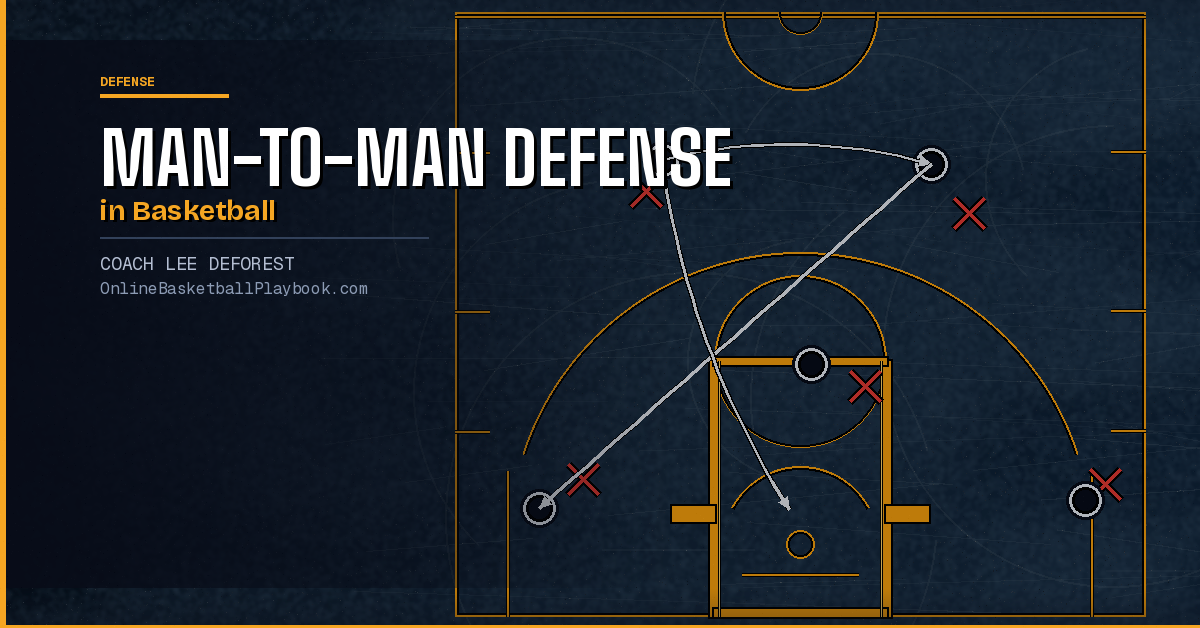

Man-to-man defense assigns each defender a specific player, but the real structure comes from the ball-you-man line — positioning every defender relative to the ball, not just their opponent. Master this and your team competes on every possession.
The Ball-You-Man Fundamentals
The phrase "man-to-man" makes it sound simple — you take your man, I take mine. But the system is far more nuanced. The organizing principle is the ball-you-man line: draw an imaginary line from the ball to your player, and position yourself on that line, slightly toward the ball. Your position on that line shifts constantly as the ball moves. Off-ball defenders are never simply "standing next to their man" — they are reading the ball and adjusting in real time.
This distinction matters more than almost anything else you can teach. Defenders who only think about their man get beaten by back cuts, skip passes, and quick reversal offense. Defenders who think ball-first and use the ball-you-man line make the entire defense function as a connected unit. The farther your man is from the ball, the farther you can sag off of them — staying closer to the paint, available to help, while still tracking your assignment.
One-pass-away defenders operate in what coaches often call a flat triangle: you see your man, you see the ball, and your body position keeps both in your peripheral vision simultaneously. This allows you to deny the direct pass while remaining ready to help if the ball handler beats someone. Two passes away, you sink even deeper — near the elbow or paint — because your man cannot receive a direct pass without the ball traveling twice, giving you time to recover.
Teaching this spatial awareness is the foundation. Players who understand where they should be before contact happens will make every other aspect of your defense easier — rotations, help, and closeouts all flow from sound positioning. Use the shell drill to build this positional instinct with live reps before adding offensive pressure.
On-Ball Defense and Pressure
On-ball defense is the most visible part of man-to-man, and it shapes how everything else in your scheme functions. The goal is to apply pressure on the ball handler without fouling and without getting beaten off the dribble in a way that collapses your help structure. "Guard Your Yard" is the mental cue: you own the space around the ball handler, and you are responsible for making them go where you want them to go — not where they want to go.
Start with stance. Feet wider than shoulder width, knees bent, weight slightly forward on the balls of your feet — never your heels. Active hands are low and to the sides, not reaching across the body. Reaching is the single most common on-ball foul, and it comes from overcommitting to a steal. Teach your players that their job is to influence the dribbler, not lunge for the ball.
Force the ball handler toward the sideline or baseline, away from the middle of the floor. "No middle" is a phrase used across all levels of the game — penetration into the heart of the defense is the most dangerous play an offense can make because it puts your entire help structure under pressure simultaneously. Sideline and baseline drives are more manageable because they limit angles and compress the attack.
The moment the dribble is picked up, the defensive posture changes. Belly up — close the gap aggressively, crowd the ball handler's space, and force a difficult pass. This is where the Zig-Zag drill ("nose on the ball") earns its keep. When a player learns to keep their nose on the basketball during live dribble, closing out on a dead ball becomes natural. Make sure your defenders understand the difference between pre-dribble (contain and influence), live dribble (stay in front, channel), and dead ball (belly up, deny the easy pass).
"On-ball pressure without fouling — force the dribbler outside; stay between man and basket — 'Guard Your Yard.'"
— Basketball Vault
Help Defense and Rotation
No man-to-man defense survives on individual effort alone. The help structure — where off-ball defenders position themselves and how they rotate when a teammate gets beaten — determines whether you give up easy baskets or make the offense work for everything.
The most important movement in man-to-man help defense is the jump to the ball. When a pass leaves a passer's hands, every off-ball defender should reposition during the ball's flight — not after the catch. This is what eliminates basket cuts. If defenders wait until the ball is caught to adjust, an offensive player cutting hard behind them will be wide open by the time anyone reacts. Learn to move on air time and the entire defense tightens up immediately.
Help positioning follows a few clean rules. Guards help guards, bigs stay home. This principle keeps your matchup structure intact and prevents the most damaging switches — a big sliding out to guard a perimeter player leaves the paint exposed, and a guard dropping into post coverage usually gives up a size or strength advantage. Weak-side defenders take a "skinny" stance — feet narrow, body angled to the rim-to-rim line — ready to rotate on a drive while still tracking their man.
When a drive does happen, the nearest help defender steps up to take the charge or force a redirect pass. The next defender rotates to cover the open player created by that help, and the back-side defender sinks to protect the paint. This rotation is not spontaneous — it requires practice. That is why help defense principles need to be drilled in isolation before they appear in a real game situation.
Strong help rotations also link directly to rebounding. When a shot goes up, every defender must box out their man immediately. Man-to-man schemes that practice help rotations regularly tend to rebound well, because the players are already trained to find their man spatially rather than just watching the ball. Connecting defensive rotations to box-out discipline reinforces both habits at once.
Shell Drill: Building the System
The shell drill is the most widely used man-to-man teaching tool in basketball, and for good reason — it isolates every positioning concept in a controlled environment before you ask players to execute it under pressure. If you are installing man-to-man defense with a new team, the shell drill should appear in nearly every early practice.
The basic setup is four offensive players placed at the four perimeter spots (two wings, two corners or guards) with four defenders. No dribbling, no cutting — the offense just passes while defenders adjust their positioning in real time. Coaches use this to check ball-you-man alignment, flat triangle positioning one pass away, and two-pass-away sag depth. Because there is no live action, you can freeze the drill instantly and correct every defender simultaneously.
Once the basics are established, you add one element at a time: live dribble penetration, basket cuts, skip passes. Each addition tests whether the positioning principles hold under a new type of pressure. The shell drill works precisely because it builds the system from the ground up, not from the top down. Players understand why they are in each position before they are asked to execute it with a live offense attacking them.
Incorporate the shell drill into your basketball practice plan at least twice per week during your defensive installation phase. Even experienced teams benefit from returning to shell drill reps when the defense breaks down — usually, the problem traces back to a basic positioning error that the drill will expose within minutes. A 10-minute shell drill at the start of a practice session is one of the highest-leverage uses of your available time.
Run your shell drill without dribbling first, then add one live dribble, then allow cuts. Each constraint you remove adds a layer of realism while letting you isolate the skill you are actually teaching that day. Rushing to full live defense before positioning is sound builds bad habits that are hard to correct later.
Defending the Pick and Roll
The pick and roll is the most common action in modern basketball at every level. Any man-to-man scheme that does not have a defined answer for the pick and roll will be attacked relentlessly. The good news is that the answers are manageable — what varies is which one fits your personnel and your defensive identity.
The most common approaches are going over the screen, going under, switching, and hedging (also called showing). Going over the screen keeps the ball handler in front of the on-ball defender and denies them the open catch-and-shoot. Going under concedes the perimeter shot — acceptable against non-shooters, but exploitable against players who can knock down threes. Switching eliminates the coverage gap entirely but can create mismatches if a guard ends up on a big or vice versa.
Hedging — where the big defender steps out aggressively to slow the ball handler while the on-ball defender recovers — requires significant athleticism and communication. The big must "show" early enough to flatten the drive, then recover to the roll man before a lob pass arrives. It looks spectacular when it works and catastrophic when it doesn't. Most youth and high school teams are better served by a simpler rule — go over everything and communicate every screen — until the personnel justifies something more complex.
Regardless of which coverage you choose, communication is non-negotiable. The on-ball defender must hear "screen left" or "screen right" before the screen arrives. Without that call, the on-ball defender has to find the screen visually while tracking the ball handler — a nearly impossible task at game speed. Build the habit of calling screens in every drill, every scrimmage, every game. For a deep dive, the guide on defending the pick and roll covers every coverage option in detail.
Defensive Identity and Effort Standards
Man-to-man defense is as much a mindset as it is a system. The technical principles — ball-you-man, jump to the ball, no middle — are learnable. What separates teams that execute them consistently is whether those principles are backed by a clear defensive identity that players believe in and hold each other accountable to.
Defensive identity starts with the non-negotiables your staff defines and enforces every single day. Some programs pressure the ball full court; others pick it up at half court to force longer possessions and harder passes. Some deny one pass away aggressively; others sag into the paint and pack the lane. Neither approach is universally correct — what matters is that your players know which one you are running, why it works, and what the standard looks like on every possession.
Frank Martin and Ken Ammann have both articulated versions of a disruptive man-to-man identity that never needs to trap: pick up the ball handler farther from the basket to force passes to happen away from the rim, keep your butt down and hands up to make passes higher and slower, and never put your hands on the ball handler ("pressure defense doesn't foul — players fouling foul"). This approach builds defensive effort into the fabric of the scheme rather than treating hustle as a personality trait some players have and others don't.
The connection between man-to-man defense and transition is also critical. Great man-to-man teams get back early because they are trained to find their man immediately after a shot — and that same instinct carries into transition defense when a possession ends in a turnover or missed shot. Linking defensive concepts across contexts builds more complete defenders and a more connected team.
Finally, hold the standard in practice with the same language you use in games. If "no middle" is a game rule, call it in every shell drill rep. If communication is expected every time a screen is set, enforce it in every 3-on-3 drill. Culture is built in the repetitions, not in the speeches. Players who are accountable to each other on defense every day in practice will carry those standards onto the floor when it counts. Building that accountability is part of building basketball team culture — and defense is the fastest place to establish it.
- Ball-you-man first: every off-ball defender positions on the line between the ball and their man, not next to their man
- Move on air time: reposition the instant a pass leaves — this eliminates basket cuts and tightens the entire defense
- No middle: channel the ball handler to the sideline or baseline on every live dribble; never concede the center lane
- Belly up on dead ball: crowd the ball handler the moment the dribble is picked up to force a difficult, slow pass
- Guards help guards, bigs stay home: keep your rotation structure clean so a switch never puts the wrong body type in the wrong spot
- Call every screen: verbal communication ("screen left / screen right") must be a habit built in every drill before it appears in games
- Shell drill twice a week: isolate ball-you-man alignment, flat triangle spacing, and help depth before adding live pressure
Get free play diagrams, drills, and coaching guides delivered weekly.
Keep Building
Related breakdowns
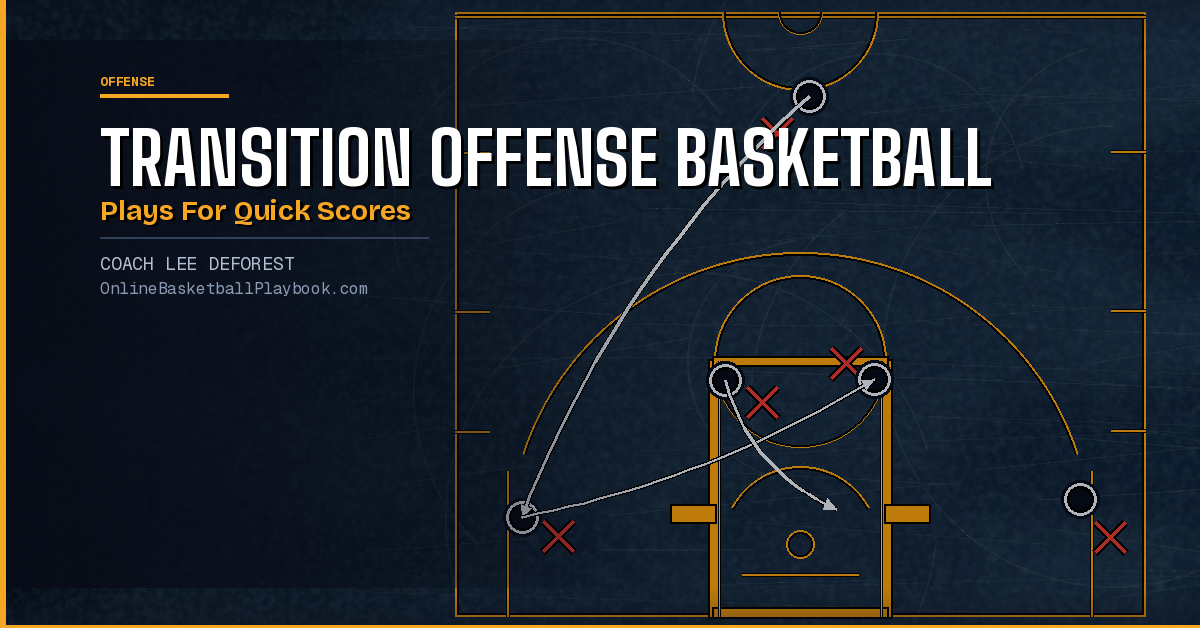
Transition Offense Basketball Plays for Quick Scores
Transition Offense Basketball Plays for Quick Scores