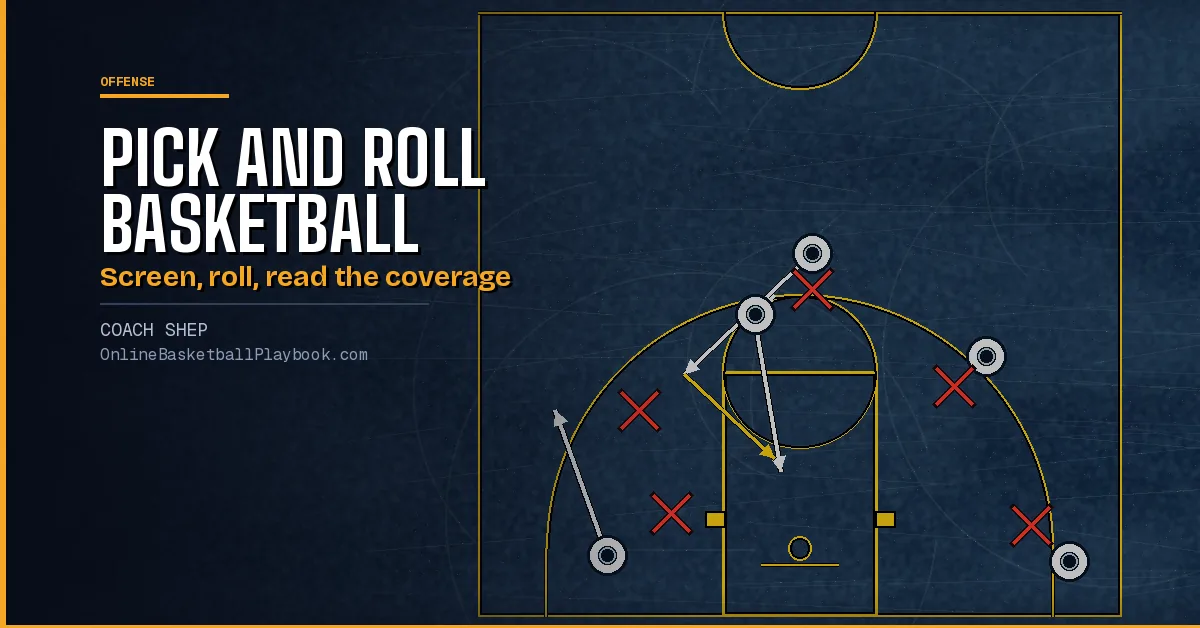
Pick and roll basketball starts with one player setting a screen on the defender who guards the ball handler. The handler uses the screen to attack. The screener then rolls to the rim or pops out to shoot. Two offensive players force two defenders to make a choice, and the offense reads that choice. This guide covers the screen and its angle, the handler's job, the screener's options, the reads against each coverage, the spacing around the action and the order to teach it in.
The Pick and Roll at a Glance
The short version is below. Every coverage with the handler's and the screener's answers is on pick and roll reads.
| What the defense does | What the offense does |
|---|---|
| Screener's defender hedges too far | Handler splits the two defenders |
| Screener's defender stays attached | Handler attacks the outside hip |
| Handler's defender cheats over early | Handler turns the screen down and goes the other way |
| Hard hedge | Handler backs out, then isolates the switch or posts the mismatch |
| Handler's defender goes under | Handler shoots if no help steps up |
| High hedge from the big | Screener slips to the rim |
| Big drops low | Screener pops for the shot |
| Trap | Handler takes two retreat dribbles and the screener short rolls for a 4-on-3 |
| Switch | Keep the floor spread, then attack the mismatch |
Pick and Roll Basketball: The Screen

The angle is the most overlooked detail. Screen the back hip of the handler's defender with the screener's back turned toward the corner. That angle stops the defender from sliding under. Some coaches teach the same idea as a flat screen across the defender's path. A flat screen gives the handler room to come off, and a screen pointed up and down narrows the path.
The screener also creates his own separation. He should not telegraph the screen. He sprints to it, makes contact and hunts the defender instead of screening air. A ram screen is one way to free him, where a third player screens the screener.
The Handler's Job
The handler creates separation before the screen arrives. A sweep, a jab or an inside-out dribble keeps the defender from locking on and trailing. Then he waits. Impatience causes most illegal screens, because a handler who leaves before the screen is set drags the screener into a moving screen.
He comes off shoulder to shoulder with the screener, at the level of the screen. Coming off high wastes the angle and coming off low hands the defender the baseline. Coaches ask for at least two dribbles off the screen. The extra dribbles pull the help defender toward the ball, so he cannot guard the handler and the pass back to the screener at the same time.
A simple order of reads for young players is below.
- Turn the corner for a layup or a floater.
- Pull up for the jumper if the defender trails or the hedge retreats.
- Hit the pocket pass to the rolling screener if the defense collapses on the drive.
Against a hedge, a good pull-up read also opens the roll, because the hedging big commits to the shooter and leaves the roll lane.

The Screener's Job: Roll, Pop, Slip, Short Roll
The screener makes the second decision. Teach him the cue "screen to a stop, roll to a target." It fixes the two common errors, a screener who keeps moving and a screener who rolls with nowhere to go. He should roll at the moment the handler turns the corner. Too early is a moving screen. Too late lets the defense recover.
Roll. Coaches split on the footwork. Some teach a reverse pivot and a seal of the defender. Others teach an immediate dive. A third group has the big turn his back and sprint for a lob, which frees him faster and makes the help defender guard two threats.
Pop. The pick and pop suits a big who shoots better than he scores at the rim. He turns his shoulders toward the basket while he moves out so he is ready to shoot on the catch. The handler takes several dribbles into the middle first, so the post defender cannot help and also recover to the shot. Against a big who drops low, the pop leaves that defender with a long close-out.

Slip. Against a high hedge the screener slips to the rim before the screen is fully set. He reads the defender's stance and cuts as soon as it shows. The slip also answers a screener's defender who helps early and works well against a trap.

Short roll. Against a trap the handler takes two retreat dribbles away from the pressure. The screener steps one step to the high post and catches the pass. The offense now has four players against three defenders, so the next pass finds an open shooter.

Get the next coaching guide in your inbox
One email when a new guide or diagram set goes up. Free.
Reading the Coverage
The handler reads what the two defenders show. The table near the top of this page lists each answer. Coaches also add a few more.
- Against a quick hedge, attack the outside hip of the post defender, because many post players move sideways poorly.
- Against a defender who goes under, re-screen if the handler is not a shooter.
- Against a switch, keep the floor spread so the defense cannot switch back, then attack the mismatch. Some teams post the smaller defender right away.
- After a failed first screen, the screener can set it again at a better angle. That forces the defense to adjust twice.
The full coverage-by-coverage plan is on pick and roll reads. The defensive side is on How to Defend the Pick and Roll.
Spacing Around the Pick and Roll
Spacing decides how much room the handler and the roller get. Put shooters where help defenders would stand.
- Top screen. One player waits in the short corner and two shooters wait on the opposite side.
- Side screen. Three players wait on the opposite side, one on the wing, one in the corner and one at the weak-side post.
- Corner lift. When the handler uses a wing screen, the corner player on that side lifts into the spot the handler left. The lift is a rule with no decision attached, and it gives the handler a shooter to find.
- Hold the sideline. When two players end up on the same side, one stays in the corner and the high player holds the sideline.
- Weak side. Keep the far players spread so their defenders cannot help.
Only ball screen for a player who can dribble, and pick quick decision makers as the ball screen users. Have every player practice both roles. See What Is Spacing in Basketball for the wider picture.
Teaching Order for Youth Teams
- Start with the screen. Set the angle on the back hip and coach "screen to a stop, roll to a target."
- Run it with no defender, then have a coach guard the action, then give the offense an extra player, then play it live.
- Repeat that same ladder as you add players, from two up to four, before you run it five on five.
- Teach it as a two-player read game before a third player joins.
- Name the reads and call the coverage from the sideline so players learn which read matches which look.
- Play 2-on-2 in a quarter court with every possession starting on a ball screen. No switching and make-it-take-it keeps it competitive.
- Watch for the two common youth errors. The handler uses the screen before it is set, and the screener leaves before the handler turns the corner.
Drills are on Pick and Roll Basketball Drills, Pick and Roll Drills for Guards and Drills to Teach Ball Screen Offense.
Questions Coaches Ask About the Pick and Roll
What is the pick and roll in basketball?
A screener sets a screen on the ball handler's defender, the handler uses it, and the screener rolls to the basket or pops out to shoot.
What is the difference between a pick and roll and a pick and pop?
In the pick and roll the screener goes to the rim. In the pick and pop he steps out to shoot. The pop fits a big who shoots better than he scores inside. See Pick and Pop.
What should the screener do against a high hedge?
Slip to the rim before the screen is set. He reads the defender's stance and cuts as the big jumps out.
How do you beat a trap on the pick and roll?
The handler takes two retreat dribbles away from the pressure and the screener short rolls one step to the high post. The offense then has a 4-on-3.
How do you teach the pick and roll to a young team?
Fix the screen angle first, then teach it with no defense, a coach as the defender, an extra offensive player and finally live 2-on-2.
Why do ball screens get called as fouls?
A moving screen is the usual reason. It happens when the handler leaves before the screen is set or the screener keeps moving. See Basketball Screening Technique.
All offense pages sit under the Offense hub and the Basketball Screens guide. Related pages are What Is a Screen in Basketball, Drills to Teach Ball Screen Defense and Basketball Screening Technique.
Want the printable playbook packs?
OBP Pro members get the premium playbook packs: the zone attack, out of bounds and practice plan PDFs, plus each new pack as it is finished. The membership page lists what is in each one. Or draw your own version free in PlayDraw.
See what OBP Pro includesMore Offense Guides
Back to Basketball Screens and every Offense page.
Keep Building
Related breakdowns
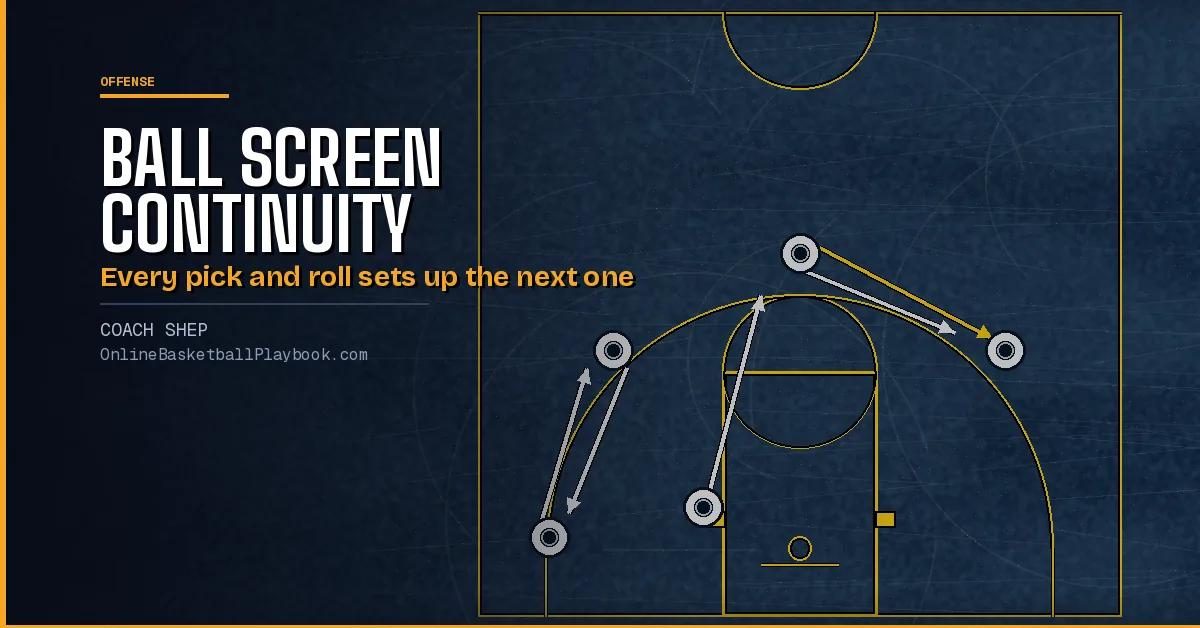
Ball Screen Continuity Offense: Pick and Roll Rules and Reads
Ball screen continuity offense in full: the 4-out and two-big engines, reload rules, spacing, angles, reads, counters, Spain, Ram, double drag and zone sets.
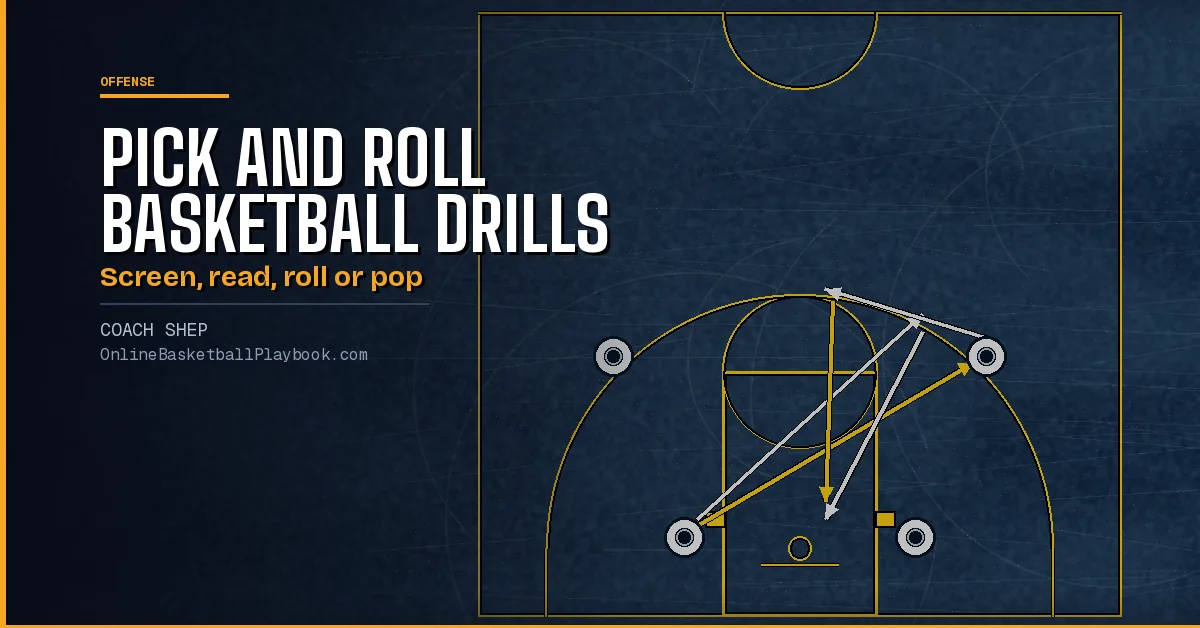
Pick and Roll Basketball Drills: From 2 on 0 to Live Reads
Pick and roll basketball drills that teach the action in order: a 2 on 0 screener series, chair reads, advantage drills, live coverage drills and youth steps.
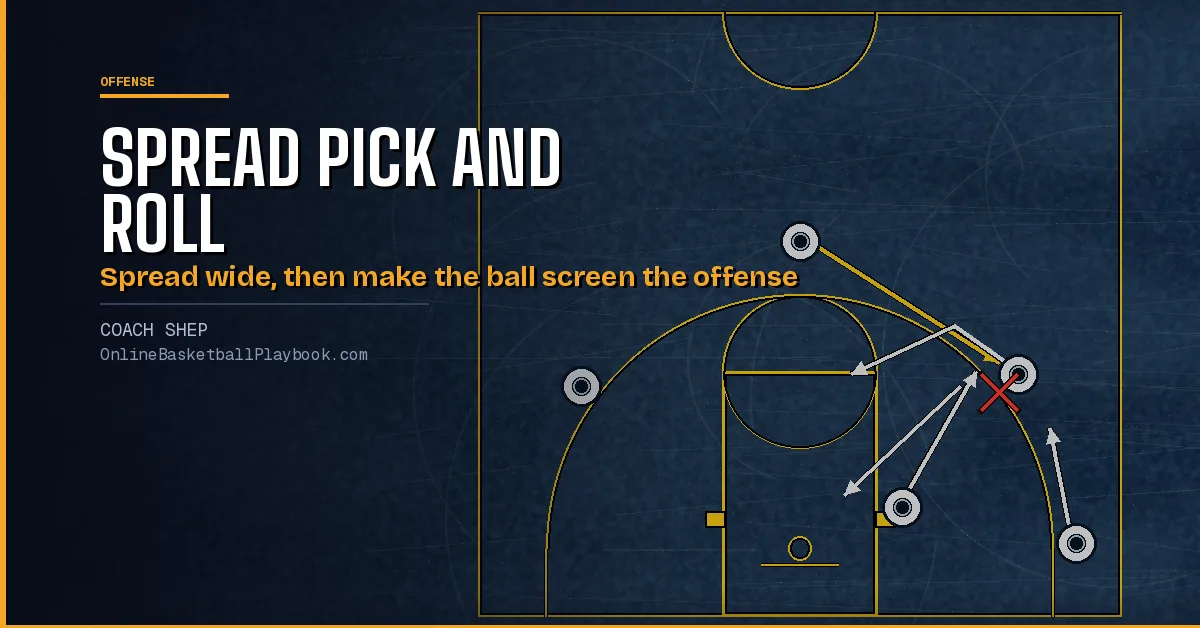
Spread Pick and Roll Offense: Flat Screens, Reads and Counters
Billy Donovan's spread pick and roll offense step by step: the trail pass, the angled wing screen, the second side, the flat screen and the counters.