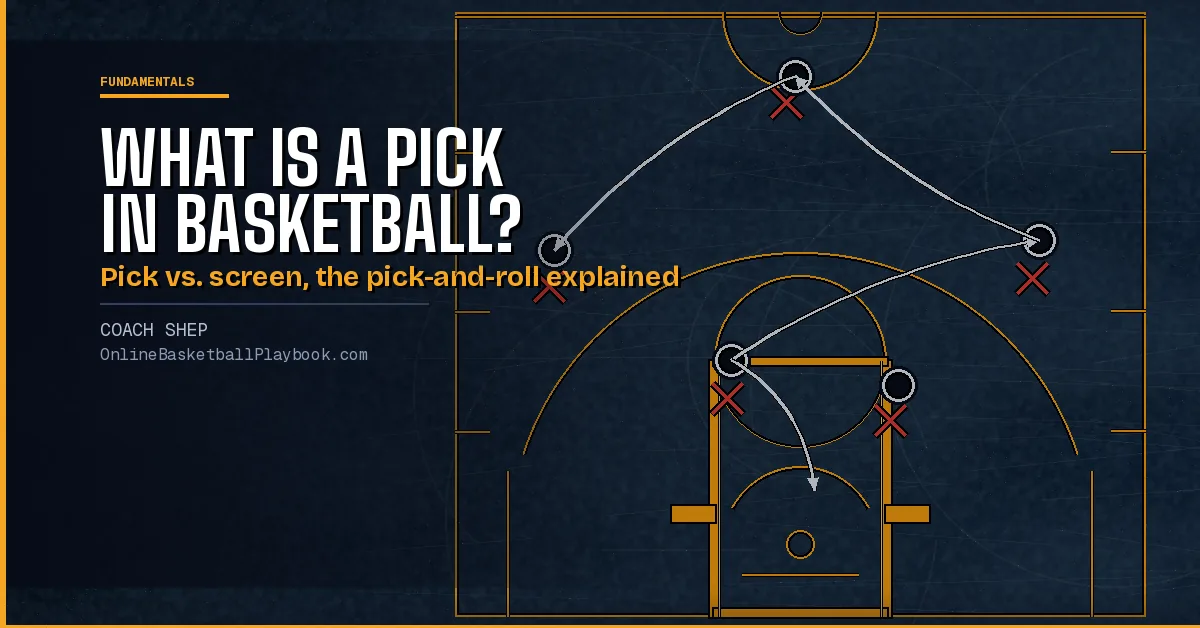
A pick in basketball is the same as a screen: one offensive player stands stationary and uses their body to block a defender, freeing a teammate to catch or drive. The terms are interchangeable. Coaches and players use both.
Pick vs. Screen: What's the Actual Difference?
There is no rule difference. The NFHS rulebook (high school), NCAA rulebook, and NBA rulebook all use the term "screen." The word "pick" is common language. Coaches, broadcasters, and players use it, but it is not an official term in any rulebook.
In general usage:
- Screen tends to be the broader term used for off-ball actions (back screen, down screen, cross screen) as well as ball screens
- Pick tends to refer specifically to an on-ball screen (the action set directly on the ball handler's defender), which is why "pick-and-roll" is the phrase, not "screen-and-roll"
But this is convention, not rule. Many coaches use the terms interchangeably. In practice: pick = screen = the same action.
How a Pick Works
A pick works by creating a body obstruction that the defender cannot go through. Because defenders must go around the screener (either over the top, under, or by switching), the ball handler (or cutter) gains a step of separation that translates into an open shot or drive.
A legal pick requires the screener to be stationary. They cannot move into the defender. They must arrive at their position first, stop completely, and let the defender run into them. The screener absorbs the contact. They do not initiate it.
The five things a screener does on a legal pick:
- Signal the teammate who will use the screen
- Jump-stop into position, one step away from the defender
- Stay completely stationary: feet planted, body neutral
- Pivot and seal the defender after the cutter goes through
- Look immediately for the ball. The screener is often open
What Is the Pick-and-Roll?
The pick-and-roll is the most common two-man action in basketball. The screener sets a pick on the ball handler's defender, then immediately rolls (cuts toward the basket) looking for a pass from the ball handler who just used the screen.
Why it is so effective:
- The defense must make a decision: stay with the ball handler, switch, or hedge. Each choice creates a different opening
- The rolling screener is often the most open player because their defender was just used to block the ball handler's path
- It works at every level, from youth basketball to the NBA, because the geometry of the two decisions it forces cannot be defended perfectly
"How can I get one of my teammates open?" The right attitude frame for every screener, before worrying about technique.
Gary Petrin, AVCS Basketball, Basics of Setting Screens
The roll is what separates the pick-and-roll from a simple pick. After the cutter goes by, the screener pivots toward the basket and sprints for a catch. A screener who sets the pick and stands still is only half of the action. The roll is where the scoring opportunity lives.
Types of Picks Coaches Call
| Term | What it is | Common use |
|---|---|---|
| Ball screen / on-ball pick | Pick set directly on the defender of the ball handler | Pick-and-roll, pick-and-pop, high ball screen |
| Off-ball screen / pick away | Pick set on a defender whose player does not have the ball | Down screen, back screen, flare screen |
| Back pick | Screen set on a player's back, often creating a backdoor cut | Princeton offense, motion offense |
| Cross pick / zipper cut | Pick set horizontally across the lane | Clearing the lane for a post catch |
| Stagger (double pick) | Two screens set in sequence for one cutter | Getting a shooter multiple chances to get open |
When a Pick Becomes Illegal
A pick is illegal when the screener is moving at the moment of contact. The official calls it a moving screen or illegal screen, an offensive foul on the screener, which turns the ball over to the defense.
Three things that make a pick illegal:
- Feet in motion at contact: The most common call. The screener hasn't fully stopped when the defender arrives.
- Extended body parts: Sticking out an elbow, hip, or leg beyond the natural body footprint to widen the block.
- Insufficient space given to a moving defender: Stepping into the path of a defender who is already moving and cannot stop in time.
If the pick is called as a foul on your player but you believe the defender ran into a legally set screen, that's the case. A screener who arrives first AND stops before the defender makes contact has committed no foul. The defender ran into a legal pick. The only question is whether the screener's feet had stopped: if yes, legal; if no, foul.
Teaching the Pick to Young Players
Young players set illegal picks almost always because of one cause: they don't stop. They run to their spot and try to use their body while still in motion. Teaching the jump stop first, before teaching any screen concept, eliminates this immediately.
Progression for beginners:
- Walk through the five screener steps without any defense. Just get the footwork right
- Add the cutter using the screen at half speed, still no defense
- Add a passive defender who walks slowly. Screener must hold stationary while the defender makes contact
- Run at 75% with live defense and a ball. Both screener and cutter make decisions
- Full-speed 2-on-2 pick-and-roll, live. Coach watches only the screener's feet
Don't teach the pick-and-roll play before players can set a legal pick. Every step in the progression above should happen multiple times before moving to the next. Most youth teams skip directly to step 5 and wonder why they collect illegal screen calls all season.
- Pick = screen. Identical action, different vocabulary. Both mean one player using their body to block a defender for a teammate.
- Pick-and-roll: on-ball pick followed immediately by the screener rolling (cutting) to the basket for a pass.
- Legal pick requires stationary feet at the moment of contact. Jump stop into position. Don't jog in.
- Illegal pick = offensive foul (moving screen). Turnover, no free throws for the defense.
- The seal is the hidden step: After the cutter goes by, pivot and face the ball. The screener is often the most open player.
For a complete breakdown of screen mechanics (including how to use a screen as a cutter, the different types of screens, and the five-step teaching progression), see our full guide to screens in basketball.
Get free play diagrams, drills, and coaching guides delivered weekly.
Draw this play free in the play drawer →
Membership: the full library, playbook packs, and Pro drawing tools →
Keep Building
Related breakdowns
Basketball Positions: What Each of the 5 Positions Does
The point guard, shooting guard, small forward, power forward and center, what each one does on offense and defense, and when to ignore the numbers.
High School vs College vs NBA Rules: What Changes for a Coach
High school vs college vs NBA rules: shot clock, three-point line, bonus, fouling out, timeouts, backcourt count and defensive three seconds, and what each changes.