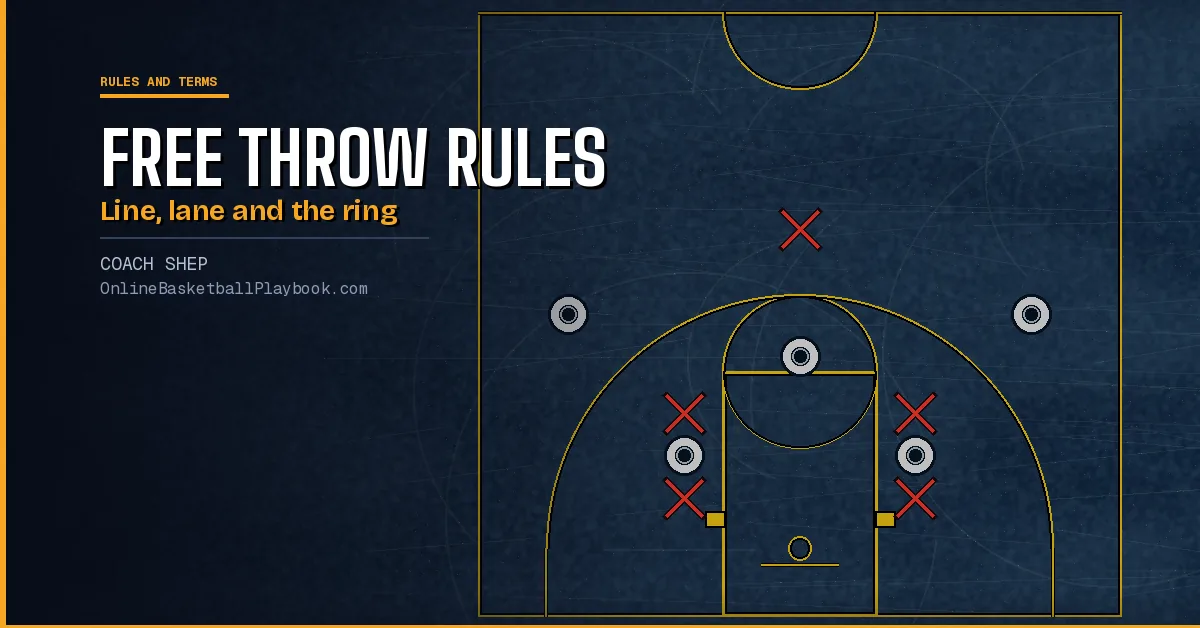
Basketball free throw rules look simple from the stands: one shooter, one line, one point. On the floor there is more to know. The shooter has a time limit, the ball has to touch the ring, up to six players stand in marked lane spaces with rules on when they may move, and a violation means something different depending on which team commits it. This guide sets out each rule at the NFHS, NCAA men, NCAA women, NBA and FIBA levels from the current rulebooks. The current high school book is not free to read, so high school lines that rest on an older edition say so, and you should confirm them with your state association.
Basketball Free Throw Rules at a Glance
| Rule | NFHS | NCAA men and women | NBA | FIBA |
|---|---|---|---|---|
| Time limit | 10 seconds (2017-18 text) | 10 seconds | 10 seconds, from when the shooter controls the ball | 5 seconds |
| The ball must | Enter or touch the ring (2017-18 text) | Enter or touch the ring or flange | Enter or touch the ring | Enter from above or touch the ring |
| Lane players | Two teammates and four opponents (2017-18 text) | Up to six: four opponents, two teammates | Opponents nearest the end line, teammates next, one third space for an opponent | Places held alternately. Count not confirmed here |
| Lane players may move | On the release (since 2014-15) | On the release | On the release | When the ball leaves the shooter's hands |
| Other players may move | When the ball touches the ring (2017-18 text) | When the ball strikes the ring, flange or backboard, or the free throw ends | On the release | When the free throw ends |
| Bonus | 5th team foul per quarter, two shots | Men: 7th foul per half one-and-one, 10th two shots. Women: 5th per quarter, two shots | 5th team foul per period, two shots | 5th team foul per quarter, two shots |
What a Free Throw Is
The NCAA describes a free throw as a privilege to score one point by an unhindered try from within the semicircle and behind the free-throw line. The NBA calls it an unhindered attempt from directly behind the free-throw line, and FIBA an uncontested chance to score one point from behind the line and inside the semicircle. The 2017-18 NFHS text uses the same idea. The shot itself is taught on free throw shooting.
The Time Limit
- NFHS: 10 seconds after the ball is at the shooter's disposal in the 2017-18 text. Confirm the current wording with your state association.
- NCAA men and women: 10 seconds, so the ball enters the basket or touches the ring or flange before the free throw ends. The free throw starts when the ball is at the shooter's disposal.
- NBA: 10 seconds from when the shooter controls the ball, not from when it is placed at his disposal.
- FIBA: 5 seconds after the referee places the ball at the shooter's disposal.
The Try Must Touch the Ring
At every level, the try has to go in or touch the ring. The NCAA books add the flange, and FIBA says the ball must enter from above or touch the ring. A try that touches only the backboard does not meet that requirement, and neither does an air ball. A try that hits the backboard and then the ring, or goes in, has met it.
None of the NCAA, NBA or FIBA books gives the backboard-only case as a worked example, but each one's ring requirement leads to the same result. The 2017-18 NFHS text also requires the ring, and the NFHS confirmed the ring requirement in a 2016 rules story.
Lane Spaces by Level
The players in the marked lane spaces are the ones who rebound a miss. The order of the spaces gives the defense the spots nearest the basket.

- NCAA men and women: at most six players in the lane, four opponents and two teammates. The two spaces closest to the end line stay open. On each side, the first space above the block goes to an opponent, the second to a teammate and the third to an opponent. One player per space, with one foot near the outer edge of the lane line and the other foot in the 3-foot space.
- NBA: opponents fill the spaces nearest the end line and teammates take the next ones. Only one third space may be held by an opponent, never both, and never by a teammate.
- FIBA: the free-throw rebound places, 1 meter deep, are held alternately by the two teams. The number of players per side is shown in a diagram in the rulebook and is not confirmed here.
- NFHS: the 2017-18 text puts two teammates and four opponents on the lane, opponents in the first spaces nearest the basket end, teammates in the second, opponents in the third, one player per space, and lets players move along the lane into a vacant space. Confirm the current setup with your state association.

How coaches use these spaces, with box-out, pinch and offensive rebounding versions, is on free throw alignments.
When Players May Enter the Lane
Lane players and everyone else follow different triggers, and the triggers differ by level.

Players in the lane spaces
- NFHS: since 2014-15, players in the lane spaces may move when the shooter releases the ball. Before that they waited until the ball touched the ring or backboard. Since 2016, they may not enter the semicircle until the ball touches the ring or the free throw ends.
- NCAA men and women: no player may enter or leave a marked lane space until the shooter releases the ball.
- NBA: lane players may not touch the lane line or the floor inside it, or reach over their space in front of an opponent, when the ball is released. They may not move more than 3 feet from the lane line before the release.
- FIBA: players in the rebound places may not enter the restricted area or the neutral zone, or leave their place, until the ball has left the shooter's hands.
Players outside the lane spaces
- NFHS: in the 2017-18 text, they stay behind the free-throw line extended and the three-point line until the ball touches the ring.
- NCAA men and women: they stay behind the free-throw line extended and the three-point line until the ball strikes the ring, flange or backboard, or the free throw ends.
- NBA: they stay behind the three-point line above the free-throw line extended and may not touch the line or the floor inside it when the ball is released.
- FIBA: they stay behind the free-throw line extended and the three-point line until the free throw ends. If more free throws or a throw-in follow, everyone stays behind those lines.
In the NBA, no one may touch the ball before it touches the ring or backboard. If an opponent does, the shooter gets one point and another free throw.
Where the Shooter Stays

- NFHS: in the 2017-18 text, the shooter may not go past the line until the ball touches the ring.
- NCAA men and women: he may not break the vertical plane of the free-throw line with either foot until the ball strikes the ring, flange or backboard, or the free throw ends.
- NBA: he may not cross the plane of the line until the ball touches the ring or the backboard, or the free throw ends. A violation means no point on any attempt.
- FIBA: he may not touch the line or enter the restricted area until the ball has entered the basket or touched the ring.
The NCAA men's list of free-throw violations also includes faking a try and disconcerting the shooter.
Get the next coaching guide in your inbox
One email when a new guide or diagram set goes up. Free.
Lane Violations by the Offense and the Defense
The penalty depends on which team broke the rule first and whether the try went in.
| Level | Violation by the shooter or a teammate | Violation by an opponent only | Both teams |
|---|---|---|---|
| NCAA men and women | Ball dead, no point. After a personal foul, the opponents throw in at the designated spot nearest the violation | A made try counts and the violation is ignored. A miss earns a substitute free throw | Ball dead, no point. In the men's book an alternating-possession throw-in follows unless another free throw or a throw-in comes next |
| NBA | When the throw stays in play: no point, and the opponents inbound at the free-throw line extended | A made try stands. A miss earns a substitute free throw | Jump ball at midcourt |
| FIBA | A made throw does not count if the shooter violated. A teammate's violation on a made throw is ignored. On a missed last throw, a violation by the shooter or a teammate gives the opponents a throw-in from the free-throw line extended | A made throw counts. A missed throw earns a substitute free throw | On the last throw, a jump ball situation |
| NFHS | Ball dead, no point, and the opponents throw in at the nearest spot after a personal foul (2017-18 text) | A made try counts. A miss earns a substitute free throw (2017-18 text) | Ball dead, no point (2017-18 text) |
NCAA women add one difference. After a free throw for a technical or flagrant foul, the ball goes to the shooting team at the division line opposite the table. In the NBA, if the free throw is not one that stays in play, no lane violation can happen except disconcerting the shooter. The full violation list is on basketball violations list.
The Intentional Miss
Late in a game a team down two or three may want the free throw to miss so it can rebound and score. The ring rule still applies to a miss on purpose. The try has to touch the ring. If it misses the ring, it is a violation by the shooter, and the ball goes to the other team.

The lane rules decide who can get to the miss. Lane players may move on the release at the NFHS, NCAA and NBA levels. A player coming from outside the lane must wait behind the free-throw line extended and the three-point line until the ball touches the ring at the NCAA level (or the backboard) and until the free throw ends in FIBA, while in the NBA he may go on the release. The alignments coaches use for the miss are on free throw alignments and last second basketball plays.
The Bonus by Level
The bonus is the team-foul count after which common fouls send the other team to the line.
- NFHS: since 2023-24, two free throws on a common foul starting with a team's fifth foul in each quarter. There is no one-and-one, and team fouls reset at the end of each quarter.
- NCAA women: two free throws for each personal foul except an offensive foul, starting with the fifth team foul in a quarter. No one-and-one. The count resets each quarter.
- NCAA men: the seventh team foul in a half brings a one-and-one, so the second shot comes only if the first is good. The tenth brings two free throws. The count resets at halftime.
- NBA: four team fouls per regulation period, then two free throws on each common foul. Overtime allows three. A team that has not used its four in the first ten minutes of a period may commit one team foul in the last two minutes without the penalty.
- FIBA: a team is in the penalty after four team fouls in a quarter, so the fifth brings two free throws. A foul by the team in control brings a throw-in for the opponents. Overtime fouls count as fourth-quarter fouls.
The fouls that count toward the bonus are on basketball fouls list. To make more of the free throws you earn, see free throw drills. More rules by level are in basketball rules and regulations and under Rules and Terms.
Questions Coaches Ask
Does a free throw have to hit the rim?
Yes. At the NCAA, NBA and FIBA levels, and in the 2017-18 high school text, the try has to go in or touch the ring. A try that hits only the backboard, or an air ball, is a violation.
When can players enter the lane on a free throw?
Players in the lane spaces may move when the shooter releases the ball at the NFHS, NCAA and NBA levels, and when it leaves his hands in FIBA. Players outside the lane spaces wait longer at the NCAA and FIBA levels and in the 2017-18 high school text.
How long do you have to shoot a free throw?
10 seconds in the NCAA and NBA, and in the 2017-18 high school text. 5 seconds in FIBA. The NBA count starts when the shooter controls the ball.
What happens on a lane violation by the defense?
If the free throw goes in, it counts and the violation is ignored. If it misses, the shooter gets another try.
How many players are allowed in the lane on a free throw?
Up to six in the NCAA, four opponents and two teammates, with the two spaces nearest the end line open. The 2017-18 high school text also places four opponents and two teammates.
Can you miss a free throw on purpose?
Yes, but the try still has to touch the ring. A miss of the ring is a violation that hands the ball to the opponents.
Want the printable playbook packs?
OBP Pro members get the premium playbook packs: the zone attack, out of bounds and practice plan PDFs, plus each new pack as it is finished. The membership page lists what is in each one. Or draw your own version free in PlayDraw.
See what OBP Pro includesMore Rules, Terms and Game Guides
- When to Call a Timeout in Basketball: Strategy and Rules
- Basketball Terms: A Glossary for Coaches and Players
- How to Read a Basketball Play Diagram: Symbols and Lines
- Basketball Shot Clock Rules: Length and Resets by Level
Back to Basketball Rules and Regulations and every Rules and Terms page.
Keep Building
Related breakdowns
List of Basketball Violations: Every Violation by Level
A list of basketball violations from the NCAA, NBA and FIBA books with NFHS notes: ball handling, time counts, out of bounds, throw-ins, free throws, goaltending.
Basketball Throw-In Rules: Spot, End Line and Boundary Plane
Basketball throw-in rules by level: the designated spot, the five seconds, the boundary plane and delay warnings, and throw-ins after a made basket or a timeout.
Basketball Shot Clock Rules: Length and Resets by Level
Basketball shot clock rules at the NFHS, NCAA, NBA and FIBA levels: the length, what counts as a try, and when it resets on rebounds, fouls and kicked balls.