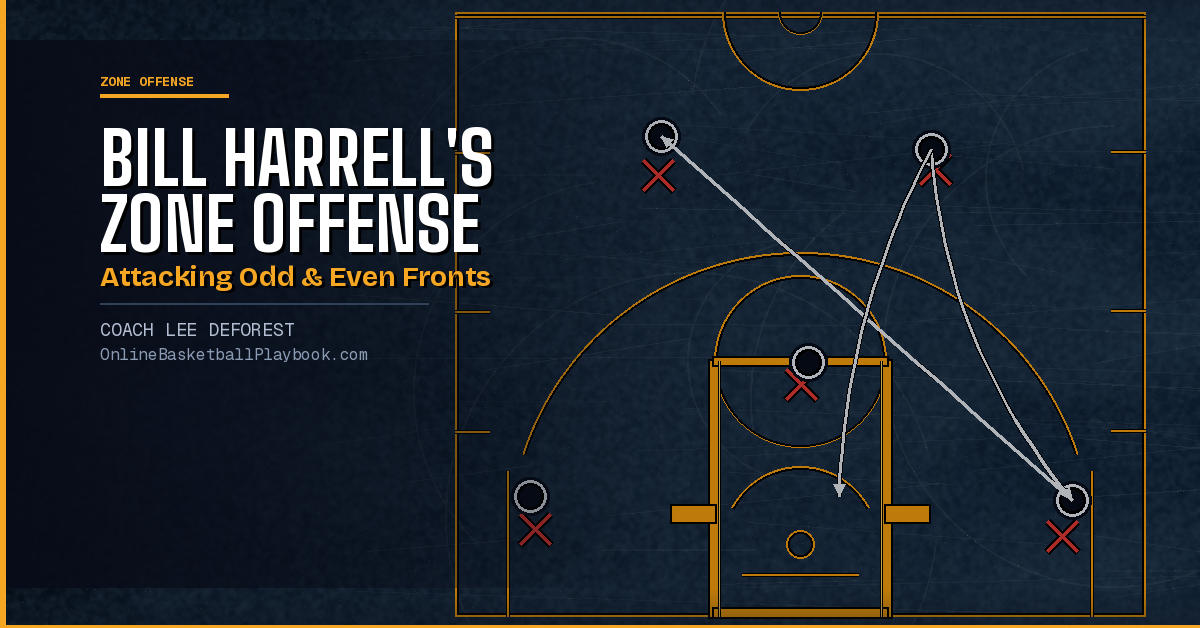
You run a zone offense and the ball goes around the horn, guard to guard to wing and back, but nobody moves. Five defenders slide two steps, the clock bleeds, and you settle for a guarded three.
Bill Harrell's answer is a philosophy, not a single set. He starts by reading the front: is it an even (two-guard) front or an odd (one-guard) front? Then he attacks it with the opposite shape — even sets against odd fronts, odd sets against even fronts — so the gaps line up where the defense is weakest and your players catch in space instead of in traffic.
The thread running through all of it is motion. Harrell isn't looking for one open man; he's moving all five so the zone has to make choices on every pass. When shooters relocate and posts duck in on the same action, the defense can't sit and watch the ball.
All 5 players are moving when ball is passed or dribbled
This breakdown gives you Harrell's core fundamentals for attacking zones, how to read and attack an even front and an odd front, the 1-3-1 series with its wing cuts and popout passes, how to get posts and shooters to their spots, and a Monday practice plan to install the whole thing.
Coach's Cheatsheet
- Use this when: your zone offense swings the ball without moving anyone, and you need a system that attacks the front you actually see instead of running one stale set against every zone.
- Core teaching point: attack odd fronts with even sets and even fronts with odd sets, so your alignment puts a player in every soft gap the front leaves open.
- Read first: count the top — one defender up top is an odd front, two up top is an even front. Your set is chosen by what you count, not by habit.
- Spacing rule: all five move on every pass or dribble; the popout pass and popout dribble relocate your shooters while the 4 and 5 duck to post-up spots.
- Correction cue: "Make the forward guard the wing." If a back-line defender has to step out to a shooter, the inside is now a man short — that's the whole point.
- Practice install: one half-court block, about 25 minutes — read the front, run the matching set, then live to a shot with a "must touch the post once" rule.
The Philosophy: Keep All Five Moving
Harrell's zone offense is built on a handful of fundamentals that travel to any front. The first is the read: attack an odd front with an even set and an even front with an odd set. The mismatch in shape is what creates the gaps — your alignment puts a catcher where the defense has nobody assigned.
The second fundamental is delivery. It isn't enough to have a man open; you have to get him the ball on time, in rhythm, at the spot where he's a threat. Harrell's standard is exact.
Get the ball to the right player at the right position at the right time
The third fundamental is what makes the read pay off: force a forward to guard a wing. When a back-line defender steps out to cover your relocated shooter, the inside is suddenly a man short, and your 4 or 5 is one duck-in away from a layup. The fourth is the toolbox — ball fakes and pass reversal — and the fifth is the reminder that some zones don't need anything fancy at all.
The Key Principle: a zone offense is a read, not a script. Count the front, attack it with the opposite set, and move all five players on every catch so the defense has to choose between covering the shooter and protecting the post — it can't do both.
Attacking an Even (Two-Guard) Front
Against a two-guard front, Harrell attacks with an odd alignment that sends a player into the gap between the two top defenders. The engine here is the popout — both the popout pass and the popout dribble — which relocates your perimeter players while the bigs find post position.

The advantages he lists for this action are concrete:
- It moves three outside shooters to different spots. Nobody stands still — the shooters relocate on the popout so the zone has to re-find them every time the ball moves.
- The 4 and 5 get to position quickly and have post-up opportunities. While the perimeter relocates, the bigs are sealing on the back line, ready to catch on the duck-in.
- All five are moving on the pass or the dribble. The action isn't a set play that ends; it's continuous motion that keeps the zone reacting.
The popout dribble is the part coaches forget. A guard who dribbles at a top defender forces that defender to commit, which bends the front and opens the gap behind him. Pair the dribble with a popout pass to a relocated shooter and you've moved the whole front line without a screen.
Attacking an Odd Front
Against an odd front — one defender up top — Harrell flips to an even, two-guard look so the entry attacks the seams on either side of that single top man. The key wrinkle is what the post does on any wing entry.
4 goes to corner on any wing entry
That corner cut by the 4 is a forcing move. When the ball hits the wing and the 4 sprints to the corner, the bottom of the zone has to decide who takes the corner and who stays home on the block. Whoever steps out leaves the post open behind him — exactly the "make the forward guard the wing" idea in action.
From there Harrell builds in rotations: the post pass triggers a diagonal cut by the 4 or 5, and the perimeter reverses the ball to attack the opposite seam. The rule is that the wing has to make a defender commit to him before he gives it up, so the forward is pulled out and the inside opens.
Teach the wing to hold the ball a beat and show it before reversing. A wing who catches and immediately swings it lets the zone slide for free. A wing who squares up and threatens forces the nearest defender to step, and that step is what bends the back line so the post pass or the skip is there.
The 1-3-1 Series and Cuts
The 1-3-1 series is Harrell's continuity built on wing cuts and the popout pass. Two cuts anchor it: the 3 cuts from the wing to the corner, and the 5 cuts from the wing to the point. Those two movements keep bodies flowing through the gaps so the zone never gets a static picture to defend.
Wing to Corner, Wing to Point
When the 3 cuts wing-to-corner, he's filling the same corner pressure spot that stresses the bottom of the zone. When the 5 cuts wing-to-point, he's relocating up top to give the ball a new entry angle and to open the spot he just vacated. The cuts are timed off the pass, so the player is moving as the ball is in the air.
Post Pass Triggers the Diagonal
The series has a clear inside trigger: when the ball goes into the post, the 4 or 5 makes a diagonal cut. The post catch freezes the back line, and the diagonal cut by the other big attacks across the zone before it can recover. One post touch becomes two inside threats moving in opposite directions.
Run the series to both sides before you ever add a defense. The wing cuts and popout passes are a footwork pattern first — players have to know whether they're the cutter, the filler, or the post on each entry. Once the spacing is automatic, the reads against a live zone come fast because nobody is thinking about where to stand.
Getting Posts and Shooters to Spots
Everything in Harrell's philosophy serves one goal: the right player catching at the right spot. For shooters, that means relocating off every pass via the popout so they're squared and ready, not drifting. For posts, it means the 4 and 5 racing to position early and sealing while the perimeter does its work.
The most important reminder he gives is that you don't always need a clever action to do it.
Some zones are beaten by ball movement only
Some nights the zone is slow or undisciplined, and quick, honest ball reversal with a popout on the back side is enough — no special call required. The system gives you the gap reads and the cuts for the nights you need them, but the first weapon is simply moving the ball faster than the zone can slide and trusting your shooters to relocate into the openings.
Practice Install: Your Monday Plan
Here's how I'd install Harrell's zone attack with a team that swings the ball but doesn't move. One half-court block, about 25 minutes.
Block 1 (6 min) — Read the Front, Pick the Set
Put a coach or a card at the top showing one defender or two. On "one," the team aligns even; on "two," it aligns odd. Just the recognition and the alignment, no offense yet. Players have to count the front and get to the right shape before they can attack it.
Block 2 (7 min) — Popout and Post-Up, No Defense
Run the even set against an air front: popout pass and popout dribble to relocate the three shooters while the 4 and 5 sprint to post position. The only correction is the rule itself — all five players moving on every pass and every dribble. Then run the odd set with the 4 going to the corner on every wing entry.
Block 3 (8 min) — Live to a Shot, Must Touch the Post
Now add a live zone. Play it out, but a rep only counts as a good possession if the ball touches the post at least once before the shot. That rule forces the wing to make the forward guard him and rewards the duck-in instead of a quick guarded three.
Block 4 (4 min) — 1-3-1 Cuts, Both Sides
Finish by running the 1-3-1 series cuts — wing-to-corner and wing-to-point — to both sides against a token defense. The goal is timing: the cutter moves as the ball is in the air, and the popout fills behind him so the spacing never collapses.
Variations and Progressions
Progression 1: Disguise the Set
Start in one alignment and shift on the first pass, or have the point read the front live and call even or odd at the line. Forcing your own team to read on the fly is what makes the system work when the zone changes its front mid-possession.
Progression 2: Score the Post Touch
Award a point for every possession where a post catches at the spot, on top of any made shot. You're rewarding the habit Harrell prizes — getting the ball to the right player at the right position — so the inside threat becomes automatic, not optional.
Progression 3: Ball-Movement-Only Rule
Run a stretch where no dribble is allowed except the popout dribble. Players have to beat the zone with passing and relocation alone, which sharpens the "some zones are beaten by ball movement only" read and speeds up your reversals.
Get Free Coaching Notes
Join the Online Basketball Playbook newsletter for new playbook breakdowns, drills, and practice-ready install ideas.
Get Free Coaching NotesDraw this play free in the play drawer →
Membership: the full library, playbook packs, and Pro drawing tools →
Final Thoughts
Harrell's zone offense isn't a stack of plays to memorize. It's a read and a habit: count the front, attack it with the opposite set, and move all five players on every catch so the zone has to choose between the shooter and the post. The popout relocates your shooters, the corner cut pulls the forward out, and the post touch punishes whoever steps.
Give your team the read and the cuts, then make them prove it in practice with a post touch on every possession. Do that, and your zone offense stops swinging the ball to nowhere and starts forcing the defense to guard all five — which is the only way a zone ever breaks.
Keep Building
Related breakdowns
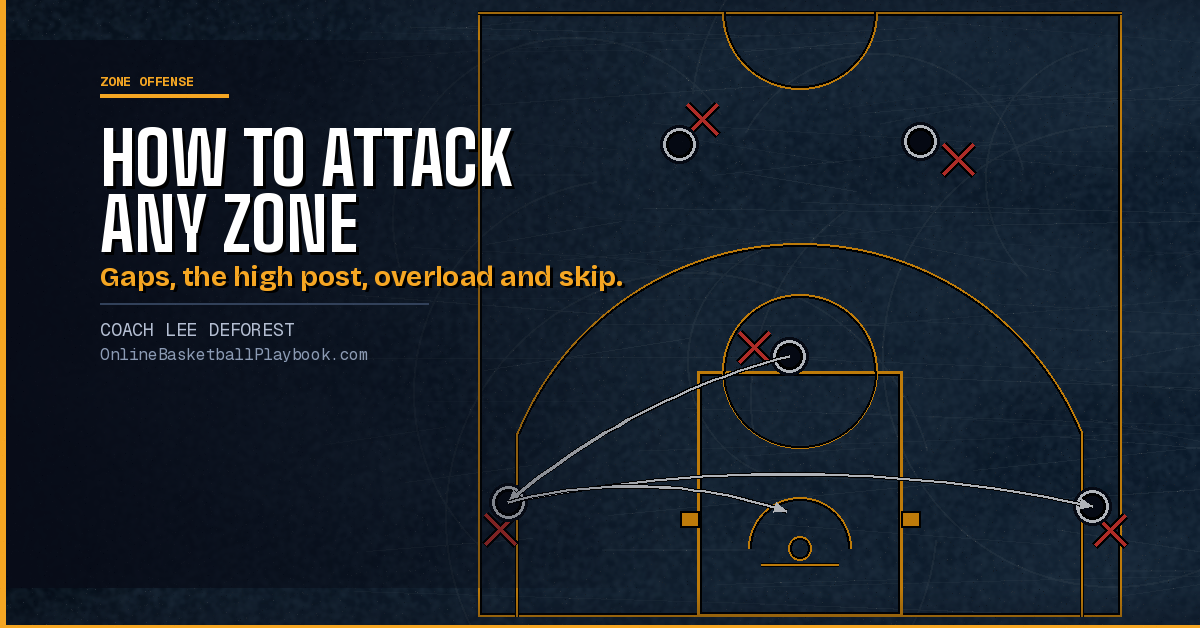
How to Attack a Zone Defense (Complete Guide)
A zone guards areas, not players — so you beat it by distorting its shape, not running your man offense at it.
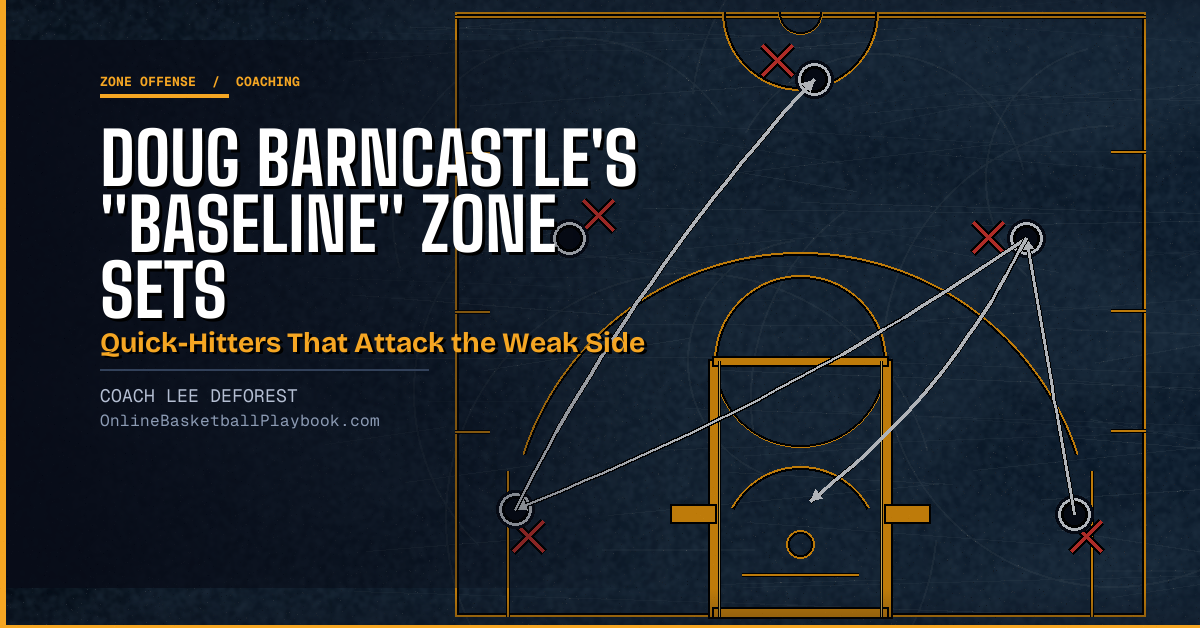
Doug Barncastle's "Baseline" Zone Sets: Quick-Hitters That Attack the Weak Side
A handoff-action quick-hitter and two counters — Baseline Push and Baseline Dive — built to attack a zone to the weak side and get clean, makeable shots.
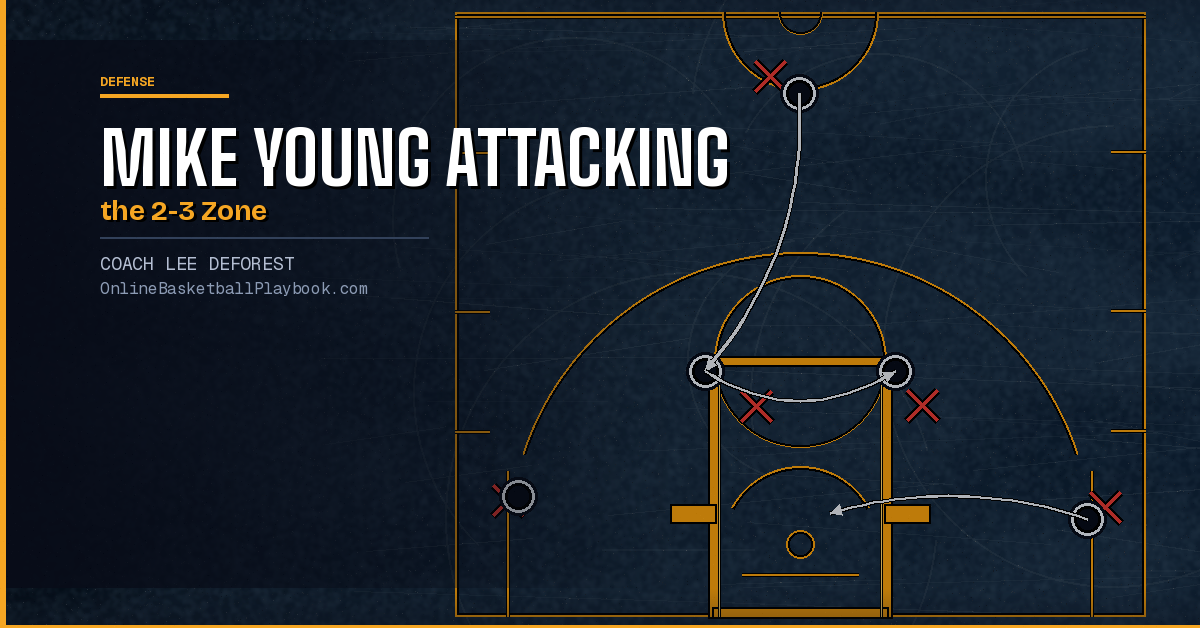
Mike Young Attacking the 2-3 Zone in Basketball
Mike Young Attacking the 2-3 Zone in Basketball
More from Online Basketball Playbook
1-3-1 Offense
A complementary zone-attack structure — run it alongside Harrell’s motion to keep defenses guessing.
How to Beat the 1-3-1 Zone
When teams go 1-3-1 in response to your zone attack, here’s how you counter.
How to Beat the Matchup Zone
Matchup zones demand different reads than standard zones — add this to your arsenal.