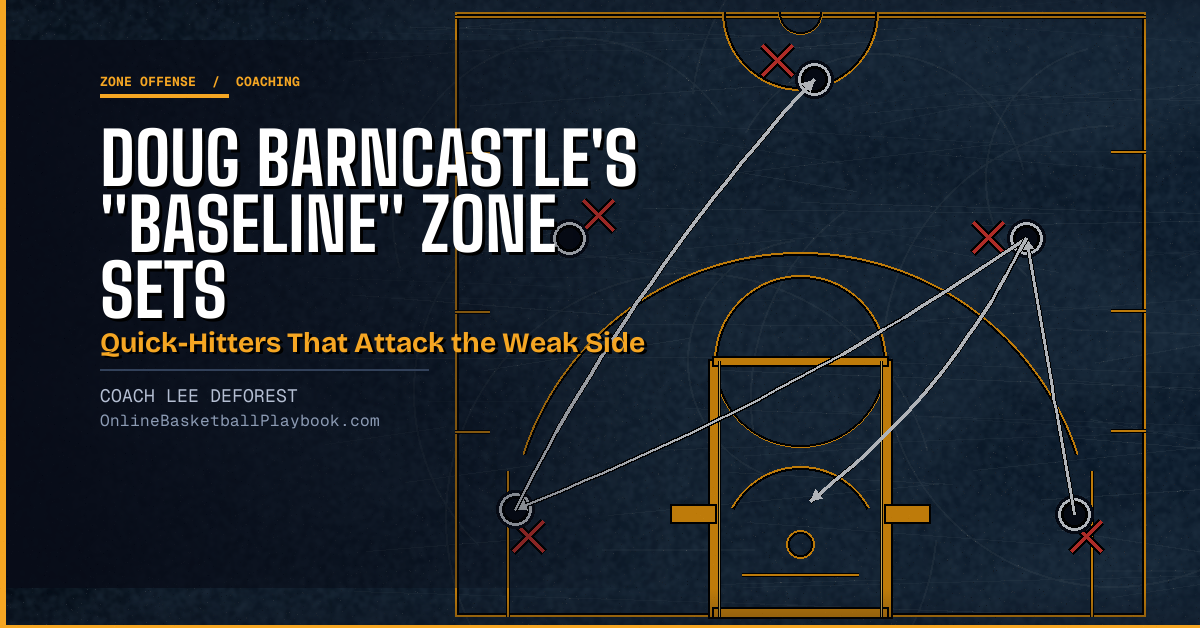
Most zone offense dies on the strong side. You swing it, the zone shifts, and your shooter catches it covered. Barncastle's fix is to make the zone chase one action while the shot opens on the weak side.
Doug Barncastle coaches at Martin's Mill, a Class A program in Texas, and his answer to a zone is a short series of quick-hitters he calls "Baseline." It is not a full motion offense. It is three sets that share one entry, one handoff look, and one job: catch the zone leaning the wrong way and get a clean, makeable shot to the weak side before the defense can recover.
The beauty of it is the disguise. The base set, the Push counter, and the Dive counter all start identically. The defense sees the same first three seconds every time, so they cannot key on the one that hurts them. By the time the zone reads which version it is, the ball is already on the weak side and the shot is already up.
"I have stolen a lot of different sets from people that I thought had some good ideas and composed them into a series. I call the series 'baseline'."
Coach's Cheatsheet
- Use this when: you face a zone and want quick-hitters that get a clean weak-side shot instead of a covered strong-side swing.
- Core teaching point: all three sets start the same — 01 hits 05 stepping out and runs off him as if for a handoff toward the baseline.
- The shot you want: the base set ends with 05 turning and skipping the ball to 03 on the weak side for a 10-to-20-footer.
- When they close out hard: call Push — 03 drives the baseline and you swing it back to 05 pinning inside for a layup.
- When the middle sits: call Dive — 04 dives in front of the rim for a lob, with 05 as the dump-off if the base defender helps.
- The constant: 04 sliding to the block to form a double screen and the weak-side skip pass appear in every version — drill those two things first.
Why Attack a Zone to the Weak Side
A zone is built to load up where the ball is. Two or three defenders crowd the strong side, the shape tilts, and the help is all sitting on the action you are running. That is exactly why so many zone possessions end with a contested shot — you attacked the part of the floor the defense was already covering.
Barncastle's whole series flips that. The action happens on one side to pull the zone, but the shot is engineered to come out on the other side, where the defense is thinnest and slowest to rotate. That is the entire philosophy in one line.
"I like to run sets against a zone to the weak side."
If you already attack zones by keeping bodies moving and reading the front, this fits right in — it is the same instinct behind Bill Harrell's zone offense, just packaged as a set series instead of a continuity. The difference is that a quick-hitter lets you put the shooter exactly where you want him, on a specific defender, on a specific read — so you can target a slow weak-side wing or a base defender who likes to cheat. For a deeper look at scripting offense against a tilted defense, the counters to a box-and-1 work off the same idea: make the defense honor one threat, then score off the player they forgot.
Scout the weak-side wing on the zone you are about to play. Some teams have a guard there who closes out late or drifts ball-watching. That player is the target for this whole series. The base set already delivers the ball to your shooter on the weak side — so pick the night your matchup there is the one the other coach is trying to hide, and run Baseline early to make him defend in space.
The Base Set: "Baseline" and the Handoff Entry
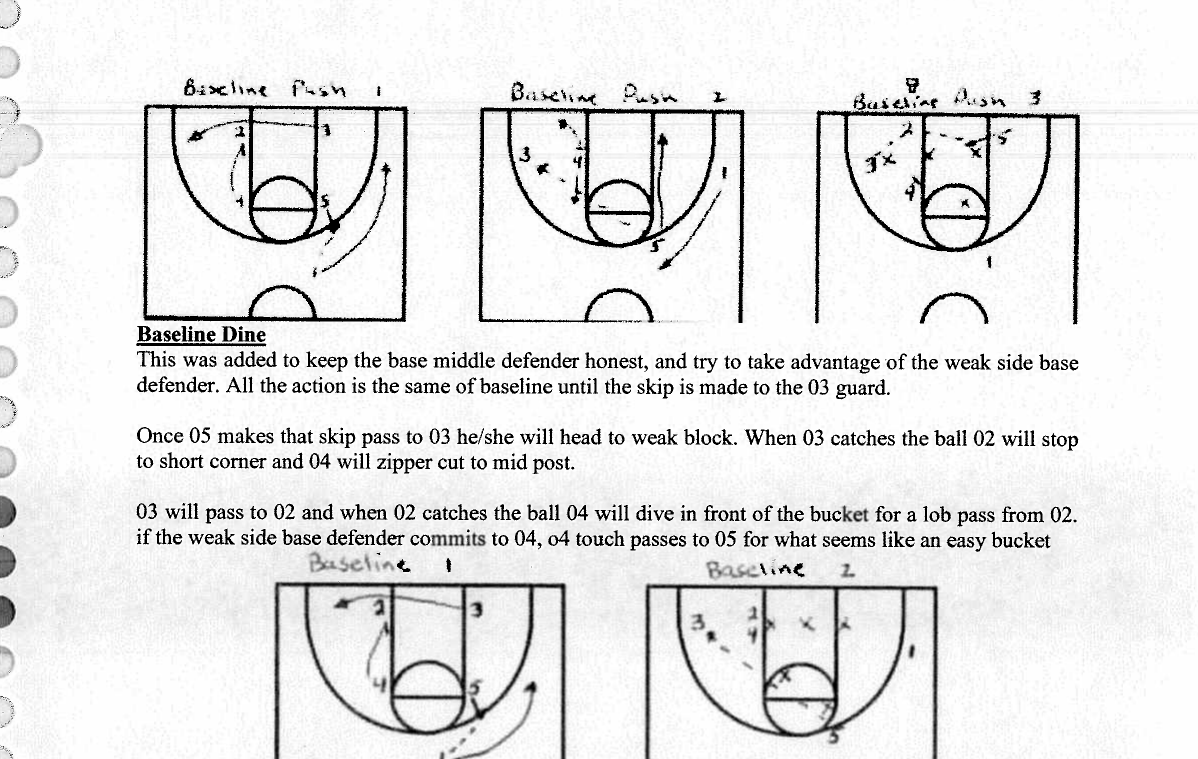
Everything starts with the entry, and the entry is the same in all three sets. 01 passes to 05, who has stepped out to receive with his back still to the basket. As the pass goes, 01 runs off 05 as if they are about to handoff toward the baseline and the corner three. That fake handoff is the bait — it pulls the top of the zone toward the ball and the corner.
On that same pass, 04 slides down to the block to form a double screen for the 03 guard on the weak side. Now you have a screen built on the back side of a zone that is leaning toward the ball. 05 turns to face the basket and skips the ball across to 03, who curls off that double screen into a clean 10-to-20-footer before the weak side can close.
The roles on the base set
- 01 — the bait. Hit 05 and run off him toward the baseline so the front of the zone has to honor the handoff. You are not getting the ball back; you are moving defenders.
- 05 — the trigger. Catch with your back to the basket, then turn, face up, and read the weak side. Your skip pass to 03 is the shot.
- 04 — the screen. Slide to the block and form the double screen with the natural defenders so 03 has a wall to curl off.
- 03 — the shooter. Read the curl off the double screen and be ready to catch and shoot on the skip. This is the look you want every time down.
The Key Principle: the handoff action with 01 and 05 is a decoy, not the play. Its only job is to tilt the zone toward the ball so the weak-side skip to 03 comes against a defense that has already shifted away. Sell the handoff hard and the shot opens itself.
"Baseline Push": The Counter When They Run at the Shooter
Good zones adjust. After they see the base set once or twice, the weak side stops cheating in and starts flying out at 03 on the skip. The moment the defense runs at your shooter, you call Push — and now their closeout is the mistake.
The entry is identical: 01 to 05, run off the handoff, 04 down to screen, 05 skips to 03. But this time 03 does not shoot. He catches and immediately drives the baseline at the defender who just flew at him. As he drives, 02 steps to the short corner and 04 zipper-cuts up to the mid-post, giving 03 two outlets. 03 hits 02 in the short corner. Meanwhile 05 goes inside to pin the baseline defender, sealing him under the rim. 02 steps around and throws a bounce pass to 05 on the weak side for an easy basket.
Walk the chain through once and it clicks: the hard closeout on 03 opens the baseline drive, the drive collapses the zone, and the pin by 05 turns one rotation too many into a layup. You are punishing the exact adjustment the defense made to stop the base set.
Push only works if 03 reads the closeout, not the clock. Teach him a simple key: if the weak-side defender is still recovering, shoot the base look; if that defender is flying out under control to contest, rip it and drive the baseline. Same catch, two answers. Drill it live with a closeout defender so the read becomes automatic and 03 stops settling for a covered shot when the layup is sitting right there.
"Baseline Dive": Punishing the Weak-Side Base Defender
The third set exists because of two specific defenders: the base middle man who sits and waits, and the weak-side base defender who over-helps. Barncastle added Dive to keep the first one honest and to make the second one pay.
"This was added to keep the base middle defender honest, and try to take advantage of the weak side base defender."
Again the start is the same, right up through 05's skip to 03. From there it changes: 05 heads to the weak block, 02 steps to the short corner, and 04 zipper-cuts to the mid-post — the same spacing picture you build in Push, so the defense cannot tell them apart yet. 03 passes to 02. As 02 catches the ball, 04 dives in front of the rim, and 02 throws a lob over the top for the finish. If the weak-side base defender commits to stop 04's dive, 04 simply touch-passes to 05 waiting on the weak block for the bucket.
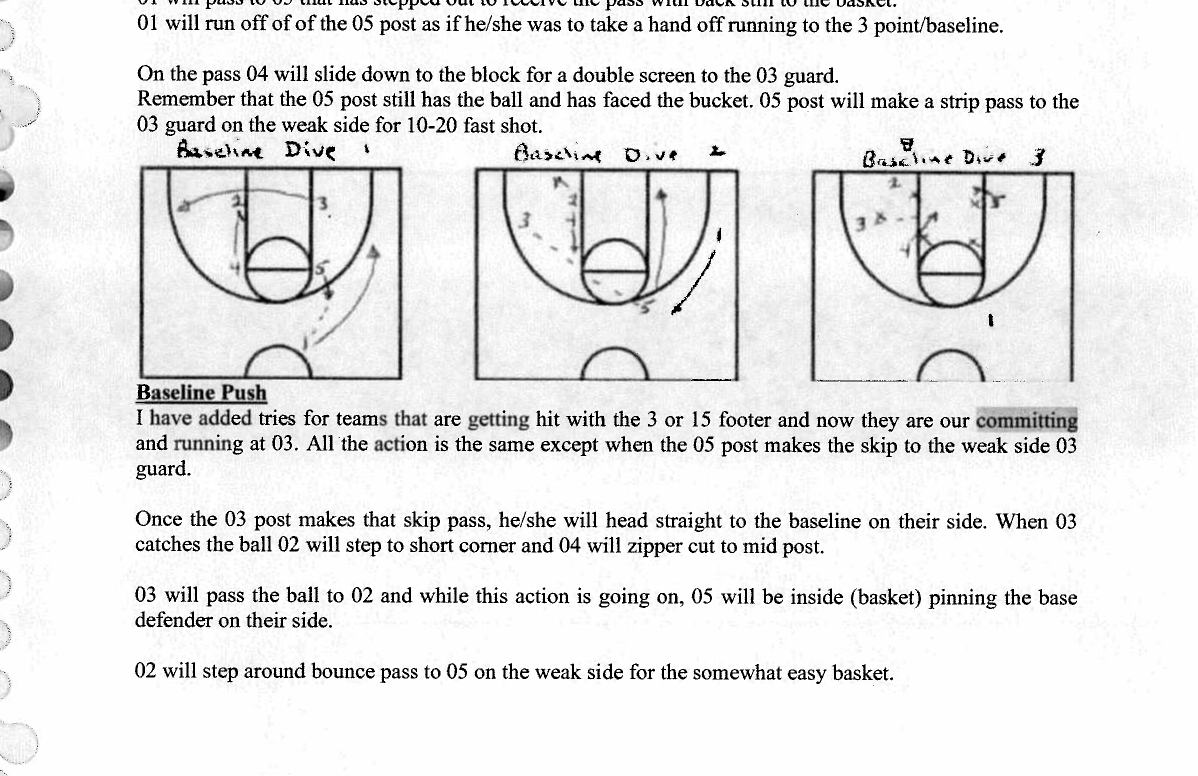
That last line is what makes Dive un-guardable when it is timed right. The weak-side base defender has a true two-way bind: stay home and 04 catches the lob clean; help on 04 and he gives up 05 on the block. There is no correct answer, which is exactly the kind of stakes you want a quick-hitter to create.
The Key Principle: Dive and Push wear the same disguise — identical entry, identical spacing into 02's short-corner catch. The defense has to commit before it knows whether the danger is the baseline pin (Push) or the rim dive (Dive). Run them back to back and you turn one read into a guess.
Reading the Zone and Calling the Right Set
The series is only as good as your reads, and the reads are simple because the three sets map cleanly to three things the defense can do. Here is how I would coach the call.
Call the base "Baseline" when:
The weak side is honest and slow to close. If the wing defender ball-watches the handoff and is late getting out to 03, the skip-and-shoot is your best available look. Start here every game — it is the cleanest shot in the series and it sets up both counters.
Call "Push" when:
They start flying out at 03. The second the weak-side defender hard-closes the skip, the base shot is gone but the baseline drive is open. Push converts their over-aggressive closeout into a layup at the rim via the 05 pin.
Call "Dive" when:
The base middle man sits and the weak-side base defender over-helps. If the interior of the zone is passive in the middle and the base defender keeps cheating to the ball, Dive attacks both — the lob keeps the middle honest, and the dump-off to 05 punishes the help.
Install all three in one practice, but install them in order — base first, then Push, then Dive — and walk each one to the skip pass before you ever add the counter. Because the entry never changes, your players are really learning one set with three endings, so spend your reps on the branch points: 03's read on the closeout, and 04's read on the base defender. Get those two decisions right and the rest of the series runs itself. If you build it into a broader zone-attack plan, file it alongside your other playbook breakdowns so the calls are ready by scouting night.
Variations and Progressions
Progression 1: Shooter's Choice on the Skip
Once 03 trusts the read, give him full freedom on the catch: shoot the base look, rip-and-drive into Push, or relocate for the Dive spacing. You are not calling a set anymore — you are letting the closeout decide. Drill it with a single defender flying out at different angles so 03 learns to punish whatever the defender gives him.
Progression 2: Flip the Strong Side
Run the mirror image so the action can start on either side of the floor. Against a zone with a clear weak link on one wing, you want the freedom to aim the whole series at that defender regardless of which side you entered on. Teach both handedness reps so the team is not locked into one entry side.
Progression 3: Quick-Hitter Into Continuity
If all three looks are covered, do not force a bad shot — flow the spacing straight into your base zone offense and keep playing. The set series is a first-strike, not the whole possession. Pair it with a continuity so a covered quick-hitter resets into motion instead of a rushed heave at the shot clock.
Get Free Coaching Notes
Join the Online Basketball Playbook newsletter for new playbook breakdowns, drills, and practice-ready install ideas.
Get Free Coaching NotesDraw this play free in the play drawer →
Membership: the full library, playbook packs, and Pro drawing tools →
Final Thoughts
Barncastle's "Baseline" series works because it does one thing on purpose: it attacks a zone where the zone is weakest. The handoff entry pulls the defense to the ball, the double screen springs the shooter on the back side, and the skip pass delivers a clean weak-side look before the rotation arrives. Push and Dive then sit underneath that same picture and punish the two ways a defense tries to take the base shot away.
Steal the parts you like, name the series whatever you want, and install it as one set with three endings. Sell the handoff, screen the weak side, and let 03 and 04 read the defenders in front of them. Do that, and you stop swinging the ball into coverage and start putting it exactly where a zone cannot get to in time.
Keep Building
Related breakdowns
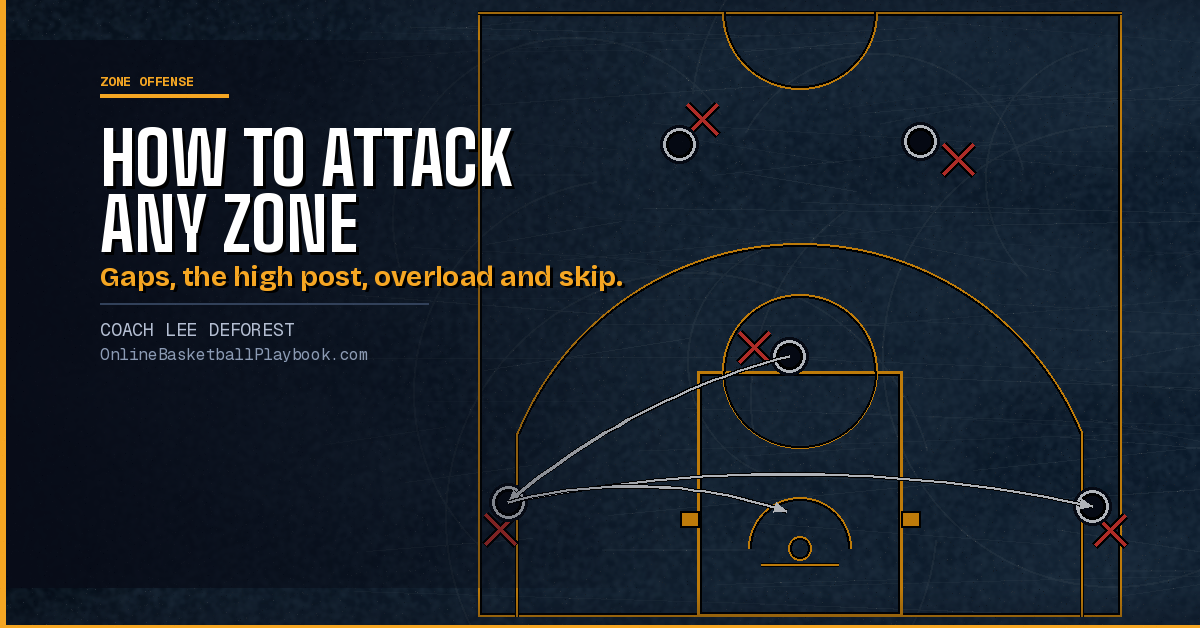
How to Attack a Zone Defense (Complete Guide)
A zone guards areas, not players — so you beat it by distorting its shape, not running your man offense at it.
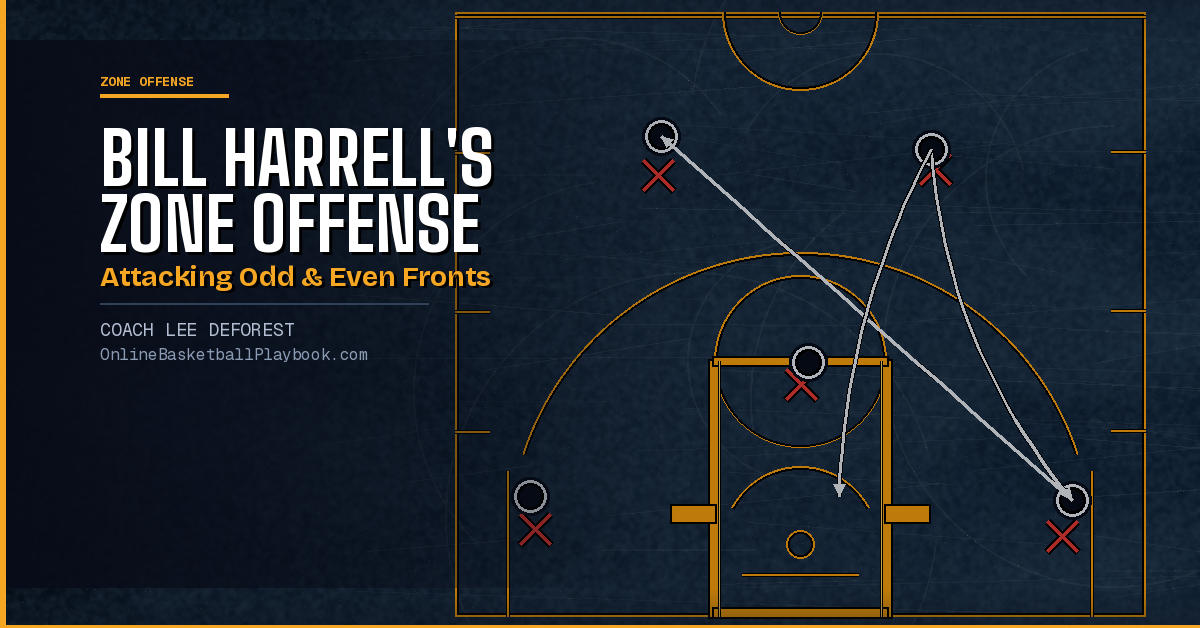
Bill Harrell's Zone Offense: Attacking Odd and Even Fronts
A zone-attack philosophy that keeps all five players moving, gets shooters to open spots, and feeds the post against any front.
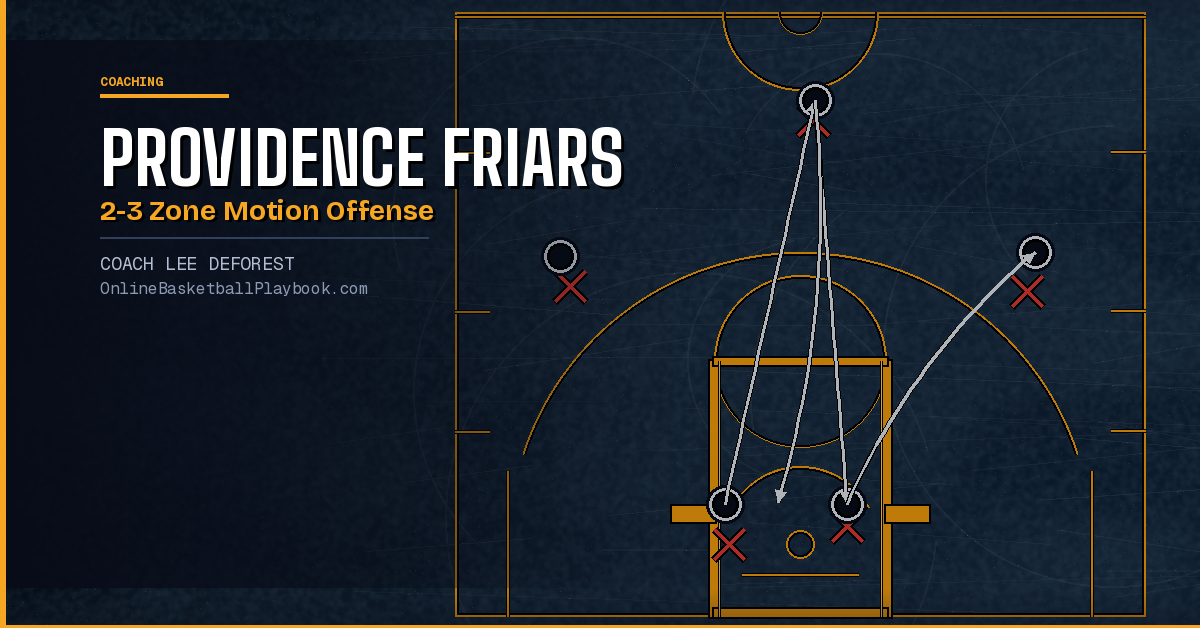
Providence Friars 2-3 Zone Motion Offense Baseline Runner Basketball Play
Providence Friars 2-3 Zone Motion Offense Baseline Runner Basketball Play
More from Online Basketball Playbook
1-3-1 Offense
Add this complementary zone-attack structure to expand your zone offense package.
How to Beat the 1-3-1 Zone
When teams counter with a 1-3-1, here’s how you attack their traps.
How to Teach Basketball Decision-Making
Zone sets require players to read the gaps and make fast decisions — teach the framework.