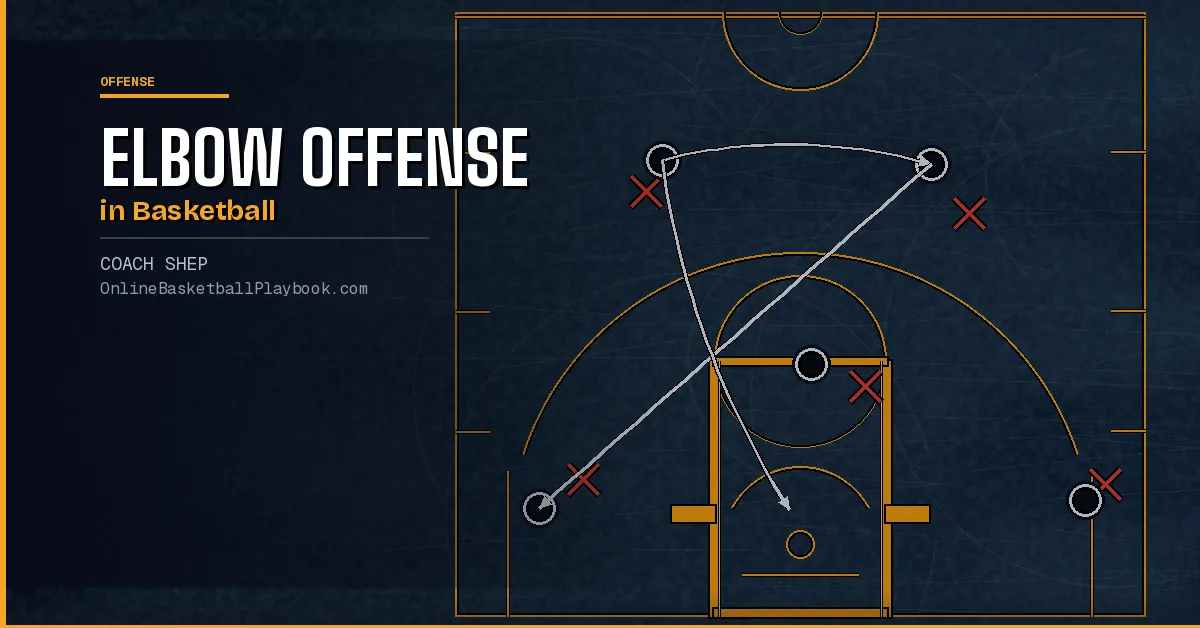
The elbow offense uses the high-post area, the junction of the free-throw line and the lane, to create shots, cuts, and mismatches. It is one of the most versatile offensive concepts in basketball at any level.
What Is the Elbow in Basketball?
The "elbow" is the spot where the free-throw line meets the edge of the lane on each side of the floor. There are two elbows, one on the left block side and one on the right, and both sit roughly 15 feet from the basket. The name comes from the L-shape the lane and free-throw line form at that junction, which looks like a bent elbow when you view the court from above.
As a scoring location, the elbow is valuable for several reasons. A mid-range jump shot from the elbow is a relatively efficient look, especially when the shooter catches in rhythm and faces a closeout. As a passing hub, the elbow creates angles that let a high-post player see the entire floor. When a forward or center catches at the elbow, he can scan baseline cutters, split-cut opportunities, and corner shooters all in a single read. That combination of shot threat and passing vision is what makes elbow actions so hard to defend.
Coaches at every level use elbow entries as a primary or secondary option. At the youth and high school level, a simple elbow series (entry, face-up, read the cutter) teaches players to make decisions rather than just run scripted routes. At the college and professional level, elbow actions get layered into spread sets, horns looks, and motion offense principles to keep defenses guessing.
Understanding the elbow starts with understanding geography. On most half-court sets, guards operate at the top of the key or on the wing while forwards work the mid-post or corner. The elbow sits between those zones. It is close enough to the basket that a catch-and-drive is dangerous, yet far enough from the rim that the defense cannot simply collapse and recover in time. That geography is the elbow's central advantage.
Spacing and Floor Balance
No elbow action works without proper floor spacing. If players stand too close together, defenders can cheat off their man to help on the elbow catch. If spacing collapses, driving lanes close and passing angles disappear. Building the floor correctly before you enter the ball to the elbow is what separates an organized offense from a random possession.
The most common spacing structure for elbow offense is a two-guard front with two players in the corners and one player at the elbow. The two guards control the top of the key and handle ball reversals. The corner players stretch the defense horizontally, keeping help defenders from sinking too low. The elbow player, typically a forward or a skilled big, catches and operates from the high post.
Some coaches use a horns set to get two players simultaneously to the elbows. In horns, a point guard brings the ball up and the two bigs flash to opposite elbows on the entry. This creates immediate decision pressure for the defense: which elbow do you protect first? The reads off horns entry include a middle drive, a skip pass to the weak-side corner, or a dribble hand-off on either side. Horns is one of the most widely copied set plays in the modern game precisely because the double-elbow alignment is so difficult to guard.
Spacing is also about movement. Players in the corners should be active, ready to cut baseline if their defender sinks into the lane. Guards in the slots must stay on the strong side to allow a simple skip pass when the elbow player draws the defense. Poor spacing produces standing, and standing invites defenders to double-team or rotate without consequence. Good spacing means every defender on the floor has a reason to stay attached to their assignment.
Core Elbow Actions and Reads
Several specific actions define elbow offense, and each one has a primary read, a secondary option, and a counter move when the defense adjusts.
The Elbow Entry and Face-Up
The most basic action is the wing-to-elbow entry. A guard on the wing passes to a forward who has flashed to the elbow. On the catch, the forward pivots to face the basket. From there, the reads unfold in order: look at the rim first, check the weak-side cutter, scan the corner, then attack off the dribble or pull up for the mid-range jumper.
The face-up read is the foundation of basketball IQ development at the forward position. Players who catch and immediately look to drive give away what they see, or do not see. The best elbow scorers take a quick glance at the basket first, which freezes the on-ball defender and allows them to process what the rest of the defense is doing. That split-second pause is what creates the advantage.
The Elbow Cut
When a guard drives from the perimeter and the defense collapses, the elbow player must move. The standard response is a cut to the opposite block or a drop to the corner to create a passing outlet. This cut not only provides the driver with an escape valve but also keeps defenders from camping in the paint to take charges or deflect passes.
The elbow cut in the opposite direction, an off-ball player cutting from the weak-side block to the elbow, is equally important. When a team runs a baseline cut or a backdoor, a player flashing to the elbow gives the ball handler another option mid-drive and keeps the offense moving forward rather than stalling.
The Dribble Hand-Off at the Elbow
One of the most effective counters off the elbow is the dribble hand-off. The elbow player catches, faces the basket to draw the defender, then meets a cutting guard near the free-throw line for a hand-off. If the elbow defender does not bump the guard, the guard gets a clean look at the rim. If the defender switches or hedges out, the elbow player slips toward the basket for a drop pass. This two-man game is difficult to stop without help, and when it draws extra defenders, corner shooters open up.
Skip Passes and Weak-Side Action
The elbow also serves as a hub for skip passes. When a defense overloads the strong side, the elbow player can reverse the ball quickly to the weak-side guard or skip all the way to the corner. These skip passes work best when off-ball players are already moving, a corner player stepping into his shot, a backdoor cutter crossing the lane. Timing the skip with the cutter's movement is a skill that takes repetition, and it is best developed through deliberate basketball practice planning that isolates those two-man reads.
Connecting the Elbow to Motion Offense
The elbow is not a stand-alone set. It is most effective when embedded inside a broader motion offense framework. In motion offense, players read the defense and react rather than running scripted routes. The elbow fits naturally into that framework because it provides a central location from which multiple actions can branch without the offense telegraphing what is coming next.
In a standard motion offense, a player who passes and cuts through the lane often ends up at the elbow. If his cutter defender follows him, there is a gap in the paint. If the defender stays home, the cutter catches at the elbow with space to operate. That built-in read, cut and read the response, is the core loop of motion offense applied to elbow geography.
The 5-out alignment is another natural partner for elbow actions. In 5-out motion offense, all five players are above the three-point line and the paint is completely empty. When one of those players cuts to the elbow on a pass-and-cut, he becomes an interior threat for just a moment, long enough to threaten the mid-range, draw a closeout, or dump the ball off to a trailing cutter. The elbow flash out of 5-out creates the same decision pressure as a traditional high-post entry but from a read-based structure that is harder to scout.
Coaches who teach motion offense will find that the elbow becomes one of the most-used positions on the floor without anyone ever being assigned to camp there. Players learn to flash to the elbow when their cut does not produce a catch, when a ball reversal creates an open seam, or when a teammate drives and needs a safety outlet. That spontaneous use of the elbow is the mark of a team that has internalized the offense rather than just memorized plays.
How Defenses Guard the Elbow
Understanding how defenses try to take away elbow actions helps coaches design counters and helps players make better reads in the moment.
The most common defensive tactic is front-loading the entry. Defenders who anticipate the elbow entry will bump the cutter before he reaches the high-post area, forcing the offensive player to receive the ball further from the basket or to change his angle entirely. The counter is a flash-and-backdoor combination: the forward shows the elbow cut, the defender overplays, and the forward cuts backdoor instead. Teaching players to read the defender's weight before committing to the elbow cut is essential.
A second approach is the show-and-recover on drives. When the elbow player catches and attacks the basket off the dribble, a help defender may step up to take a charge or force a difficult pass. The offensive counter is patience. Take two dribbles, let the help come, then pass to the vacated area. Players who rush the drive give the help defense time to recover. Players who hesitate one beat create a passing lane to the corner or the opposite block.
Zone defenses present a different challenge. In a 2-3 zone, the high-post area is traditionally protected by the two top defenders. Getting the ball to the elbow against a 2-3 requires a skip pass from the wing, a ball-screen used to draw a defender out of position, or a guard who drives into the seam and kicks back to a teammate flashing to the elbow from the weak side. Attacking the zone through the elbow is especially effective because it splits the gap between the two top zone defenders and forces the middle-bottom defender to make a choice about guarding the catch versus protecting the rim.
Drills for Teaching Elbow Actions
Teaching elbow offense requires repetition on specific actions before live play. Below are three progressions that work at the youth, high school, and adult levels.
Two-Man Elbow Entry (Pairs Drill)
A guard starts on the wing with the ball; a forward starts at the mid-post or block. The forward flashes to the elbow on the guard's cue. The guard delivers the pass and then cuts through the lane. The forward reads whether the cutter is open. If yes, deliver the pass. If no, face up and attack off the dribble or shoot the mid-range. This drill builds the entry read in a clean environment before adding defenders.
3-on-3 Elbow Shell
Use the same two-man elbow entry but add a third offensive player in the opposite corner and assign live defenders. The third player creates the spacing that makes the entry work. Defenders can now stunt at the ball or tag the cutter, and offensive players must react to what they see. This progression mirrors the shell drill concept, isolating decision-making in a small-group environment before expanding to five-on-five. For teams that already run a shell drill, the transition to elbow reads is natural.
Horns Read Series
Set up horns with a point guard at the top of the key and two forwards at opposite elbows. The point guard drives one direction, both forwards move on the drive, and the offense reads the results in order: layup for the driver, pass to the crashing elbow forward, skip to the opposite corner, or pull-up for the driver in the short-roll area. Running this at half speed first, then increasing to game speed, builds the visual sequencing players need to process four options in a single possession.
Repetition on these drills builds the habit that makes elbow offense effective in live games. Players who have taken hundreds of reps reading the elbow in practice will make those same reads instinctively when the game is on the line.
Start every elbow drill with no dribble allowed on the catch. Forcing players to pass out of the elbow before they can drive trains them to see the floor first, and teams that develop this habit generate far more open looks than teams that rely on isolation scoring from the high post.
- Enter to the elbow with purpose. The passer cuts immediately on delivery to create a two-man read.
- Elbow player catches and looks at the rim first; that pause freezes the on-ball defender and opens reads.
- Corner players must stay active. Step into the catch when the elbow draws the help defense away.
- If the defense fronts the elbow entry, counter with a backdoor cut from the same player before they reach the spot.
- Horns entries create simultaneous pressure on both elbows. Use them to identify which defender is the weakest link.
- Against zone, flash one player to the high post from the weak side to split the top two defenders and force a rotation.
Get free play diagrams, drills, and coaching guides delivered weekly.
Draw this play free in the play drawer →
Membership: the full library, playbook packs, and Pro drawing tools →
Keep Building
Related breakdowns
Basketball Quick Hitters: 25 Sets by Action and Formation
Basketball quick hitters sorted by the action you want, catch-and-shoot to post feed, with each set's formation, diagrams, the read and the counter.
Princeton Offense Drills: Breakdowns, Shooting and Live Reps
Princeton offense drills that teach the reads: spacing, backdoor and hand-off breakdowns, 3-0 Chin and wave drills, Point shooting, a drive drill and an install.
Four Corners Offense Basketball: Roles, Rules and Versions
Four corners offense basketball: the set, the chaser, the corner and post rules, three versions, when to run it, the shots it hunts and shot clock limits by level.