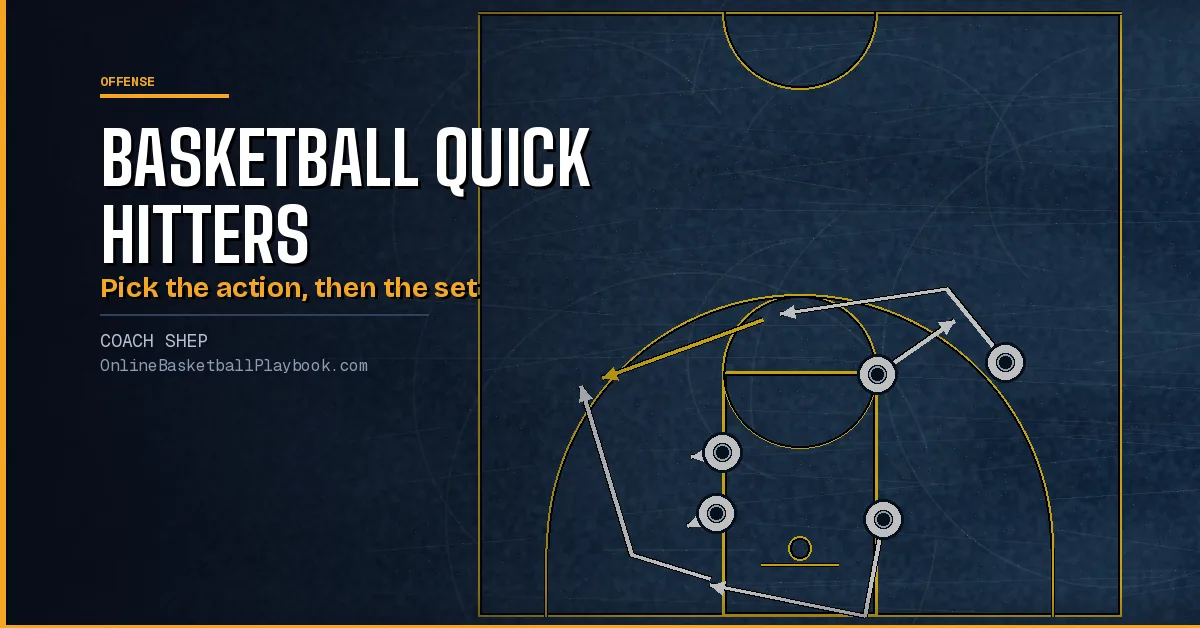
Basketball quick hitters are named set plays a coach calls to get a chosen shot for a chosen player, fast. This library holds 25 of them.
They are sorted first by the action you want to run (a catch-and-shoot, a double screen, a ball screen, a post feed) and then tagged by the formation they start from, so you can find a set either way. Every set is drawn step by step with what it gets, the read and the counter. For the bigger picture of systems, actions and sets, start at basketball plays.
Find a Set: By Action and By Formation
Pick the action you want, or open the formation view to see what runs from the look your team already knows. Tap a set to jump to its diagrams. Sets labeled Coach Shep's set come from our own playbooks. The rest are standard sets named by the action they run.
By action

Best for a shooter

Best for a shooter

Best for a shooter
- Scissors 5-out Coach Shep's set
- Iverson cut Horns
- Triple stagger Box

Best for a guard who makes plays off the bounce
- Horns pick and roll Horns
- Pistol 4-out 1-in
- Spain pick and roll 4-out 1-in

Best for the player who wins one on one
- Elbow isolation 4-out 1-in

Best for a big who scores inside
- Cross screen post 4-out 1-in
- Box post entry Box

Best for a slasher
- Iso Backdoor 4-out 1-in Coach Shep's set
- One-Four 1-4 high Coach Shep's set
- 40 Box Coach Shep's set
- Chin 4-out 1-in
- UCLA cut and double curl 1-4 high

Best for a guard who makes plays off the bounce
- Money 4-out 1-in Coach Shep's set
- Weak-side flash 4-out 1-in
- Chicago 5-out
By formation
4-out 1-in
11 sets
- Wheel catch-and-shoot Coach Shep's set
- Hammer catch-and-shoot
- Low Down double screen Coach Shep's set
- Pistol ball screen
- Spain pick and roll ball screen
- Elbow isolation isolation
- Cross screen post post feed
- Iso Backdoor layup Coach Shep's set
- Chin layup
- Money handoff Coach Shep's set
- Weak-side flash handoff
1-4 high
5 sets
- 13 catch-and-shoot Coach Shep's set
- Elevator double screen
- Hawk double screen Tom Izzo's set
- One-Four layup Coach Shep's set
- UCLA cut and double curl layup
Box
3 sets
- Triple stagger stagger
- Box post entry post feed
- 40 layup Coach Shep's set
Horns
2 sets
- Iverson cut stagger
- Horns pick and roll ball screen
3-out 2-in
1 set
- Zipper catch-and-shoot
1-4 low
1 set
- Floppy catch-and-shoot
What Basketball Quick Hitters Are
A quick hitter is a set: a called play with a scripted opening. It sits between a system (a continuity or a motion offense that runs all game) and an action (one screen or one cut). The coach decides who shoots and from where, and the set is built to get that look before the defense sorts it out.
Coaches call one at these moments:
- After a timeout. The defense is set, so the play has to beat a defense that expects something. The full treatment is on after timeout plays.
- Late in the shot clock. A high ball screen call needs time to work. One rule of thumb is never to start one with less than 7 or 8 seconds left.
- To open a half. Some staffs script the first plays of the game. Tom Izzo scripts his first six or seven.
- To feed a matchup. A post call goes in when the other team's post is in foul trouble, or for a deep post-up against a smaller defender after a switch.
- To restart a stale possession. One rule of thumb is to call a set for your best player after three trips with no good look.
Most quick hitters start from a box or a 1-4 high look, open the same way every time, and branch into a few finishes read off the defense. The 1-4 high spreads the floor, gives the point guard a UCLA cut and hides many sets behind one look. It also invites denial on the wings and at the high post, and every player has more calls to learn.
Know the shot you want before you call the set.
Play to Their Strengths
Pick the set by what your players do best, not by what looks good on the whiteboard. Cast the play to a player or a matchup:
- A shooter. Catch-and-shoot, double screen and stagger sets: Wheel, 13, Floppy, Low Down, Elevator, Triple stagger.
- A big who scores inside. Post feeds: Cross screen post, Box post entry, and the cross screen at the end of 40.
- A slasher. Layup sets: Iso Backdoor, One-Four, Chin, UCLA cut and double curl.
- A guard who makes plays off the bounce. Ball screen and handoff sets: Horns pick and roll, Pistol, Spain, Money, Chicago.
The set that fits your best player beats the set that fits somebody else's.
Catch-and-Shoot Sets
Wheel (Coach Shep's set)
Formation: 4-out 1-in, from the Low start. Gets: a shot for your best wing shooter. There are a lot of cuts, and the ball goes to the shooter to start the play.


The read. 3 stays a little flat on his dribble and looks for 2's backdoor cut. On the dribble at 4, 4 cuts backdoor too. The flare gives 1 an angle on 3 for the three, or 3 can drive and kick.
The counter. The two backdoor cuts are built in. If nothing comes off the flare, the next dribble up puts the team in Chin. See the Princeton offense for the base actions.
13 (Coach Shep's set)
Formation: 1-4 high. Gets: a jumper for 2 coming off a down screen, then a curl or pop for 3.


The read. 2 looks for his jumper on the catch. If it is not there, the second action is already coming: 5's screen for 3, who curls or pops depending on how his defender plays it.
The counter. The second screen, for 3, is the counter. It is already coming when 2 catches.
Zipper
Formation: 3-out 2-in. Gets: a catch at the top of the key for your shooting guard, for a three or a drive. Some teams run it straight off the break as early offense.


The read. 2 shoots the three on the catch or puts it on the floor.
The counter. The backdoor. The ball handler dribbles at 2 and 2 cuts behind his man to the rim, with a down screen on the far side to keep that defender busy.
Hammer
Formation: 4-out 1-in, drawn here with only the three players in the action. Gets: a corner three off a baseline drive.


The read. The ball drives baseline, a teammate screens the weak-side player's defender, and the driver throws to the corner to the player who was screened. It often catches the help side unaware.
The counter. With no screener in place, run the same drive as a baseline drift: drive baseline and hit the corner. Our flare screen page covers the screen side of it.
Floppy
Formation: 1-4 low, the shooter under the rim with screens on both sides. Gets: a catch at the arc for the shooter off a staggered double screen, then a second shooter on the other side.


The read. In this version 2 always goes around the staggered double, and 3 cuts the opposite way right after him.
The counter. If neither shooter is open, the high pass to 5 just outside the elbow triggers 2's back-cut to the rim. If that is covered, 2 keeps going to the opposite corner and the play flows on.
Every catch-and-shoot set needs a real shooter at the end of it. Run them for the player who makes the shot.
Double Screen Sets
Low Down (Coach Shep's set)
Formation: 4-out 1-in, from the Low start. Gets: a three for 5, your post, popping off a double down screen. It is a counter for a sagging defense.

The read. 5 is open when his defender is slow or sags into the lane.
The counter. If there is no shot, keep going into the next action, with 1 and 2 cutting off down screens by 4 and 3. Against defenders who just chase cutters off back screens, the post snaps back to the ball for a score.
Elevator
Formation: 1-4 high. Gets: an open three for your best shooter, running through two screeners who close the gap behind him like elevator doors.


The read. Dribbling the ball the opposite way first holds the shooter's defender in the paint. The screeners have to time the close perfectly, or the defender slips through or the screen is a foul.
The counter. If the defense switches the elevator, the screener whose man switched dives to the block and posts up, because a guard is now guarding him. More on the screen itself is on elevator screen.
Hawk (Tom Izzo's set)
Formation: 1-4 high. Gets: four looks from one entry: the UCLA cutter, the ball handler off a ball screen, and two shooters off the same double screen. Tom Izzo ran it at Michigan State.


The read. The UCLA cutter looks for the ball back first. Then 2 comes off 4's ball screen to shoot or kick out to 1 coming around the double. Then 4 comes around the double too.
The counter. The sequence is the counter. Each look the defense takes away hands the ball to the next shooter on the same double screen. The UCLA cut is explained on UCLA offense.
Rep the screen as much as the shot.
Stagger and Multiple Screen Sets
Scissors (Coach Shep's set)
Formation: 5-out, the post at the top of the key. Gets: a shot for 2 at the top of the key off a staggered screen, with 3 posting up on the way.


The read. 3 posts up after his slice cut, and 2 comes off the stagger for the shot at the top of the key.
The counter. If 2 has no shot, he passes to 4 on the wing and 4 looks inside to 5, which starts Low. The set never ends in a dead possession.
Iverson cut
Formation: horns. It also runs from a 1-4 set or any look with both posts at the elbows. Gets: a wing catch for your best shooter cutting over two elbow screens.


The read. On the catch, 2 can shoot, drive, or post up.
The counter. If the pass goes to one of the posts instead, 2 back-cuts to the rim.
Triple stagger
Formation: box. Gets: an open shot for the point guard coming off three screens in a row.


The read. 1 runs the baseline around all three screens and catches on the far wing for the shot.
The counter. None is drawn in the play. It is a one-look set for the point guard. One rule for box sets is to make them all look identical, so pair it with another box set, like the box post entry below.
Rep the stagger until the timing is automatic.
Ball Screen Sets
Horns pick and roll
Formation: horns, posts at the elbows and shooters in the corners. The spacing pulls the shot blockers away from the rim. Gets: a ball screen with a roll and a high-low behind it.

The read. 1 hits 5 on the dive, or swings to 4 at the top of the key for the high-low to 5 posting up.
The counter. Run it the other way from the same start: 1 uses the screen to the other side, 4 screens for 5, and 5 cuts to the rim. 1 can also drive it himself and kick to the corner. More pick and roll reads are on pick and roll.
Pistol
Formation: 4-out 1-in, as early offense off one sideline, with a post at the top of the arc. Gets: a two-man game between the point guard and a wing, then a ball screen before the defense is set.


The read. In the dribble version, 1 dribbles at 2 and uses 2's screen while 5 flare-screens for 2. If 2's defender switches and jumps out on 1, the skip pass goes to 2 off the flare for a three. If 1's defender goes under the screen, 1 steps back and shoots.
The counter. When nothing comes, 5 sets the ball screen for whoever has it, as drawn. Some staffs put a forward at the top of the key instead of 5 to create a mismatch.
Spain pick and roll
Formation: 4-out 1-in. Gets: a middle ball screen with a back screen on the roller's defender, a screen the screener.


The read. The ball handler can drive, pull up, hit 5 rolling, hit 2 popping or hit the corner. If 2's defender helps on the roll, 2 is open for three.
The counter. If 5's defender hedges out on the ball, 2 forgets the back screen and pops straight to the arc.
Whatever ball screen set you run, rep the reads from both sides of the floor.
Isolation Sets
Elbow isolation
Formation: 4-out 1-in. Gets: the ball to your post at the high post with the floor cleared, so he can attack the rim one on one. For more ways to isolate a scorer, see isolation plays for star players.

The read. 5 attacks the rim first.
The counter. The weak-side flare. As 5 attacks, the corner player screens the shooter's defender, and the shooter drifts to the corner for the kick-out when the help comes.
Give the isolation to the player who wins one on one.
Post Feed Sets
Cross screen post
Formation: 4-out 1-in. Gets: a low post entry for your big off a cross screen, then a shot for the screener.

The read. 5 looks to score on the catch. 1 cuts off him to the rim, and 3 comes off the down screen.
The counter. Screen the screener. After the entry, 2 screens down for 3, the player who set the cross screen.
Box post entry
Formation: box. Gets: a direct post feed to a big who bumps off a down screen to the block. It was built to get the ball inside to a dominant center.


The read. Throw it inside to 4 on the block.
The counter. The same down screen brings 2 to the top of the key, open for the three.
Run post feeds for the big who finishes, and rep the entry pass.
Layup at the Rim Sets
Iso Backdoor (Coach Shep's set)
Formation: 4-out 1-in, from the same Low start as Wheel. It begins exactly like the wave entry, which is the disguise. Gets: a backdoor layup, a shot off a baseline double, or a one-on-one drive on an empty side.


The read. 5 has three options in order: 2 off the double screen, 1 cutting backdoor, then 1 catching and driving one on one because his side of the floor is empty.
The counter. The options are the counters, and 5 reads them in order.
One-Four (Coach Shep's set)
Formation: 1-4 high, both posts flashing from the blocks to the elbows. Gets: a backdoor layup, then a pick and roll with a double screen on the weak side.


The read. 5 looks to 3 on the backdoor first. After the swing, 1 looks to score off the ball screen, then 5 rolling, then 3 off the double.
The counter. The pick and roll and the double screen run at the same time. The sets in our 1-4 series share one look, 4 and 5 at the elbows, so the defense cannot tell them apart.
40 (Coach Shep's set)
Formation: box. Gets: a lob to the guard off a back screen, then a post feed off a cross screen.


The read. 2 looks for the lob to 1 off 5's back screen.
The counter. If the lob is covered, reverse it: 2 to 5 at the top of the key, 1 pops to the wing, and 3's cross screen gets 4 to the ball-side block.
Chin
Formation: 4-out 1-in. Chin can be run as a read the team makes on its own, with no call from the bench. Gets: a layup off a back screen, or a shot off a flare.


The read. 3 does not cut off 5 until the ball leaves 4. 2 looks for 3 on the layup first, then 4 off the flare. The full series is on Princeton Chin series.
The counter. If 2 is denied on the wing, 4 dribbles at him and 2 goes backdoor.
UCLA cut and double curl
Formation: 1-4 high. Gets: two layup looks for guards cutting to the rim, then a wing pick and roll. Both posts start high, so the lane is empty and the roller meets a guard, not a post, at the rim.


The read. A cutter who is open shows a target hand and calls for the ball. The passer throws only to a called target.
The counter. If neither cutter gets it, the wing pick and roll is the finish, and both cutters have cleared to the corners to space it.
Layup sets punish a defense that overplays. Answer every overplay with a backdoor, and never throw a pass that is not there.
Handoff Sets
Money (Coach Shep's set)
Formation: 4-out 1-in, the post at the elbow. Gets: a scoring drive off a dribble hand-off, with a post and a curling shooter as the outlets.


The read. 2 looks for his own shot, then 5 inside, then 3 curling over the top.
The counter. The curl. 3 coming over the top of 2 off the down screen is the last look.
Weak-side flash
Formation: 4-out 1-in. Gets: an answer when the pass to the slot is denied: a hand-off and drive, then a flex cut.


The read. 2 looks for 4 on the hand-off first, then 3 on the flex cut, over or under the screen. If the defense switches the flex, 5 seals and ducks in. A shooting 5 pops out instead.
The counter. With nothing open, the ball goes back to 1 and 2 clears to the right wing. 5 back-screens for 1, and the team is in Chin.
Chicago
Formation: 5-out. Gets: a pin-down straight into a dribble hand-off for a shooter.


The read. 4 can shoot off the hand-off or turn the corner and drive the middle.
The counter. If 4's defender jumps the pin-down, 4 rejects the screen and back-cuts to the rim for 1's pass. Chicago pairs with 5-out motion.
Rep the hand-off exchange until it is automatic.
Counters: The Next Call in the Series
Every quick hitter needs a counter. One staff checklist builds every man and zone hitter around three options. The best sets carry the counter inside the same call:
- Make the counter the next call. Build a base set plus the counters for how the defense adjusts to it, all from one look.
- Call it again. Call every counter as the same play plus "again", so the defense expects the first set while you run the counter.
- Answer overplay with a backdoor. Against pressure, cut backdoor. Against a sagging defense, screen down.
- Slip the switch. When a screen is switched, the screener slips. When a smaller defender switches onto the screener, he seals.
- End inside the base offense. When the set is over, the players are back in spots they know, like Scissors flowing into Low and the weak-side flash into Chin.
If a set works, some coaches keep calling it until the defense stops it.
Draw the counter before the season, not in the timeout.
How to Install and Practice Quick Hitters
Teach one option first and get the players to run it before you give them a choice. Then add the reads one at a time.
- Three steps. Half speed against a defense, then against a dummy offense look, then full speed. Too much dummy work builds habits that do not hold up in a game.
- Small groups. Rehearse box sets in groups of three players before you put all five together.
- Let them call it. In a 5-on-5-on-5 drill of six possessions, the coach calls the first four and the players call the last two.
- Shout the call. The point guard shouts a live call before half court and the team shouts it back.
- Script it. Rehearse the game script in practice: the sets after the tip, the sets after subs, and the point guard telling a sub what is next.
Drills for each step are on drills to teach quick hitters, and the call system (hand signals, call words and cards) is on play calling and signals.
How many to carry
Coaches split on menu size:
- Few and trusted. Some coaches run one core special at every stop, and keep last-second plays few and well drilled.
- Many and countered. Others carry a large catalog so opponents cannot prepare for all of it. A typical NBA team carries more than 150 sets with counters.
Either way, run nothing in a game you have not run in practice.
Zone, out of bounds and after timeouts
Against a zone, quick hitters run on the same engine but attack gaps instead of matchups. Those sets are on zone offense quick hitters. Out of bounds sets are organized by formation, and live on baseline out of bounds plays and sideline out of bounds plays. A Quick Hitters Playbook is coming to OBP Pro.
Get the next coaching guide in your inbox
One email when a new guide or diagram set goes up. Free.
Questions Coaches Ask
What is a quick hitter in basketball?
A quick hitter is a named set play the coach calls to get one planned shot for a chosen player, fast. It has a scripted opening and a few finishes read off the defense, unlike a motion offense that runs on rules all game.
When should you run a quick hitter?
After a timeout, late in the shot clock, to open a half, to go at a matchup, or when the offense has gone a few trips without a good shot.
What is a good quick hitter for a shooter?
Pick a catch-and-shoot or screen set: a floppy, an elevator, a stagger or a double screen. Then run it from the formation your team already uses so the defense gets no early cue.
How many quick hitters should a team have?
Coaches split. Some carry only a few and drill them hard. Others carry many with counters so opponents cannot prepare. Either way, every set needs a counter.
What is the difference between a quick hitter and a continuity offense?
A continuity repeats the same pattern until a shot comes. A quick hitter runs once for a planned look, then ends back in the base offense if the shot is not there.
Want the printable playbook packs?
OBP Pro members get the premium playbook packs: the zone attack, out of bounds and practice plan PDFs, plus each new pack as it is finished, and a Quick Hitters Playbook is coming. The membership page lists what is in each one. Or draw your own version free in PlayDraw.
See what OBP Pro includesBack to Basketball Plays and every Offense page.
Keep Building
Related breakdowns
Basketball Plays: Sets, Quick Hitters and Diagrams
Basketball plays explained for coaches. Systems, actions and sets, the types of plays, when to call one, how many to carry, and three diagrammed plays.
Zone Offense Quick Hitters: 3 Sets That Attack the Weak Side
A handoff-action quick-hitter and two counters, Baseline Push and Baseline Dive, built to attack a zone to the weak side and get clean, makeable shots.
Princeton Offense Drills: Breakdowns, Shooting and Live Reps
Princeton offense drills that teach the reads: spacing, backdoor and hand-off breakdowns, 3-0 Chin and wave drills, Point shooting, a drive drill and an install.