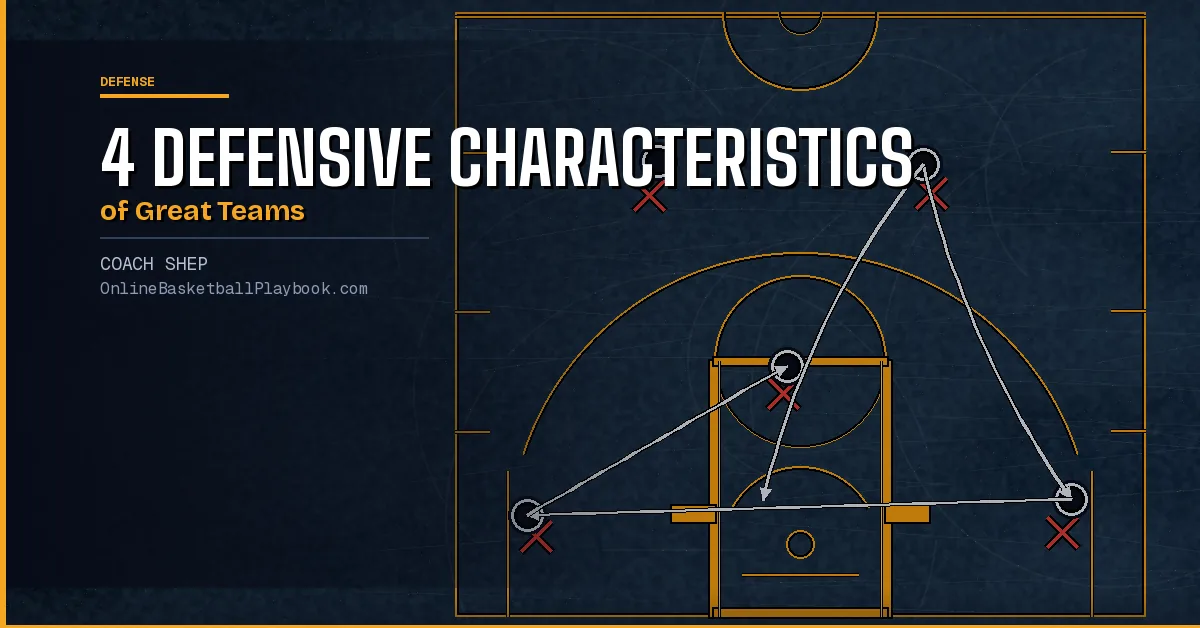
Great defensive basketball teams share a set of common traits. Whether you coach youth basketball or the varsity level, these four characteristics define every program that consistently locks down opponents night after night.
1. Relentless Competitive Effort
Defense is not a system. It is an attitude. The teams that dominate defensively over an entire season are not necessarily the most talented rosters on the floor. They are the ones who refuse to give anything away. Every possession matters. Every closeout is taken seriously. Every rotation is made on time, even when legs are tired and the game is already decided.
Relentless effort on defense means sprinting back in transition every single time. It means taking a charge when the easy play is to get out of the way. It means boxing out on every shot, not just the close ones. These details compound over the course of a game and a season. Teams that commit to this standard early, before the competitive schedule begins, develop a baseline of toughness that is very difficult for opponents to overcome.
The best way to build this in your program is through practice habits. If you allow loafing in drills, you will see loafing in games. The standard you set in early-season workouts becomes the floor for what your players believe is acceptable. Raise that floor and your defensive effort in real games follows. Your basketball practice plan should include specific moments that demand maximum effort on the defensive end, not just offensive reps.
Effort is also contagious. When one player makes a spectacular deflection or a diving loose-ball play, the bench reacts, the crowd reacts, and teammates lift their level. Great defensive teams create these moments deliberately. They celebrate effort plays as loudly as they celebrate made shots, which reinforces the standard across the entire roster.
2. Constant Communication
If you watch a great defensive team warm up, you will notice something before the game even starts: they talk constantly. Ball, ball, ball. Help left. Screen right. I've got your help. These are not suggestions. They are requirements. Defensive communication is the connective tissue that turns five individuals into a single coordinated unit.
Communication serves two purposes simultaneously. First, it gives teammates real-time information they cannot see. A guard fighting over a screen cannot see the helper rotating behind him. A call from a teammate tells him where to recover. That information changes how aggressively he can contest without gambling. Second, it keeps every defender mentally locked in. When you are required to call out every screen, every cut, every change in ball position, you cannot drift. Talking keeps you present.
The most important conversations on defense happen before the play develops. Pre-switch calls, ICE calls on ball screens, and early help announcements prevent breakdowns before they happen. Teams that communicate only after something goes wrong are always behind the play. Teams that communicate ahead of the action control the defense proactively. If you want to develop this in your players, study the help defense principles that elite programs use to keep everyone on the same page.
Communication is also a character trait, not just a skill. Players who truly buy in to the team's defensive identity understand that calling out a screen is an act of service. It benefits a teammate at no cost to themselves. Building a culture where players see communication as caring about the person next to them changes how seriously they take it. It stops being a coaching requirement and becomes part of who they are as defenders.
3. Shared Defensive Principles
Great defensive teams do not defend differently depending on who is on the floor. The principles do not change when the second unit comes in, when a starter is in foul trouble, or when the opponent throws something unexpected at them. The principles are the same for every player in the program, every night of the season.
Those shared principles typically include stance, ball pressure, help positioning, and rotation rules. Every player knows where to be when the ball is on the wing versus in the post versus above the three-point line. Every player understands when to stay attached to their man and when to sink into the lane. These decisions are not made in real time. They are trained. Players are conditioned to make the right read automatically because they have practiced it hundreds of times.
One of the most effective ways to build shared principles is through the shell drill. The shell drill is not complicated, but it is a complete representation of defensive philosophy. Where players stand in the shell tells you everything about what the coaching staff believes about team defense. Run it early, run it often, and hold every position accountable to the standard your system demands.
Shared principles also cover what happens in specific situations: ball screens, post feeds, skip passes, and baseline drives. When a ball screen happens, does every player on the floor know what to do? When the ball goes into the post, does the weakside wing know how to sink without losing their man? These answers need to be automatic. If players are thinking, they are slow. If players are slow, your defense breaks down.
Man-to-man principles and zone principles can coexist within the same program, but the underlying philosophy should be consistent. Effort, help, communication, and toughness are not system-dependent. They are cultural standards that apply in every defensive scheme you run. Check your man-to-man defense system to ensure your players can execute these shared concepts at full speed.
4. A Culture Built Around Defense
Culture is not a poster on the locker room wall. It is the combination of what coaches reward, what players celebrate, and what the program refuses to accept. Every elite defensive team has built a culture where stopping the other team matters as much as or more than scoring. The identity of the program is wrapped up in defense, not just offense.
Building this culture starts with what you do first in practice. If you run offensive sets before you ever talk about defense, you are sending a message. If the hardest minutes of your practice are devoted to defensive concepts and the scrimmages end with accountability for defensive breakdowns, you are sending a different message. Players pay attention to what coaches prioritize, and they build their own identity around those priorities.
Culture also lives in the language of the program. What do coaches say after a win? After a loss? When a player makes a great defensive play in a close game, does the coaching staff celebrate it on film as loudly as a go-ahead basket? The spoken and unspoken messages of a coaching staff shape what players value. Great defensive programs have coaches who genuinely believe that holding an opponent below their average is a victory worth celebrating.
Roster building matters here too. A player who refuses to defend, regardless of their offensive skill, is a threat to the culture you are building. Programs that consistently protect their defensive identity make difficult decisions about playing time based on who will commit to the standard. That consistency over time tells every returning player and every recruit exactly what the program stands for. For a deeper look at how culture translates to on-court results, the framework around building basketball team culture applies directly to defensive identity.
Defensive culture is not built in the first week of practice. It is tested then. The real culture reveals itself in February when legs are tired, rotations get sloppy, and the temptation to coast is at its peak. Teams that maintained their defensive standard in November still have it then.
Putting It All Together
These four characteristics (relentless effort, constant communication, shared principles, and a defensive culture) are not independent of each other. They reinforce one another. Culture makes effort the expectation rather than the exception. Shared principles give communication something specific to convey. Effort makes principles executable at game speed. Communication keeps culture alive when the game is hard.
The sequence for building a great defensive team usually starts with culture and effort (because those are coachable without any system in place) and then adds shared principles once players have bought into the standard. Communication is woven in from day one because it costs nothing and returns enormous value immediately.
Teams that get all four right become genuinely difficult to play against. Not because they are executing a clever scheme, but because every possession is contested, every rotation is made, every screen is called out, and every player understands their role in protecting the basket. Opponents begin to feel the pressure before plays even develop because nothing comes easy.
Transition defense is often where these characteristics are tested most severely. It is the moment where effort is visible, communication is urgent, and shared principles must function at a dead sprint. Teams with true defensive culture hold together in transition even when the previous possession ended badly. Explore the specific demands of transition defense to see how these four characteristics apply under the most challenging conditions.
Building These Traits in Practice
Every characteristic described above must be trained deliberately. Effort can be conditioned through competitive drills where the stakes are clear and loafing has consequences. Communication can be required explicitly. If a player does not call out a screen, stop the drill and reset. Shared principles are built through repetition at game speed in competitive scenarios. Culture is shaped by every decision a coach makes about playing time, praise, and accountability.
The most productive defensive practice sequences combine all four characteristics at once. A live 5-on-5 half-court drill with required verbal calls, clear rotation rules, and competitive scoring presses players to integrate effort, communication, and principles under pressure. When coaches add accountability (whether that is running, resets, or film review), the culture piece closes the loop.
Great defensive teams also spend time on the specific situations that break down under pressure: late-shot-clock possessions, ball screen coverage at the top of the key, post defense with weakside activity, and closeouts off skip passes. Repetition in these scenarios builds the automatic responses that make shared principles executable when the game is on the line.
Conditioning is an underrated component of defensive greatness. Tired players make slow rotations, miss calls, and give up on the principle. A basketball conditioning program designed around defensive demands (lateral movement, sprint recovery, and sustained effort over multiple possessions) directly supports everything else on this list. Teams that can defend at full intensity in the fourth quarter have a structural advantage that no offensive adjustment can fully overcome.
- Demand verbal calls on every screen, cut, and skip pass. No silent defense allowed in practice or games
- Run your shell drill daily until every position understands the principles without thinking
- Celebrate effort plays (charges, dives, deflections) as visibly as you celebrate scoring
- Make playing time decisions based on defensive accountability. Protect the standard consistently
- Add conditioning sets at the end of practice when players are tired to simulate fourth-quarter defense
- Review defensive film as often as offensive film. Show players what great defense looks like, not just mistakes
Get free play diagrams, drills, and coaching guides delivered weekly.
Draw this play free in the play drawer →
Membership: the full library, playbook packs, and Pro drawing tools →
Keep Building
Related breakdowns
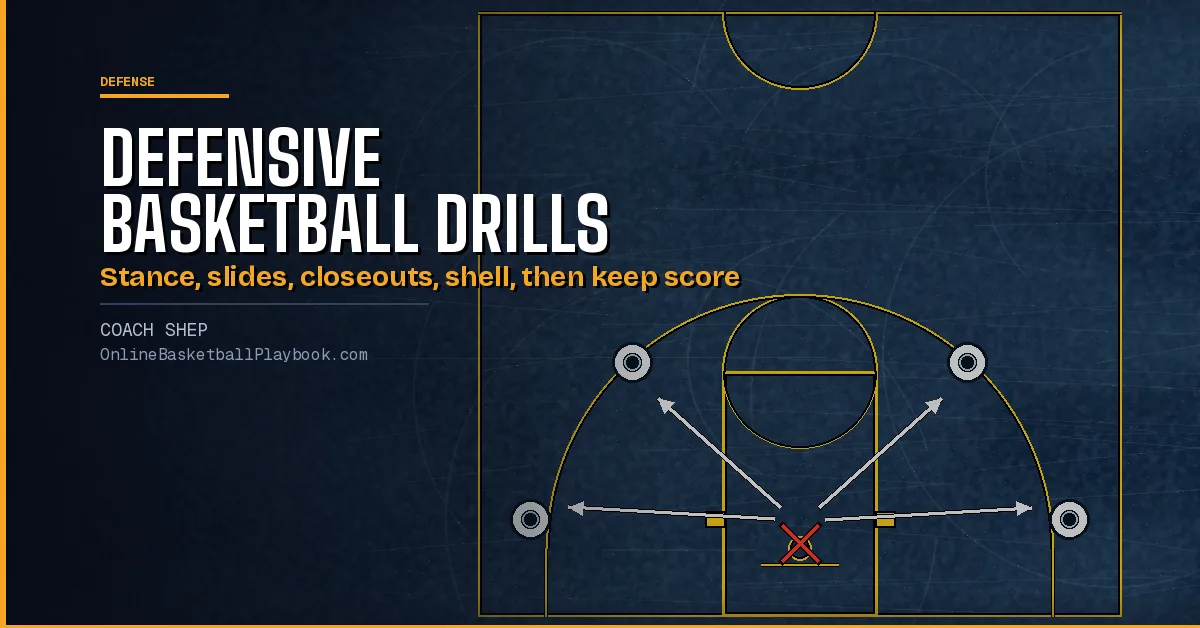
Defensive Basketball Drills: Slides, Closeouts, Shell and Games
Defensive basketball drills in teaching order, from stance and defensive slide drills to closeouts, pass denial, shell and scored games, with the versions coaches split on.
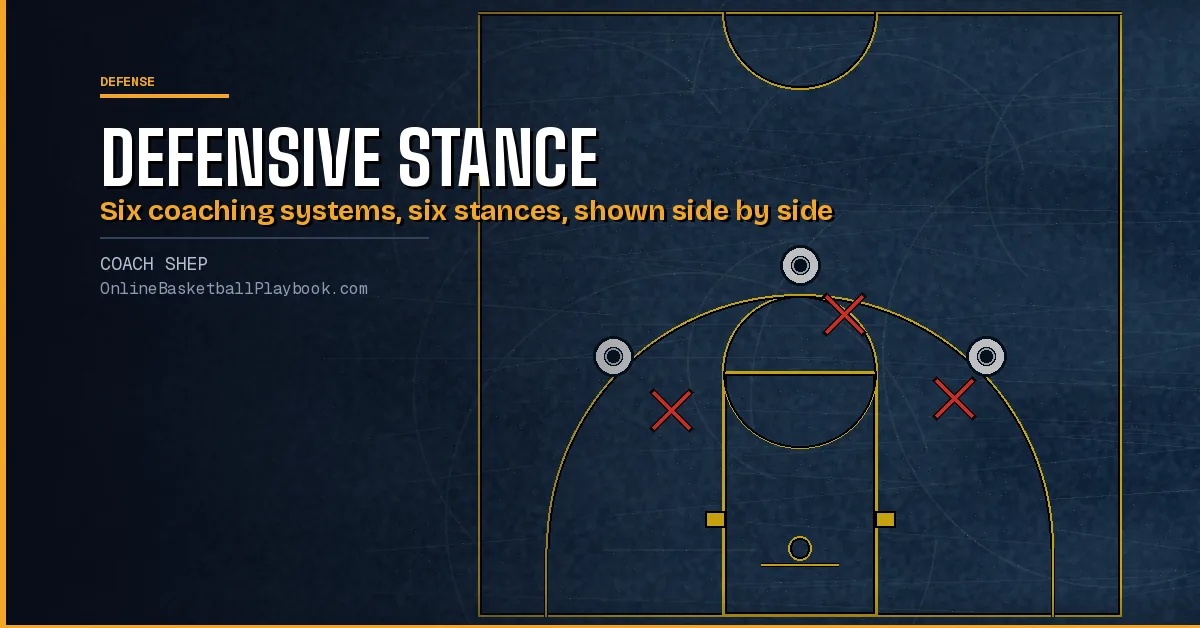
Defensive Stance in Basketball: Weight, Feet, Hands and Drills
Defensive stance in basketball: weight, feet, hands and eyes, the footwork out of the stance and the drills that build it.
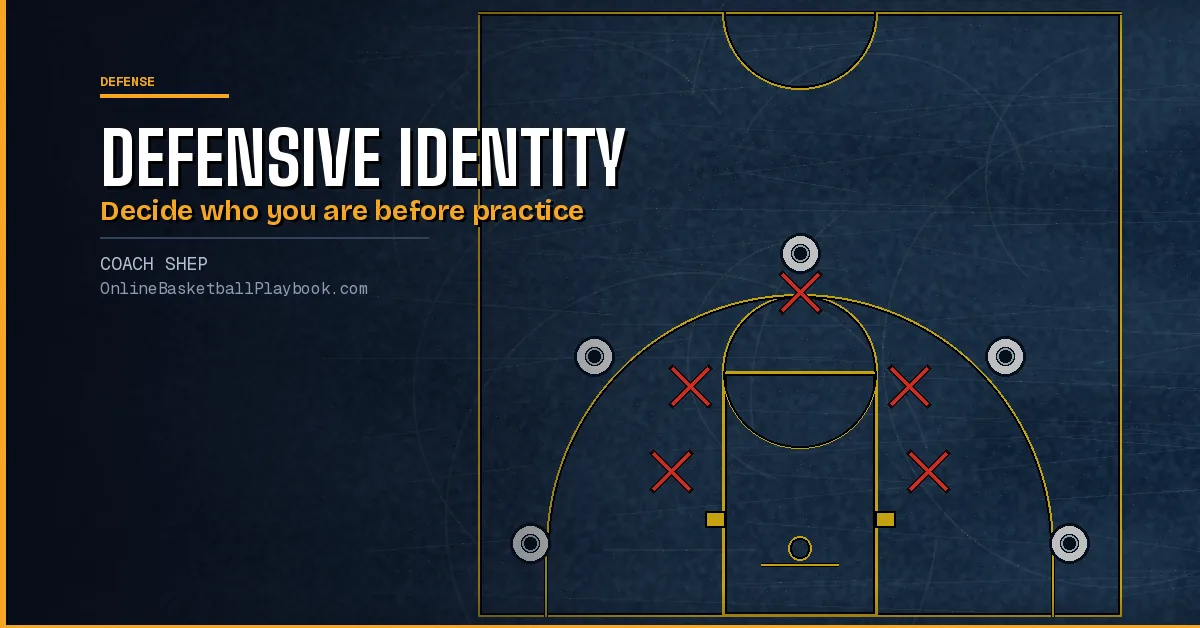
Defensive Identity Basketball: Choosing What Your Team Will Be
Defensive identity basketball coaches build on purpose: deny or pack, switch, force, press, zone, crash or get back, plus the standards that make it stick.