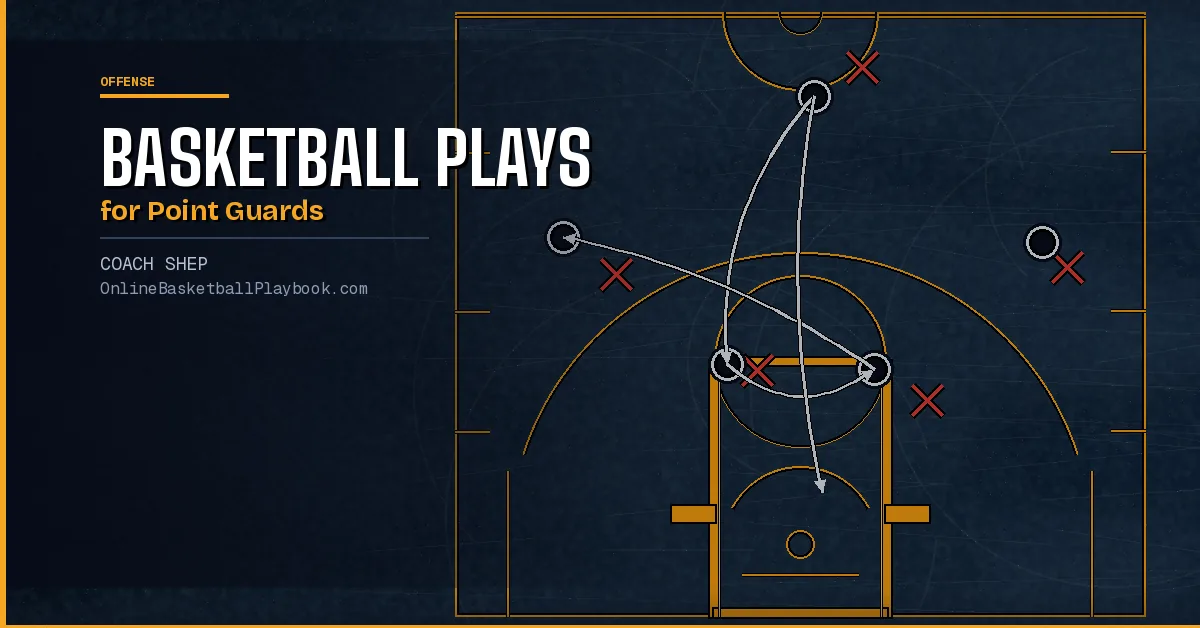
Point guards run the offense. These plays give your one-guard actions that create layups, open shooters, and put pressure on any defense from youth leagues to varsity competition.
What Point Guards Need from Their Plays
The point guard is the engine of every offense. Every play you draw up for the one-guard position should accomplish at least two of three things: create a high-percentage shot for the point guard, force a defensive decision that opens a teammate, or advance the ball quickly into an advantageous situation. Plays that only do one of those things are too easy to guard.
Before building a play package for your point guard, consider what the position demands. The one-guard must read pressure and pick-and-roll coverages, identify open cutters, make decisions in traffic, and still stay a scoring threat. When you design plays without those realities in mind, you end up with sets that work on the whiteboard and fall apart in games.
The best play packages for point guards are built around a small number of core actions (the pick-and-roll, the dribble handoff, and the middle-ball-screen) rather than a dozen unique sets that share no common DNA. Defenders can be confused through angles and combinations, not complexity. When your point guard runs the same footwork on three different plays, the reads become automatic and execution under pressure improves dramatically.
Developing basketball IQ In your point guard is just as important as diagramming plays. A one-guard who understands why a play works (not just the choreography) will make better decisions when the defense takes away the primary option.
Pick-and-Roll Actions
The pick-and-roll is the most versatile action in basketball, and for point guards it is the foundation of any modern play package. Every team at every level runs it. The question is not whether to use it but how to organize it so your point guard can make the right reads consistently.
Ball Screen Side Pick-and-Roll
Start your point guard at the top of the key. The screener (typically your four or five) sets a flat ball screen on the ball-handler's side, either right or left depending on your point guard's dominant hand and the defense you want to attack. The one-guard uses the screen, turns the corner, and reads the coverage.
Against a drop coverage, the guard pulls up for a mid-range jumper just inside the foul line. Against a hedge or hard show, the guard rejects the screen and attacks the now-vacant lane. Against a switch, the point guard isolates a mismatched defender on the drive or passes to the rolling big who now has a size advantage in the post. Teaching all three reads turns one action into three different ways to score.
Elbow Pick-and-Roll
Move the ball screen to the elbow (the intersection of the free-throw line and the lane line). This variation tilts the angle and forces the defense to adjust its communication and positioning. For point guards who are better pull-up shooters than straight-line drivers, the elbow screen creates a higher volume of clean catch-and-shoot opportunities off the popping screener and a better angle for the pull-up.
An elbow pick-and-roll into a corner kick pairs well with a strong corner shooter. The point guard turns the corner off the screen, draws two defenders, and hits the corner three. Run it repeatedly, and the defense will cheat the corner, at which point the guard attacks the lane.
How to Defend What You're Running
Understanding how teams defend pick-and-roll is critical for teaching your point guard which action to choose. If you want your one-guard to work on defending the pick and roll As well, that knowledge carries directly back into their offensive reads. Guards who have defended these actions understand hedges, drops, and switches from the inside, and they exploit each coverage more quickly.
Dribble Handoff Sets
The dribble handoff (DHO) is the pick-and-roll's close cousin. A player dribbles toward a teammate and hands the ball off, creating a screen in motion. For point guards, it offers a way to attack the defense while technically operating off the ball (an increasingly important skill as defenses key on one-guards at higher levels).
High DHO Into the Paint
Post your five at the elbow. The point guard passes to the wing and cuts to the elbow to receive a dribble handoff from the five. The timing is the key: the five picks up the dribble just as the guard arrives, creating a live screen. If the defense goes under, the guard pulls up for the elbow jumper. If the defense fights over, the guard continues to the lane. If the defense switches, the five seals a smaller defender for a post catch.
Wing DHO with Flare Screen
This set adds a flare screen to the standard handoff. The point guard receives the handoff on the wing while a second screener sets a flare on the guard's original defender. The flare forces a second defender to make a choice (help or stick with the flare) while the guard reads the primary coverage from the handoff. The result is a three-way decision: pull-up off the handoff, drive baseline, or hit the shooter off the flare.
Pairing DHO actions with good motion offense principles gives your point guard a framework for when to call a specific action versus when to let the offense flow. Point guards who can toggle between set plays and motion offense are far harder to scout and prepare for.
Teaching the Point Guard to Read
Plays get open looks. Reads turn open looks into made shots. The gap between a point guard who runs plays and a point guard who makes plays live in the reads (the split-second decisions made after the primary action unfolds and the defense responds).
Read the Second Defender
Most plays are designed to attack the first defender (the one guarding the ball). But the scoring opportunity almost always comes from what the second defender does. If the weak-side help rotates early, the corner is open. If the help stays home, the paint is available. Teach your point guard to scan for the second defender before the dribble ends, not after.
Go-Under vs. Go-Over the Screen
Tony Parker's principle applies directly to point guard play: never expose yourself unnecessarily. When a defender goes under a screen, the correct read is to pull up for the jumper, not drive into a collapsed defense. When the defender goes over and fights through, the correct read is to reject the screen or split the coverage. Point guards who make the same move regardless of the coverage are easy to stop.
The Hesitation Read
One of the most effective tools for a point guard is the hesitation dribble (a pause that forces the defender to commit). After a ball screen is set and the guard turns the corner, a well-timed hesitation freezes both the on-ball defender and the help. If the help rotates, the guard kicks. If neither moves, the guard attacks the frozen defense. The key is reading the reaction, not predetermining the move.
That principle shapes how point guard plays should be practiced. Drill the reads more than the choreography. A guard who has made the correct decision a thousand times in practice will make it automatically in a game, which means fewer wasted dribbles and more efficient possessions.
Transition Plays for the Point Guard
Point guards are at their most dangerous in transition (when defenses are disorganized and the court is wide). A point guard who can push the pace, make quick decisions, and either finish or find an open teammate before the defense sets up is worth more than any half-court set.
The Early Offense Initiative
Early offense is not a fast break. It is what happens between the fast break and the half-court set. The point guard receives the outlet, pushes ahead, and attacks the defense before it fully loads. If no advantage exists, the guard decelerates and the half-court offense begins. The decision to push or slow down must be made in under two seconds, which is why point guards who have run fast break principles in practice make better decisions in early offense situations.
Drag Screen in Transition
The drag screen is one of the most effective transition plays for a point guard. As the one-guard pushes the ball up the floor, the five sprints ahead and sets a ball screen near the three-point line before the defense is set. The guard uses the screen in transition, creating a numbers advantage. Defenses that sprint back to stop the fast break often aren't positioned to guard a ball screen at the top of the key, which means the guard gets the same pick-and-roll reads from the half-court in a much less organized defensive picture.
Secondary Break Actions
After the initial push, the secondary break creates structure from transition. Common secondary break actions for point guards include the wheel action (a guard-to-forward pass followed by a back cut and dribble-entry for a ball screen), the push-middle (the one-guard drives middle off the initial push and dishes to a trailing shooter), and the early post-up (the point guard skips to the corner while the five seals before the post defender is set). Each of these gives the point guard a structured action to run if the primary fast break doesn't yield an advantage.
Drilling These Plays in Practice
A play is only as good as the players who execute it. Point guard plays in particular require repetition with live reads (not just choreography in a walk-through). The following approach builds execution from the ground up.
Skeleton Reps First
Begin with skeleton offense (a passive defender who shows coverages without live pressure). The point guard learns to recognize the coverage and make the corresponding read without the chaos of a live defender. Run each action fifteen to twenty times against each coverage before progressing to live work. This approach is especially effective for pick-and-roll reads, where the coverage varies more than any other action in the half-court.
Build Conditioning Into Skill Work
The worst time to make a read is when you're tired. Design your point guard drills so the decision-making happens on fatigued legs. Run the ball screen action at the end of a conditioning circuit, not before it. A point guard who can make the right read in the fourth quarter, when breathing hard and legs heavy, is a point guard who has trained the right way. A well-structured basketball practice plan builds these game-condition reps deliberately rather than leaving them to chance.
Film and Feedback
Point guards develop faster when they can see their own decisions on film. After live scrimmages or controlled play work, review two or three possessions with the one-guard and identify the key read (what the second defender did, what coverage the screener drew, and whether the decision matched the situation). This feedback loop shortens the time between learning a play and executing it under pressure.
When a point guard consistently makes the wrong read on a pick-and-roll, resist the instinct to change the play. First, confirm the guard can identify the coverage (hedge, drop, or switch) before the ball reaches the screen. Misreads are almost always a recognition problem, not a footwork or decision problem. Fix the recognition, and the reads correct themselves.
- Run the pick-and-roll from multiple angles (top, side, elbow) so the guard learns to read coverage from different positions on the floor.
- Pair dribble handoff actions with a flare screen on the weak side to create a two-player decision for the defense on every possession.
- Teach the hesitation dribble as a read tool, not a highlight move. It freezes defenders and forces commitments that open driving lanes or kick-out passes.
- Use the drag screen in transition before the defense sets up; point guards who master this action score easy baskets without running a half-court set.
- Practice all play actions against each coverage (drop, hedge, switch) in skeleton form before adding live defense. Correct reads must become automatic before pressure is applied.
- Drill point guard plays at the end of conditioning work so that decision-making is trained on tired legs, matching the game conditions when these reads matter most.
Get free play diagrams, drills, and coaching guides delivered weekly.
Draw this play free in the play drawer →
Membership: the full library, playbook packs, and Pro drawing tools →
Keep Building
Related breakdowns
Basketball Positions: What Each of the 5 Positions Does
The point guard, shooting guard, small forward, power forward and center, what each one does on offense and defense, and when to ignore the numbers.
Basketball Game Clock Rules: When It Stops and When It Starts
Basketball game clock rules by level: when the clock stops, when it starts on a throw-in or a missed free throw, made baskets late and the last-two-minute rules.