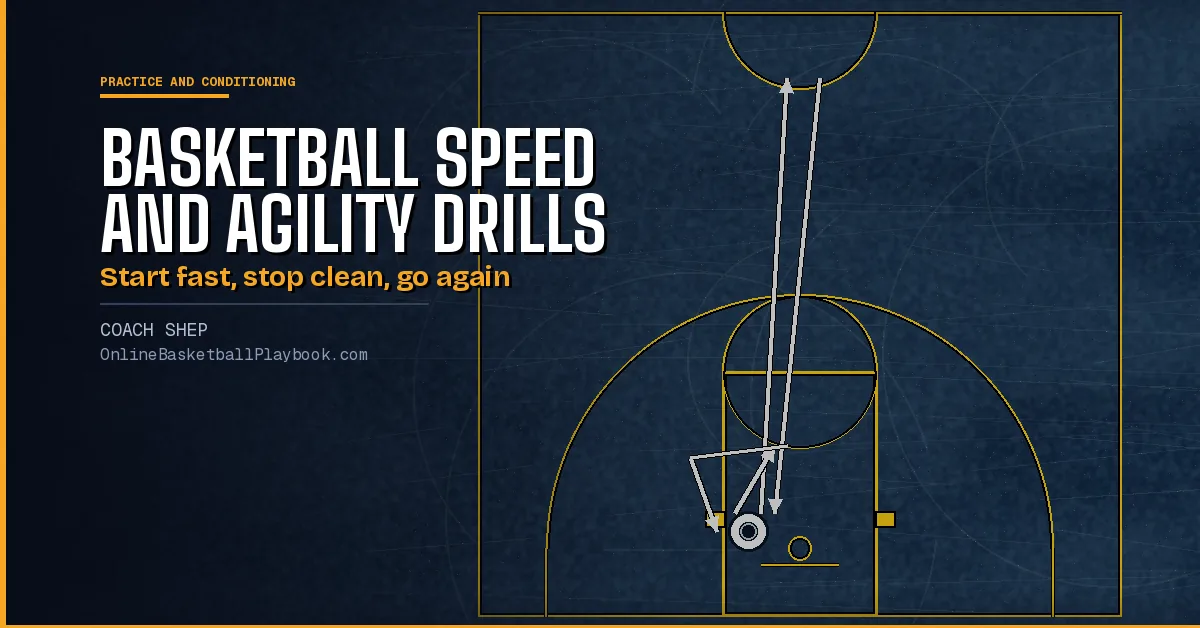
Basketball speed and agility drills train a player to start fast, run short distances at full speed, stop under control and go again in a new direction. The game is a string of short bursts, so the drills are short too, with real rest between reps. This guide covers the energy system behind that rule, the mechanics of stopping, straight-line sprint and start work, court drills with cones and a ladder, an eight-week summer plan, tests and the places where coaches disagree.
Cone-test and reaction drills such as the lane agility test, the 5-10-5 and the partner mirror are on the basketball agility drills page, so this page leans on sprints, starts and stops.
Basketball Speed and Agility Drills at a Glance
| Drill | What it trains | Dose |
|---|---|---|
| Short sprints | Straight-line acceleration | 10, 20 and 30 yards, 2 sets each, 2 minutes rest |
| Shuffle to sprint | A lateral start that turns into a sprint | 5 yards of shuffle and 10 of sprint, each direction |
| Lateral bounding and backpedal | Side-to-side power and the backward start | 10 yards, 15 from week 3, bounding 20 from week 5, 2 minutes rest |
| Lateral and linear circle drills | Slides and sprints on a curve, then a plant | 5 sets of 30 seconds |
| Rebound and transition | Land, turn the hips and sprint | 5 repetitions |
| Perimeter closeout cones | Sprint, plant and shuffle | One trip around three cones per rep |
| Lane slide with turn and go | A slide that breaks into a sprint on a call | 5 to 7 seconds of slides, then the sprint |
| Speed ladder rip and go | Foot speed into a catch and drive | Six ladder moves, each done twice |
| Jump rope circuit | Quick, light feet | 20 seconds per exercise, rest falling from 30 to 10 seconds |
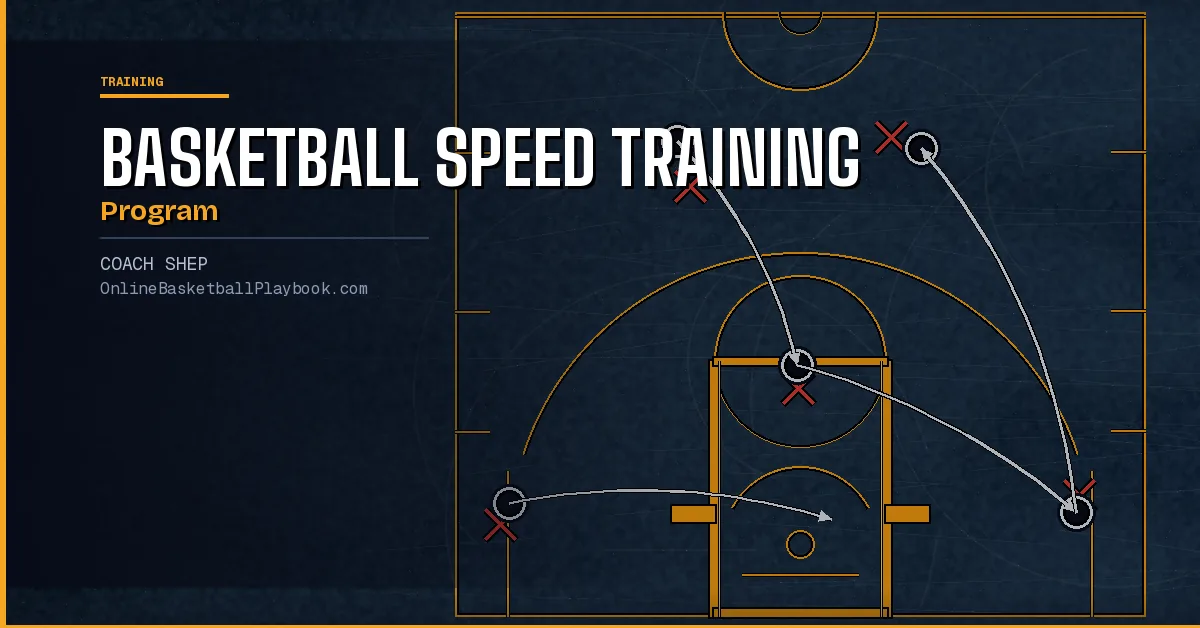
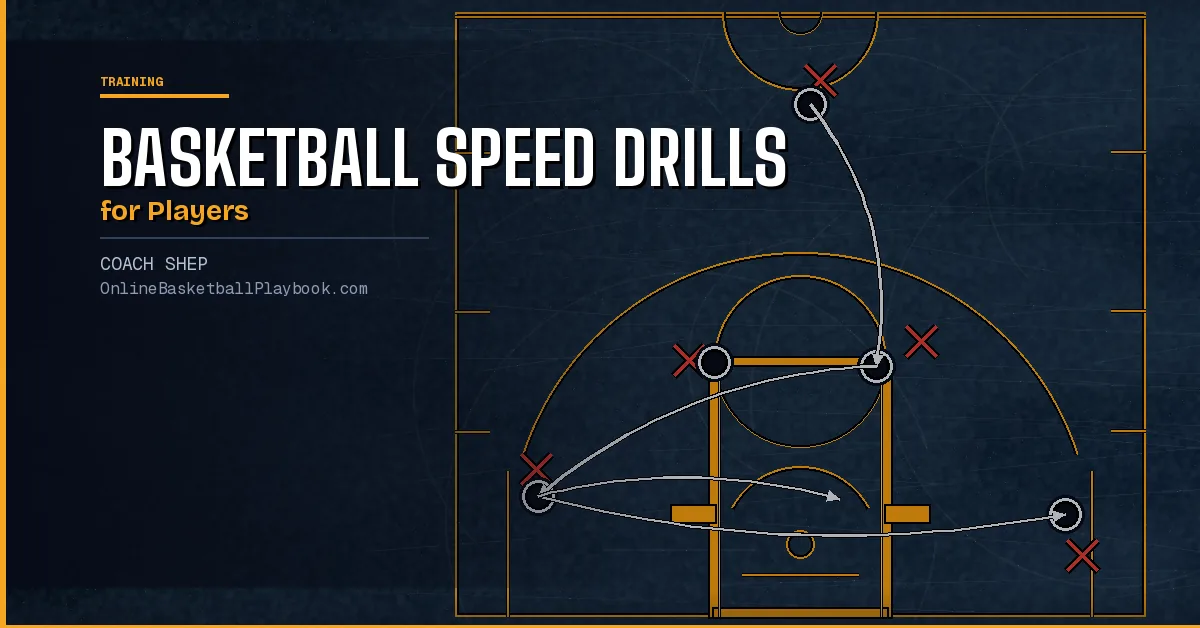
The doses are the ones each drill is run with. Two pages cover the neighbors of this work: basketball speed drills for players and the basketball speed training program page.
Why the Work Stays Short
Basketball is a string of short bursts, so train short bursts with real rest.
- Match the game's ratio. Game studies put basketball's work-to-rest ratio near 1 to 3.6, a change of activity about every 3.8 seconds, and per-game counts of 105 forward sprints and 63 high-intensity lateral or backward shuffles.
- Train near 1 to 3 or 1 to 4. Keep the intensity at game level and add lateral and backward shuffling to forward sprinting. A sample format is 10 seconds of hard sprinting and 30 seconds of active rest.
- Skip long, slow runs. Avoid long, slow endurance runs. Two miles on a track trains the wrong energy system for this sport, and sprint and agility work trains the fast-twitch fibers used to jump and cut.
- Cap all-out efforts at 60 seconds. Keep work to rest at 1 to 3 early in the year and 1 to 2 as fitness builds.
Coaches split on the aerobic base. A women's college team called the game anaerobic but still ran timed 12, 15 and 18 minute runs before its in-season intervals, and a year-round periodized plan opens with an aerobic base phase. The split is real, and it is laid out near the end of this page. The fitness side of it lives on basketball conditioning drills.
Keep every rep short and every rest long enough to go again at full speed.
Speed Starts With Stopping
Deceleration is half of basketball speed. The fastest straight-line players are not always the quickest at changing direction, because they cannot control their own momentum.
Three kinds of deceleration show up in the game.
- Intentional stop. A tactic, such as selling a stop to relax a defender before exploding past him.
- Intentional slow-down. Easing off on purpose.
- A cut sharp enough to cost momentum. A reaction, such as a defender stopping because the offense moved.
The mechanics use a defensive slide to the right as the example.
- The outside foot. Wide enough to stop the momentum but not so wide that it slips, pointed straight ahead or turned slightly in, with the ankle cocked (dorsiflexed) to protect it and load the next push.
- The knees. Inside the width of the plant foot, so the force runs straight down the leg. The common "knee over toe" cue is dangerous on a lateral stop because it can roll the ankle and push the knee out.
- The hips. Level through the stop, and not dropped very low, since an extra-low stance takes more strength to hold and slows the next move.
- The upper body. No sway. Shoulders that keep drifting after the legs stop slow the change of direction, and weak core and low-back strength are tied to that.
- The head. Still, with the eyes on the target, because the body follows the head.
The teaching point is about attention. The player thinks about the change of direction, not the stop. If the lower body is set right, the next push is the same stance continuing. This footwork for defense is on basketball defensive footwork and for closeouts on closeout technique. Own the stop and the change of direction follows.
Sprint and Start Drills
Give one whole training day a week to straight-line and lateral speed, and rest long enough that each rep stays at full quality. An eight-week summer plan builds it this way.
- Week 1. Lateral bounding for 10 yards, a backpedal for 10 yards, a shuffle to sprint of 5 plus 10 yards in each direction, and sprints of 10, 20 and 30 yards, two sets each with two minutes of rest.
- Week 3. The bounding and backpedal grow to 15 yards and a 40-yard sprint is added.
- Week 5. The sprints are 20, 40 and 60 yards, and the backpedal becomes a backpedal into a sprint.
- Weeks 7 and 8. The 10-yard sprints come back.
Lane slide with turn and go. This drill joins the slide to the sprint. Players slide for 5 to 7 seconds and then turn and sprint on a whistle or a "go" call, and a clap can change the slide direction before the go.
Three-length check drill. A "check" call sends a group back to the nearest marker to change direction and go again, with zero to three calls per length so the players cannot predict it.
Add the power side. A year-round periodized plan brings speed and acceleration work in with its strength phase, and its power phase adds overspeed drills such as downhill sprints. It sets rest for repeated sprints at a rest-to-work ratio of at least 3 to 1 for efforts over 120 meters and at least 5 to 1 for efforts under 120 meters. For the first step itself, see how to improve your first step.
The long rests keep each rep at full quality. Sprint hard, rest fully and stop under control.
Court Drills With Cones and a Ladder
Put the speed work on the court in basketball shapes. The coaching point for the circle drills is to stay low and in good athletic form for the whole rep, because form that breaks down builds a bad habit.
Lateral and Linear Circle Drills
Each runs 5 sets of 30 seconds on the half-court circle or a free-throw circle. In the lateral drill the player faces into the circle in an athletic stance and slides around the line at full speed. When he gets back to his starting spot he plants and slides back the other way. The linear drill sprints the circle instead of sliding. Either one becomes a race with a partner who follows and tries to catch the leader.

Rebound and Transition
The player starts in the lane even with the block in an athletic stance. On the whistle he jumps as if catching a rebound, turns his hips the moment his feet land and sprints to a cone, then backpedals to the start. He jumps again at once, sprints to a second, farther cone and backpedals back. That is one repetition, and he does five.
Race it. Start two players together. The "rabbit" picks either cone first and the "chaser" must copy him, and the loser does 10 push-ups.

Perimeter Closeout Cones
The player starts below the basket and sprints to the top of the key. He plants, shuffles to a cone on the left wing, plants and shuffles back to the top of the key, then to the right wing cone and back. From the top of the key he turns and sprints through the start under the basket.

Tennis Ball Races
Two racing drills end at a tennis ball.
- Race through the cones. Players start outside the three-point line and on the whistle sprint or slide through a set of cones to reach the ball before a competitor.
- Face off in the cones. Two players face each other, each in the center of his own set of cones. They cut to a cone on the arc, then to a cone near the rim, drop-step back to touch a final cone and race for the ball.
Speed Ladder Rip and Go
The player works six footwork moves through a speed ladder, each one twice before the next. Out of the ladder he sets his feet with quick "machine-gun feet," catches a pass from a coach, rips the ball low and drives to the rim, alternating sides each rep. Keep ladders in individual work and out of team practice, because they build foot speed, not a change of direction against an opponent.

Get the next coaching guide in your inbox
One email when a new guide or diagram set goes up. Free.
An Eight-Week Summer Plan
Run the summer plan three days a week with no lifting. Each day has one theme.
| Day | Weeks 1 to 4 | Weeks 5 to 8 |
|---|---|---|
| Day 1, footwork and agility | Speed ladder (forward two feet in, lateral two feet in, Ickey shuffle, lateral in-in-out-out), then the X-drill, T-drill and lane agility drill with 2 minutes rest, and full-court zig-zag sprints with a walk back | Mini hurdle hops (two legs, single leg, high knees, lateral high knees) replace the ladder. The X, T and lane drills run the pattern twice with 3 minutes rest |
| Day 2, speed | Lateral bounding, backpedal, shuffle to sprint, sprints of 10, 20 and 30 yards (40 from week 3) | Sprints of 20, 40 and 60 yards (10 yards back in weeks 7 and 8), backpedal into a sprint |
| Day 3, rope and reaction | Jump rope circuit (two legs, alternating, side to side, single leg) at 20 seconds each, 5 minutes rest, then the 3-cone drill, a mirror drill and full-court up and backs | Same circuit with shorter rest, and a change-of-direction drill replaces the up and backs |
Volume climbs before distance.
- Add sets. Sets on the agility drills rise from 2 to 4 by week 4, then restart at 2 when the doubled patterns begin.
- Shorten the rope rest. Rest between rope exercises falls from 30 seconds in weeks 1 and 2 to 10 seconds in weeks 7 and 8.
- Stretch the mirror drill. It grows from 15 to 30 seconds.
The plan names its drills without describing them and has no warm-up, strength work or ball work, so a coach supplies those. The lane agility and 5-10-5 patterns are drawn on the agility drills page, and a fuller off-season frame is on basketball conditioning programs. Run the plan as written, then add the warm-up and ball work.
Where Speed Work Fits in the Year
Place the work by these rules.
- A short block early in practice. Keep it to 10 to 15 minutes right after the warm-up, 2 or 3 drills a session, more often in the off-season and once a week in season.
- A phase in the year. Run base, hypertrophy, strength and power phases of 4 to 8 weeks each, add speed and agility in the strength phase and keep in-season work to 1 or 2 days a week. Plyometrics are not recommended under age 16.
- High days and low days. Never stack max sprints, heavy lifts and intense jumps back to back. Alternate them with low-intensity tempo days, because the nervous system is usually the limit. Jump work belongs with plyometric drills on that schedule.
- Test, then retest. Take a baseline with a beep test, a 40-yard dash, a vertical jump and a shuttle run, build the program from it and retest. A year-round plan tests a T-drill, a half-court sprint and a fatigue test of ten three-quarter-court sprints, where a power-maintenance ratio above 0.9 rates excellent.
- Tilt it by role. Give guards more agility and speed work and forwards and centers more strength and rebounding work.
Preseason sequencing is covered on basketball preseason conditioning. Put the speed work where it fits your year and keep it fresh.
Where Coaches Split
Coaches split on four questions.
Build an aerobic base first?
- Short bursts from the start. No long runs, 1 to 3 or 1 to 4 work to rest.
- An aerobic base, then intervals. Timed runs in preseason, then intervals.
How much rest between reps?
- Two to three minutes. Every rep is full quality (the summer plan).
- Game-like ratios. Such as 10 seconds on and 30 seconds of active rest.
Ladders in team practice?
- Individual work only. They build foot speed and not reaction.
- Ladders first. Ladder work as the first block of a speed day, or into a catch and drive.
Separate running at all?
- A block of its own. A speed and agility block.
- Run inside basketball work. No separate conditioning runs, with fitness built inside shooting and transition drills.
Drills that put the running inside basketball work are on fast break basketball drills. Settle the four questions before the season and keep to the answers.
Want the printable playbook packs?
OBP Pro members get the premium playbook packs: the zone attack, out of bounds and practice plan PDFs, plus each new pack as it is finished. The membership page lists what is in each one. Or draw your own version free in PlayDraw.
See what OBP Pro includesQuestions Coaches Ask
What are the best speed and agility drills for basketball?
Short sprints and shuffle-to-sprint starts, circle drills, the rebound and transition drill, closeout cones and ladder work into a catch and drive. Keep each rep short and rest long enough to go full speed again.
How long should a speed and agility session be?
Keep the block to 10 to 15 minutes with 2 or 3 drills, right after the warm-up.
How many days a week should players do speed and agility drills?
The eight-week summer plan uses three days a week. Do it more often in the off-season and once a week in season.
How do you get faster for basketball?
Train short sprints at full speed with full rest, and train the stop as hard as the start, since a player who cannot stop cannot change direction quickly.
Are ladder drills good for basketball?
They build foot speed. Keep them to individual workouts because a ladder does not react like an opponent.
What is the difference between speed and agility drills?
Speed is straight-line pace, quickness is the first step and agility is stopping and changing direction under control.
More Guides From This Batch
- Fast Break Basketball Drills for Youth and Varsity Teams
- Pick and Roll Basketball Drills: From 2 on 0 to Live Reads
- Flagrant Foul in Basketball: Rule, Penalties and Calls by Level
- Jab Step Basketball: How to Do It and How to Teach It
Back to Practice Plans and every Practice and Conditioning page.
Keep Building
Related breakdowns
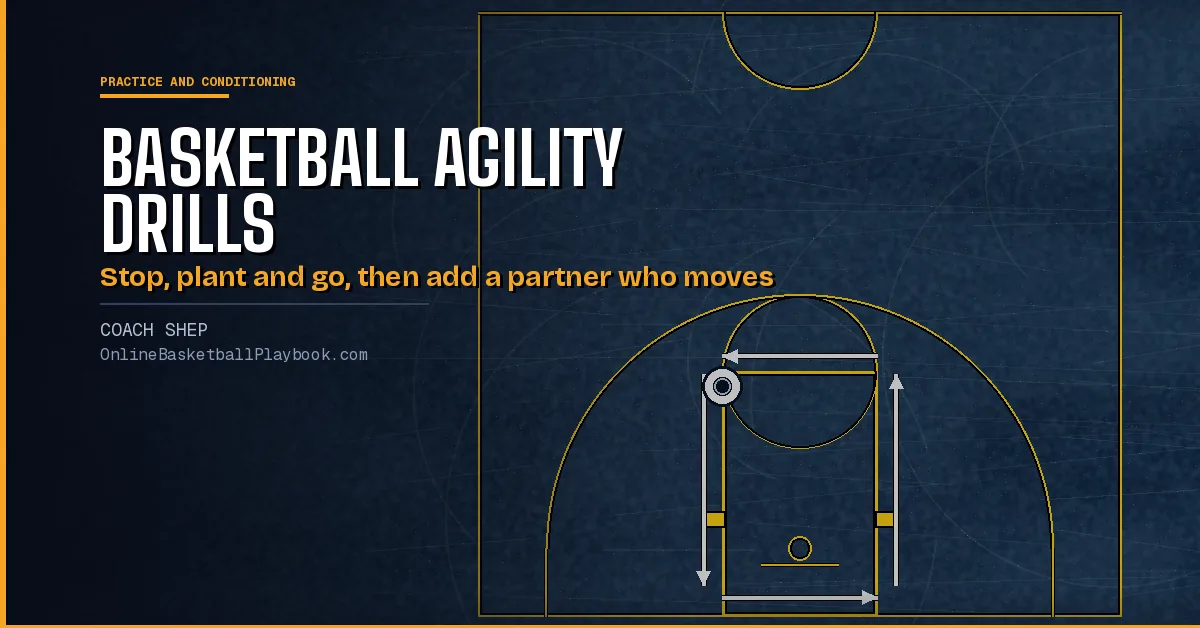
Basketball Agility Drills: Cone, Reaction and Ladder Drills
Basketball agility drills from timed cone tests to reaction, mirror and ladder drills and defensive circuits, with schedules and where coaches differ.