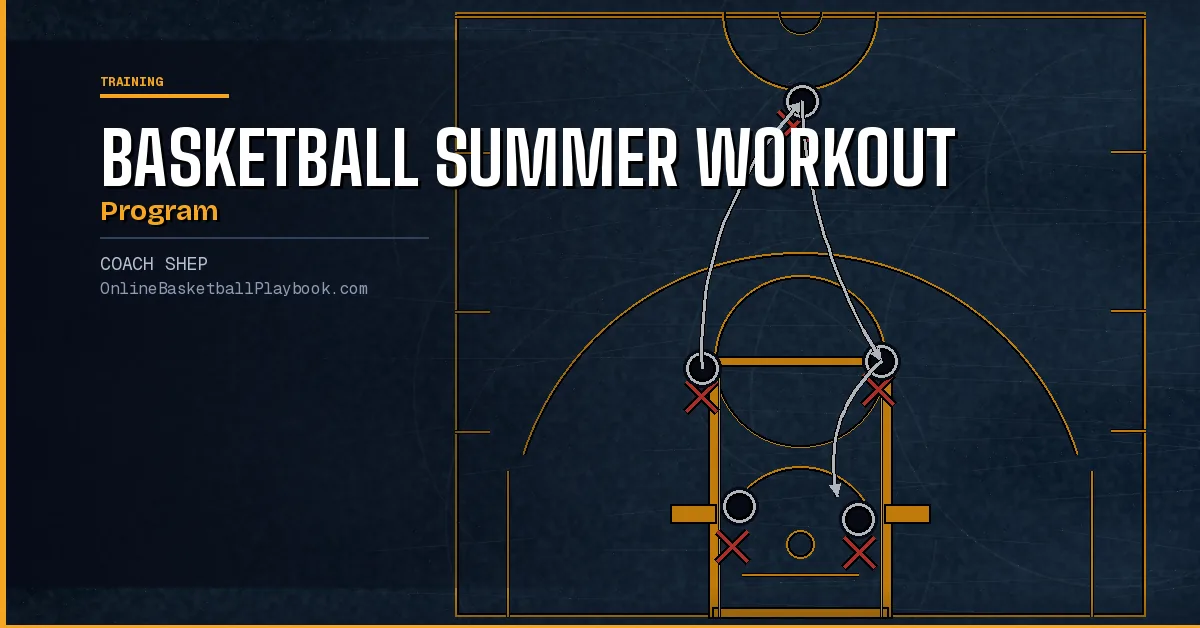
Summer is the off-season window where real player development happens. This program gives you a structured, week-by-week approach to build the skills, conditioning, and basketball IQ that show up when the season starts.
Why Summer Training Matters Most
The players who separate themselves don't do it during the season. They do it in the gym in July when no one is watching. Summer is the longest uninterrupted window a player gets to work on their game without the pressure of film, scouting, or opponent prep getting in the way. It's the time to break old habits, install new skills, and build the physical base that every in-season demand will draw on.
Most players waste this window. They shoot around with no plan, no tracking, and no progression. They put in time but not work. An hour of purposeful, tracked, competitive reps beats three hours of aimless gym time every single time. The goal of a summer program isn't to get tired. It's to get better.
The summer is also the right time to work on your basketball player development in a systematic way. When there's no game on Friday, you can afford to take your handle apart and rebuild it, to shoot from spots you're uncomfortable with, and to train the footwork patterns that feel awkward before they feel natural. That discomfort is exactly where growth lives.
Coaches notice summer workers before the first preseason practice. Players who show up to tryouts with a tighter handle, a quicker release, or better conditioning didn't get that way by accident. They had a plan and they executed it over 8 to 12 weeks. That's what this program is designed to give you.
How to Structure Your Summer Program
A summer basketball program should be built around three pillars: skill development, conditioning, and recovery. Most players focus only on the first and ignore the other two, which limits how much the skill work actually sticks. Your body needs volume to build motor patterns, but it also needs rest to consolidate what you've trained.
The most effective summer programs run 5 days per week with intentional variation across the week. Not every day should be max-intensity. A typical week looks like this: two heavy skill days, one conditioning-focused day, one lighter shooting and ball-handling day, and one competitive or team-play day. That fifth day of pick-up or team work is where you test what you've been building in isolation.
Every workout session should follow a consistent internal structure: warmup and activation (10 minutes), ball-handling and footwork (15–20 minutes), the main skill block (25–35 minutes), shooting on fatigue (10 minutes), and a brief cool-down. That total is 60 to 75 minutes. If you're going longer than 90 minutes regularly, you're probably going at less than game speed, which defeats the purpose.
Pair your skill work with a basketball practice plan mindset even in individual workouts. Know what you're going to work on before you step in the gym. Have a target number of makes. Know your previous record so you can beat it. Structure is what separates a player who improves from a player who just shows up.
Skill Progressions for Every Position
One of the most important principles of off-season development is that skill progressions should move from simple to complex, from stationary to moving, and from controlled to competitive. You don't start with contested game shots. You start with form, then footwork, then the full move, then competition. Skipping steps in that chain produces habits that break down under pressure.
Guards
Guards should anchor their summer around three areas: ball-handling under pressure, pull-up and mid-range shooting off the dribble, and finishing at the rim with both hands. Ball-handling is the foundation. Start every session with stationary moves, then stationary combination moves, then movement, then full-speed attack situations. Work the ball handling drills that simulate the decisions you'll face in games: tight space, change of speed, change of direction.
For shooting, guards need to log serious volume at the pull-up and off-the-catch. Every shooting block should end with a game-speed shot off an action: a dribble handoff, a DHO into a step-back, a catch-and-shoot off a pin-down. Practice the exact mechanics of basketball shooting form first, then layer the game action over it. By the end of summer, pulling up in rhythm off the dribble should feel as automatic as a spot-up catch-and-shoot.
Wings
Wings need to develop in both directions. They need a credible handle for ball-screen actions and isolation situations, and they need a reliable catch-and-shoot game from the corners and wings. Summer is also the time for wings to work their post entry and mid-post game. Even if you're primarily a perimeter player, spending time in the post builds body control, footwork vocabulary, and a skill set that defenders can't scheme out of you.
Bigs
The modern big needs to shoot. If you're a post player who can step out to 15 feet (or better, to the arc), you change the geometry of every offense you play in. Summer is where bigs earn that range. But it starts with footwork, not shooting. Spend the first few weeks of summer locking in drop steps, up-and-unders, and rip-throughs before adding the mid-range and three-point work. Footwork is what separates a shot from a bucket.
Conditioning and Athletic Development
Basketball conditioning is not just running. The sport demands short explosive bursts, lateral movement, the ability to sprint and stop and sprint again, and the cardiovascular base to sustain all of that for 32 to 40 minutes of playing time. Your conditioning program should reflect that reality.
The best summer conditioning for basketball combines three elements: linear speed work (sprints, starts, finishes), lateral agility (defensive slides, closeout patterns, shuffle ladders), and sport-specific conditioning (full-court transition runs, timed suicides, 17s). Linear speed builds the athletic base. Lateral work builds the defensive athleticism that separates committed players. Sport-specific conditioning builds the engine you'll actually use on the floor.
Check out basketball conditioning drills for specific workout protocols you can layer into your summer program. The general principle is this: condition in a way that mirrors game demands. Run at game speed, stop at game speed, and recover for game-realistic rest intervals.
Weight training is a valuable supplement but not the anchor of a basketball-specific summer program. For high school players, two to three days of strength training per week is appropriate, focused on posterior chain development (glutes, hamstrings, lower back), explosive hip work (jumps, med ball), and shoulder stability. The goal is to be more athletic on the court, not to add mass for its own sake.
Tracking Reps and Measuring Progress
Players who track their workouts improve faster than players who don't. This is not a suggestion. It's one of the most well-supported principles in skill acquisition. When you record how many makes you hit in a block, when you clock yourself on a drill, when you set a personal record and try to beat it next session, you introduce the kind of productive pressure that mirrors competition. You can't fake it. The chart doesn't lie.
The most practical tracking system for a summer program is a simple workout log. Write down the date, the blocks you trained, your make counts, and your times. Star your personal records. At the end of every week, review it. Are you hitting your targets? Where are you stalling? What did you skip? The log holds you accountable when no coach is in the gym with you.
A good tracking structure for shooting blocks works like this: set a target (make 20 of 25 from the right wing), attempt the block, record the result, rest, and move to the next spot. As you progress through the summer, raise the targets. If you started July making 15 of 25 and you finish August making 22 of 25, that's measurable growth. That's what summer is for.
Also track your athletic benchmarks. Time your sprint drills. Count your made free throws under fatigue. These numbers give you a baseline and a progress line. When September comes, you want to be able to point to specific data that proves you are a better player than you were in June.
Always shoot free throws tired and counted inside your workout, not fresh at the end as an afterthought. Make them the consequence of the conditioning work so your body learns to execute mechanics under physical stress, exactly like late-game situations demand.
Sample Weekly Schedule
What follows is a model 5-day summer week. Adjust the volume and intensity based on age, current fitness level, and whether you're also playing in summer league. If you're playing games two or three times per week, reduce the heavy days to one and treat the game days as your competitive reps.
This schedule assumes a player working independently or with one partner. It is scalable. Add a third player and you can run most of the shooting progressions off live reads and ball movement, which is the bridge toward motion offense in basketball principles you'll use in team settings.
Monday: Skill Day (60–75 min)
Warmup → ball-handling combination work (15 min) → shooting off the dribble from five spots (25 min, logged makes) → free throws on fatigue (10 min). Focus: your primary skill gap from last season. Chart every shooting block.
Tuesday: Conditioning + Footwork (45–60 min)
Dynamic warmup → footwork ladder and defensive slides (15 min) → timed sprints or 17s (20 min) → finishing footwork at the basket: drop step, up-and-under, Euro (15 min). Keep intensity high and rest intervals honest. Review basketball footwork drills to build this block out with specific progressions.
Wednesday: Lighter Skill Day (45 min)
Lower intensity. Form shooting from close range (10 min) → stationary and moving ball-handling (15 min) → catch-and-shoot from your favorite spots (20 min, no time pressure). Wednesday is a recovery day with a ball in your hands. Keep the volume moderate.
Thursday: Heavy Skill Day (75 min)
Ball-handling → your signature move with 2–3 counters drilled in sequence (25 min) → competitive shooting: 1-minute make challenges at different spots (20 min) → post or mid-range work specific to your position (15 min) → free throws on fatigue (10 min). Thursday is your hardest workout day.
Friday: Competitive Day
Pick-up game, open gym, or team workout. This is where everything you built Monday through Thursday gets tested. Go hard. Make reads. Play fast. Don't coast. This is the day you find out what's actually stuck and what still needs work.
- Always have a plan before you enter the gym: Write your blocks, targets, and make counts the night before so you don't waste the first 10 minutes deciding what to work on.
- Train at game speed from day one: Slow reps build slow habits. If the drill is hard to do fast, slow down the drill design, not the speed of execution.
- Build every move with its counters: A pull-up with no counter is a tendency, not a weapon. Drill the step-back, the rip-through, and the drive every time you drill the pull-up.
- Log your makes and times every session: The tracking is the accountability. Set a personal record each week and try to beat it the next.
- Shoot free throws tired and counted inside every workout: Late-game free throws come after physical stress. Train that exact scenario rather than shooting fresh at the end as a cooldown ritual.
- Pair Friday competition with Sunday film or reflection: Note which moves worked, where you hesitated, and what you need to prioritize in the next training week.
Get free play diagrams, drills, and coaching guides delivered weekly.
Draw this play free in the play drawer →
Membership: the full library, playbook packs, and Pro drawing tools →
Keep Building
Related breakdowns
Guard Workout: Handles, Reads and Finishing You Can Print
A guard workout you can print: a full session with its standards, plus handle work, jab, closeout and ball-screen reads, finishing and shooting off the dribble.
Basketball Workout Plan: How to Build One by Position
How to build a basketball workout plan: the blocks to include, the order, how long, make counts and game speed, position work, tracking, and where coaches disagree.
Big Man Workout Basketball: Drills, Make Counts and Order
Big man workout basketball: the order of a post session, Mikan and McHale finishing, catching drills, block-to-block moves, face-up work and make counts.