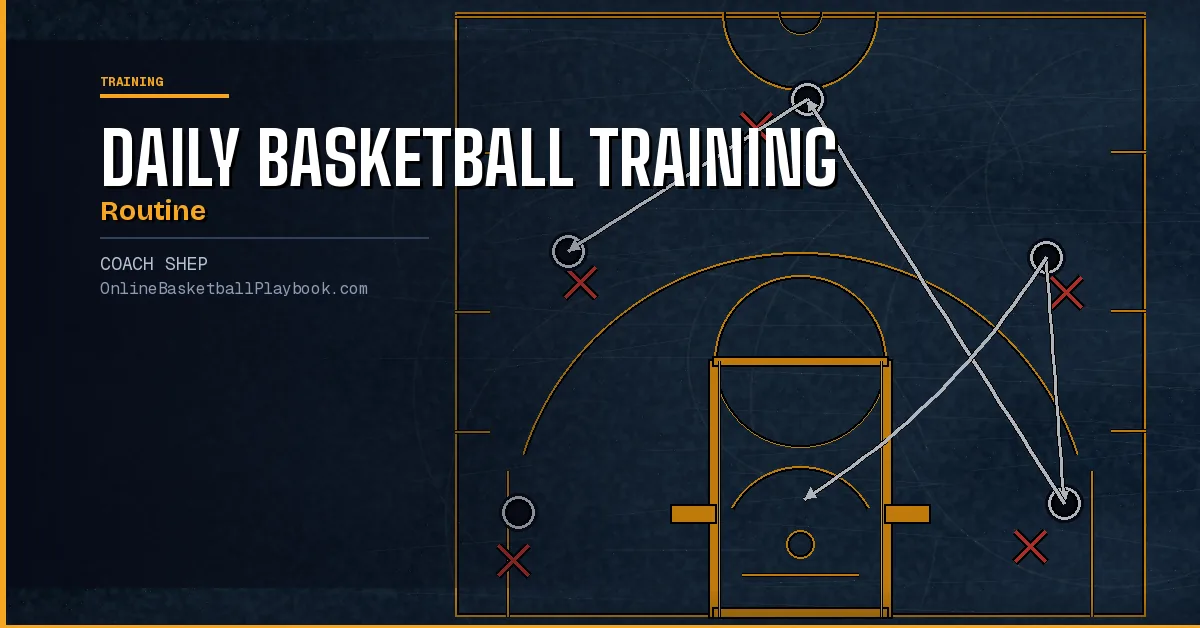
Most players show up, shoot around, and call it a workout. That approach doesn't develop anyone. A structured daily training routine, with a plan, game-speed reps, and tracked results, is what actually moves the needle.
Why Structure Matters More Than Hours
Time in the gym is not the same as development. A player who spends two hours heaving pull-up threes with no feedback and no plan is not training. They're practicing bad habits. The research on skill acquisition is unambiguous: deliberate practice with clear objectives and measurable feedback drives improvement far faster than unfocused repetition.
Structure does several things for a player. First, it removes decision fatigue. When you walk into the gym knowing exactly what you're doing and in what order, you spend your energy on quality reps rather than figuring out what to work on. Second, it creates accountability. A plan that you can track (makes, attempts, time) gives you an honest picture of your progress over days and weeks.
Third, and most underrated, structure forces you to address weaknesses. Left to their own devices, most players practice what they're already good at. A designed routine sequences weak-area work early, when focus and energy are highest, and saves comfort zones for later in the session.
This is why basketball player development at every serious program, from AAU powerhouses to college programs, centers on structured individual workouts rather than open gym. The design of the session is the difference between a player who plateaus and one who keeps climbing.
If you're also working within a team environment, your individual training routine should complement your basketball practice plan: Not duplicate it. The gym time you control is for the skills the team setting doesn't give you enough reps on.
The Three Non-Negotiables of Every Workout
Before designing any routine, understand the foundation. These three elements are what separate productive workouts from wasted gym time, and they apply regardless of position, age, or skill level.
A plan means you know before you enter the gym what you're working on, in what order, and for how long. You're not deciding on the fly. The plan can be simple, a half-sheet with four blocks and targets for each, but it must exist.
Game speed is non-negotiable because the body learns at the speed you practice. Slow, deliberate repetitions have a place early in skill acquisition when you're installing a new movement pattern. But once the pattern is established, you must push it toward the pace of actual competition. A pull-up jumper executed slowly off a casual dribble is a different motor program than the same shot off a hard two-dribble action with a defender closing. Train the speed of the game.
Tracking shots and reps closes the feedback loop. "Make 14 of 20 from the mid-range" is a real standard. "Work on mid-range" is not. When you record your results (makes, misses, time to complete a block) you create a baseline you can beat the next session. That's how you know you're actually improving.
Building Your Daily Training Routine
A well-structured daily routine has four zones: activation, skill installation, competitive application, and conditioning. The order is deliberate. You go from controlled to contested, from fresh to fatigued, so that every skill block gets the focused attention it requires before you push toward game conditions.
Zone 1: Activation (5–10 minutes)
Begin with dynamic warm-up and form work. This is not stretching. It's movement prep and skill calibration. Form shots from close range, footwork patterns, and ball-handling at controlled speed. The goal is to wake up the motor patterns you're about to train at full speed. Players who skip this zone tend to develop sloppy habits early in the main block because their movement patterns aren't dialed in yet.
Zone 2: Skill Installation (20–35 minutes)
This is the core of the session. Pick one to three skill areas and sequence them from technical to competitive. Work weak areas first. If your off-hand is the liability, that block goes before your comfort zones. Use make-count targets, not time limits, for at least part of this zone. "Make 15 from the left elbow" is more productive than "shoot from the left elbow for five minutes."
Good skill areas for daily installation include basketball shooting form refinement, ball handling drills, and basketball footwork drills. These are the foundational mechanics that compound over weeks and months of consistent work.
Zone 3: Competitive Application (10–15 minutes)
This zone puts the skills you just trained into game-like situations. Live reads, contested reps, game-shot scenarios coming off real actions. If you've been working on your pull-up, this block has you pulling up after a hard change-of-direction, not off a stationary cone. The gap between Zone 2 and Zone 3 is the gap most solo workers skip, and it's why their practice skills don't show up in games.
Zone 4: Conditioning and Free Throws (5–10 minutes)
Finish with basketball conditioning drills and free throws shot while fatigued. This sequence matters because free throws in games are almost always shot under physical stress. Training them fresh, at the end of a relaxed session, builds a habit that falls apart when it actually counts. Shoot your free throws tired, with real stakes (a make-count you have to hit before leaving), and record the results.
Skill Progression: Part-to-Whole Development
The biggest mistake players make in individual training is jumping straight to full-speed, full-complexity skill work before they've installed the movement correctly. This is how bad habits get hardwired. The correct approach is part-to-whole: introduce the skill in a controlled environment, add complexity in stages, and only push to full game application when the base pattern is solid.
The progression runs like this: introduce the skill with no defender and controlled pace (1v0); move to coach-guided reads and reactions with cues from a partner; shift into a controlled advantage situation where the defense is present but limited; then apply in a full game situation. Alongside this, scale the numbers: start 1-on-0, build to 2v2, then 3v3, then 4v4.
This approach does something critical that aimless repetition doesn't: it teaches reads, not memorized routes. A player who only trains skill blocks in a vacuum will execute well in isolation and fall apart when a defender takes away their first option. Part-to-whole development bakes in the decision-making from the start.
Also key: always pair a signature move with its counters. If you're drilling your right-hand drive, you need to be drilling the pull-back, the step-through, and the kick-out in the same session. A move that has no counters trained alongside it is a one-option dead end. Defenders at every level will take it away within two possessions.
Tracking Results and Staying Accountable
The scored-rep discipline is what turns a workout program into a development system. Every block in your routine should have a number attached to it. A target you're shooting for and a result you record. This does three things for you as a player.
First, it creates an objective standard. When you have to make 20 in a row from the mid-range before moving on, you know immediately whether you're where you need to be. There's no self-deception. Either you hit the number or you didn't.
Second, tracking creates a record you can compete against. When you log that you hit 14 of 20 from the left elbow on Monday, you have a target for Wednesday. The progress becomes visible. You're not guessing whether you're improving. You have data.
Third, accountability changes behavior in the moment. When you know you're charting your makes, you don't take lazy reps. The standard pulls your focus and intensity up to meet it. This is why elite players and elite programs track everything: practice stats, make percentages, conditioning times. The act of measurement raises the level of the work.
Carry a small notebook or use a notes app. At the start of each session, write your plan. After each block, log the result. At the end of the session, note what was strong, what needs more work, and what the next session should prioritize. This five-minute habit compounds over months into a detailed picture of your development that no guesswork can replicate.
Pair up with a teammate for accountability even when training solo. Share your daily make-count results. Having someone see your numbers creates the same pressure as being watched, and it costs nothing except a text message after the session.
Sample Daily Routines by Level
The structure described above applies at every level, but the content (drills, make-count targets, conditioning volume) should be calibrated to where the player actually is. Here are three sample daily routines organized by level.
Beginner (Youth / Middle School)
Keep sessions to 45–60 minutes. Focus on form and fundamentals: shooting mechanics from close range, basic ball-handling patterns, and footwork. Use low make-count targets that the player can hit with some challenge. Success builds the habit of training; failure every session breaks it. End with 10 free throws and record the result. Build the culture of tracking early.
Intermediate (High School)
Expand to 60–90 minutes. Introduce move-and-counter work. Add competitive application blocks with a partner when possible. Make-count targets should push the player. Not impossible, but requiring real focus and consecutive makes. Conditioning at the end should be basketball-specific: suicides, defensive slides, sprint-and-shot sequences. Free throws are mandatory and always recorded.
Advanced (College Prep / Post-High)
Full 90-minute sessions with a clear plan for each zone. Skill installation covers multiple moves with their counters, off multiple actions. Competitive application should be live reads against resistance whenever possible. Conditioning is high-volume and finished under fatigue. Free throw percentage over the last 10 sessions should be tracked and visible. Positionless training (guards doing post work, bigs doing guard skill blocks) keeps the game versatile and prevents the defensive specialization that limits players at higher levels.
- Plan before you enter the gym. Know your four zones and your make-count targets before you touch a ball.
- Work weaknesses first. Off-hand, weak foot, contested mid-range. Address the liability when your focus is highest, not as an afterthought.
- Reps are built on makes, not attempts. "Make 15" is a standard. "Take 15 shots" is not.
- Shoot free throws tired. Never end a session with fresh, comfortable free throws. Always shoot them after your conditioning block with a real make-count target.
- Drill every signature move with 2–3 counters in the same block. A single-option move gets taken away; a series with counters survives defenders.
- Log every session. Plan at the start, results after each block, notes at the end. Five minutes of documentation that compounds into real development data.
- Train positionless at least once a week. Guards doing post work and bigs doing guard drills expands the game and prevents easy defensive scouting at higher levels.
The physical skills you develop in individual training connect directly to your effectiveness in team settings. Players with strong individual foundations absorb team concepts faster, execute under pressure more reliably, and contribute more consistently across a long season. The daily routine is where that foundation gets built.
Get free play diagrams, drills, and coaching guides delivered weekly.
Draw this play free in the play drawer →
Membership: the full library, playbook packs, and Pro drawing tools →
Keep Building
Related breakdowns
Free Throw Shooting: Routine, Form and Drills
Free throw shooting starts with a routine the player never changes. Form cues, the mental side and drills that copy the fatigue and pressure of a game.
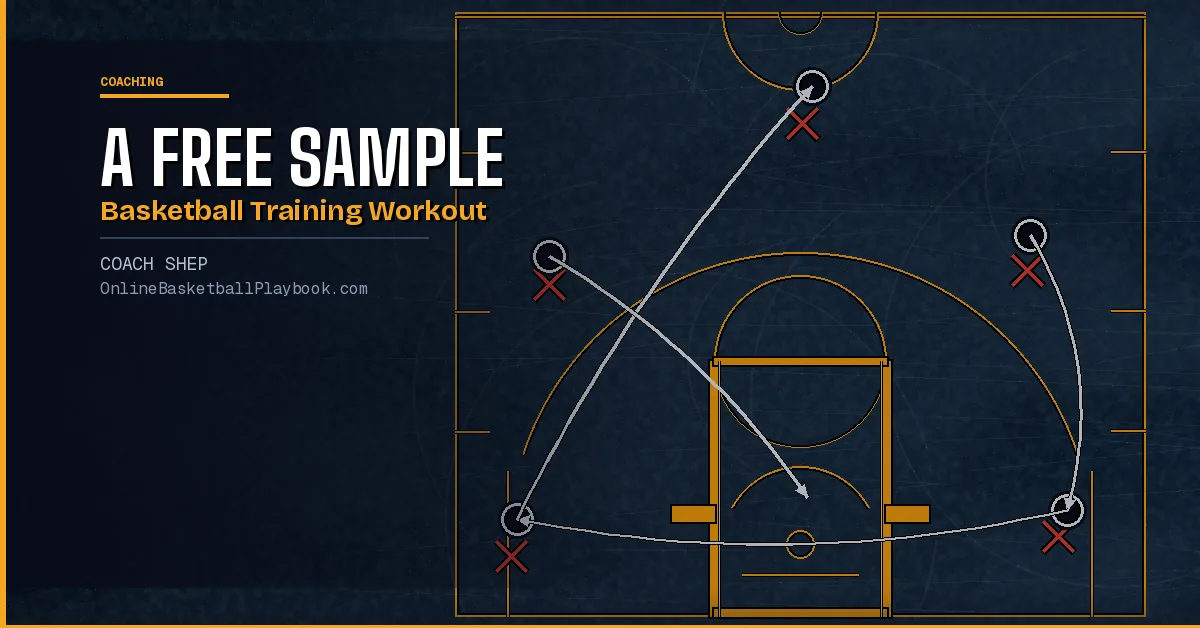
A Free Sample Basketball Training Workout
A Free Sample Basketball Training Workout
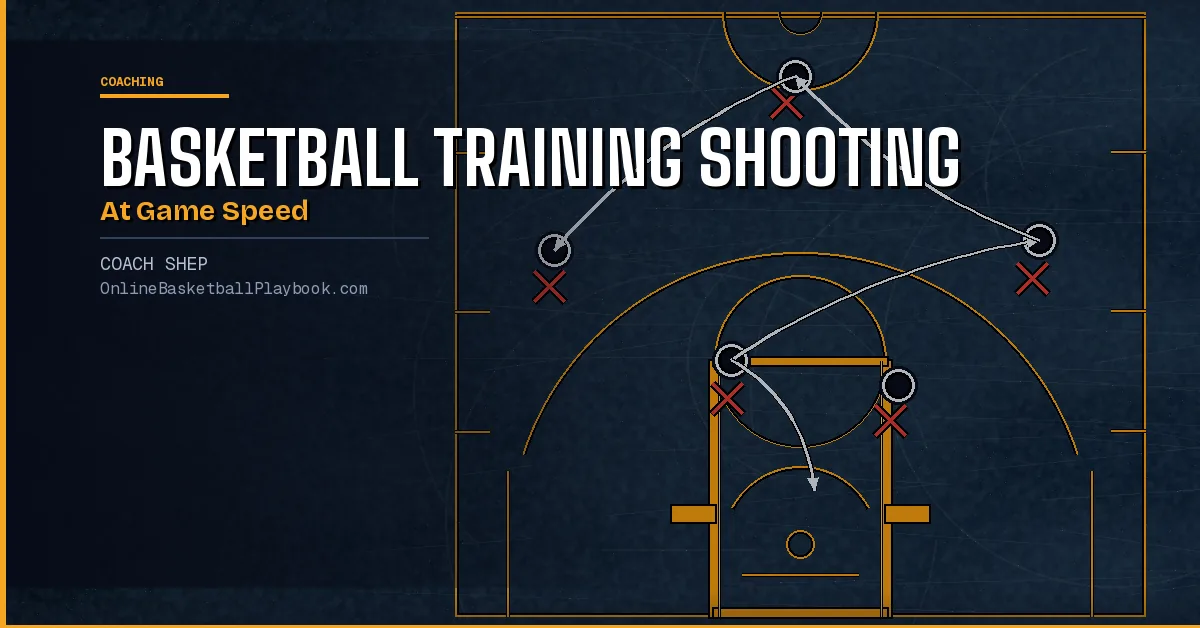
Basketball Training: Shooting at Game Speed
Basketball Training: Shooting at Game Speed