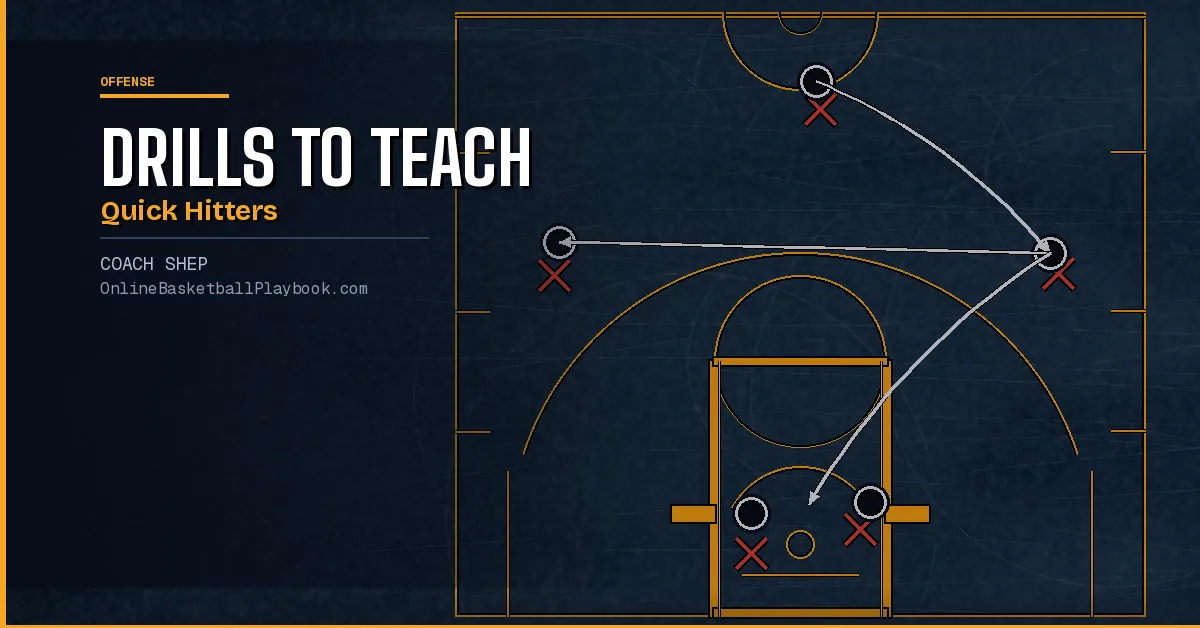
Quick hitter sets only work if every player knows exactly where to go and when to go there. These drills build the scripted execution, timing, and counter recognition your team needs to run set plays reliably under pressure.
What Makes a Quick Hitter Different
Before you can drill a quick hitter, your players need to understand what it is and why it exists. A quick hitter is not a motion offense sequence, not a freelance option, and not a "see what develops" action. It is a scripted play called by a coach to manufacture one specific look: free a shooter, attack a post mismatch, get a high-percentage shot in a compressed time window. That framing matters for how you train it.
Motion offense develops Basketball IQ and read-and-react habits over an entire season. Quick hitters do the opposite. They demand memorization, precision, and trust in the script. When a coach calls "KC" out of a timeout, five players need to move to five exact spots at five exact moments. There is no improvising the first two or three actions. Those are the play. The read only comes at the end, after the structure has run its course.
This distinction shapes how you drill. Motion habits are developed over weeks of 5-Out Motion Offense reps and defensive shell work. Quick hitter habits are installed through precise repetition of scripted sequences, walk-throughs at reduced speed, and gradual introduction of live defense to stress-test the timing.
The other thing that separates quick hitters from other offensive sets is their situational nature. These plays exist for the end of a quarter, the last shot of a half, the possession after a timeout when your opponent has had 30 seconds to set its defense. That means your team must be able to run them cold, without a warm-up, in a loud gym, after a long substitution sequence. That level of automaticity only comes from one thing: drilling the plays relentlessly until they are muscle memory.
Most teams install five to ten set plays. Championship-level programs organize those plays into families (a box family, a horns family, a high ball-screen family) so that multiple looks share spacing, timing, and movement patterns. The drilling philosophy follows the same logic: build the family first, then teach the variations within it.
The Walk-Through Method for Installing Sets
Every quick hitter installation starts on foot. No dribbling, no defense, just players walking through each position and action at conversational speed while the coach narrates. This is the single most efficient teaching method for scripted plays, and most coaches under-use it.
The walk-through serves three purposes. First, it lets you correct positional errors before they become habits. If your shooting guard lines up on the wrong block in a box set, catching it in a walk-through costs you ten seconds. Catching it in a 5-on-5 rep costs you the play and the rep. Second, walk-throughs let players ask clarifying questions without the pressure of a live situation. Third, they build a shared mental image of the play. Every player can see what the whole action looks like from every position, which dramatically speeds up the transition to full-speed reps.
A structured walk-through progression looks like this. Start with the coach narrating each cut and position while players walk. Run it two or three times this way. Then have players narrate it themselves. Call out each action as they do it. That verbal ownership locks in the sequence far better than passive repetition. Finally, speed up to jogging pace with no defense. By this point, most players can run the first pass or two without prompting.
One common mistake is rushing past the walk-through the moment players look comfortable. Comfort at walk-through speed does not equal reliability at game speed. The walk-through is the foundation, not the destination. A good rule: spend at least as much time walking and jogging as you do running full-speed, especially in the first two or three practice sessions after installing a new set.
Walk-throughs also belong in your Basketball Practice Plan as a daily two-minute review at the start of the set-play period. Before any live rep, walk the play once. It refreshes the mental map and catches any drift that accumulated since the last session.
Segment Drilling: Breaking Sets into Teachable Parts
A well-designed quick hitter has three to five distinct action sequences. The opening action creates the structure. The second action is the primary read. The third action is the counter if the primary is denied. Trying to drill all three at once is the most common installation mistake. Players get overwhelmed and nothing gets clean.
Segment drilling means you isolate each piece and rep it to automaticity before connecting it to the next piece. Take a box set as an example. The opening action is a simultaneous double screen on one side. Drill that piece by itself: five players in box, coach calls it, two screeners set, two cutters run their paths. Rep it ten times until the footwork, the angles, and the timing are clean. Then layer in the next piece, the pass entry and the first read. Then the counter.
This approach works because it respects the way motor learning actually happens. Complex sequences are learned in chunks, not as a whole. Athletes need to automate each chunk before the working memory is free to handle the full sequence. A player who is still thinking about where to set the screen cannot simultaneously be reading the defense to decide whether to pop or roll.
For ball-screen-heavy sets (horns, high ball-screen families) segment drilling is especially valuable. The screener's footwork, the ball handler's dribble angle, and the timing of the slip are all separate skills that need individual reps before they connect. The same is true for back-screens, cross-screens, and any double-screen action. Each one has its own mechanics, and mechanics drilled in isolation transfer more reliably to the full play than mechanics that are only ever practiced in context.
One practical structure: split your team into two groups. One group drills the opening action of Set A on one end. The other group drills the opening action of Set B on the other end. Rotate. This doubles your reps in the same practice time and keeps players active. After both groups have each opening action clean, bring everyone together to run the full sets 5-on-0.
Teaching Live Reads and Built-In Counters
Once a set is clean at full speed without defense, the next step is teaching the reads, and this is where many coaches stop too early. A quick hitter that only works when the defense cooperates is not a reliable tool. It needs a built-in counter for every way a defense can disrupt the primary action.
The drill structure for reads is straightforward: run the set 5-on-2. Use just two defenders, positioned to simulate the most common defensive disruption. If the primary read is a catch at the elbow off a back-screen, put a defender on the back-screen cutter. The player catching the entry pass has to read the defense and make the correct decision: hit the primary if it's open, go to the counter if it's not. This forces the read without the chaos of a full 5-on-5.
For sets that include a ball screen, teach the ball handler to read the screen coverage before they get to the action. Is the defender going over or under? Is there a switch waiting? The counter decisions (slip early, pop instead of roll, throw back to the corner) need to be drilled as specific reads, not as general concepts. Name each counter. Give it a verbal cue the point guard can use. "Slip" means the screener slips early. "Pop" means the big reads a hard hedge and opens to the ball. Those names become part of the play vocabulary.
A progression for building counter reads: first week, run the primary only (no defense). Second week, 5-on-2 with defenders on the primary read. Third week, 5-on-3, adding a help defender. Fourth week, 5-on-5. Each week adds one layer of defensive complexity. By the time you run the set 5-on-5, every player has already made every decision dozens of times at reduced complexity.
Competitive Reps: Running Sets Under Game Pressure
The gap between a clean practice rep and a reliable game execution is pressure. Until your players have run a set with something on the line, they have not truly installed it. Competitive reps close that gap.
The simplest competitive structure: set a score or rep goal, and the offense must execute the set to earn points. Three clean executions (meaning the correct player gets the correct look) earns a point. A defensive stop earns the defense a point. First to five wins. The losing group runs. This structure is low-stakes enough to maintain a teaching environment but high-stakes enough to introduce the mental load that comes with real execution.
A second structure is the two-minute drill. Clock runs, score is tied or your team is down one, and you have two possessions. Coach calls a set. The team must communicate the call, set up, and execute. If they score, run the drill again with 45 seconds left. This simulates the exact conditions where quick hitters get called: late game, tight score, defense ready and organized.
The two-minute drill also teaches your point guard to be the play's director. Most breakdowns in set execution happen in the three seconds after the coach calls the play and before the players are in position. Someone runs to the wrong spot. Someone forgets the name. Someone sets up for a different set. The point guard's job is to put everyone in the right place before the play starts. That skill (scanning, communicating, correcting) only develops under competitive pressure.
Competitive reps should also include situational packaging. Run the set after a timeout, where players have to sprint from the bench to their spots. Run it after a made basket, where the defense gets to set and your team is inbounding with less than ten seconds on the shot clock. Run it after a scramble situation where two players had to rotate quickly. The more diverse the entry conditions, the more durable the execution becomes. This kind of situational variety is a core component of Effective Basketball Practice design.
Situational Packages and How to Drill Them
A complete quick hitter library is organized by situation, not just by play name. You need different sets for different game states: end of half, end of game, down two versus down three, needing a two-point shot versus needing a three, attacking man-to-man versus attacking a zone. Drilling these as a unified package (not as isolated plays) is what makes the library functional under pressure.
Start by mapping your plays to situations. For each set in your library, answer four questions: When do we call this? What shot are we hunting? Who is the primary read? What is the counter? Write it down. Give every player a reference card. The act of mapping builds intentionality. You stop running sets randomly and start calling them for specific reasons.
Drill the zone package separately from the man-to-man package. Zone quick hitters move differently. You are occupying gaps, screening the zone rather than defenders, and timing skip passes. The footwork and spacing for a zone set do not transfer directly to a man-to-man set, so mixing them in the same drill session dilutes both. Dedicate one practice per week to zone quick hitters if zone defense is something your opponents run regularly.
For end-of-game situations, drill the full sequence including the communication chain. Coach calls the play, point guard repeats it and puts players in position, a designated player makes the inbounds pass or brings the ball up. Every link in that chain needs to be practiced. In tight games, the breakdown usually happens not in the play itself but in the five seconds before the play starts: a miscommunication about what was called, a player lined up on the wrong side, the ball handler taking too long to get into the set.
Inbounds plays are a specialized sub-category of quick hitters and deserve their own drill block. Basketball Inbounds Plays live-or-die on timing between the inbounder and the first cutter. The inbounder needs five seconds, and that countdown starts the moment the official hands them the ball. Drilling inbounds quick hitters means drilling the entire five-second window from the moment the official hands the ball to the moment a shot goes up. Count it every time. If a drill rep takes longer than five seconds, it does not count.
Across all situational packages, the organizing principle is the same: define the situation, define the desired outcome, design the drill to simulate that situation as closely as possible. The more your practice reps resemble the game moments where you will call the play, the more reliable your execution will be. Player development within set plays comes from this kind of deliberate, situation-specific work. It mirrors the broader principles of Basketball Player Development applied to tactical execution.
Most quick hitter breakdowns trace back to insufficient walk-through time, not insufficient live reps. When a set fails in a game, go back to the walk-through before you add more 5-on-5 reps. Rebuild the mental image first, then return to speed.
- Walk every new set before you jog it, and jog it before you run it. Automaticity needs a foundation of clean slow-speed reps first.
- Segment each set into two or three teachable pieces and drill each piece to automaticity before connecting them into the full sequence.
- Name every counter action and rep each counter separately. Players cannot read "slip" or "pop" under pressure if they have only drilled the primary.
- Use 5-on-2 and 5-on-3 structures to introduce defensive reads progressively before going full 5-on-5.
- Run two-minute drills with a live clock and real stakes to simulate the exact pressure conditions where quick hitters get called in games.
- Map every set to a specific situation and drill zone packages and man-to-man packages separately. Their timing and spacing principles differ enough to warrant distinct drill blocks.
- Drill inbounds quick hitters with a five-second countdown every rep, from the moment the official hands the ball to the moment a shot is attempted.
Get free play diagrams, drills, and coaching guides delivered weekly.
Draw this play free in the play drawer →
Membership: the full library, playbook packs, and Pro drawing tools →
Keep Building
Related breakdowns