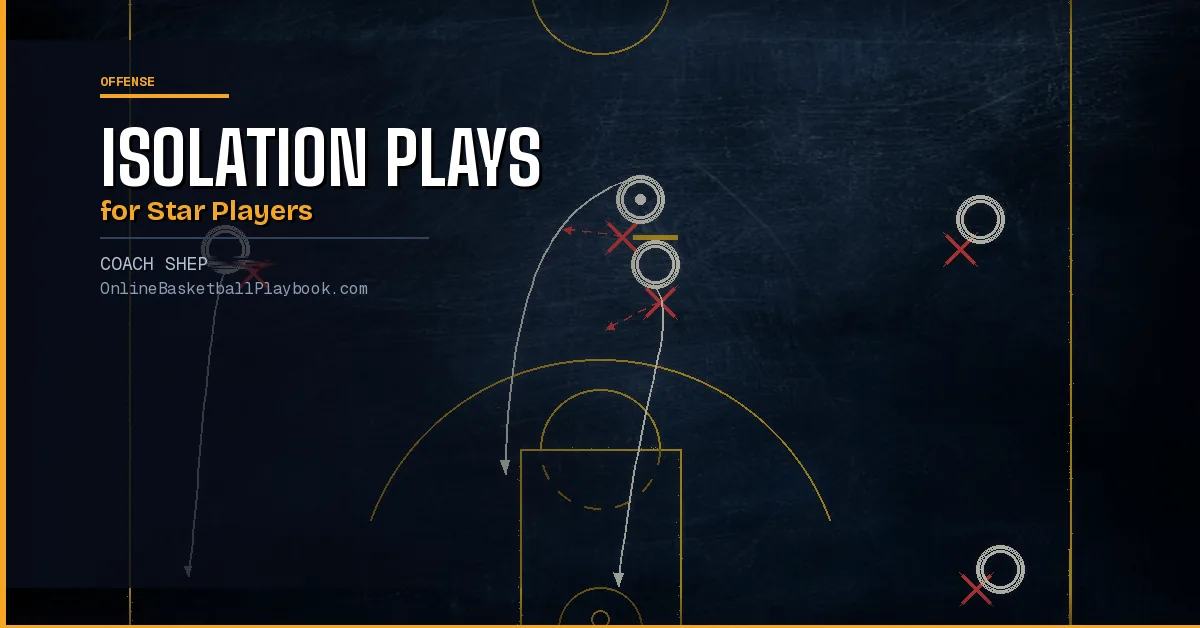
Isolation plays put your best scorer in a one-on-one matchup with space to attack. When designed and executed correctly, they are among the most reliable scoring weapons in your half-court offense at any level.
What Is an Isolation Play
An isolation play (commonly called an "iso") is a designed half-court action that clears one side of the floor so your best offensive player faces a single defender without help within immediate recovery distance. Every other offensive player occupies a spot designed to either pull a defender away from the action or threaten enough that no one can rotate to help without giving up an open shot.
The fundamental promise of an isolation is simple: if your best player is better than the defender covering him, you should win. That is as true at the youth level as it is in the NBA. The question coaches need to answer is not whether isolation is a valid offensive tool (it absolutely is) but how to design the set so the matchup is actually favorable, the spacing is correct, and the star player has the footwork and decision-making to exploit the advantage.
Many coaches conflate iso with a "breakdown" or an unplanned one-on-one situation. Those are different things. A true isolation play has structure: deliberate floor spacing, a designed entry, and a clear read built in for when the primary action breaks down. Understanding that structure is the difference between putting a player in a position to score and simply hoping he figures it out.
Isolation is not the same as playing without a system. The best iso-heavy offenses (from Phil Jackson's triangle principles to modern NBA motion-iso hybrids) use designed spacing and sequencing. The star player operates in a structured environment, not a vacuum. That structure is what separates scoring at a high rate from simply creating contested shots.
When to Call Isolation
Isolation is at its most powerful when used selectively and situationally. Calling five isos in a row telegraphs to the defense exactly what you are doing, and every team has a plan to send help, trap the ball, or switch assignments to neutralize a repeating action. The more randomness the defense has to account for, the more effective any single isolation will be.
The best moments to call isolation plays include:
- After an offensive rebound: the defense is scrambling and often has one or two defenders caught under the basket. Your star can catch on the perimeter and attack a disorganized defense before they reset.
- After a made basket by the defense: most defenses do not get back into their help structure immediately after scoring. A quick iso before the defense can organize gets your star the ball with the opponent still in transition.
- When your star has a clear mismatch: if the defense switches a ball screen and leaves a slower or smaller player on your best scorer, call the iso immediately before the opponent can hide the mismatch.
- Late-game possessions: isolation plays with a high-IQ star player are among the most reliable sources of points or free throws in end-of-game situations. This is exactly what basketball IQ development prepares players to execute when the game is on the line.
- When your motion offense has been disrupted: if the defense is doing a good job of denying your 5-out motion offense, a direct iso call resets the offense to a structure the defense is not prepared for.
The rule of thumb: isolation plays should account for no more than 20 to 25 percent of your half-court possessions. Used more than that, they become predictable. Used within the context of a broader offense, they are extraordinarily difficult to stop.
Spacing Principles That Make Iso Work
Spacing is the single most important factor in isolation basketball. A great player with poor spacing around him will still be stopped by a collapsing defense. The same player with four shooters spaced to the corners and wings (or to positions where they threaten the rim) becomes nearly unguardable.
The standard spacing for a wing isolation puts the ball handler on the wing, inside or at the three-point line. The other four players spread to the corners and opposite wing. This spacing forces all four of their defenders to make a choice: stay home on a shooter or rotate to help. If all four stay home, the iso player has true one-on-one space. If anyone cheats, the star kicks to an open shooter. That threat of a kick-out pass is what makes the spacing work. It is not decoration.
Three spacing rules every team needs to follow:
Rule 1: No one stands inside the three-point line when the iso is live. Any player inside the arc is giving his defender a free rotation to help. Keep all four off-ball players behind the arc or in the short corner.
Rule 2: Space baseline-to-baseline, not just side-to-side. If everyone is spaced along the same horizontal line, a defense can rotate across with one step. A corner player and a wing player on the same side force two separate recovery decisions.
Rule 3: The weak-side players must be genuine threats. If the defense knows your off-ball players will not shoot or attack, they will send two or three defenders to the ball without consequence. Spacing only works when every player in the formation is a credible offensive threat. This is one reason basketball player development for role players (not just stars) matters so much to how well your iso sets actually function.
Entry Actions for Getting Your Star the Ball
One of the most overlooked elements of isolation design is how the star player actually receives the ball. Simply lobbing it to the wing and saying "go get it" is not a play. It is a hope. Effective iso plays have a designed entry that gets the ball to the star in a position where she can attack immediately, before the defense can set a proper stance.
The DHO Entry (Dribble Handoff)
A ball handler dribbles toward the star player as if running a dribble handoff. The star comes off the handoff with momentum toward the basket, already in attack position. This is highly effective because the star receives the ball moving forward, which is harder to contest than catching a pass from a standstill. The defender guarding the star must navigate the handoff action while also getting into a defensive stance, a difficult task even for experienced defenders.
The Pin-Down Entry
A post player sets a down screen for the star player, who cuts from the baseline to the wing to receive a pass. The pin-down forces the defender to either fight over the screen (giving the star a clean catch on the wing with a step of separation) or go under (giving the star a catch-and-shoot opportunity or a clear drive lane). This entry works especially well for players who are threats from the mid-range because the defense is put in a lose-lose situation immediately on the catch.
The Spain Pick-and-Roll Entry into Iso
Run a standard pick-and-roll to get the defense moving laterally, then re-route the ball to the star player on the opposite side of the court where a defender is out of position from helping on the ball screen. This combines the value of your pick-and-roll action with the isolation principle. The star is getting the ball against a defender who is already scrambling.
The Post-Entry to Face-Up Iso
Enter the ball into a skilled big who can face up from the elbow or short corner. While the defense collapses on the entry, the star player uses that attention to get free on a skip pass. The skip creates an immediate one-on-one before the defense can recover. This works particularly well against teams that send two to the post every time. They create the spacing problem themselves.
Reading the Defense Out of Isolation
A well-designed isolation play is not a one-option possession. It is a structure with a primary action, a secondary read, and a tertiary kick-out, all built into the play before it begins. The star player should never be choosing between more than two or three options on any given possession. That clarity of decision-making is what makes the iso sustainable at a high volume.
The primary read is always: can I score directly? If the defender is playing off or showing poor foot positioning, attack immediately. Do not waste the advantage by hesitating. Direct scoring is the highest-efficiency outcome of any isolation and the reason the play exists.
The secondary read: is help coming early? If a weak-side defender rotates before contact is made, kick to the open teammate immediately. A kick-out three from a corner shooter who catches before the defense can close out is a high-quality shot, in many cases better than the contested drive the star was facing. Teaching players to make this read early (before the drive, not during) is one of the biggest jumps a star player can make in their offensive development.
The tertiary read: when to use the pick-and-roll as a second action. If the defense is playing the isolation correctly (staying home on shooters, the primary defender in good position), do not force the iso. Call for a ball screen from the high post and attack the screen-and-roll as a secondary action. This gives the offense a completely different look without burning a timeout or a possession.
Teach your star player to make the kick-out decision before the drive, not during it. A player who reads help early creates open threes; a player who reads late creates contested floaters. The mental timing of this read separates good iso players from great ones, and it is trainable with deliberate repetition in practice.
Teaching Your Star Player Built-In Counters
No isolation play survives contact with a disciplined defense without counters. Every defender who contests an iso action will eventually find a tendency: a preferred hand, a go-to move, a hesitation step. The best isolation players in basketball are impossible to scout because they have a counter for every defensive strategy, and they execute those counters without the hesitation that kills possessions.
Counter 1: The Two-Dribble Pull-Up
When a defender plays soft, the instinct is to drive all the way to the rim. But a hard-closing help defender waiting in the paint turns that drive into a difficult floater or a turnover. Teach your star to attack two hard dribbles, then pull up for a mid-range jumper before the help arrives. The two-dribble pull-up is one of the most efficient shots in basketball. The defender is on their heels and cannot contest without committing to a foul.
Good basketball footwork drills in practice can ingrain this habit. The jump-stop into a pull-up, the one-two step into a pull-up off the dribble. These are mechanical skills that need to be trained thousands of times before they are reliable in a game under pressure.
Counter 2: The Step-Back Three
When a defender overplays the drive, a single step-back dribble creates room for a pull-up three. The step-back has become a standard weapon at every level of basketball because it exploits a defense trying to take away the drive. Your star does not need to be a 40-percent three-point shooter for this counter to be effective. The threat of the step-back is what keeps the defender from over-committing to one side.
Counter 3: The Rip Through
When a defender reaches or overextends, a low rip-through of the ball, moving it from one hip level to the other, draws contact and creates a straight-line drive to the rim. This counter is about exploiting aggression, not skill. Teach your star player to hold the ball low, invite the reach, and attack downhill through the contact. Free throw opportunities are among the most reliable outcomes of a well-designed isolation sequence.
Counter 4: The Pump Fake
Against a help defender who anticipates the drive, a single pump fake freezes the closest helping defender and creates a window to either shoot over them or drive past a compromised stance. This counter requires confidence. A half-hearted pump fake fools no one. Your star must sell the shot fully before deciding to pull the ball back. Drilling basketball shooting form regularly builds the kind of realistic pump fake that actually freezes defenders, because it mirrors the mechanics of the actual shot.
Drilling Isolation in Practice
Isolation plays need to be trained, not just diagrammed. A star player who has walked through an iso play on a whiteboard but never lived reps executing it against a live defense will not perform under game pressure. Building isolation skills into your regular basketball practice plan is what translates the design into actual points.
The most effective isolation drill structure uses three phases: individual skill work, two-player competitive work, and team integration. Individual skill work focuses on the moves themselves: footwork patterns, finishing actions, pull-up shooting mechanics, and counter sequencing. Two-player competitive work puts the star against a live defender, building the instincts for reading positioning and executing counters under resistance. Team integration puts the full five-on-five context around the isolation so the star player learns to use spacing, read kick-out options, and make the entry into the iso correctly.
Three drills worth incorporating into every week:
1-on-1 from the Wing (Full Defense): The star catches at the wing from a live pass, defender is live. No restrictions. The star must score or kick out within six seconds. This builds the core read, attack or pass, under game-realistic conditions.
3-on-3 Iso Shell: The star plus two corner shooters versus three defenders. The star plays iso, the corner players are live shooters. Defenders have to choose: stay home or send help. This teaches the star to read the kick-out option before it fully develops. It also develops the role players' ability to catch and shoot from a kick-out pass under mild defensive pressure.
Iso Counter Series (1-on-1 with Scouting): The coach tells the defender what to take away before the rep starts: take the drive, take the pull-up, take the left hand. The star has to execute the correct counter for what the defense is giving. This is the highest-level isolation drill because it forces the star to read and respond, not just execute a memorized sequence.
- Space all four off-ball players behind the arc. No one inside the three-point line while the iso is live.
- Design the entry action so your star catches the ball moving toward the basket, not standing flat-footed
- Build at least two counters into every iso set, a primary attack and a secondary read based on what the defense takes away
- Train the kick-out decision BEFORE the drive; a star who reads help early creates open threes, not contested finishes
- Use isolation selectively, no more than 20 to 25 percent of half-court possessions to keep the defense from preparing for it.
- Run iso in different spots and different entries each game; repeating the same action gives the defense a scouting advantage
- Pair isolation sets with pick-and-roll threats. A defense that must respect both is far harder to organize than one that only has to stop one action.
The best way to evaluate whether your isolation sets are working is not to count how often the star scores on the primary action. It is to count how many times the defense sends help and gives up a kick-out three or a wide-open drive from a corner player. When the defense is forced to choose between stopping the star and stopping the open teammate, the isolation is doing exactly what it is designed to do, making the defense pay for every decision they make.
Get free play diagrams, drills, and coaching guides delivered weekly.
Draw this play free in the play drawer →
Membership: the full library, playbook packs, and Pro drawing tools →
Keep Building
Related breakdowns
Basketball Quick Hitters: 25 Sets by Action and Formation
Basketball quick hitters sorted by the action you want, catch-and-shoot to post feed, with each set's formation, diagrams, the read and the counter.
Princeton Offense Drills: Breakdowns, Shooting and Live Reps
Princeton offense drills that teach the reads: spacing, backdoor and hand-off breakdowns, 3-0 Chin and wave drills, Point shooting, a drive drill and an install.
Four Corners Offense Basketball: Roles, Rules and Versions
Four corners offense basketball: the set, the chaser, the corner and post rules, three versions, when to run it, the shots it hunts and shot clock limits by level.