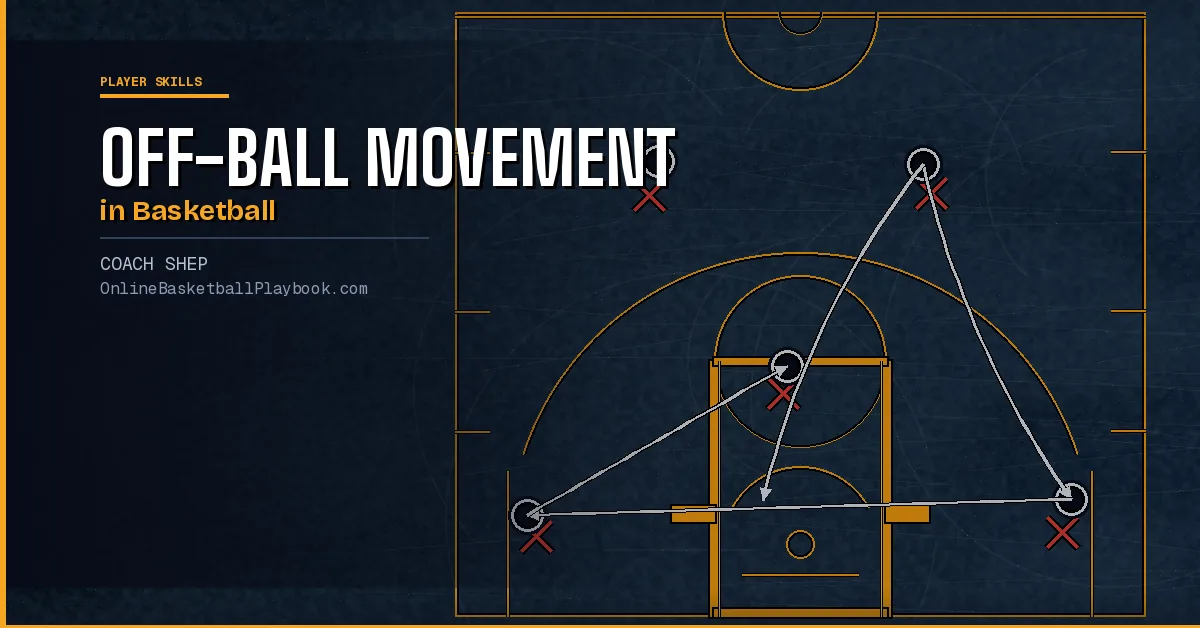
Most possessions are decided by players who never touch the ball. Off-ball movement (purposeful cuts, screens, and spacing) creates open looks, collapses defenses, and separates good offenses from great ones at every level.
Why Off-Ball Movement Matters
Watch any high-level offense and you notice something immediately: the ball handler is rarely the one who creates the advantage. The advantage is manufactured before the pass arrives. A sharp backdoor cut forces a help rotation. A flare screen drags a defender out of position. A skip pass finds a shooter who sprinted from corner to wing before the defense could recover. The player with the ball finishes what four other players started.
Defenses are designed to load up on the ball. Help-side defenders crowd the paint, waiting for the drive. That strategy only works when off-ball players stand still and let it work. The moment those players start cutting and relocating with purpose, defenders face an impossible choice: stay attached to cutters and give up the drive, or sag into help and give up the catch-and-shoot. Good off-ball movement turns a defense's strength into its vulnerability.
This matters at every level. Youth players who learn to move without the ball become high basketball IQ Players who make everyone around them better. At the varsity and college level, off-ball discipline is what separates teams that execute an offense from teams that just run one. You cannot scout a team that reads and reacts. The ball finds open players before a scheme can shut them down.
Standing still is never neutral. A stationary player is easy to guard. Their defender can watch the ball, cheat into passing lanes, and help on drives. Every second a player stands without purpose, they are making the offense worse. Movement (even a hard two-step to re-space) forces a defensive decision.
Types of Cuts Every Player Needs
Cutting is the most fundamental off-ball skill. A cut is not a jog; it is an explosive directional change designed to create separation at the moment the ball arrives. There are several core cuts every player should master.
The Basket Cut (Give-and-Go)
After passing to a teammate, the passer immediately attacks the basket on the ball-side. This is the oldest action in basketball and still one of the most effective. The key is the commitment: a half-hearted trot gets nothing. A full sprint to the rim forces the on-ball defender to make a decision and opens the floor for the next read. In a motion offenseThe basket cut is the default action after every pass. You pass and you cut, every time.
The Backdoor Cut
When a defender overplays the passing lane (body turned, arm in the gap), the offensive player fakes toward the ball, then cuts hard to the basket behind the defense. Timing is everything. The cut happens when the on-ball defender turns his head or when the passer makes eye contact. Cutting before the passer looks away is wasted movement. The backdoor punishes defensive aggression and keeps defenders honest for the rest of the possession.
The Curl Cut
Coming off a screen, the cutter reads the defender. If the defender tries to chase over the screen, the cutter curls tightly around the screener's hip and attacks the basket. The curl is not a wide arc. It is a tight, sharp turn that uses the screener as a shield. This cut typically leads to a mid-range pull-up or a layup if the curl is run at full speed.
The Flare Cut
When the defender cheats under a screen (expecting a curl or a pop), the cutter flares away from the basket to the three-point line. The flare is most effective for shooters who have established a reputation for curling. Once defenders start anticipating the curl, the flare becomes wide open.
The L-Cut and V-Cut
For wing and post players trying to get open on the perimeter, footwork matters more than athleticism. The L-cut drives the defender toward the baseline, then cuts sharply back to the wing. The V-cut does the same thing with a drive toward the paint. Both cuts work because they change the defender's momentum; you step one way to make the defender commit weight, then cut sharply the other direction to create the catch window.
Off-Ball Screens and How to Use Them
A screen is only as good as the cut that follows it. Coaches spend hours teaching players to set screens correctly (feet wide, hands in, stationary) but screening without teaching the read is half the job. The cutter must read the defender and choose the right action.
Setting the Screen
A legal, effective screen is set with feet at least shoulder-width apart, body still before contact, and hands held in front of the body. The screener targets a specific spot (typically one step behind the defender) so the cutter can use the screen with maximum separation. Setting the screen early and tight is non-negotiable; a screen set too far away gives the defender room to slide through.
Reading the Defender
Before using the screen, the cutter must see where the defender is. If the defender is trailing (caught behind), curl to the basket. If the defender tries to fight over early, flare to the perimeter. If the defender goes under the screen and concedes the catch, pop to the three-point line and catch with feet set to shoot. Good off-ball players make this read automatically, without thinking, because they have run the action hundreds of times in practice.
The Screener's Role After the Screen
Too many players set a screen and then watch. That is a wasted body. After setting the screen, the screener reads the defense too. If their defender steps out to help on the cutter, the screener slips to the basket (slip screen). If the defense switches, the screener posts up the smaller defender. The two-man game off a screen involves two simultaneous reads, which is why off-ball screening is hard to defend even when a defense knows it is coming.
Spacing: The Foundation of Off-Ball Play
Spacing is what turns individual cuts and screens into a system. Without proper spacing, cuts collapse on each other, screens create traffic, and the drive lane closes before the ball handler can attack. Spacing is not a position. It is a constant responsibility shared by all five players.
The standard is 15–18 feet between players. That gap is large enough to keep defenders from helping without leaving a wide-open teammate, and small enough that skip passes arrive before defenses can rotate. Players drift closer than that gap (whether from lack of attention or instinct to follow the ball) and the whole offense breaks down. Good spacing is active, not passive. It requires players to read where their teammates are and adjust constantly.
In a 5-out motion offense, all five players start above or at the three-point line, creating the maximum spacing possible. Every cut opens the paint for the next cutter. Every drive turns into a kick-out to a shooter. The system only works if players maintain their gaps when they are not the cutter or screener. Standing on the three-point line and being spaced correctly are two different things. Players must be ready to shoot or attack the moment the ball arrives.
Corner spacing deserves special attention. The corner is the most efficient catch-and-shoot spot on the floor (shorter distance, unobstructed angle). A player stationed in the corner pins the corner defender and keeps that defender from helping on the drive or the cut. If the ball goes to the corner, the action starts on the opposite side. This is why teams that space one corner with a non-shooter often look slower than their athleticism suggests.
Stop practice anytime and call out the score: where is each player standing? If anyone is inside the three-point line without a purpose (cutting, posting, or screening), that is a spacing violation. Make the correction live, during action, not just in film sessions. Players internalize spacing rules fastest when they are corrected in the moment, not 24 hours later.
Drills to Develop Off-Ball Habits
Off-ball movement cannot be developed by telling players what to do in games. It must be built through repetition in practice. The habits form in drills long before they show up in a possession.
No-Dribble Passing Game (5-on-5)
Remove the dribble entirely and run a half-court 5-on-5. With no dribble, every player must move to create a passing option. The ball stalls immediately if even one player stands still. This drill forces off-ball movement as the only path to offensive success. Run it for five-minute blocks, keeping score. Players who struggle in this drill struggle with off-ball movement in games. The correlation is nearly one-to-one.
Pass-and-Cut Drill (3-on-0)
Three players start at the top of the key and two wings. The player at the top of the key passes to a wing and makes a basket cut. The wing makes a decision, hit the cutter or skip across. The other players fill the open spots. The drill runs continuously for two minutes. The coaching point: every pass must be followed by a cut or a fill. Standing after passing is not allowed. This builds the pass-and-move habit that is the foundation of any motion system. You can incorporate this into a broader basketball practice plan as a warm-up activity before half-court work.
Shell Drill with Off-Ball Emphasis
The shell drill is typically taught as a defensive tool, but it works equally well for developing off-ball awareness on offense. Set four offensive players in their spots and let the defense play honest. The drill stops anytime an offensive player stands without a purpose. The offense must keep moving with cuts, relocations, and screening until a shot is created. The constraint of being called out for standing still accelerates the habit-building faster than open scrimmage.
Curl-Flare Read Drill (2-on-1 Screening)
One screener, one cutter, one defender on the cutter. The screener sets the screen. The defender lines up in different positions before each rep: sometimes overplaying, sometimes trailing, sometimes going under. The cutter must read the defender's position before contact with the screen and execute the correct action. This drill isolates the read-and-react skill without the noise of a full-court game.
Coaching Off-Ball Movement Effectively
The most common coaching mistake with off-ball movement is addressing it only in film or chalk talk. Players nod, understand conceptually, and then stand still the next possession. Off-ball habits are behavioral, not intellectual. They require real-time correction in live action to stick.
Stop practice when it breaks down. When a player stands still after passing, stop the drill and reset. Explain what the player should have done, walk through it once, and run it again. Three or four of these interruptions in a single practice session will do more than a 20-minute film session on the same topic. The player builds the correct reflex because they experienced the correction in the moment they needed it.
Positive reinforcement for off-ball movement is underused. Coaches who call out great cuts, even when the ball doesn't arrive, teach players that movement itself is valued, not just scoring. A player who sets a great screen and the cutter gets open deserves acknowledgment even if the shot misses. Building that culture accelerates buy-in across the roster.
For player development, off-ball movement should be introduced early and reinforced constantly. Youth players who learn to move without the ball develop into versatile players who fit any offensive system. Players who learn to hunt the ball as youth players spend years in high school unlearning that habit. The investment in off-ball fundamentals early pays compounding returns.
Accountability matters. Some teams post a stat called "empty movements": sprints, cuts, and screens that created the defensive breakdown, even when the ball never arrived. Tracking this stat shifts players' understanding of what success looks like. Off-ball movement becomes its own scoreboard, separate from points and assists, and players compete to lead that category.
- Pass and cut every time: No player stands still after passing. The default is a basket cut unless a better read is available.
- Read before you use the screen: See the defender's position before you arrive at the screen and commit to the correct action: curl, flare, or pop.
- Maintain 15–18 ft spacing: Check your gap constantly. If you are inside the arc without a purpose, you are shrinking the offense.
- Cut only when the passer can see you: A backdoor cut timed before the passer looks is a wasted possession. Wait for eye contact or a head-turn.
- Screeners have a second job: After setting the screen, read the defense and either slip to the basket or post up a switched defender.
- Corner players pin their defender: Standing in the corner is an active job. Your presence keeps a helper from collapsing into the paint.
- Fake before every move: A quick shoulder fake or step fake before a cut gets the defender to commit weight and creates real separation.
Get free play diagrams, drills, and coaching guides delivered weekly.
Draw this play free in the play drawer →
Membership: the full library, playbook packs, and Pro drawing tools →
Keep Building
Related breakdowns
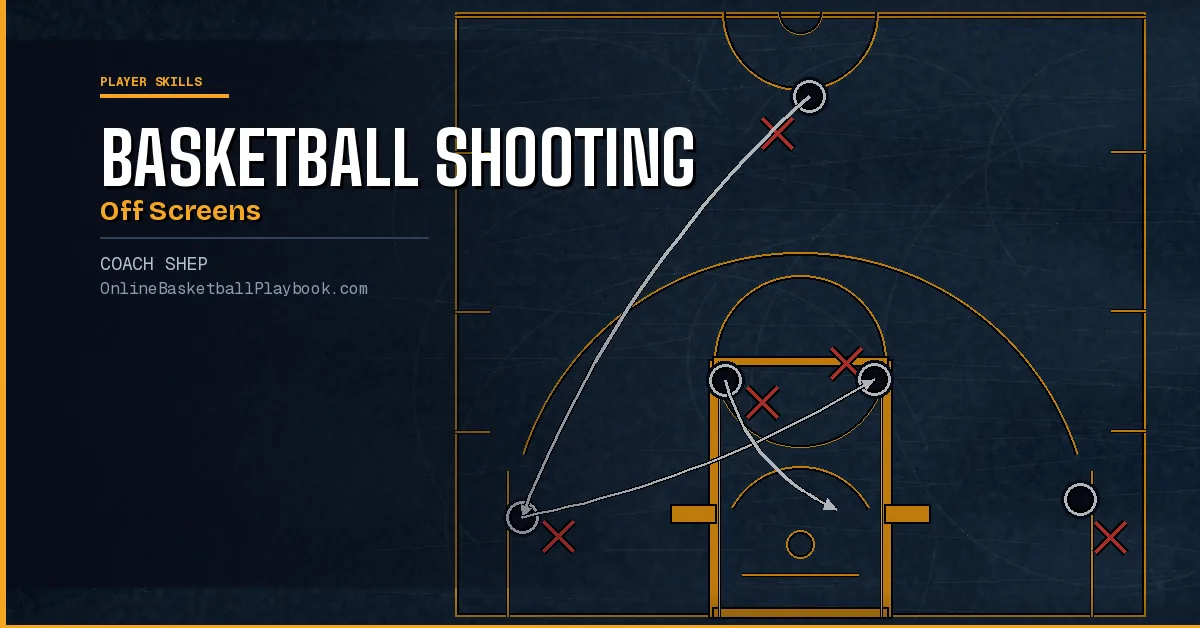
Basketball Shooting Off Screens: Complete Guide
Basketball Shooting Off Screens: Complete Guide