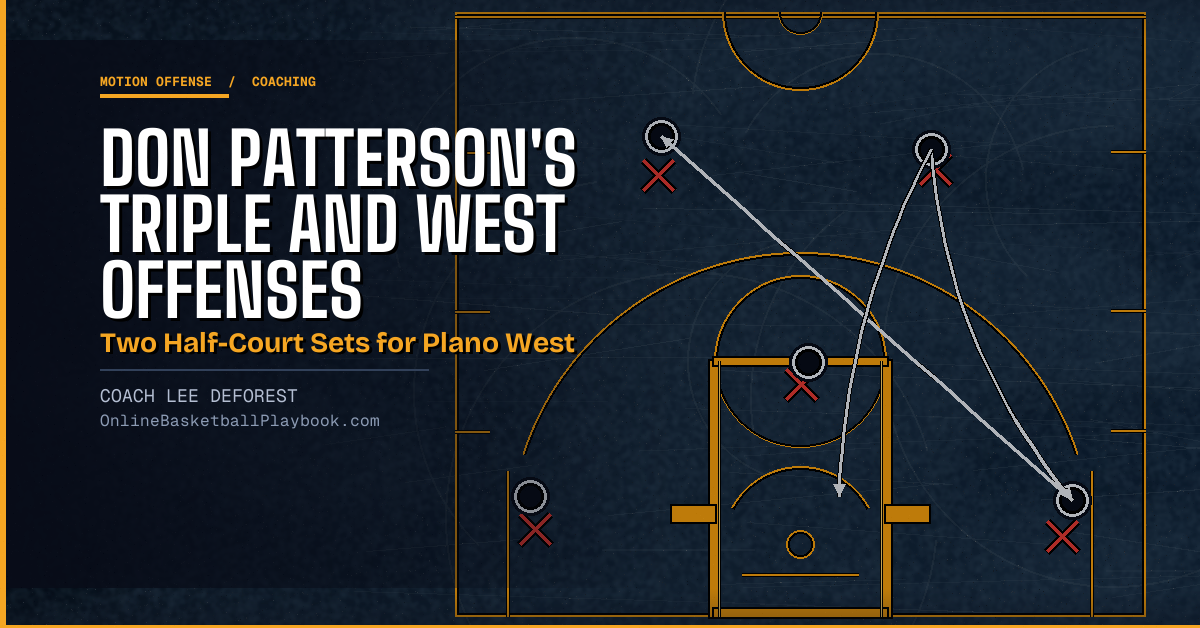
You have size and shooting, and you need a half-court offense that turns that edge into clean looks instead of crowded post catches. Don Patterson runs two at Plano West that do exactly that.
The first is TRIPLE, an offense Patterson installed to take advantage of three tall, skilled players. The second is West, a pick-and-roll set old enough to have proven itself a hundred times over. Together they give the Wolves a way to attack man and zone without rebuilding their team identity every week.
"Put this offense in to utilize our size. We had 3 6'2″ girls that can shoot outside, handle the ball and were excellent passers."
Coach's Cheatsheet
- Use TRIPLE when: you have size and shooting and want a post-and-screen set that gives you three man options before the defense can settle, plus a clean zone counter.
- TRIPLE's first option: feed the low post while a teammate screens down for the shooter — your simplest, highest-percentage entry.
- TRIPLE vs zone: get a man to the short corner, dive-cut a second man to the rim, and flash a third to the high post to stretch the zone in three directions at once.
- Use West when: you want a two-man game and a double screen working at the same time, so the defense has to guard a pick-and-roll and a shooter coming off stagger on the same possession.
- West's timing rule: the shooter must wait — he comes off the double screen only after the pick-and-roll has had its chance, so the two actions never collide.
- Universal cue: on switches, seal at the basket — turn a defensive scramble into a deep catch.
TRIPLE vs Man: Three Options, One Look
TRIPLE is built so the defense never gets comfortable. From one alignment, Patterson runs three man-to-man options in sequence, each one flowing into the next if the first look is covered. The point is volume of actions — post, screen, reversal — out of a picture that looks the same every time.
Patterson put it in for a specific reason, and it is worth hearing in his own words.
Notice Patterson's last line: this set was built around size, but he is clear it works with smaller players too. The actions — a post feed, a down screen, a ball reversal into a second post — do not require 6'2″ shooters. Size makes the catches deeper and the screens harder to fight through, but the structure scores against any personnel. Do not skip the offense just because your roster is small.
Option 1 — Post feed, screen down
The first option is the cleanest. The point guard feeds the ball into the low post (1 to 5) while 4 screens down for 3. You get a deep catch and a shooter coming open off the screen in the same beat — the post can score, or kick to the shooter if help comes.
Option 2 — Screen away, down-screen, seal
If the post is fronted or the first look is dead, flow into the second option. The 5 screens away for 3, 4 down-screens for 5, and 5 seals. Now the player who was the screener becomes the target, sealing his man for a deep catch on the block.
Option 3 — Reverse and re-post
The third option attacks the weak side. Reverse the ball — 2 looks for 3 posting up, 4 screens down for 5, and 2 passes to 5. The 4 seals, and 5 can dump it down to him at the rim. This is where the offense punishes a defense that has shifted to take away the first two looks.
The Key Principle: every option ends with a seal and a deep catch. Whether you are on the first action or the third, the man receiving the screen turns and seals his defender on the way to the block — so the catch comes close to the rim, not 15 feet from it.
That sealing habit is the thread through all three options, and it matters most when the defense scrambles. Patterson's rule for those moments is short.
"On switches try to seal at basket."
When the defense switches a screen, the natural instinct is to keep cutting and reset. Patterson wants the opposite — the screener has a mismatch or a beaten defender for a split second, so he seals right there at the basket and asks for the ball. A switch is not a problem to solve; it is a deep catch waiting to happen.
TRIPLE vs Zone: The Short-Corner Wrinkle
The same offense has a zone answer, and it changes the spacing instead of the spots. Against a zone, TRIPLE attacks three areas at once: 5 goes to the short corner, 4 dive-cuts to the basket, and 3 flashes to the high post. The zone now has to account for a short-corner catch, a rim runner, and a high-post flash on the same pass — and it cannot cover all three.
When the ball is reversed, the action mirrors to the other side. Now 2 goes to the short corner, 3 dive-cuts to the basket, and 5 flashes the high post. Same three jobs, opposite side of the floor, so the zone never gets to set its feet.
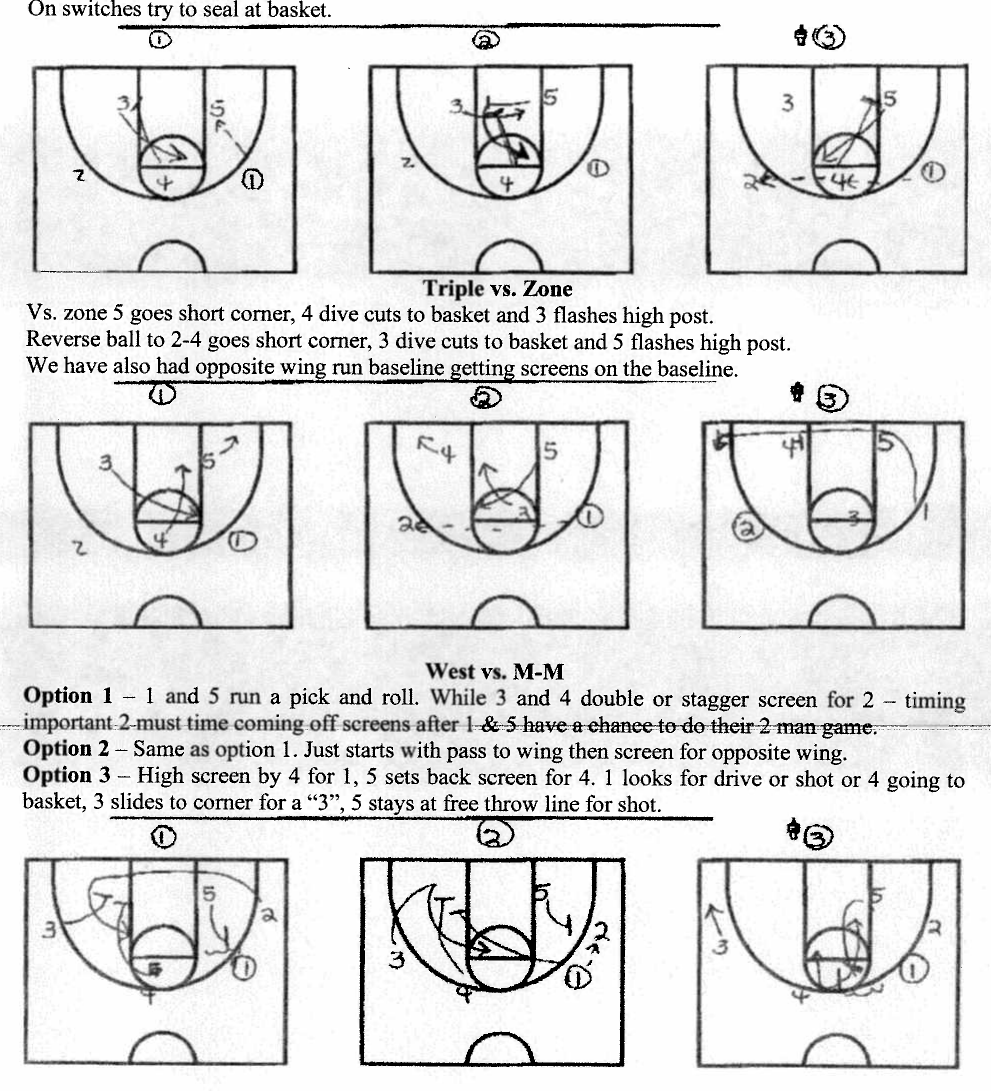
The high-post flash is the read that breaks the zone. When 3 flashes to the high post against a 2-3 or 1-3-1, the zone has to choose between collapsing on the flash and protecting the short corner and the rim. If the high post catches with the zone collapsed, the short-corner and dive-cut players are open underneath. Teach your flasher to catch, turn, and read both the short corner and the diver before he ever looks to score.
Patterson also runs a baseline-screen wrinkle out of the zone look, sending the opposite wing along the baseline off screens to surface in scoring position on the far block. It is the same short-corner spacing with an extra body moving baseline to occupy the back line of the zone — a useful counter when a zone starts cheating to the short corner you have been feeding all game.
West: An Old Offense That Still Works
West is the veteran of the two. Patterson has run it for years, and it earns its keep by stacking two actions on top of each other so the defense has to guard a pick-and-roll and a double screen at the same time.
"West is an offense I have used for years and still works well."
Option 1 — Pick-and-roll plus a double screen
The first option runs two things at once. The 1 and 5 run a pick-and-roll while 3 and 4 set a double — a stagger screen — for 2 on the other side. The two-man game gets first crack; if it is covered, 2 comes off the stagger for a shot. Timing is the whole game here, which Patterson is specific about.
The Key Principle: the shooter has to wait. The 2 must time coming off the double screen only after 1 and 5 have had their two-man-game chance. Come off too early and you crowd the pick-and-roll; come off on time and you arrive open the instant the defense has committed to the ball.
Option 2 — Enter to the wing first
The second option is the same shape with a different trigger. It starts with a pass to the wing, then a screen for the opposite wing — so the entry pass sets the timing, and the screening action flows from the side the ball was entered to. Same two-man-game-plus-screen idea, reached through a wing entry instead of a top start.
Option 3 — High screen, back screen, three jobs
The third option is a quick-hitter with three scoring threats built in. The 4 sets a high screen for 1, and 5 sets a back screen for 4. From there, 1 looks to drive or shoot or hit 4 going to the basket, 3 slides to the corner for a three, and 5 stays at the free-throw line for a shot. One action, three places the ball can end up — at the rim, in the corner, or at the elbow.
West's third option is your end-of-clock or special-situation call. It gives the ball handler a downhill read off the high screen, a corner three as the kick, and a free-throw-line shooter as the safety valve — three answers on one possession. Rep it as a set play, not motion, so your players know which read is theirs before the screen is even set.
When to Call TRIPLE and When to Call West
The two offenses solve different problems, and the call should match the night. TRIPLE is your answer when you have a size or shooting edge and want to attack the post — and it is the one with a built-in zone counter, so it is the call when the other team mixes defenses on you. If you scout a team that plays zone, TRIPLE travels from man to zone without a substitution or a new set.
West is your answer when you want guard play and screening to carry the possession. It puts the ball in your point guard's hands in a two-man game, gets a shooter open off a double screen, and finishes with a quick-hitter that does not depend on a dominant post. Call West when your guards are your best players or when a team takes your post away and you need scoring from the perimeter in. For more sets built around the same screen-and-seal ideas, the playbook breakdowns library is a good next stop, and the has the individual actions you can pull out of either offense.
Variations and Progressions
Progression 1: Install TRIPLE Option by Option
Do not teach all three man options at once. Install Option 1 — the post feed and down screen — until the seal and the catch are automatic, then layer Option 2's screen-away action, then Option 3's reversal. Because each option flows from the same alignment, players learn them as one read instead of three separate plays.
Progression 2: Drill the West Timing in Halves
The hardest part of West is the shooter's timing off the double screen. Drill it on air first: run the 1-5 pick-and-roll on one side and the 3-4 stagger for 2 on the other, and have 2 count out loud so he feels the beat where he releases after the two-man game. Only once the timing is clean do you add a defense.
Progression 3: Use the Switch as Offense
Spend a block teaching players to seal at the basket the instant they feel a switch. Run TRIPLE against a switching defense on purpose, and reward any deep seal-and-catch even if the shot misses. You are training the instinct Patterson wants — that a switch is a scoring chance, not a stoppage. The same habit carries straight into the down screens in Clint Swan's five-man open post offense.
Get Free Coaching Notes
Join the Online Basketball Playbook newsletter for new playbook breakdowns, drills, and practice-ready install ideas.
Get Free Coaching NotesDraw this play free in the play drawer →
Membership: the full library, playbook packs, and Pro drawing tools →
Final Thoughts
TRIPLE and West give Patterson two ways to win the same game. TRIPLE punishes size with three man options that all end in a seal, and it carries a short-corner-and-flash counter that beats a zone without a substitution. West runs a two-man game and a double screen on top of each other, then finishes with a three-threat quick-hitter — a guard-driven set that still works because the timing is taught, not hoped for.
You do not need 6'2″ shooters to run either one. Install TRIPLE option by option, drill the West timing in halves, and teach your players that a switch is a deep catch waiting to happen. Do that, and you will have two half-court answers that fit whatever the defense gives you — man, zone, or a switch you turn into a layup.
Keep Building
Related breakdowns
How to Coach the 5-Out Motion Offense (Complete Guide)
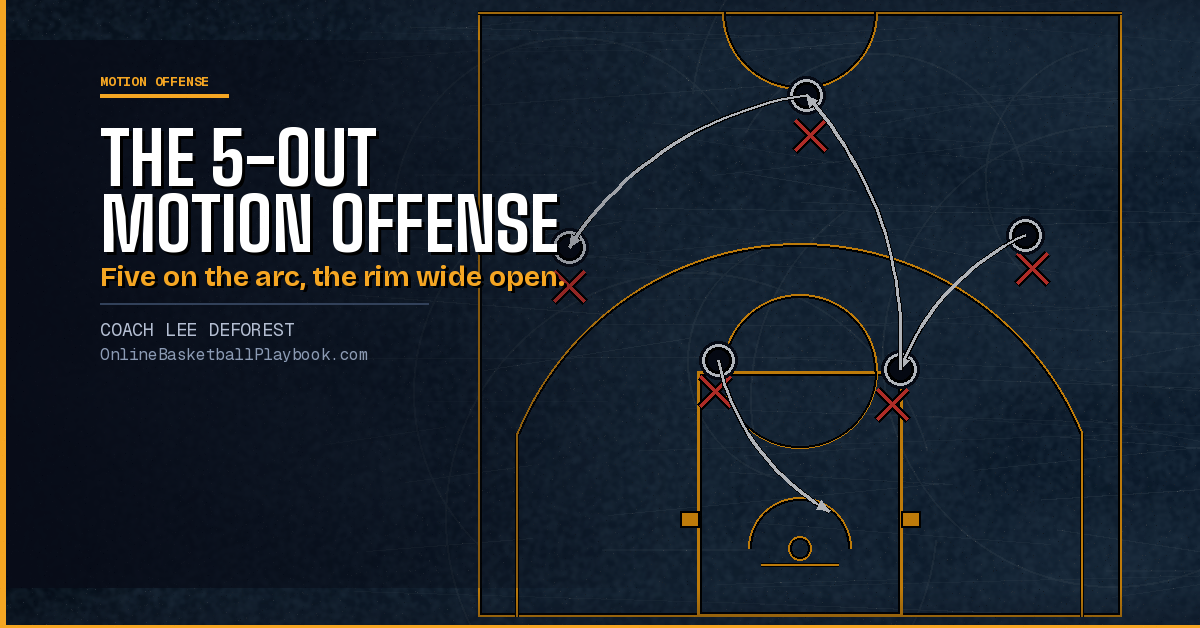
All five players spread outside the arc, the paint completely empty, and your players making reads — not running plays. Here's how to build it from scratch.
How to Coach the Dribble-Drive Motion Offense (Complete Guide)
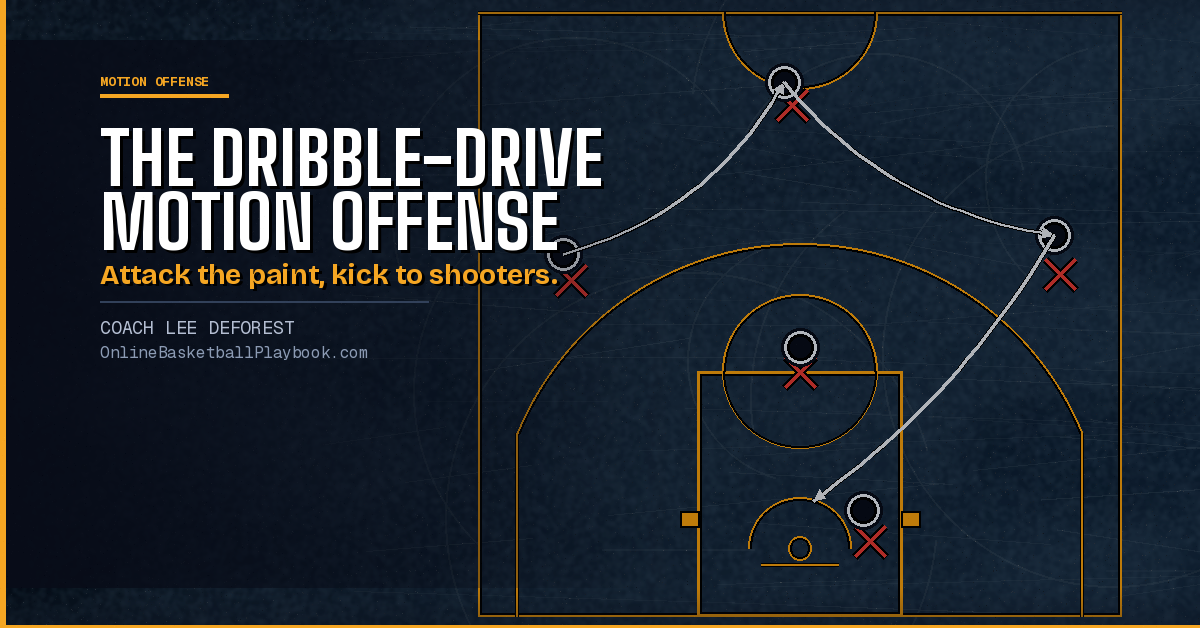
A spread, attack-the-paint system built on dribble penetration, wide spacing, and kick-out threes — and why it might be the best offense for a guard-heavy team.
How to Coach a Motion Offense (Complete Guide)
Spacing, cutting, screening, reading the defense — how to build an offense built on rules, not memorized plays, that develops players and can't be scouted.
More from Online Basketball Playbook
Taking Advantage of Early Offense
Run early before the defense sets — the TRIPLE and West work best off transition.
How to Run Productive Basketball Scrimmages
Install the TRIPLE in scrimmage so players make reads in real time, not walkthrough pace.
Basketball Pace & Tempo Strategy
The West spread works best at a controlled tempo — here’s how to set it.