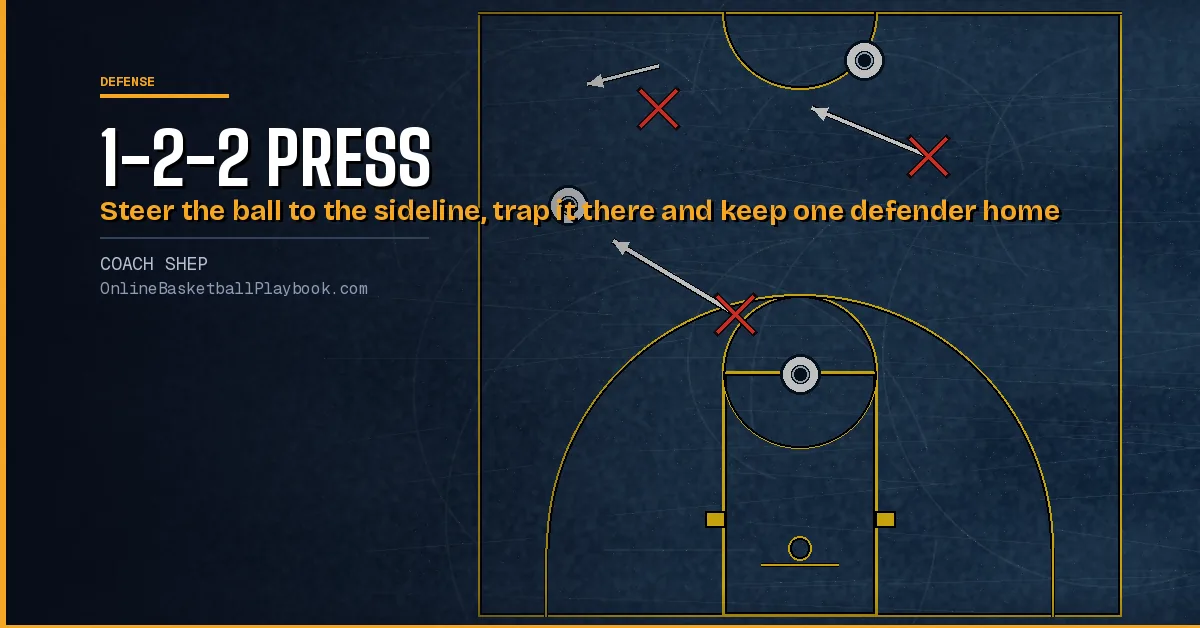
The 1-2-2 press is a zone press with one defender on top, two in a middle line and two in a back line. Most versions let the inbound pass happen, steer the ball toward a sideline and trap it there, and they keep one defender home to guard the basket. It gets labeled a low-risk press because someone is always behind the ball. This guide lays the main versions side by side, because they disagree on where to pick up, where to trap and how much the back line can gamble. Pick one answer per question and put it on your team's call sheet.
1-2-2 Press at a Glance
| Question | Answer | Version |
|---|---|---|
| Where it picks up | Three-quarter court, with less pressure on the inbound | Tempo version |
| Where it picks up | Half to three-quarter court, with the trap as the ball crosses half court | Half-court-line version |
| Where it picks up | Full court, or three-quarter court, with the inbound denied or allowed | Point-force version |
| Main job | Control tempo, force extra passes and catches, trap the sideline dribble | Tempo version |
| Main job | An identity defense that dictates and disrupts, with turnovers as a byproduct | Identity version |
| Who guards the basket | The weak-side back player, with the role shifting on a reversal | Tempo version and the point-force version |
| Main cost | Less pressure on the inbound pass, so the offense gets the ball in comfortably | Tempo version |
1-2-2 Press Alignment and Roles
The press is drawn as a point at the top, two defenders across the middle of the backcourt and two behind them near the sidelines and the basket. The numbers do not have to match positions, so put each player where he does the job best.

The tempo version names three roles and describes each. Each version on this page is named for what it stresses.
- Top (X1). Quick and long, because the offense will pass over him again and again. He is deceptive about when he leaves to trap and keeps his shoulders to the sideline so the handler is steered up the sideline toward the ball-side middle player. On a reversal he moves to the new handler with the same aim.
- Middle line (X2 and X3). Good anticipators. The ball-side player traps with the top. The weak-side player rotates to take away the middle, because nearly every team flashes someone there.
- Back line (X4 and X5). Usually the post players. The ball-side player sits between the ball and the sideline receiver. The weak-side player guards the basket as high as his speed allows.
Other versions split the five differently. The three-intensity version treats X1, X2 and X3 as one trapping unit and X4 and X5 as a back safety unit. The point-force version gives the point guard the key job of forcing the ball down a sideline, has the strong-side wing wait for the ball to come to him, has the weak-side wing cover the middle and tells the strong-side back "ball comes, you come" while the weak-side back owns the basket. The all-five-back version sends all five into the backcourt and wants it set within two seconds.
Rules of the Press
Each version boils the press down to a few rules. They overlap, and the differences show what each one is protecting.
| Rule | Idea | Version |
|---|---|---|
| No straight-line passes | High hands force slow lob passes that can be stolen or at least give the defense time | Tempo version |
| Keep the ball out of the middle | Squeeze toward the ball while it is in the middle third, and shift to the middle whenever the ball sits in an outer third | Tempo version |
| Keep the ball out of the middle | Split the court into thirds. The ball stays out of the middle third | Identity version |
| Keep the ball out of the middle | The top priority in all three of the three-intensity version's modes, and in the half-court-line version the middle denier does not leave to trap until the weak-side top has rotated across | Three-intensity version and the half-court-line version |
| No easy sideline catch or dribble | Trap the dribbler up the sideline and make sure the back line takes away the simple pass | Tempo version |
| No forward pass | No forward pass in the ball's third or into the middle | Identity version |
| No passes behind the defense | The rim role shifts on every reversal, so the back line talks and knows its own speed | Tempo version |
| No fouling in the trap | "Fouling negates hustle." Keep high hands and take good angles | Tempo version |
| Make the dribbler uncomfortable | No comfortable dribbling forward | Identity version |
How the Press Moves With the Ball
The tempo version walks the press through the inbound, the outer third, the reversal, the sideline dribble, the late sideline pass and the pass to the middle, and the pictures below mirror them with the ball on the right side of the floor.
The inbound. The two middle-line players pinch toward any receiver in the middle so the first pass cannot go there. The outer third. The defense loads. The top steps between the handler and the reversal player to force a dribble up the sideline toward the ball-side middle defender. The ball-side back defender takes away the sideline pass, the weak-side middle defender rotates to the middle and the weak-side back defender drops toward the basket.

The reversal. Strong-side and weak-side jobs switch. The top uses his length and high hands to slow the reversal pass, which buys time for everyone else to rotate. The three-intensity version has the front three rotate on a reversal with the middle player holding the middle until the ball-side defender arrives, while the two back players swap safety and sideline-denial jobs.
The sideline dribble. The top and the ball-side middle defender trap. The weak-side middle defender and the ball-side back defender read eyes and shoulders as interceptors, and the weak-side back defender has the rim. The tempo version teaches that the ball is never dribbled through a trap and that players in the trap keep their hands high and their feet together. Its point is that the trappers do not hunt the steal. Weak passes out of a high-hand trap give the interceptors theirs.

The late sideline pass. When the back line is a step late and the sideline pass is completed, the tempo version turns it into a vertical trap. The late back defender stops the ball, the ball-side middle defender runs down the sideline to trap and the top and the weak-side middle defender sprint in front of the ball.

The all-five-back version adds a vocabulary for the pass back out of a trap. It splits throw-backs into short, which do not cross the lane, and long, which do, and it changes who chases and who floats by length. Once the player guarding the basket takes that job on a throw-back, he keeps it whatever the ball does.
Where Each Version Traps
| Trap spot | Idea | Version |
|---|---|---|
| The outer third, when the ball is dribbled up the sideline | Top and ball-side middle defender trap. A second trap is the vertical trap | Tempo version |
| About 6 to 8 feet either side of half court | An automatic double team in that area | Identity version |
| As the ball crosses half court | X1 contains above half court, then X1 and X2 trap and use the half-court line and sideline as extra defenders. X2 should not cross the line early except to stop a middle crossover | Half-court-line version |
| The backcourt at the trapping intensity, the frontcourt corner in the delayed corner trap | One hard trap deep, sometimes a second near half court. The delayed corner trap waits and then traps the corner | Three-intensity version |
| Wherever the ball goes to a sideline | The point forces the ball down the sideline and traps with the wing. In the half-court version the wing and back trap a corner | Point-force version |
The half-court-line version has a rule for the flip side. If the ball is passed sideways before it crosses half court, the whole coverage flips. The defender who was denying the middle plays the ball, the top sprints to trap, the other middle defender slides to deny the middle, and the top gets a hand in the passing lane to take away the return pass. A sideways pass across half court under pressure risks an over-and-back violation.
One Press at Three Intensities
The three-intensity version runs one 1-2-2 at three levels of pressure.
- Trapping intensity. The aggressive three-quarter-court trapping version. X1 pressures the ball and either attacks right away or waits for the dribble. X2 and X3 protect the sideline and the middle to close the trap, X4 slides up to deny the sideline pass and X5 drops back as the deep middle safety. Its teams usually got one hard trap deep and sometimes a second near half court, then retreated to look for the half-court trap.
- Float intensity. A safe press with no trap. The players set up deeper and float in front of the offense to slow its progress and use clock without risking a foul or a layup.
- Delayed corner trap. It starts like the float intensity with light pressure to lull the offense into crossing half court along the sideline, then traps hard in that corner while the opposite wing denies the middle reversal. Its teams became more effective in the delayed corner trap because it covered less floor than the trapping intensity.
A gamble call brings the deep safety up to deny the middle pass. This version calls that a genuine gamble that opens a long diagonal pass under the basket, to be used sparingly as a surprise. The press sometimes forced turnovers from confusion even in the lighter float look.
The Back Line Compared
Each version gives the back line a basket-protection job. They differ on how high he plays and how much he can bait.
| Question | Idea | Version |
|---|---|---|
| How high the weak-side back plays | As high as his speed allows. A quick player can sneak up to bait the deep pass and sprint back to steal it. A slower player stays conservative | Tempo version |
| How high the weak-side back plays | Responsible for the basket, and the ball-side back follows "ball comes, you come" | Point-force version |
| The deep player's job | A deep middle safety, with X4 sliding up to deny the sideline pass | Three-intensity version |
| The deep player's job | X5 reads whether anyone is deep and either stays as the safety or cheats toward the middle. X4 denies the sideline pass | Half-court-line version |
| Can the safety leave the basket? | All five start in the backcourt. Once X4 drops to the basket on a throw-back, "no movement under any circumstances" changes that job | All-five-back version |
| Can the safety leave the basket? | On the gamble call he comes up to deny the middle, and this version calls it a gamble | Three-intensity version |
When the Press Breaks
The tempo version says a pass into the middle usually means the press is beaten. The nearest defender takes the ball and the other four sprint into the half-court defense. It tells coaches to practice that transition, because even a good press does not force a turnover every possession.

The versions give different places to land.
- Man or a 2-3. The tempo version says the press is rarely broken at full speed, so the team has time to settle into man or a 2-3, or to stay in the 1-2-2 shape. The identity version has the team declare the ball on the flight of the pass and then drop to a 2-3.
- A half-court 1-2-2. The point-force version's press converts into a half-court trapping defense with its own jobs for the point, wings and backs, including fronting the post.
- Retreat and look for a half-court trap. The three-intensity version's teams had everyone retreat after the first hard trap, whatever the call.
For the zone you land in, see the 2-3 zone defense and the 1-2-2 zone defense. The five spots of the base 1-2-2 zone already form a press alignment.
When to Run It and What It Costs
The tempo version lists five advantages. It is low risk because someone always guards the rim. It breaks a fast-breaking team's rhythm. It wears down guards, so the reward can show up in the fourth quarter. It drops into man or a 2-3. It lets more players play. Its goals are to control tempo, make the offense handle more passes and catches, and trap the sideline dribble. It says you can use the press all game or in spurts.
The identity version treats it as a program identity, not a changeup, and lists what it needs. It asks for elite doubling, elite transition defense, length and communication, and it puts the smartest player, not necessarily the most athletic, at the point. The point-force version asks for great conditioning, communication and anticipation, and wants defenders who approach traps at the right angle with arms up and knees bent without reaching.
The costs are named too. The tempo version says the 1-2-2 puts less pressure on the inbound. Compare the 2-2-1 press, the 1-2-1-1 diamond press and the 1-3-1 full-court press in the best full-court press comparison, and read full court press defense for how the families fit together.
Get the next coaching guide in your inbox
One email when a new guide or diagram set goes up. Free.
Related Pages
Teams that face a 1-2-2 press need a plan for the middle flash and the reversal, which the press break guide and how to beat a full-court press cover. For installing a press in practice, use the full-court press defense drills and the three-quarter court press guide. For the call words, see the press terminology guide, and for the defense you fall back into, see the transition defense guide.
Questions Coaches Ask
What is a 1-2-2 press?
A zone press with one defender on top, two in a middle line and two in a back line. It usually lets the inbound pass happen, steers the ball to a sideline and traps it there while one defender guards the basket.
Is the 1-2-2 press a zone press or a man press?
It is a zone press. Each defender covers an area, and the jobs shift with the ball. Some versions end in man or in a 2-3 zone once the press is beaten.
How does the 1-2-2 press differ from the 2-2-1 press?
The shapes differ in who starts up front. The tempo version notes that the 1-2-2 puts less pressure on the inbound and that the 2-2-1 gets few steals against patient teams.
Where do you trap in a 1-2-2 press?
The versions differ. The tempo version traps the sideline dribble in the outer third. The identity version doubles automatically about 6 to 8 feet either side of half court. The half-court-line version traps as the ball crosses half court. The three-intensity version's delayed corner trap catches the corner after the ball crosses half court.
What happens when the ball goes to the middle against a 1-2-2 press?
The tempo version calls the press beaten in most cases. The nearest defender takes the ball and the rest sprint back into the half-court defense.
Want the printable playbook packs?
OBP Pro members get the premium playbook packs: the zone attack, out of bounds and practice plan PDFs, plus each new pack as it is finished. The membership page lists what is in each one. Or draw your own version free in PlayDraw.
See what OBP Pro includesMore Guides From This Batch
- Basketball Offense: Systems, Actions and Sets Explained
- Traveling in Basketball: Rule, Steps and Pivot Foot by Level
- 2-1-2 Zone Defense: Rotations, Weak Spots and Personnel
- Triangle and 2 Defense: How It Works and How to Beat It
Back to Full Court Press Defense and every Defense page.
Keep Building
Related breakdowns
1-3-1 Full Court Press: Roles, Traps and Rotations to Install
The 1-3-1 full court press from setup to frontcourt trap: each role, the reversal rotations, an aggressive version, the costs and when coaches call it.
1-2-1-1 Diamond Press Basketball: Roles, Traps and Install
How to run the diamond press in basketball: who plays each role, how to trap the corner, what to do on the reversal and the lob, and how to install it step by step.
2-2-1 Press: Setup, Traps, Rotations and Drills
How to run the 2-2-1 press: who plays each spot, how coaches trap the sideline, the rotations after a reversal, how it breaks, how offenses attack it and the drills.