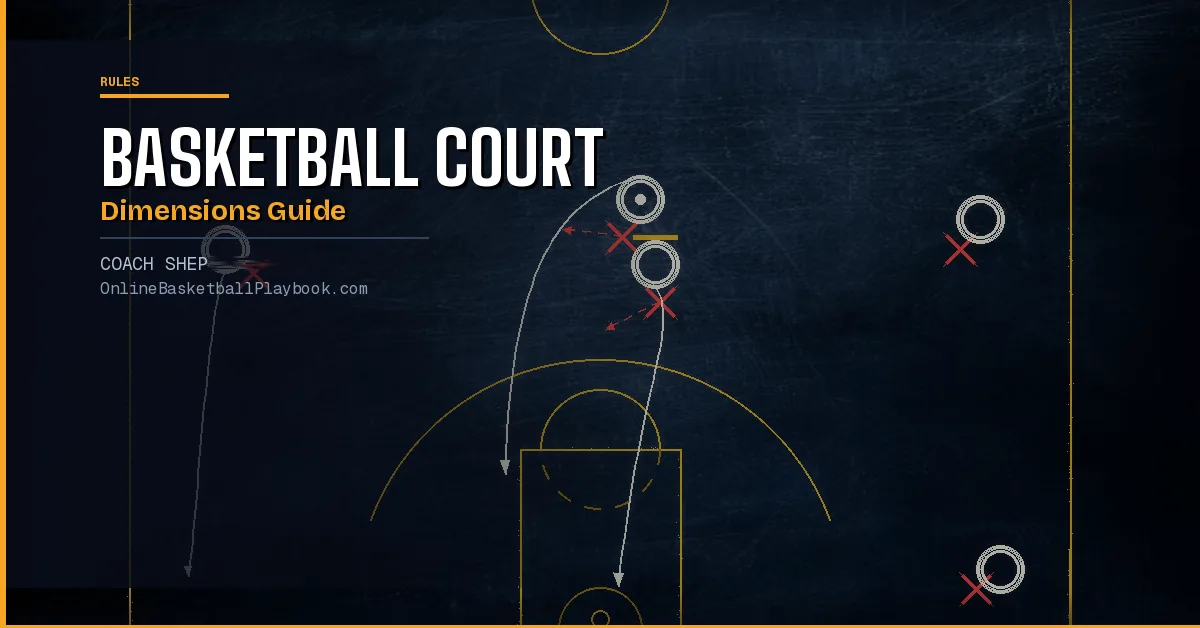
Every coach needs to know the court cold: not just the measurements, but how every line and zone shapes offensive spacing, defensive rotations, and the rules that govern play at each level.
Standard Court Dimensions by Level
The first thing to establish is that there is no single universal court size in basketball. Dimensions vary by level, and those differences have real tactical implications. An NBA court measures 94 feet long by 50 feet wide. The NCAA uses the same overall footprint (94 by 50) for both men's and women's play. High school courts drop to 84 feet in length with the same 50-foot width, though some older gyms run narrower. International FIBA courts are slightly different, measuring 28 meters by 15 meters, which converts to roughly 91.9 feet by 49.2 feet.
Why do these differences matter beyond just knowing the rules? Because court length directly affects transition time, pressing opportunities, and how hard your team has to work to execute a full-court press defense. A ten-foot shorter court at the high school level means less recovery time on broken plays and faster transitions in both directions. Coaches moving from one level to another often underestimate how much the floor geometry shapes the game.
The half-court line divides the floor into two equal halves and triggers several rules. The 8-second backcourt violation at the NBA level (10 seconds in college and high school) and the restriction preventing offensive players from returning to the backcourt once they've crossed it. The center circle at half-court, 12 feet in diameter at the NBA level, is used exclusively for the opening tip-off.
Key Court Markings and Zones
Beyond the overall dimensions, a basketball court is divided into functional zones by a set of painted lines, each with specific rule implications. Understanding these zones is foundational (both for teaching players the rules and for designing your offense and defense around the geometry).
The midcourt line creates the backcourt/frontcourt distinction. Once a team gains possession and advances the ball past midcourt, they cannot legally return it to the backcourt. Defenses that apply ball pressure in the frontcourt like a 2-3 zone defense: use the constraint of the midcourt line to limit skip passes and force the offense into condensed areas.
The lane lines (often called the key or the paint) form the rectangular area extending from the baseline to the free-throw line. In the NBA, the lane is 16 feet wide. In college and high school play it's 12 feet wide. That 4-foot difference is significant: a wider lane forces post players to establish position from a greater distance and makes it harder for big men to dominate near the basket. The 3-second lane violation, which prevents offensive players from standing in the lane for more than three consecutive seconds, is one of the most frequently called violations at every level, and understanding its boundaries is essential for player development.
The free-throw line sits 15 feet from the backboard. The semi-circle at the top of the key (often called the free-throw circle) has a radius of 6 feet. Players must remain behind this line when shooting free throws, and lane positions during free-throw attempts are measured from specific spots marked along the lane.
Three-Point Line and Perimeter Zones
The three-point line is arguably the most strategically consequential marking on the floor, and its dimensions vary significantly by level. In the NBA, the arc sits 23 feet 9 inches from the center of the basket at its furthest point, with corners measuring 22 feet. The NBA corner three is the shortest three-pointer on the floor, which is why corner three attempts have become so valued in modern analytics. You get the same three points for a shorter shot.
The NCAA men's game moved its three-point line to 22 feet 1¾ inches in 2019, a change designed to open up driving lanes and reduce crowding near the basket. Women's college basketball and high school play sit at slightly different distances. FIBA uses 22 feet 1¾ inches as well, bringing international play more in line with college dimensions than the NBA.
The area behind the arc but inside the sidelines and baseline is called the perimeter. Offensive systems built around perimeter spacing like 5-out motion offense: rely on all five players operating at or beyond the three-point line to maximize driving lanes. When you understand the exact geometry of the arc, you can teach players precisely where to stand to provide spacing without crowding the action. A player standing two feet inside the three-point line isn't just giving up a potential three-pointer, he's collapsing the lane for the ball-handler driving off a screen.
The corner zones (bounded by the three-point arc, the sideline, and the baseline) are compact, forcing defenders to cover shorter distances when rotating. For offenses, the corner is a natural catch-and-shoot spot. For defenses, it's an area where help defense principles must account for shooters who are close to the basket and the sideline simultaneously.
The Paint, Lane, and Low-Post Area
The paint is the most contested real estate on the basketball court. Points scored near the basket carry the highest efficiency rating in the sport, which makes the lane the center of gravity for both offensive and defensive schemes. Understanding the geometry of this area in precise terms helps coaches design post actions, set screens, and teach players their exact positioning responsibilities.
The low-post area is generally understood as the area along the lane line from the block (the small square marks at the corners of the lane near the baseline) up to the elbow (the junction of the lane line and the free-throw line). The block is typically 7 feet from the baseline. The elbow (one of the most important locations for mid-range and screen-the-screener actions) sits where the free-throw line meets the lane line, 15 feet from the basket.
The restricted area arc sits underneath the basket, painted as a semi-circle with a 4-foot radius from the center of the basket. This arc exists to prevent defenders from drawing offensive charging fouls when they've positioned themselves under the basket. Any contact in the restricted area is automatically called a blocking foul on the defense. Teaching players (both offensers driving to the rim and defenders rotating to take charges) to recognize the restricted arc is a fundamental part of court awareness at every level above youth ball.
The lane also defines the positioning for free-throw rebounding. Offensive and defensive players take assigned spots along the lane, two defensive spots closest to the basket, then alternating offensive and defensive positions moving outward. These positions are marked by lane space marks painted on the lane lines, and understanding them prevents violations during free throws and sets teams up for rebounding advantages.
For coaches developing post play in basketball, the precise measurements of the lane matter when teaching players to flash, seal, and receive passes. A player who understands that the block is 7 feet from the baseline knows exactly how far he needs to move to clear the three-second lane. That spatial awareness, built from real knowledge of the court, makes better players.
Coaching Applications: Using Court Geometry
Knowing the measurements is the starting point. Using them to teach the game is the actual job. Every offensive and defensive principle connects back to the court's geometry, and coaches who can explain why spacing rules exist (not just that they exist) develop players who make better decisions.
Spacing on offense is essentially a geometry problem. When five offensive players are spread correctly, each one forces the defense to cover distance. That distance creates time, and time creates open shots and driving lanes. The 15-foot free-throw line, the 22- to 23-foot three-point arc, the corners at 22 feet. These aren't arbitrary numbers. They're reference points that coaches use to define where players should stand to maximize the floor's effectiveness. Running a motion offense in basketball well requires players to understand not just the movement rules but the floor geometry those movements are designed to exploit.
On defense, the court's dimensions define the distances your players must cover during rotations. A defender helping from the weak-side corner to stop a drive has a longer recovery route than a defender collapsing from the elbow. Teaching those distances explicitly (rather than just telling players "rotate") creates defenders who understand why positioning matters before a play happens rather than after. A well-designed shell drill uses the court's actual geometry to teach these rotation distances in a controlled environment.
Transition basketball is another area where court dimensions shape tactics. On a 94-foot court, a point guard with a 3-on-2 advantage has roughly 47 feet of floor to cover from half-court to the rim. That distance determines how quickly the defense can recover, which in turn determines whether the offense should push the pace or pull up. Coaches who internalize these distances can make better real-time decisions and teach their players to do the same.
Youth and Modified Court Sizes
Youth basketball programs frequently play on modified courts with smaller dimensions designed to match the physical capabilities of developing players. USA Basketball and most state athletic associations publish recommended court sizes by age group, and coaches working with young players should understand how those modifications affect the game's teaching environment.
For players ages 7–8, a common court size is 42 feet by 50 feet with a lowered basket height of 8 feet. Ages 9–11 typically play on a 74-foot court with a 9-foot basket, and ages 12 and up generally move to the full court with standard 10-foot baskets. These modifications aren't just about physical safety. They're about keeping the game's geometry appropriate for players' size and skill level so that fundamental skills like dribbling, passing, and shooting can be practiced with correct technique rather than compensating for a court that's too large.
For coaches running a basketball practice plan with youth players, understanding the modified court dimensions helps you design drills that use the actual game geometry your players will face. A shooting drill designed for a regulation court doesn't translate perfectly to a youth court. The distances, angles, and spacing all shift. Adjusting your practice environment to match your players' court makes every repetition more transferable to game situations.
The three-point line is often removed entirely for younger age groups, replaced by a shorter arc or no arc at all. This is a sound developmental decision: shooting from a distance that forces players to compromise their mechanics to reach the basket builds bad habits that take years to unlearn. Prioritizing proper shooting form over three-point attempts is well-supported by player development research, and the court's geometry should reflect that priority.
NBA and NCAA: 94 ft × 50 ft. High school: 84 ft × 50 ft. FIBA: 91.9 ft × 49.2 ft. Three-point line: NBA corners 22 ft, top of arc 23 ft 9 in; NCAA 22 ft 1¾ in; high school 19 ft 9 in. Free-throw line: 15 ft from backboard at all levels. Lane width: 16 ft NBA, 12 ft college and high school.
- NBA/NCAA court: 94 ft × 50 ft, the standard full-size floor used in high-level play
- High school court: 84 ft × 50 ft is 10 feet shorter, which shortens transition time and press recovery distances
- Three-point distances: NBA corners 22 ft, top of arc 23 ft 9 in; college 22 ft 1¾ in; high school 19 ft 9 in
- Free-throw line: 15 feet from the backboard (face of the backboard) at all levels of play
- Lane width: 16 ft in the NBA, 12 ft in college and high school, which affects post positioning and three-second coverage
- Restricted area arc: 4-foot radius semi-circle under the basket; contact inside this arc is a blocking foul on the defense
- Youth courts: Sizes vary by age group, 42 ft for ages 7–8 up to full court for ages 12+; basket heights lower from 8 ft to 10 ft progressively
Get free play diagrams, drills, and coaching guides delivered weekly.
Draw this play free in the play drawer →
Membership: the full library, playbook packs, and Pro drawing tools →
Keep Building
Related breakdowns
Basketball Positions: What Each of the 5 Positions Does
The point guard, shooting guard, small forward, power forward and center, what each one does on offense and defense, and when to ignore the numbers.
Basketball Game Clock Rules: When It Stops and When It Starts
Basketball game clock rules by level: when the clock stops, when it starts on a throw-in or a missed free throw, made baskets late and the last-two-minute rules.
FIBA vs NFHS Rules for Coaches Who Play Internationally
FIBA vs NFHS rules for coaches: goaltending and the ball on the ring, timeouts, travel and the gather, the clock, the throw-in, plus Olympic rules vs the NBA.