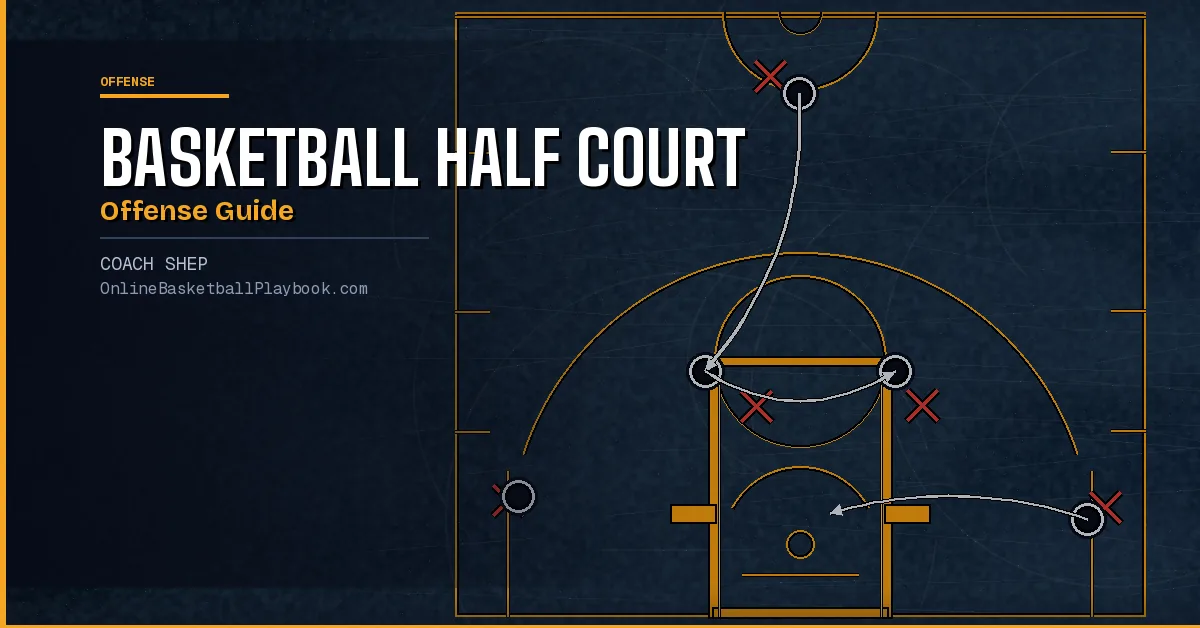
Half court offense is where games are won or lost. When the transition advantage is gone, you need spacing, reads, and purposeful movement to crack organized defenses. This guide covers everything you need to build a reliable half court attack.
Why Half Court Offense Matters
Every team wants to run. Getting easy buckets in transition is the most efficient offense in basketball. But at every level above youth ball, organized defenses will get set, slow the game down, and force you to execute in the half court. How well your team handles that moment separates good programs from great ones.
A team without a reliable half court offense becomes predictable and stagnant. Defenders can load up, protect the paint, and dare you to make shots with no movement. That is when offenses stall, shot clocks expire, and frustration builds on the bench. A well-designed half court system solves this by putting defenders in conflict on every possession.
The best half court offenses share a few traits: they create ball movement, they force defenders to guard multiple threats, and they produce high-percentage looks rather than contested isolation attempts. Whether you run set plays, motion principles, or a hybrid, those three outcomes should be your benchmark.
Understanding the connection between your half court offense and your defense also matters. If you turn it over in the half court, you give up transition opportunities. If you take poor shots, your transition defense is starting from a bad spot before the ball even hits the rim. Half court execution has a ripple effect across the entire game.
Spacing and Floor Balance
Spacing is the foundation of every half court offense. Without it, no action works. Cutters have no lane to attack, ball handlers have no driving room, and shooters have no separation from help defenders. Proper spacing means keeping all five offensive players in positions that stretch the defense and make it impossible to guard everyone simultaneously.
The standard guideline is 15 to 18 feet between players on the perimeter. When players crowd together, a single defender can guard two of them. When they are properly spread, every defensive help rotation opens a gap somewhere else. This is not optional. It is the engine that makes every action work.
Floor balance means you always have at least one player in a position to handle a potential turnover or defensive transition. You do not want four players cutting to the basket at the same time with no one back. Good offensive teams maintain this balance instinctively, keeping a ball-side wing and a weak-side corner or slot player as outlet options on every possession.
The 5-Out Motion Offense takes spacing to its logical extreme, all five players on or above the three-point line, maximizing driving lanes and spread. It is an excellent teaching tool because it forces players to maintain distance and move with purpose rather than clumping near the ball.
Common Spacing Mistakes
The most frequent spacing errors at the youth and high school level are ball-watching and drifting toward the action. When a guard drives, the corner player often drifts toward the lane instead of staying in the corner as a kick-out option. When a post catches on one block, the weak-side wing sags toward the ball instead of holding spacing for a skip pass.
Correct these habits early. They are hard to unlearn once players develop them. Drill spacing by running sets with cones marking where each player should be, then have them adjust based on ball movement. Players who understand why they need to stay spaced will maintain it far better than those who are just told where to stand.
Reading the Defense
Modern half court offense has shifted significantly toward read-based systems over the last two decades. Rather than running five scripted plays and calling them from the sideline, read-based offenses teach players a set of rules that generate actions off how the defense plays. The result is an offense that is hard to scout, fun to play, and that actually develops basketball IQ rather than just memorizing patterns.
The core rule is simple. Every pass is followed by a meaningful action. You pass and cut, pass and screen, or pass and relocate. But you never pass and stand. Standing after passing lets defenders watch the ball and provide help without cost. Movement keeps them accountable.
The read comes from identifying what the defense is giving you after each pass. If your defender follows you on a cut, continue to the basket. If they sag, stop and receive the ball in the mid-post area. If they hedge, back-cut for a layup. These decisions happen in real time based on what is in front of you. Not based on a predetermined script.
Teaching this takes time and repetition. Start with two-man games before adding a third player, then four, then five. Walk through reads slowly before making them live. The payoff is players who understand the game rather than just their role in a play, which makes them more adaptable when defenses adjust.
Pass-and-Cut vs. Pass-and-Screen
Two primary actions follow every pass in a read-based system. The first is the pass-and-cut: immediately after giving up the ball, attack the basket looking for a return pass. Read the defender. If they chase you, continue. If they front, use the passer as a screener. The second is the pass-and-screen away: after passing, go set a screen for a teammate on the weak side. This creates actions without the ball that keep the defense occupied.
Which action you choose depends on what the defense is giving you. That is the read. Over time, players develop instincts for which action will create the best opportunity in each moment. Coaches accelerate this by asking players to verbalize their reads in practice, explaining why they cut or screened after each rep.
Half Court Sets and Actions
Even in read-based systems, teams use set plays and structured actions to create specific advantages. Sets are useful at the start of possessions, coming out of timeouts, or late in a game when you need a particular look. The key is integrating them into your offensive system rather than running them as isolated plays.
The pick-and-roll is the foundational two-man action in modern half court offense. A ball handler uses a screen from a big, forcing the defense to decide who covers whom. The options off this action are enormous: the ball handler can pull up, turn the corner, or find the roller. Defenses switch, hedge, drop, or trap, and each coverage creates a counter. Building a pick-and-roll package with two or three clear counters gives you a reliable half court weapon.
The dribble-handoff creates similar advantages with a different look. A perimeter player catches near the elbow, turns, and hands to a cutting teammate. The defender on the receiver must navigate the handoff, which creates contact points and separation. Pair it with a slip from the screener and you have two threats on every rep.
Horns is a popular alignment that puts both bigs at the elbows while the point guard enters from the top of the key and guards are spaced in the corners. From this look, you can trigger pick-and-roll in either direction, run a lob for the non-screener, or pass to the elbow and initiate dribble-drive actions. The alignment itself gives you multiple options before any play is called.
Understanding how your sets connect to your reads matters at every level. When players know the options and counters off each set, they make better decisions under pressure. Pair your set plays with structured practice planning so players get enough repetitions to execute automatically rather than thinking through each step in the moment.
Run each half court set from both sides of the floor so defenders cannot cheat based on which side you enter. Ambidextrous teams are much harder to scout and prepare for because every action becomes a genuine threat regardless of direction.
Attacking Zone Defenses
Half court sets that work against man-to-man do not automatically transfer to zone defense. Zones protect the paint and take away driving lanes, so the attack requires a different set of principles. Understanding how to crack a zone is essential. At the youth and high school levels especially, you will see zone defense frequently.
The 2-3 Zone Defense is the most common look you will face. Its vulnerability is the high post and the short corners. When you can get a player to the high post area with the ball, you create a pivot point that collapses the zone and opens either block or a skip pass to the weak-side wing. The short corner (just outside the block on the baseline) creates similar problems because neither the bottom wing nor the corner player of the zone can guard it comfortably.
Ball movement is even more important against zones than against man. The zone shifts as a unit to follow the ball, but a quick reversal can catch it out of position. Two or three swing passes that move the ball faster than the defense can rotate will create open mid-range and corner opportunities. Teach players to catch ready to shoot rather than catching and deciding. Hesitation lets the zone recover.
Attacking the gaps is the other key principle. Zones have seams between defenders that cutters and drivers can exploit. A guard who dribble-penetrates a gap forces two defenders to account for one offensive player, creating a kick-out opportunity. Train players to identify the gaps in each zone before the possession begins, so they know where to attack when they receive the ball.
Overload Principles
Overloading one side of the zone with three offensive players against two defenders is a structural advantage you can build into your zone offense. Running a 1-3-1 set against a 2-3 or using a three-player corner alignment creates these overloads naturally. The zone cannot guard all three without abandoning help responsibilities elsewhere, so ball movement within the overload eventually finds an open player.
Teaching Progression for Coaches
How you install your half court offense matters as much as what system you choose. Players who understand the why behind each action execute better under pressure than those who have simply memorized sequences. A structured progression makes that understanding possible.
Start with 5-on-0 walkthroughs. Move through your base alignment and actions at half speed, stopping to explain spacing requirements and reads at each step. No defense means no decisions to make. Players can focus entirely on footwork, timing, and positioning. Run the 5-on-0 for several practices before adding defense.
Next, add a token defense (one or two defenders who are passive and let the action develop without interference). This introduces a read without the pressure of live defense. Players can practice identifying what the defense is giving them and responding with the correct action before those decisions become high-stakes.
Progress to 3-on-3 in a half court setting. Three players forces spacing and movement without the complexity of five. It is a great format for emphasizing pass-and-cut and pass-and-screen reads because there are fewer distractions. The Shell Drill is an excellent complement here, teaching defensive positioning and helping offensive players understand what they are trying to attack.
Finally, go 5-on-5 live. Use your sets and actions, but keep the conversation going. Stop and ask players what they saw, what read they made, and what the alternative was. A practice culture where players can discuss and explain their decisions builds the collective understanding that makes half court offense click during games.
Track what is and is not working. Chart shot locations in practice to see whether your offense is generating the looks you want. If you are getting a lot of contested mid-range attempts but no corner threes, your spacing or ball movement rules need adjustment. Data from practice tells you where to spend your repetitions.
Connecting your half court work to individual skill development also pays dividends. Players who are working on their footwork and finishing separately will execute better when those same movements appear in your half court sets. Skills practiced in isolation compound when they show up in the context of team offense.
- Space first. Reset to proper spacing before initiating any action. Crowding kills every play before it starts.
- Pass and move. Standing after passing gives help defenders a free look. Cut or screen every time.
- Attack the first gap. When the ball is entered, the first cutter should attack the nearest gap immediately to threaten the defense.
- Catch ready to shoot. Feet set, eyes up. Hesitating on the catch lets zones recover and help defenders rotate back.
- Read the top defender. In pick-and-roll, the coverage the top defender plays determines the correct action: pull up, turn corner, or find the roll man.
- Skip passes beat zones. A direct skip from one side to the other moves the ball faster than the zone can shift. It is your best weapon against any zone coverage.
- Practice both sides. Run every set from the left and right entry so players are comfortable and defenders cannot predict direction.
Get free play diagrams, drills, and coaching guides delivered weekly.
Draw this play free in the play drawer →
Membership: the full library, playbook packs, and Pro drawing tools →
Keep Building
Related breakdowns
Basketball Shooting Off Screens: Complete Guide
Basketball Shooting Off Screens: Complete Guide
How to Train to Play Basketball: Complete Guide for Beginners
How to Train to Play Basketball: Complete Guide for Beginners
Off-Ball Movement in Basketball: Complete Guide
Off-Ball Movement in Basketball: Complete Guide