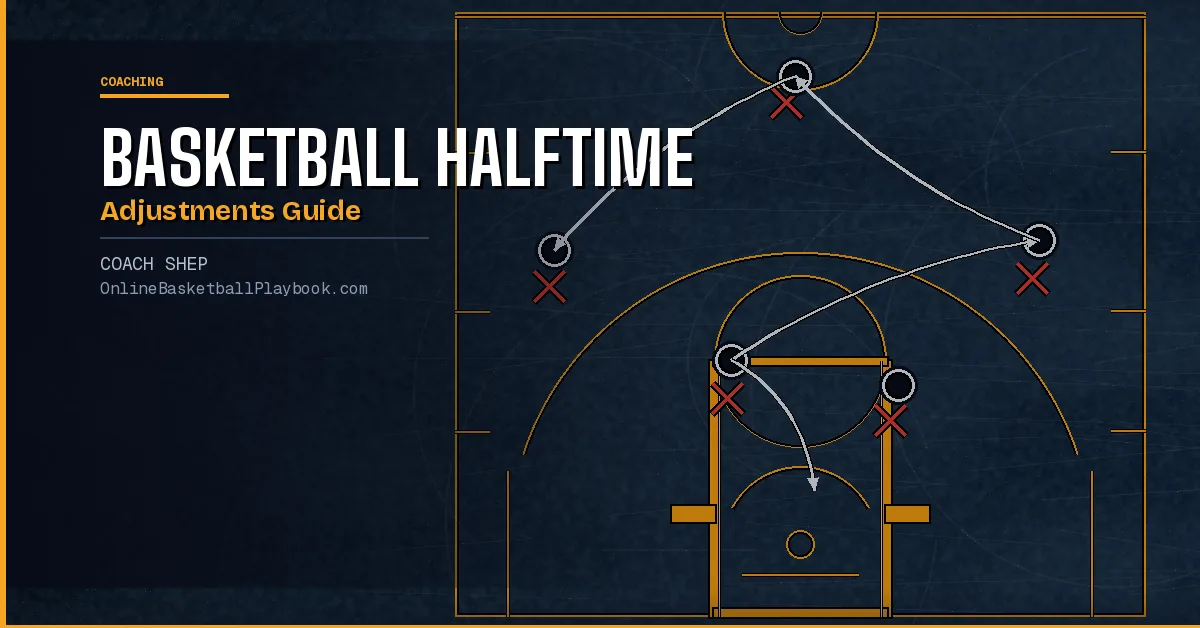
Halftime gives you twelve minutes to fix what went wrong in the first half. Coaches who use that time well flip games. Coaches who waste it on emotion hand the opponent momentum going into the third quarter.
What Halftime Is Really For
Most coaches treat halftime as a time to dump everything they observed in the first half onto their players at once. That approach almost never works. Players are physically tired, mentally processing two halves of information, and emotionally responding to the scoreboard. Flooding them with fifteen corrections does not produce better second-half basketball. It produces paralysis.
The job at halftime is surgical. Pick the one or two things that had the biggest impact on the first-half result and address those clearly. Everything else waits. This requires preparation: the best halftime adjustments happen because coaches build a basketball practice plan that deliberately conditions players to respond to in-game changes quickly and without confusion.
There are three things halftime can genuinely accomplish. First, it can fix a specific defensive breakdown that the opponent exploited repeatedly. Second, it can open up an offensive action that your scouting report identified but you did not lean into enough in the first half. Third, it can shift the emotional temperature of the locker room, settling a team that is panicking or re-energizing one that has gone flat. Often, only one of those three is actually necessary.
The coaches who make the best halftime adjustments are the ones who arrive with a short list in hand, not a long one. They have been tracking patterns throughout the first half, noting which defensive coverage broke down, which offensive actions created good looks, and which matchups are tilted in either direction. They walk into the locker room knowing exactly what they want to say before they say it.
Reading the First Half: What to Look At
Effective halftime adjustments begin well before the buzzer sounds. Coaches and assistants need to be tracking specific information in real time throughout the first half so that the halftime message can be built on observed facts rather than impressions.
On defense, the most important question is simple: how did they score? Identify the two or three actions the opponent used to generate their best looks. Was it dribble penetration off ball screens? Was it a particular post player receiving the ball in a comfortable spot? Was it transition layups off your own turnovers? The answer tells you what to adjust. Help defense principles are often where breakdowns live. A wing who is one step slow rotating, a big who is getting caught ball-watching, a guard who is going under screens and giving up open threes.
On offense, look at shot quality rather than shot volume. Your team may have taken twenty attempts in the first half, but if fifteen of them were contested mid-range pull-ups, the problem is shot selection, not effort. Ask which offensive actions produced the best looks. Did your drive-and-kick generate clean corner threes? Did your post entries create easy buckets? Did your transition offense produce layups? Those are the actions to run more aggressively in the second half.
Also pay attention to foul trouble, matchup opportunities, and pace. If their best player has two fouls, the second half is when you attack him specifically. If one of your players is physically dominating a matchup but hasn't received enough touches, that is a tactical adjustment to make explicitly. If the opponent wants to slow the game down and your team is better in transition, the adjustment might be as simple as communicating that you are going to push the pace on every defensive rebound.
Building basketball IQ in players throughout the season makes halftime communication much faster. Players who already understand the principles behind what you are adjusting can process a short instruction and apply it correctly, rather than needing a long explanation of why.
Defensive Adjustments at Halftime
Defensive adjustments tend to be the most impactful halftime changes because they address what the opponent has already proven they can do. You are not guessing. You are responding to evidence.
The most common defensive adjustment is changing the coverage on a ball screen. If their point guard has been getting into the paint off ball screens all half using your hedge coverage, switch to dropping the big or switching the screen. If they are shooting over your drop coverage, go back to a hard hedge or switch. The adjustment needs to be specific ("pick up your coverage on the screen" is too vague) and demonstrated physically, not just described verbally.
A bigger adjustment is switching defensive systems at halftime. Going from man-to-man to a 2-3 zone defense can disrupt an opponent's offensive rhythm significantly, especially if they spent the entire first half preparing to attack your man coverage. Zone halftime adjustments work best when your opponent has a weak perimeter shooter or when you need to protect a player with foul trouble. The risk is that your team has not practiced the zone extensively, which is why depth of preparation in your defensive system matters all season.
Transition defense is another area that shows up in halftime adjustments more than coaches expect. Many teams give up layups in transition not because of bad effort but because of bad habits in the moment after a missed shot: players watching rather than sprinting back, guards not locating the ball, bigs not protecting the rim. A concrete instruction like "first man back takes the ball, second man takes the rim, everyone else finds a body" is actionable and can stop a pattern of transition layups in the second half.
Finally, if the opponent has a specific player who dominated the first half, consider whether a full defensive assignment change is warranted. Putting your best perimeter defender on their best scorer at halftime (even if that means switching matchups away from your usual system) can neutralize a player who had found their rhythm and disrupt the flow they built in the first half.
Offensive Adjustments at Halftime
Offensive halftime adjustments are about attacking what the defense is giving you, not forcing your preferred action against coverage that has proven effective at stopping it. The first-half film is your scouting report update.
If they are packing the paint and taking away your drive, you need to create more space. Running more 5-out motion offense sets might open the floor if your personnel allows it. If they are switching all ball screens and leaving mismatches, your adjustment is to identify those mismatches specifically and go to them on every possession, post up the smaller defender, put the slower defender in a pick-and-roll. Name the actions you want and name the situations when to use them.
Pace is an underused offensive adjustment. If your offense has been stagnant in the half-court, committing to pushing the ball after every defensive rebound changes the kind of decisions the opponent has to make. Fast break offense takes advantage of disorganized defense, and if you can get even two or three layups in the first four minutes of the third quarter, it forces them out of their defensive comfort zone.
Be specific about personnel in your offensive adjustments. If your post player had a clear size advantage but only touched the ball four times in the first half, the adjustment is not to change your offense. It is to make explicit that he is the priority target. Tell your guards where on the floor to enter it and what to do after the entry. The adjustment is in the execution detail, not the system.
Shooting rhythm is worth addressing if your team went cold in the first half. Rather than assuming the second half will be different, identify the players whose shots looked mechanically sound but simply did not drop, and keep feeding them early in the third quarter to rebuild confidence. Players with sound basketball shooting form who are in a bad stretch often need one early make more than they need a technical correction.
Delivering the Message in the Locker Room
The structure of your halftime talk matters as much as the content. You have roughly twelve minutes, and the first two of those belong to players getting water, catching their breath, and the assistant coaches giving you information. That leaves ten minutes of actual communication time.
Start with the emotional register. If you lost the second quarter badly and your team is shaken, you need to address confidence before you address tactics. A team that believes it is already beaten will not execute your adjustments even if they understand them. Conversely, if you are up by twelve and your team is celebrating, the emotional register to address is complacency.
Then deliver your adjustments, using the fewest words possible. Write them on a whiteboard if you have one. Demonstrate physically if a defensive adjustment involves body positioning. Speak to the team about the one or two things you are changing, then speak briefly to the individual players whose roles are changing most significantly.
Bring energy as the team leaves the locker room. The tone of the third-quarter tip is set in the final thirty seconds before players take the floor. How a team runs out of that tunnel communicates confidence to the opponent before a single play is run.
Spend the first two minutes on water and assistant coach reports, the next six minutes on tactical adjustments with visuals, and the final two minutes on energy and individual role assignments. Then get your players on their feet and moving before they leave.
Halftime Adjustments for Special Situations
Certain game situations require specific halftime approaches that go beyond the standard tactical review.
When you are down by double digits, the temptation is to make dramatic changes. Switch systems, completely reorder your lineup, scrap the game plan. Resist it. Large deficits are almost always closed through superior execution of familiar actions, not through wholesale reinvention. Make two or three targeted adjustments and communicate clearly that you believe in your team's ability to execute them. The emotional message matters more when the deficit is large.
When you are winning comfortably, the most important halftime adjustment is often a warning against complacency rather than a tactical change. Name the opponent's tendencies that they have not yet used effectively but that your scouting report identified as dangerous. Tell your team what adjustments the opponent is likely making. Prepare them for the second half push rather than congratulating them on a lead that is not yet a win.
Close games require precise second-half preparation. If a game is within three or four points at half, halftime adjustments need to include end-of-game scenario preparation. Who takes the ball in the final possession? What is your defense if they call timeout with thirty seconds left? Basketball inbounds plays that your team has rehearsed need to be explicitly named as part of the halftime preparation so that players are not making decisions under pressure they have never rehearsed.
When facing a pressing team in the second half, make sure your ball handlers know exactly what you expect and that your press break assignments are fresh in everyone's mind. Turnovers in transition against a press team compound quickly, and players who are uncertain about their assignment will make worse decisions than players who have a clear role even under pressure.
- Limit to 2-3 adjustments max: More than that and nothing gets executed cleanly
- Address emotion first, then tactics: Players who are mentally checked out will not process X's and O's
- Be specific about matchup changes: Name the player, name the action, name the situation
- Use the whiteboard: Show the defensive coverage or offensive action visually, not just verbally
- End with energy: The final 90 seconds before they take the floor sets the tone for the entire third quarter
- Prepare for their second-half adjustments: Tell your team what changes to expect so nothing surprises them
Get free play diagrams, drills, and coaching guides delivered weekly.
Draw this play free in the play drawer →
Membership: the full library, playbook packs, and Pro drawing tools →
Keep Building
Related breakdowns
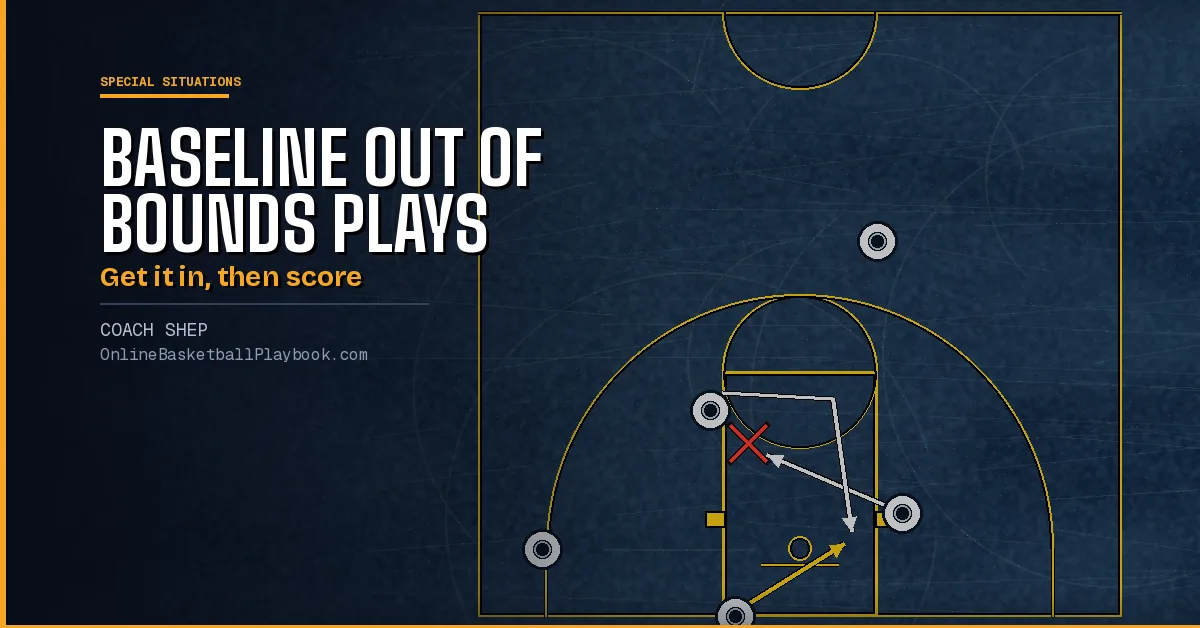
Baseline Out of Bounds Plays: Sets vs Man, Zone and for Youth
Baseline out of bounds plays drawn step by step: a box back screen and roll, Pick the Picker, the double stack, a 2-3 zone play, youth one-pass plays, the rules and the reads.
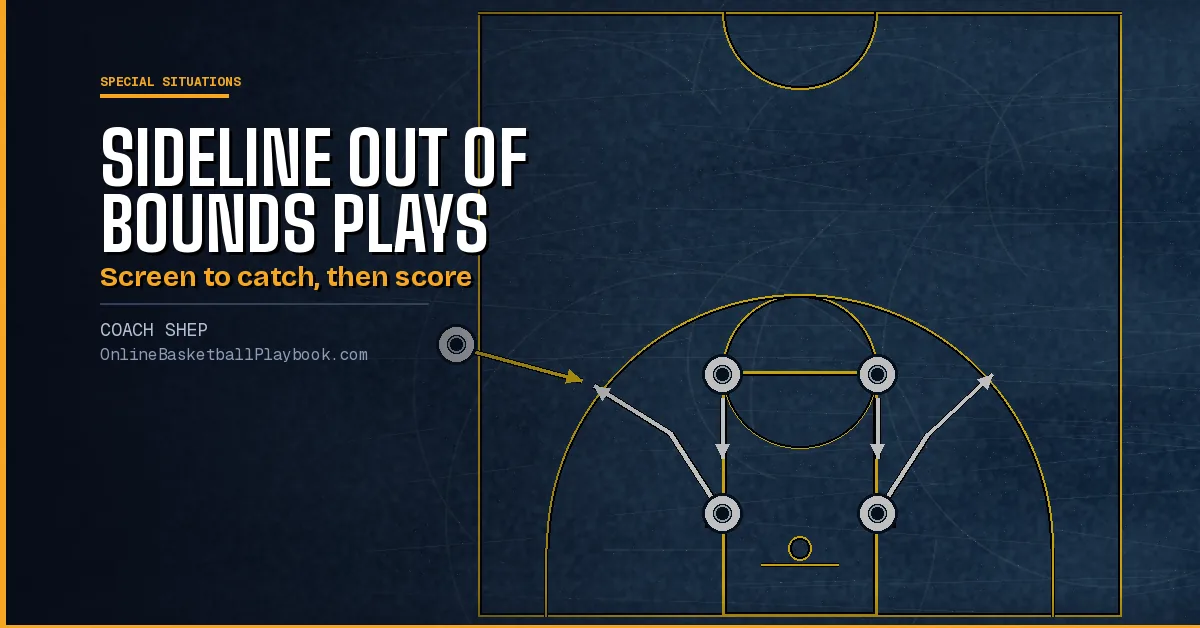
Sideline Out of Bounds Plays: SLOB Sets, Reads and Practice
Sideline out of bounds plays for coaches: SLOB sets from a box, stack and line, the inbounder's reads, plays against zone and denial, the clock and practice.
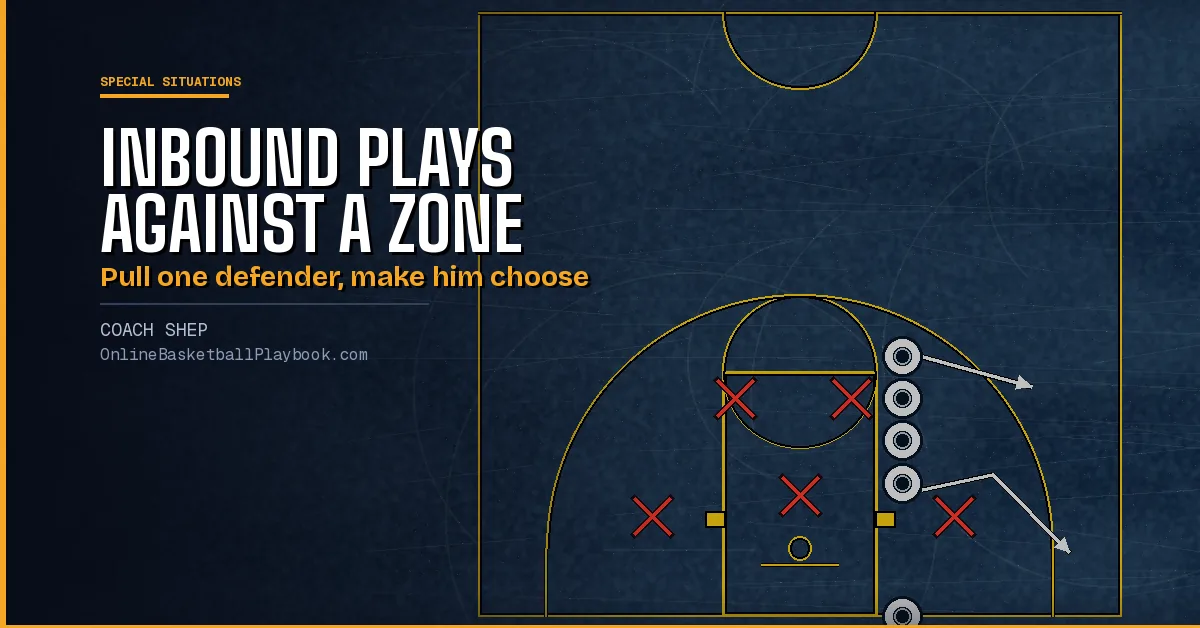
Inbound Plays Against a Zone: Baseline and Sideline Sets
Inbound plays against a zone from the baseline and sideline: the read, the stack near the elbow, short-corner pulls, split cuts, two-part sets and sideline answers.