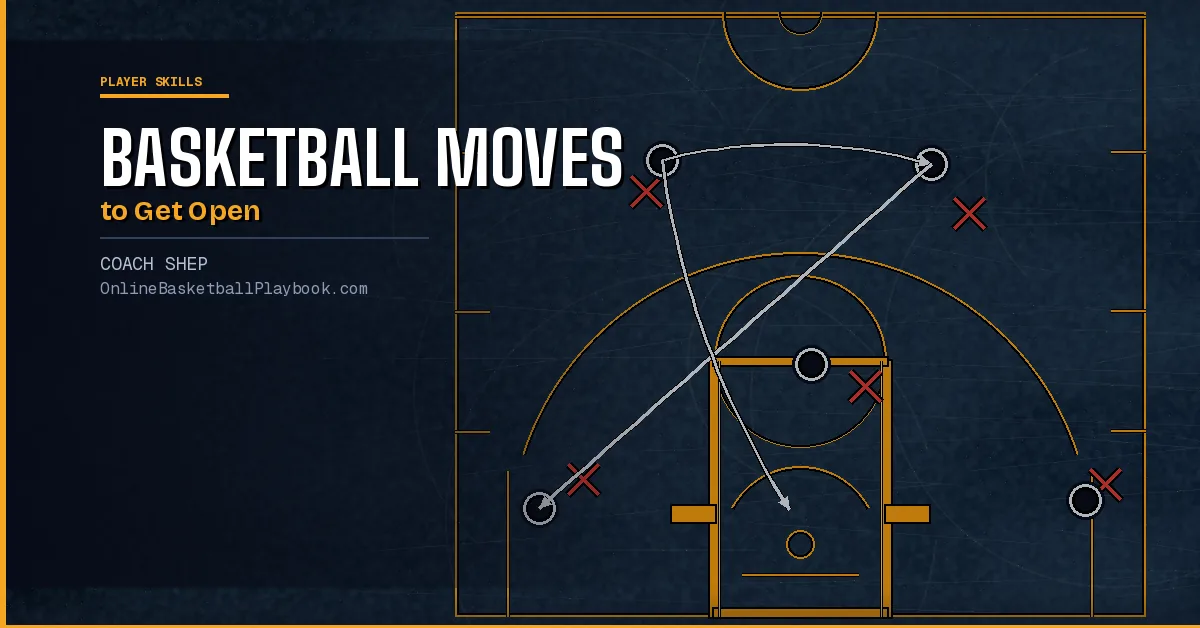
Getting open is a skill, one most players never fully develop. This guide breaks down the cuts, fakes, footwork patterns, and screen-reading habits that separate players who are always open from those who stand and watch.
Why Getting Open Is a Learned Skill
Most players believe getting open is about athleticism, that faster players simply outrun defenders. That belief is a ceiling. The best players in the world get open because they have mastered the habits, reads, and movements that make defenders wrong before the ball ever moves.
Getting open is about angles, timing, and deception. A defender who knows where you are going will always beat you there. The goal is to manipulate what the defender expects, then go somewhere different. That manipulation happens through footwork, body fakes, precise cuts, and the discipline to set up a move before you make it.
These concepts connect directly to overall basketball player development: The players who invest time in off-ball skills become the ones coaches trust in crucial possessions. They are not standing still waiting for a pass. They are working constantly, reading the defense, and creating opportunities.
The foundation of every move to get open is the same: use your body to lie to the defender, then go the other way. That principle applies whether you are a guard cutting backdoor, a wing riding off a screen, or a post player sealing in the paint. The specific footwork changes; the concept does not.
When you understand this, practice looks different. Every rep is not just about executing the move, it is about reading the defender's weight, hips, and eyes to decide which move to make. That is the level of basketball IQ development that separates players who get open from players who get shots off only when the defense breaks down.
The Four Foundational Cuts
There are four cuts every player must own. Each one is designed to exploit a specific defensive position. When you know all four and when to use each, you become a permanent problem for any defense.
The V-Cut
The V-cut is the most fundamental way to get open on the wing or at any spot on the floor. The player drives hard toward the basket, close enough that the defender must respect the cut, then plants the inside foot and explodes back to the ball. The drive toward the basket must be committed. A lazy V-cut is easy to defend. When the defender's hips turn to follow your drive, that is the moment you plant and go back.
Timing matters as much as technique. The V-cut should happen when the ball handler is ready to deliver. An early V-cut leaves the player standing and allows the defense to recover. A late V-cut means the passer has moved on. The best players read the ball handler's eyes and time the cut so the catch happens in stride, in a position ready to attack.
The L-Cut
The L-cut works in a straight-line direction rather than back toward the ball. The player cuts sharply across the lane, parallel to the baseline, then angles up toward the corner or the wing. This cut exploits defenders who shade toward the ball side. By first moving across the lane, you force the defender to chase across traffic, then your angle change puts them a step behind.
Post players use the L-cut frequently to create catches at the elbow or on the short corner. Guards use it to free themselves for skip-pass receptions on the weak side. The key is the sharpness of the angle change. A rounded L-cut allows the defender to stay connected. Cut in a straight line, plant, and redirect at a true 90 degrees.
The Backdoor Cut
The backdoor cut punishes over-aggressive defenders. When a defender is denying the pass by positioning above the passing lane, fronting the wing or playing the top hand, they are vulnerable to a backdoor. The player takes one or two steps toward the ball as if going for the catch, reads the defender's hand position, then plants and cuts hard to the basket behind the defense.
The backdoor only works when the ball handler sees it and delivers on time. This is why running motion offense concepts, including the motion offense in basketball, trains players to read these cuts together, the cutter and the passer must be connected. When it works, the backdoor is one of the most efficient shots in basketball, a layup off a read, not a play call.
The Curl Cut
The curl cut is used off a screen when the defender tries to trail underneath. Instead of flattening out to the three-point line, the player curls tightly around the screener's hip and continues toward the basket. If the cutter reads a trailing defender, curl; if the defender goes over the top, flare. Making that read in real time separates players who use screens from players who simply run off them.
Using Fakes and Footwork to Create Separation
A cut is a movement. A fake is what makes a cut work. You cannot get open consistently without mastering the fake that sets up the cut. Defenders are trained to read your hips and feet, not your shoulders or head. That means your fakes must involve your entire body, not just a head bob or a pump fake, to be effective.
The Jab Step
The jab step is a short, sharp step in one direction designed to load the defender's weight onto one foot before you go the opposite way. A good jab step looks like a real attack. The knee bends, the weight shifts, the step lands hard. A defender who sees a committed jab step will shift their weight to defend that direction. And the moment their weight shifts, you go the other way.
Jab steps are not limited to ball handlers. Off-ball players use jab steps to set up V-cuts, backdoor cuts, and flare cuts. A jab step toward the basket before flaring off a screen tells the defender you are going one direction, then exposes them when you go another.
The Hesitation
The hesitation is a pause, a deliberate break in rhythm, that makes the defender freeze. When a player is moving and suddenly hesitates, the defender's instinct is to stop and read. That freeze gives the offensive player a half-step. From that half-step, a cut, a shot, or a drive becomes available.
The hesitation works because defenders anticipate continuous movement. A sharp change in pace, whether slowing down or stopping briefly, disrupts that anticipation. Players who have mastered the hesitation can get open even when defenders are in good position, because they control the pace of the read.
The Body Fake
The body fake is a shoulder-and-torso movement that mimics a drive or cut without actually committing your feet. When you fake with your body, you keep the ball in front of you and protect it while sending false information through your upper body. The defender reacts to the shoulders; the feet stay in place, ready to go the true direction.
A body fake is particularly useful on the perimeter before a catch, or when a player has the ball and wants to create a driving lane. Keep the ball secure, don't go wide with the dribble, and use the shoulders and core to send the defender out of position.
How to Use Screens Effectively
A screen is only as good as how the cutter uses it. Most players run off screens and hope something opens up. High-level players read the defense before and during the screen, then make a specific decision, curl, flare, fade, or pop, based on what the defender is doing.
Setting Up the Screen
Before you can use a screen, you have to set it up. Walk the defender toward the screener, then accelerate. This timing forces the defender into contact with the screener rather than sliding through cleanly. If you sprint to the screen from the start, a savvy defender can anticipate and go under. The setup walk, two or three deliberate steps, is what makes the screen a genuine obstacle.
Rub your shoulder on the screener's hip. The tighter you run the cut, the harder it is for the defender to stay attached. A wide cut gives the defender room to recover and fight over the screen without contact. Tight cuts force a real decision: go over, go under, or switch.
Reading the Defender
As you approach the screen, read two things: where the defender's head is, and what the on-ball defender is doing. If the off-ball defender is trailing on your hip, curl toward the basket. If they are going under the screen, flare to the three-point line or pop back. If they are trying to fight over the top, reject the screen entirely and cut backdoor in the opposite direction.
Understanding how to use screens at a high level is part of broader man-to-man concepts. If you want to see these reads from the defensive side, the man-to-man defense breakdown explains how defenders are trained to handle them, which tells you exactly where the openings are.
The Flare
The flare is an angle cut away from the basket off a screen. Instead of curling toward the paint, the player cuts toward the three-point line on the weak side. The flare is most effective when the defense is sagging inside or when the cutter's primary value is as a shooter. A player who makes defenders pay from the flare position forces the defense to choose: help inside or chase the flare. Either choice creates an advantage somewhere on the floor.
Off-Ball Movement Habits
The best players on any team move with purpose when the ball is away from them. They are not resting, not standing, and not drifting. They are reading the defense, spacing the floor, and positioning themselves to cut the moment a seam appears. These off-ball habits are what separate players who score only when the play runs for them from players who create their own offense inside any system.
Read the Ball Handler's Eyes
The ball handler's eyes tell you when a cut is available. When the ball handler is attacking and drawing defenders, weak-side cutters have more room. When the ball handler is stopped and under pressure, a pass may come quickly. The cutter needs to be in motion, ready for the catch. Reading these cues off the ball is a habit that develops with repetition in structured practice.
Space and Timing
Spacing is not just a position on the floor. It is a discipline. Players who stand in the same spot through an entire possession take defenders out of help responsibilities. But players who move without purpose can collapse the spacing that makes cuts possible. Every movement off the ball should either maintain spacing or create a cut. If you are not doing one of those two things, you are making the offense harder for your teammates.
Good footwork habits (studied and drilled consistently) are the foundation of all of this. If you want to build these movement patterns into muscle memory, the basketball footwork drills page outlines specific repetition work that transfers directly to the off-ball skills in this guide.
React to Ball Movement
Every pass is a trigger. When the ball moves from one side to the other, every player on the floor should adjust: cutters cut, spacers relocate, and screeners set new screens. The offense should never go flat because the ball moved. Treat every pass as a signal to act, not a signal to watch.
Drills to Train Getting Open
Getting open is a skill built in practice, one read at a time. The following drills train the specific movements and decisions covered in this guide. Run them consistently (on tired legs when possible) so the habits transfer to late-game situations when defenders are at their most competitive.
Cone V-Cut Drill
Place a cone at the elbow. The player starts at the wing, drives hard toward the cone simulating a basket cut, plants on the inside foot at the cone, and explodes back to the wing for a catch. The passer delivers on the cut. Focus: the drive must be committed, the plant must be sharp, and the catch should be in triple-threat position. Do 5 reps each side before rotating.
Two-Man Backdoor Reads
A wing player starts with the ball at the top of the key. The cutter starts on the wing with a passer beside them. The cutter takes two steps toward the ball as if going for a catch. The passer reads the defender (simulated by a chair or cone) and signals backdoor. The cutter cuts, the passer lobs or bounce-passes to the basket. This drill builds the communication and timing that makes the backdoor a real weapon in any system.
Screen-and-Read Drill
Set a live screen on the wing. The cutter starts in the corner. A coach or partner holds up a hand signal (palm up for curl, palm flat for flare, or fist for backdoor) as the cutter approaches the screen. The cutter reads and reacts in real time. This trains decision-making instead of preset pattern running. Progress to a live defender making real decisions as players advance.
Jab-and-Go Series
The player catches a pass on the wing and works a series: jab-and-drive baseline, jab-and-drive middle, jab-and-shoot, jab-and-hesitate-and-drive. Each variation is one repetition. This series builds the footwork vocabulary that makes jabs deceptive in games. The key is committing to each jab. A soft jab produces no read from the defender and teaches nothing.
Players who get open consistently are the players coaches trust in important possessions. Teach your players that cutting is a skill that requires the same focused repetition as shooting. The habits built in practice are the habits they fall back on when the game is on the line and defenders are at their best.
- Set up every cut: walk the defender in, then accelerate. Don't sprint to the screen from the start or the defender anticipates.
- Rub the shoulder: cut tight to the screener's hip; a wide cut gives the defender room to recover cleanly.
- Read, then cut: identify where the defender's weight is before committing to curl, flare, or backdoor. Read first, react second.
- Time the pass: a V-cut should land when the passer is ready to deliver. An early cut means standing still. A late cut means the pass has moved on.
- Every pass is a trigger: when the ball moves, every player relocates. React to ball movement instantly, never go flat after a pass.
- Commit to the jab: a half-hearted jab teaches the defender nothing; bend the knee, shift the weight, and sell the direction before going the other way.
Get free play diagrams, drills, and coaching guides delivered weekly.
Draw this play free in the play drawer →
Membership: the full library, playbook packs, and Pro drawing tools →
Keep Building
Related breakdowns
Post Moves Basketball: Seal, Read and Score From the Block
Post moves basketball coaches teach, from the seal and the catch to the drop step, jump hook and face-up, the read on each defender and the drills that build them.
Basketball Dribble Moves: Complete Player Guide
Basketball Dribble Moves: Complete Player Guide
Basketball Dribbling Moves: Complete Guide
Basketball Dribbling Moves: Complete Guide