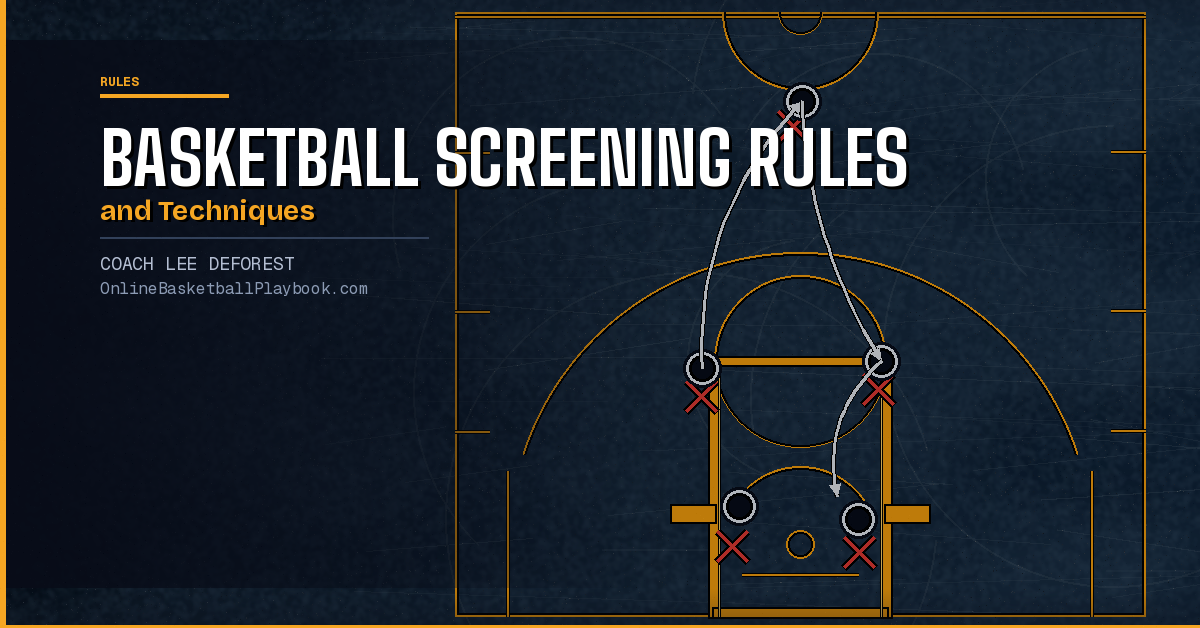

Screens create every open shot in basketball. Understanding the rules — legal position, width, movement — and the techniques to exploit them separates good offenses from great ones at every level of the game.
Legal Screen Rules Every Player Must Know
A screen is legal when the screener establishes a stationary position before contact occurs, gives the defender enough time and distance to stop or change direction, and does not move into the defender at the moment of contact. That last piece — stillness at contact — is the most violated and most misunderstood rule at every level of basketball.
The rulebook's language is precise: the screener must be stationary with both feet on the floor when contact is made. The screener cannot lean into, charge into, or extend elbows, knees, or hips toward the defender. Arms can be folded across the chest or held at the sides, but they cannot be used to create additional width. When these rules are broken, officials call an illegal screen, which turns possession over to the defense.
There is a time-and-distance principle built into the rules that many coaches fail to teach. When screening a stationary defender, the screener can set up as close as they want — directly next to the defender is legal because a stationary defender can react immediately. When screening a moving defender, the screener must give that defender one normal step to stop or change direction. The faster the defender is moving, the more space the screener must allow. A screener who jumps in front of a sprinting defender and draws contact has committed an illegal screen, regardless of whether they were stationary at contact.
The screener is also responsible for where they set the screen on the floor. Setting a screen in the lane when the ball is in the post creates chaos and invites fouls. Setting a screen that forces a defender into a teammate can be called as a moving screen even when the screener is stationary. Knowing the geometry of where to screen — not just how — is a skill that takes repetition to develop. Pair this work with your basketball footwork drills so players develop body control before they add the screen to live action.
Common Illegal Screen Violations
Moving into the path of a defender at the last second is the most common violation officials call. Leaning the shoulder or hip into the defender is the second. Extending an elbow to create a wider surface — sometimes called "spreading out" — is a third. Experienced officials also call screens set behind the defender's back with zero time to react, particularly on baseline cuts and corner actions.
Types of Screens and When to Use Each
Not all screens are created equal. The type of screen you call should match your personnel, the defense you are attacking, and the specific advantage you want to create. Understanding the menu gives coaches the ability to call the right action at the right moment.
The ball screen (pick-and-roll or pick-and-pop) is set directly on the ball handler's defender. The screener's defender must make a decision: help contain the ball or protect their own man. This two-man action is the foundation of modern basketball offense because it forces a decision on every possession. When paired with a skilled ball handler and a screener who can either roll hard to the basket or pop to the perimeter, it is the most difficult action in basketball to guard consistently.
The down screen is an off-ball screen set moving down toward the baseline, designed to free a wing or shooter coming off the top. The receiver has three reads: curl tight off the hip of the screener if the defender goes under, fade or flare away if the defender cheats to the top side, and cut backdoor if the defender overplays the anticipated direction. Teach all three reads or your players will only use one.
The back screen is set on a helpside defender, sending a cutter toward the basket. It works best when the cutter reads their defender's position and the passer is patient. In a motion offense, back screens are often countered with down screens in sequence — the stagger — which is the most difficult off-ball action for a defense to guard because it compounds decisions.
The flare screen sends a shooter away from the ball to the corner or wing. It attacks a defender who cheats toward the ball or sags off a shooting threat. If the defender tries to fight over the top, the cutter can reverse and go backdoor. If the defender goes under, the shooter catches in rhythm for three.
The cross screen moves a post player across the lane from one block to the other. It is one of the most physical screens in basketball and the hardest to set legally because the contact area is so congested. Cross screens create mismatches, free bigs from established position defenders, and are staples of Princeton-style and high-low post offenses.
How to Set a Great Screen
Setting an effective screen is a skill, not a reaction. Players who treat it as decoration — jogging to a spot and standing there — produce marginal advantages. Players who commit to angle, timing, and physicality within the rules create shot after shot.
The angle of the screen is the first decision. The screener must determine where the ball handler wants to go and set the screen perpendicular to that path — not facing the ball, not facing the sideline, but placing the flat surface of the body directly in the defender's path of pursuit. This is the most teachable piece of screening technique and the one coaches skip most often. Draw it out. Show players on video. The wrong angle by six inches turns a wide-open shot into a forced dribble.
Timing is the second element. A screen set too early gives the defender time to see it, communicate, and switch. A screen set too late catches the ball handler already committed to a direction and creates a collision rather than an advantage. The screener should arrive and be stationary a half-step before the ball handler arrives at the screen — not five steps early, not at the moment of contact.
The actual stance matters. Feet shoulder-width or slightly wider, knees bent, arms crossed at the chest or clasped in front. A wider base creates more surface area and is harder to go around. A low center of gravity helps the screener maintain position without moving when contact comes. Players who set screens straight-legged and arms loose get pushed out of their spot and rarely create a clean advantage.
After the screen is set, the screener's job is not over. Reading the defense and rolling or popping correctly makes the two-man action impossible to guard. If the defender goes over the top of the screen, the screener rolls hard to the basket — sealing the defender on their back and finishing at the rim or drawing a foul. If the defender cheats to hedge or switch, the screener pops to open space for the pull-up or the three. This decision should be automatic, not a thinking moment. Pair screen work with passing drills so the passer develops the reads at the same time the screener does.
"Switching is contested — only by guards or 'absolute necessity,' and overuse handicaps you late in the season."
— Basketball Vault
How to Use a Screen Effectively
The screener creates the opportunity. The ball handler or cutter determines whether that opportunity becomes points. Using a screen well is a skill that requires patience, deception, and a clear read of the defender before and after the screen is set.
The setup move is the foundation. A player who runs directly at a screen gives the defender no problem — they simply stop, go around the screener's back, and never lose their man. The receiver must sell a cut in the opposite direction before coming off the screen. Two steps hard toward the baseline, then attack the screen going toward the wing. One hard jab away from the screen, then cut underneath. The defender's hips must be committed to the wrong direction before the receiver changes course.
Reading the defender before the screen is set tells the receiver which option to use. A defender who is body-tight and overplaying the anticipated direction is begging for a backdoor cut. A defender who sags off expecting the screen should see the receiver catch the ball in rhythm for the open shot. A defender who goes under screens should never get a clean shot off because the ball handler attacks the pull-up before the defender recovers.
The shoulder-to-hip relationship determines the quality of separation. The receiver should brush close enough to the screener that no daylight exists between them. Daylight gives the defender a path to slide through. A receiver who gives six inches of space to the screener gives the defender the same six inches to follow without being impeded. Teach this cue directly: "skin the screener."
Timing of the catch matters as much as the cut itself. A cutter who arrives at the catch point before the ball is ready forces the passer to hold the ball, which kills the advantage. A cutter who arrives late gives the defender time to recover. The receiver and passer must be in rhythm, which only comes from repetition in practice — not from calling the play at the end of a shot clock timeout.
Defending Screens: Coverages and Principles
There is no universal answer for how to guard screens. The right coverage depends on your personnel, the opponent's personnel, and the specific game situation. What every effective screen defense shares, regardless of scheme, is communication, physicality, and no guessing.
On ball screens, the most common coverages are the hard show or hedge, the soft show, the drop, the blitz, and the ICE or sideline-push. The hard hedge forces the ball handler to go wide by having the screener's defender step into the ball's path, shoulders square to the ball. This is the right call when the handler is a dangerous pull-up shooter who scores behind the screen — you cannot let them catch the seam. The drop or sag is the right call when the handler is not a shooting threat outside the paint — the on-ball defender slides underneath the screen, the screener's defender sags two steps below, and the defense gives up nothing of value.
Blitzing — sending two defenders to trap the ball handler — is aggressive and high-risk. It creates turnovers against teams without great decision-makers, and it creates layups against teams that do. Many coaches auto-blitz any ball screen below the free-throw line because the spacing advantage the offense creates above the arc disappears in the mid-range and paint. Know what the opponent does with the blitz before committing to it.
Off-ball screen defense has its own set of coverages: fight over the top (stay connected to the cutter on the shooting side), go under (give the cutter the catch, dare them to shoot), lock and trail (attach to the cutter's hip before the screen is set and follow through), or switch. Each has a situation where it is correct. Fighting over the top is right against a great shooter taking an off-screen three. Going under is fine when the cutter cannot consistently make the catch-and-shoot.
The communication system is what makes screen defense executable. The screener's defender must call out the screen before it is set. The on-ball defender must know the coverage before the action starts. When teams communicate clearly, the defense is already in position when the screen lands. When they do not, the screener's defender is guessing, the on-ball defender gets hit, and the offense gets a clean shot. Study how teams handle these situations in the defending the pick and roll breakdown — the communication system is the same whether you hedge, switch, or drop.
Whatever on-ball coverage you run, the screener's defender must arrive with the screen — not a step late. A defender who arrives after contact has already occurred gives the ball handler a free read with no obstruction, which defeats the entire scheme regardless of how talented your on-ball defender is.
Teaching Screening to Youth and Developing Players
Young players fail at screening for two consistent reasons: they do not know the rules, and nobody has drilled the specific physical skills the right way. Telling a twelve-year-old to "go set a screen" produces a player who half-jogs to a spot and watches the play happen. Coaching them on angle, stance, timing, and reading the defense produces a player who understands why the screen matters and what to do after it.
Start with the legal screen rules before any live action. Walk through the time-and-distance principle. Show the stance — feet wide, knees bent, arms crossed. Have them hold the position while a partner runs into them at game speed. This teaches the muscle memory of staying stationary at contact, which is the most common illegal screen violation at the youth level.
Drill the angle before adding a ball. Put a defender in a fixed position. Have the screener practice setting the screen at the correct perpendicular angle to the defender's path. Move the defender to different spots on the floor and repeat. This is a two-minute drill that eliminates the single most common screening error in youth basketball.
Add the setup move next. Two players, no defense, no ball. Cutter practices the jab step or two-step sell in the wrong direction before coming off the screen. When this becomes automatic, add the defender. When the defender is present, the cutter reads where the defender is and chooses the read: curl, fade, or backdoor.
The screener's reads come last. Screener and ball handler, with a defender on the ball handler. Screener sets the screen, reads the defender's reaction — over the top, under, or switch — and rolls or pops accordingly. The ball handler passes to the correct read. This two-man game is the basic unit of modern offense and every player on the floor benefits from understanding it deeply, regardless of position. Connect this work to your broader player development framework so screening gets repetitions across the whole season, not just once in October.
The most underrated coaching moment in screening development is holding players accountable to effort on the screen itself. A player who jogs to the spot signals to the rest of the team that screening is not valued. A coach who praises a hard, legal screen — even when the play does not score — teaches players that the screen is as important as the shot. Over a full season, that message changes how a team shares the ball and how easy their offense becomes to run.
- Feet wide, knees bent: The screening stance must be athletic — straight legs and loose arms produce screens that get pushed out of position.
- Arrive early, be stationary: The screener must be set before the ball handler arrives — last-second movement into a defender is an illegal screen every time.
- Angle is everything: Screen perpendicular to the defender's path, not toward the ball or the sideline. The wrong angle by six inches gives the defender a free lane.
- Skin the screener: The cutter must brush the screener's hip with no daylight — any gap gives the defender a path to follow through without being impeded.
- Roll or pop, do not stand: After the screen, the screener reads the defender's reaction and attacks open space immediately — the advantage is only available for a split second.
- Sell the misdirection: The cutter's setup move — a hard step in the wrong direction before using the screen — doubles the separation compared to running directly at the screen.
- Communicate on defense: The screener's defender calls out the screen before it is set; the on-ball defender knows the coverage before the action starts — no guessing allowed.
Get free play diagrams, drills, and coaching guides delivered weekly.
Keep Building
Related breakdowns
Learn to Play Basketball: Essential Tips and Techniques for Beginners
Learn to Play Basketball: Essential Tips and Techniques for Beginners
Implementing New Coaching Techniques in Your Program
Implementing New Coaching Techniques in Your Program