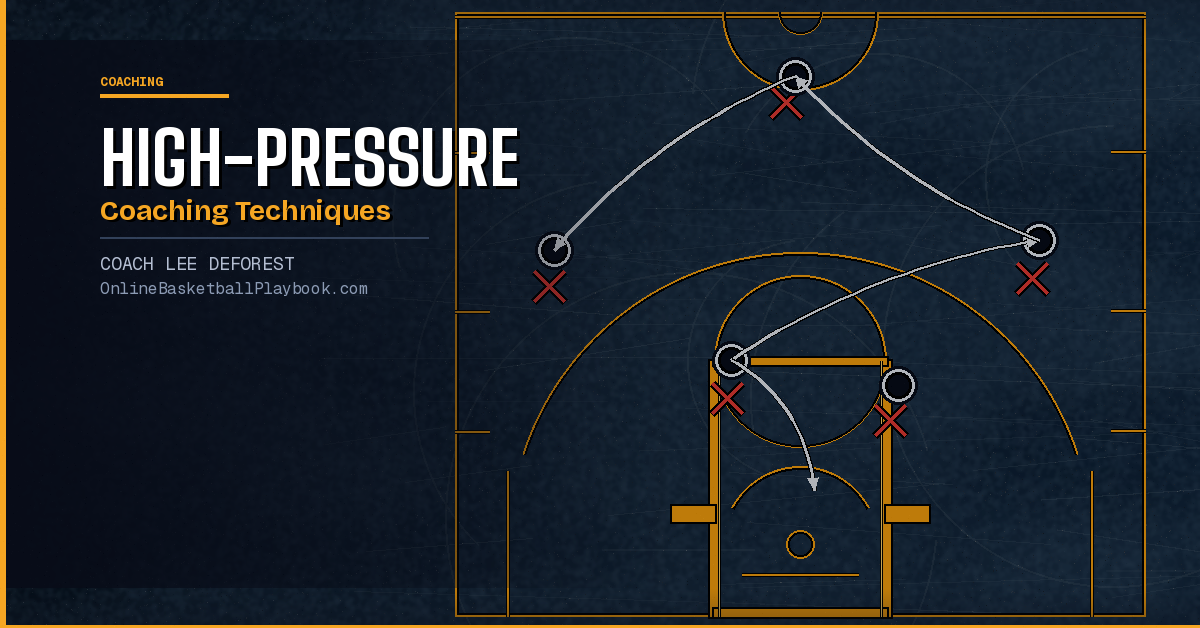

High-pressure moments separate good coaches from great ones. How you prepare your team for late-game defense, after-timeout plays, and end-of-clock situations determines whether they execute or freeze when it counts most.
Mental Preparation and Composure
Every coach talks about staying calm under pressure. Very few have a system for actually producing that composure in their players. The difference between a team that executes late and one that falls apart is rarely talent — it is preparation, repetition, and the trust players have in what the coach is calling.
The first job is to normalize pressure in practice. If your players only experience high-stakes moments for the first time during a real game, they will be unprepared. Run your drills with game clocks, game scores, and game consequences. Make them earn free throws by sinking pressure foul shots before they can go to water. Run your shell drill and your help defense principles with a shot clock so players feel the urgency of coordinated defense under time constraints.
Beyond reps, you need a clear psychological framework. Players need to understand that nerves are not the enemy — they are fuel. Teach your team to reframe anxiety as readiness. The body's response to pressure is nearly identical to its response to excitement. A player who says "I'm excited" instead of "I'm nervous" before a big moment actually performs measurably better in research studies on athletic performance. The coach's language matters enormously in shaping how players interpret their own physical state.
Build a pre-game and pre-timeout routine that is consistent. When players know exactly what the coach is going to do in a timeout — how he will set the whiteboard up, how much time goes to defense versus offense, how the huddle breaks — the routine itself signals safety. Predictability reduces anxiety. The team trusts the system because the system is always the same.
Timeout Management and ATO Sets
Timeout management is one of the most undercoached skills in basketball at every level. Most coaches treat timeouts as interruptions rather than weapons. Elite coaches know that when you call a timeout, how long you wait to call it, and what you do with those 60 seconds are all strategic decisions that compound across a game.
The first principle: protect your timeouts into the fourth quarter. Too many coaches burn timeouts in the second quarter stopping a run. Unless you are facing a true momentum crisis, absorb the run and respond with adjustments between possessions. A timeout called with 90 seconds left in a close game is worth exponentially more than one called to stop a 6-0 run in the second period.
When you do call a timeout — especially a late-game timeout to draw up a play — have a reliable after-timeout (ATO) set your team knows cold. The vault principle here is critical: your team should have one trusted core special they run with every group, year after year. Players gain confidence from familiarity. A simple ball screen into a pin-down action run crisply beats a complex set run poorly every time. The play should have a primary option, a secondary option, and a bail-out — but the players who run it should know it so well they do not need to think.
Use the timeout itself efficiently. Research on timeout effectiveness consistently shows that the quality of the message matters more than length. Keep it to three things maximum: what happened, what you are running, and the key matchup or defensive adjustment. Coaches who spend 40 seconds on a whiteboard drawing and 20 seconds on energy are less effective than those who do it in reverse. Your players are listening in the first 15 seconds. They are drifting by second 45.
"Have ONE trusted core special you run with every team."
— Basketball Vault
Late-Game Defensive Principles
Defense in the final two minutes of a close game requires a completely different mindset than defense in the first half. The strategic reality shifts: you are now playing possession-by-possession, and the consequences of a single breakdown are magnified. Coaches who do not explicitly prepare their teams for this shift will see their defense deteriorate exactly when it needs to be sharpest.
The most common late-game defensive error is giving up transition layups while chasing a steal. When you are protecting a lead, transition defense must be the first priority on every possession. Designate transition stoppers — typically your guards — and make sure they never release for an offensive rebound when your team shoots in the final two minutes of a close game. A transition defense breakdown that gives up a layup in the final minute is almost always a result of poor positional discipline, not athleticism.
Foul management is equally critical. Your best defender fouling out in the fourth quarter is a catastrophic outcome that almost always results from a failure of game management, not aggressiveness. Track your players' foul counts in real time. When a key defender picks up his third foul in the first half, he should be out of the game. When he hits his fourth in the third quarter, he sits until the fourth. This is not cowardice — it is arithmetic.
Against a team trailing and pressing, your press break and floor spacing under pressure need to be practiced live, with a clock. Players who have only run press-break drills without defensive pressure will freeze when a real press comes in a late-game situation. The spacing, the passes, and the escape valves need to be automatic.
End-of-Clock Offense
End-of-clock offense is its own discipline. Whether you need a basket in five seconds or 35, the principles that make these plays work are not complicated. They are, however, frequently violated — even by experienced coaches — because pressure causes people to reach for complexity when simplicity is what actually works.
The most important principle in end-of-clock offense is timing. A late pass or an extra dribble lets the defender recover. The pass has to hit the receiver at exactly the moment he is open. The shooter has to catch and shoot in one motion. Any hesitation, any wasted movement, any unnecessary dribble after the catch and the window closes. This is why you run the same actions in practice on a timer — not to memorize the play, but to develop the timing instinct that makes the play functional.
Space management is equally important. On a final possession, send your non-shooters to the corners and give your primary action maximum room. A two-man action with spacing — a ball screen, a hand-off, a flare screen — is almost always more effective than a five-man set with crowded lanes. The help defense cannot rotate when the floor is spread. The primary scorer has room to work. The secondary option gets a clean look if the defense collapses.
Decoy usage is the most underutilized tool in late-game offense. Defenses lock onto your best scorer in late-game situations. They will double, they will front, they will shadow him on every play. Use that against them. Set a hard screen for your best scorer and let him drag two defenders — then run the actual play for a different player off the backside. This is not a trick play; it is basic misdirection that works at every level because defenses are trained to guard the threat they know, not the one they don't.
For basketball inbounds plays in late-game situations, the same principles apply. Clear the floor, use a decoy, and execute with timing. The inbounder's positioning matters: stepping to free-throw-line-extended keeps more passing angles open than drifting to the corner, which collapses your options and allows the defense to shade.
Special Situations Your Team Must Own
Most youth and high school teams give away multiple points per game through micro-situations they have never practiced: jump balls, free-throw-rebound setups, baseline inbounds in the last second, and sideline plays from their own half. These are not afterthoughts. Over the course of a season, they are the difference between a winning and losing record.
Jump ball situations reward preparation. The tipper should know where each teammate is before the referee tosses the ball. A pre-set assignment — tip to the right, tip to the left, hit the big and go ahead — takes less than three minutes to install and pays off repeatedly. The tip to a big who immediately hits ahead for an alley-oop is a play that most youth teams will never see coming.
Free-throw-rebound situations when you need the ball are more nuanced than they appear. The standard technique of screening the box-out man and slipping behind him to cover the long board is legal, effective, and almost never practiced. Dedicate five minutes per week to this in your basketball practice plan and you will get at least two or three extra possessions per season from it. Those possessions are free points — they cost you nothing except preparation time.
Baseline out-of-bounds plays in the final seconds deserve at least one dedicated set that your team can run from any position on the baseline. The structure of a stagger cut that drags defenders to the corners followed by a deep dive to the rim is simple and effective. Add a bail-out pass back to the inbounder who steps in for a corner three and you have a complete play from a single action.
Building Pressure-Proof Habits in Practice
Everything above fails if it only lives in a playbook. The techniques that work in high-pressure games are the techniques that have been drilled under simulated pressure in practice — repeatedly, consistently, and with real consequences attached.
The most effective coaches use competitive drills in almost every practice. One-possession games where the loser runs. Drills where the defense must stop the offense on a final possession or they run. Free throws where a miss means the whole team does push-ups. These are not punishment for the sake of punishment — they are simulations of the emotional weight of game moments. Players who have made a free throw that cost their teammates learn to block out noise.
End every practice with a late-game simulation at least twice per week. Start with 90 seconds left, put your team up three, and make the offense execute a perfect last possession while the defense does everything possible to force a turnover. Then switch it: down two, ball at half court, 12 seconds left. These simulations are where basketball IQ is actually developed — not in drills, but in live situations where players have to read the game, make decisions, and live with the outcome.
Build your special situations into early practices in the season so that by February, they are automatic. Spend 10 minutes on ATOs, BLOBs, SLOBs, and jump ball situations two or three times per week in October. By the time the season is on the line, your players do not need to think about what to do — they just do it. That automatic execution under pressure is the product of months of unglamorous repetition.
Finally, talk to your team about pressure. Do not pretend it does not exist. Acknowledge it, name it, and give players language for what they experience in big moments. The teams that execute in overtime are not the teams that feel no pressure — they are the teams that have been taught how to use it.
Run a full end-of-game simulation at least twice per week in practice. Give players a specific score, time, and possession so every decision they make carries the weight of a real game situation.
- Call timeouts strategically — protect them for the final two minutes of close games whenever possible
- Install one trusted ATO set and run it consistently so players execute on instinct, not memory
- Designate transition stoppers who never chase offensive boards in the final two minutes
- Practice micro-situations — jump balls, free-throw rebounds, BLOBs, SLOBs — at least twice per week
- Use decoys aggressively: let your star drag defenders, then run the real action for a secondary player
- Run competitive late-game simulations in practice with real consequences so pressure feels familiar on game night
- Track foul counts in real time and manage your best defenders out of trouble before they foul out
Get free play diagrams, drills, and coaching guides delivered weekly.
See it drawn up
Related diagrams
Keep Building
Related breakdowns
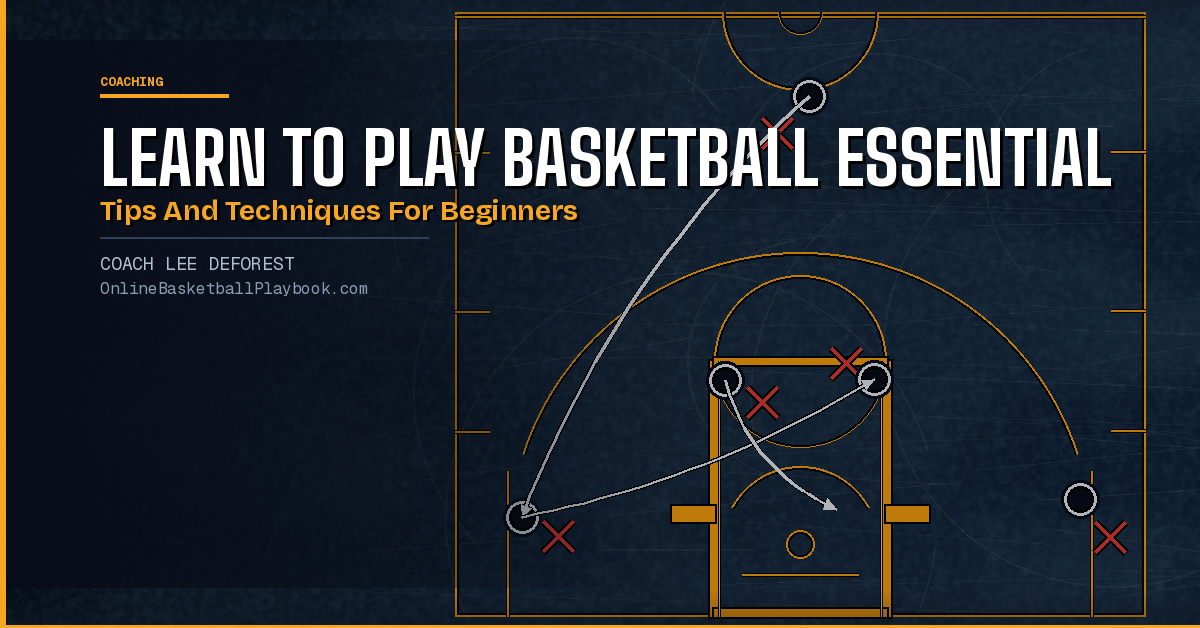
Learn to Play Basketball: Essential Tips and Techniques for Beginners
Learn to Play Basketball: Essential Tips and Techniques for Beginners
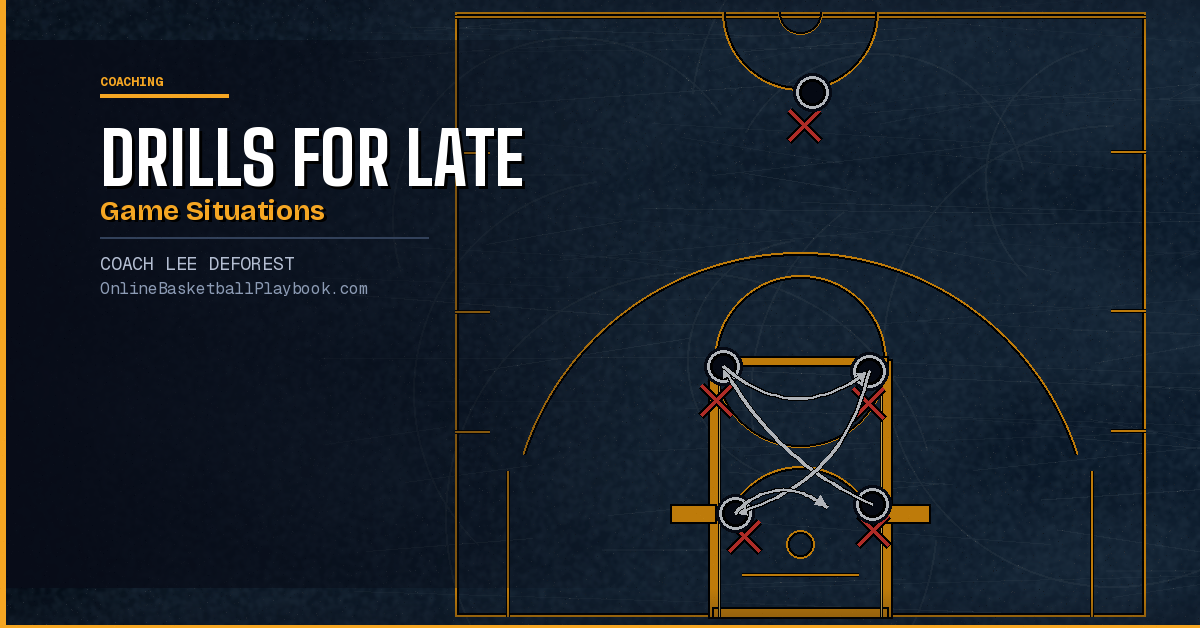
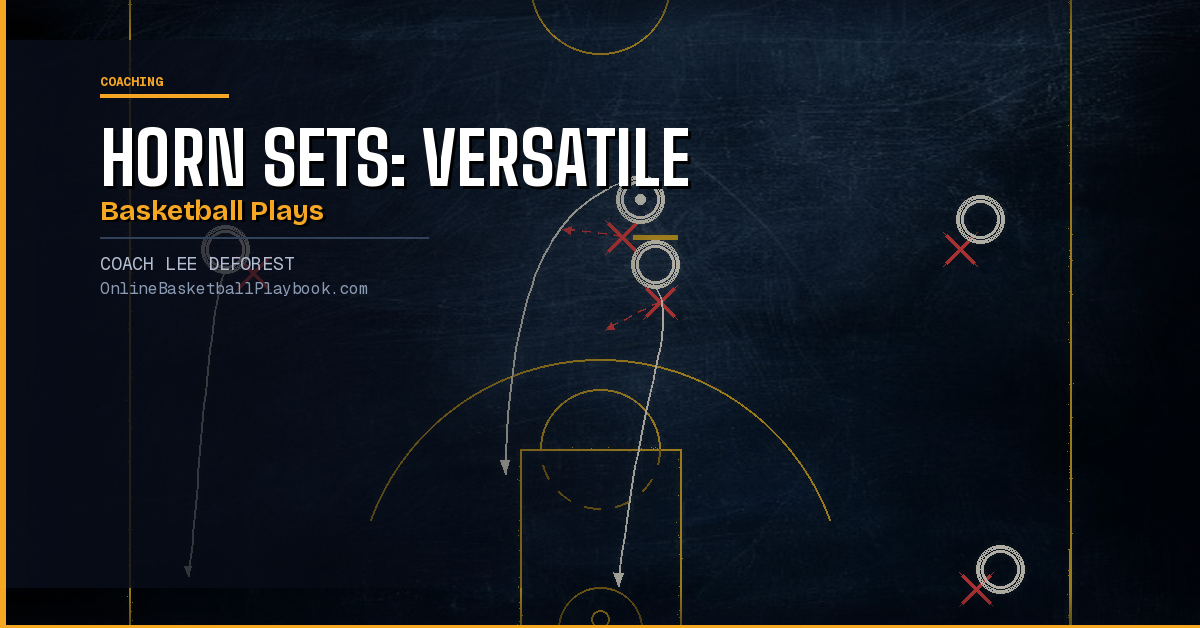
Horn Sets: Versatile Basketball Plays for Various Situations
Horn Sets: Versatile Basketball Plays for Various Situations