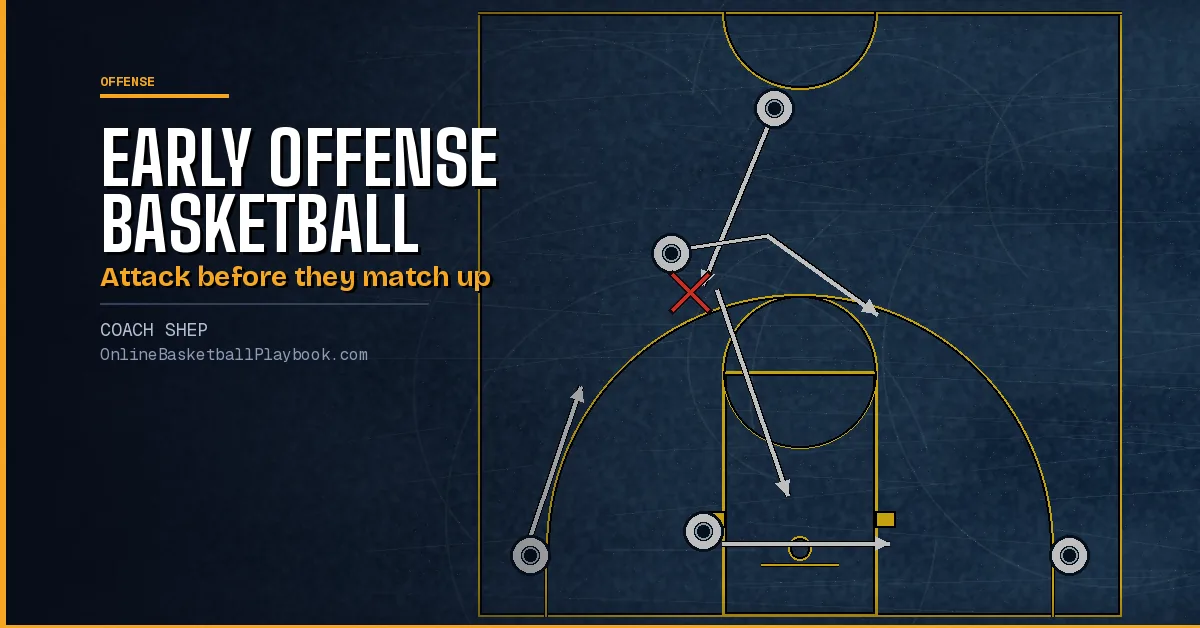
Early offense basketball is the first stretch of a possession after the ball changes hands: the outlet, the push up the floor and the first action the ball flows into before the defense is set and matched up. It runs after a miss, a make, a steal or a free throw.
One standard puts the push into the front court at 3 to 5 seconds, and says that walking the ball up or calling a set gives the defense time to get into denial and trapping position.
This page is the early-offense guide in the transition section. The lanes and the numbers reads (2 on 1, 3 on 2) are on how to run the fast break, the whole section is on fast break and transition offense, and the drill ladders are on fast break basketball drills.
Here the subject is the pace argument, the clocks coaches put on the push, the named first actions and how a team lands in its half-court offense without stopping.
What Early Offense Is
A fast break is the numbers advantage at the far end: a 2 on 1, a 3 on 2. Early offense is what the team does when the numbers are even but the defense is not ready yet. The target is the gap between a set defense and one still scrambling, where a guard may be guarding a post and the big who would help is not yet attached to his man.
A clean push pays off three ways:
- An outnumbered shot. The push can create one.
- Easy baskets or fouls. They come from defenders with no time to set.
- Mismatches. They come from defenders who never get their preferred matchup.
The prerequisite is a team that finishes the defensive possession and sprints. The defense that sets up the push is on transition defense, and the section that links every transition page is fast break and transition offense.
Finish the defensive possession, then sprint.
Run or Control: Where Coaches Split
Both sides of pace against control have backers.
The run side
- Wear them down. Rick Pitino says more possessions fatigue the opponent.
- Break them down. George Karl's offense keeps the defense in recovery for the whole possession, and he says the first attack breaks the defense down and you score on the second.
- Play fast. Dan Hurley states it simply: "we play fast."
- Two assumptions. The dribble-drive system rests on two assumptions: a recovering defender fouls more and gives up more offensive rebounds, and a faster pace of decisions forces more mistakes.
- Insurance and depth. Running adds insurance on a poor shooting night, wears the opponent down and gives possessions to the bench.
- No press. A team that runs does not get pressed.
The control side
- Controlled NBA early offense. It builds a disciplined, controlled early offense out of 1-4 high or a triangle, for skilled teams that cannot out-run opponents and win on execution.
- No bad early shot. Zeljko Obradovic says he loves to run but you cannot take a bad early shot.
- Maintain control. The Carolina break calls "always maintain control" the most important rule, and adds be quick but never hurry.
- A second late. Better a second late than a second early on offense.
One decision rule splits the two:
- Run. Run for easy baskets, to play more players and because you do not get pressed when you run.
- Do not run. Do not run when your turnovers are high, when you have a slow dominant post, or when you need to control the tempo.
The Princeton offense sits near the control end, and even it drops an early pass into its sets. The tempo choice for a whole team is on basketball pace and tempo strategy.
Pick a tempo and live with it.
Put a Clock on the Push
Coaches who run put a number on it. These are different standards, not one rule:
- Front court in 3 to 5 seconds. The standard push. A tighter standard gives 2 to 3 seconds.
- Wings and post on a stopwatch. The dribble-drive system wants the wings to their wing spots in 2.5 seconds and the post rim to rim in 2.8.
- Shot-clock marks. The ball up the floor by 27 after makes and 26 after misses, all five in the front court by 24, and a paint touch by 23.
- Four-second box. A drill that wants a layup with no dribble, with all four players inside the arc within 4 seconds of the rebound.
- Seven-second possessions. Dan Hurley's three-on-three transition drill gives each possession seven seconds.
Pick one number and time it in practice.
The Outlet and the Lanes
The outlet pass is the most critical moment of the break, and how the outlet is made is a good indicator of how the play ends. The details:
- The rebounder. Hubie Brown has him turn in the air to the outside. A quarter-turn drill teaches a quarter turn and a two-hand overhead outlet. A net-snatch drill wants the ball snatched out of the net with two hands and the outlet thrown from behind the ear so it does not float.
- The receiver. Hubie Brown's point guard catches on the wing, not 28 feet from the basket. Fred Hoiberg's point guard catches above the wing with his "butt to the sideline." Sylvia Hatchell allows no outlet below the free-throw line unless the defense is pressing.
- Where it goes. Coaches split. Hubie Brown and a wing-outlet drill outlet to the wing. Dean Smith's Carolina break outlets to the point guard in the ball-side slot up the middle third, and along the sideline after a steal.
- Pass ahead. Hoiberg's line is throw ahead and reward the runner. Roy Williams gives the point guard two options on the outlet, pitch ahead or slice the floor. Hatchell says dribbling across half court ends the break, and Hubie Brown says never pass back on the break.
- Wide wings, a rim runner, a trailer. In Hoiberg's break the wings sprint wide to the corners, the post who did not rebound runs to the block and the rebounder trails. The rule is to reward the rim runner or he stops running, and to send a trailer every time.

Coaches split on whether to number the lanes.
- Number the lanes. A numbered break assigns roles by skill: best handler as the point guard, most accurate shooter on the right wing, best all-around player on the left, post as the fly runner, best defensive rebounder as the trailer.
- Play free flow. Free flow rejects numbered breaks for youth and high school teams, because players land in the wrong spot after contesting a shot, substitutions scramble the roles and assigned lanes stop players from reading the floor. Ahead of the ball run wide, behind it fill the middle.
Both camps want wide wings, a rim runner and a trailer. The lane drills are on the 3-man weave and drills to teach transition offense.
Pick the lane rule your players can read at speed.
Early Offense Basketball Actions
When the push does not produce a layup, the first action starts. These are the common families.
The drag screen
The trailing big sprints up and sets a ball screen for the handler at or just inside the arc, before the defense is set. It works because the helping big is not yet attached and cannot defend the screen the way he would in a rehearsed half-court coverage. Fred Hoiberg says to run it a lot in transition, and his early offense hangs a whole continuity off it.

In Hoiberg's continuity, 1 comes off the drag, 4 mirrors the dribble across the lane, 5 rolls and 3 lifts to the wing. 1 can score, hit 4 inside or hit 5 on the roll.
- Pocket pass. A pocket pass to 5 near the elbow can make a 2 on 1 inside.
- Roll taken away. 1 kicks to 3, who shoots or feeds 5 posting above the block.
- 5 fronted. 4 flashes to the ball-side elbow for a hi-lo pass.
- Next side. Then 4 dribbles at 1 for a hand-off and rolls, and 2 lifts to the wing, which rebuilds the same options on the other side.


Other drag families:
- Florida spread. Billy Donovan's Florida spread runs the pick and roll early with the same handler and screener menu as its half court.
- Larry Brown's drags. A straight drag, a drag where the screener holds and a special drag.
- Double drags. Two trailers screen in turn, a look that appears in pro offenses. In one, the first screener slips while the second screens behind him.
- Two-dribble rule. At least two dribbles past the screen, a rule Hubie Brown also states.
The full ball-screen menu is on the pick and roll.
Dan Hurley's no-screen rule
Not everyone wants the drag. In Dan Hurley's three-on-three transition drill, a miss or a turnover means blast the ball ahead, attack the paint, drive and kick, and no ball screen. He calls the screen a crutch and says guards lean on it so much they stop winning one-on-one ahead of the ball.
On a made basket the offense gets a called action instead: a pistol, a wide pin, a key catch, then a dribble hand-off game. These are drill rules, not stated team rules.
Pistol, also called 21
Pistol is early action between the point guard, a wing and a big at the top of the key, started from a sideline entry rather than the middle of the floor.
- Sideline entry. Two entries, the point guard dribbling at the wing or passing to him, funnel into one menu: a flare screen, a ball screen or a dribble hand-off, with the big free to slip any screen.
- Screener as receiver first. An NBA pistol has every screener act as a receiver first: the wing flashes up to catch halfway between the lane line and the sideline, then reads his defender.
The hand-off itself is on the dribble hand-off.
Same start, several endings
Start every early possession the same way and read the catch.
- Davidson's five attacks. Bob McKillop's Davidson break has five attacks (an early go, an early drag, an early kick, a trail-man action and a break) plus a break that reverses the ball straight into motion.
- Pass ahead and sprint. A pro series starts with 1 passing ahead to 2 and sprinting to the ball-side corner while 5 screens for 4 to the elbow, and three endings hang off 4's catch.
- Quick hitters from one alignment. The big gets to the rim and the wings get to the corners, and if a defender overplays, the cutters switch roles and go the other way.
Pick the first action your players can run at speed, and read what the defense gives.
Flow Into the Half-Court Offense
Treat the break and the offense as one continuous possession. A denied push flows into the set offense without backing the ball out, because backing out lets the defense set. There are two reasons to flow straight in: the defense is often still scrambling to find its matchups, and under a 30-second clock no time is lost backing the ball out to set something up.
- The break is the offense. The Memphis dribble drive teaches its break as its half-court offense, with the 5 as the rim runner and two wide wings, so there is no separate primary break, secondary break and offense to learn. See dribble drive motion offense.
- Break into motion. McKillop reverses the ball and flows into motion, with the point guard rim-running as the ball reverses and bouncing out if nothing opens. See motion offense and 5-out motion offense.
- Break into a continuity. Run the flex off named break entries, or number a break into the flex with four transition counters. See the flex offense.
- Primary, secondary, then a set. Run the primary break, then a secondary break, then a called set. The secondary layer is on secondary break basketball.
When the push gives no advantage, read instead of resetting. A wing who cannot beat his man has three choices: stop early for a catch and shoot, take a lead in triple threat, or go backdoor. McKillop's rule is to bounce out if nothing opens off the reversal. Coaches who script the flow in practice are on the basketball practice plan page.
Flow in and keep the possession moving forward.
Which Shots Count
Coaches split on what the early window is for:
- Threes and layups only. The dribble-drive system allows only threes and layups, with the point guard the only player allowed a pull-up three. Dan Hurley's drill counts only threes and layups.
- Layups, open threes and free throws. George Karl's mandate, with no tough twos.
- Any open shot. Give shooters a green light in the push because the defense is at a rebounding disadvantage. An older form of it counts quick medium jump shots among the early looks.
- Three passes first. Require three passes before any shot other than a layup, and a post touch when possible. It fits a slower half-court team.
- No bad early shot. Obradovic's line, and a press-break rule warns that a quick long jumper is what a press wants.
Decide the shot list before the game and tell every player.
Glass or Get Back
The decision is made before the shot.
- Transition defense first. Matt Painter ranks transition defense above offensive rebounding. His point guard goes to the glass on a miss but takes the outlet at once, sprints to ball level if the outlet goes elsewhere, and cuts off the opposing point guard's angle. He teaches it in dry offense so it becomes a habit.
- Depends who shot. Hubie Brown sends three to the glass depending on who shot, and keeps a forward who shoots from outside the paint back.
- Send 3, 4 and 5. Send 3, 4 and 5 to the boards and 1 and 2 back.
- Three of five. A youth rule sends three of the five, keeps one half rebounder and half safety, and keeps one back.
The rules for who should crash the glass or get back are on their own page, and the rebounding side is on rebounding fundamentals.
Decide who goes and who stays before the shot goes up.
Get the next coaching guide in your inbox
One email when a new guide or diagram set goes up. Free.
Against Presses and Zones
Off a make or a free throw, the team inbounds before the press forms.
- Inbound at once. The 5 takes the ball out of the net and inbounds at once, and the same break doubles as a press breaker.
- Three seconds. Rick Pitino gives his team 3 seconds to inbound and beat the press after a make.
- Layup first. A layup-first press break makes the layup the first priority and says never be content just to cross half court.
Press breaks themselves are on basketball press break.
Zones get the same treatment. The first zone rule is to push the ball and attack before the zone sets, and a transition-against-zone set pins zone defenders while the zone is still forming. The half-court zone attack is on how to attack a zone defense.
Beat the press and the zone before they set.
Installing It
Coaches build early offense with progressive numbers, then with the clock:
- Hurley's daily battery. It starts from a free throw and climbs one player at a time, from 2 on 1 up to 5 on 4, then ends with a possession or two of 5 on 5. About 15 minutes early in the season, about five by March.
- Izzo's ladder. 2 on 1 up to 5 on 5 over 15 to 20 minutes, one point for a score or a foul drawn, losers run.
- Hubie Brown's 5 Man Break. Guards cross underneath, forwards cross at the free-throw line, the center outlets, up to three trips, and any mistake restarts. He uses it in place of sprints as conditioning.
- Jim Calhoun. 15 to 20 minutes of fast break in practice, and at an earlier stage 24 minutes a day and some days 35.
- Timed and scored games. The dribble-drive system scores its games and keeps any one drill to six minutes or less.
- Whole, part, whole. Install one wrinkle per practice against a defense that must earn five or six stops and is never a dummy defense.
The drills in full are on fast break basketball drills, the conditioning they double as is on basketball conditioning drills, and reading the floor at speed is part of basketball IQ.
Build it up one player at a time, then add the clock.
Questions Coaches Ask
What is early offense in basketball?
The first part of a possession after the ball changes hands: the outlet, the push and the first action the ball flows into before the defense is set and matched up.
What is the difference between early offense and a fast break?
A fast break attacks a numbers advantage at the far end. Early offense is what the team runs when the numbers are even but the defense has not matched up yet, such as a drag screen, a pistol or a pass into its half-court offense without backing the ball out.
How fast should you get the ball across half court?
Standards differ: 3 to 5 seconds into the front court, the wings to their wing spots in 2.5 seconds under the dribble-drive system, and all five in the front court by 24 on the shot clock.
What is a drag screen?
A ball screen set by the trailing big at or just inside the arc during the push, before the defense is set. Fred Hoiberg's early offense hangs a full continuity off it.
Should a team without great athletes run early offense?
Coaches disagree. One decision rule says run for easy baskets and more players, but not with high turnovers, a slow dominant post or when you need to control tempo. A controlled NBA approach builds an early offense for skilled teams that cannot out-run opponents.
Want the printable playbook packs?
OBP Pro members get the premium playbook packs: the zone attack, out of bounds and practice plan PDFs, plus each new pack as it is finished. The membership page lists what is in each one. Or draw your own version free in PlayDraw.
See what OBP Pro includesMore Guides From This Batch
- Run and Jump Press Basketball: Rules, Rotations and Drills
- Basketball Drills for 10 Year Olds: Shooting, Handling, Offense
- How to Beat a 3-2 Zone Defense: Sets, Screens and Reads
Back to Fast Break and Transition Offense and every Offense page.
Keep Building
Related breakdowns
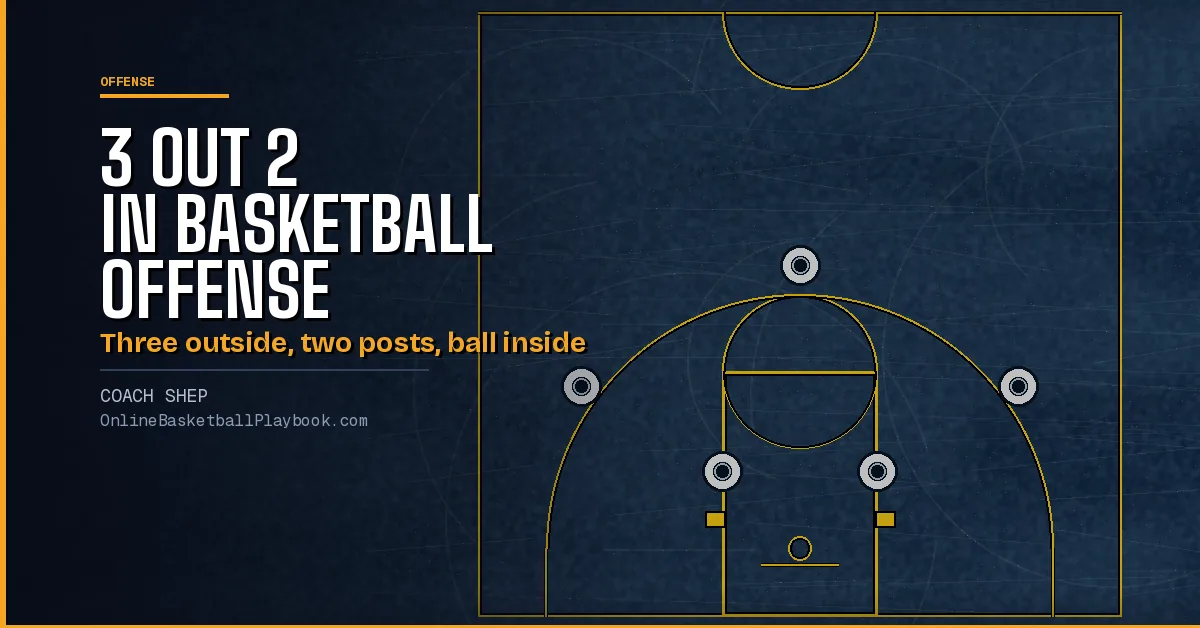
3 Out 2 In Basketball Offense: Spacing, Actions and Reads
The 3 out 2 in basketball offense explained: alignment, actions off every pass, the high-low counter, drive rules for the posts, add-on plays and who fits it.
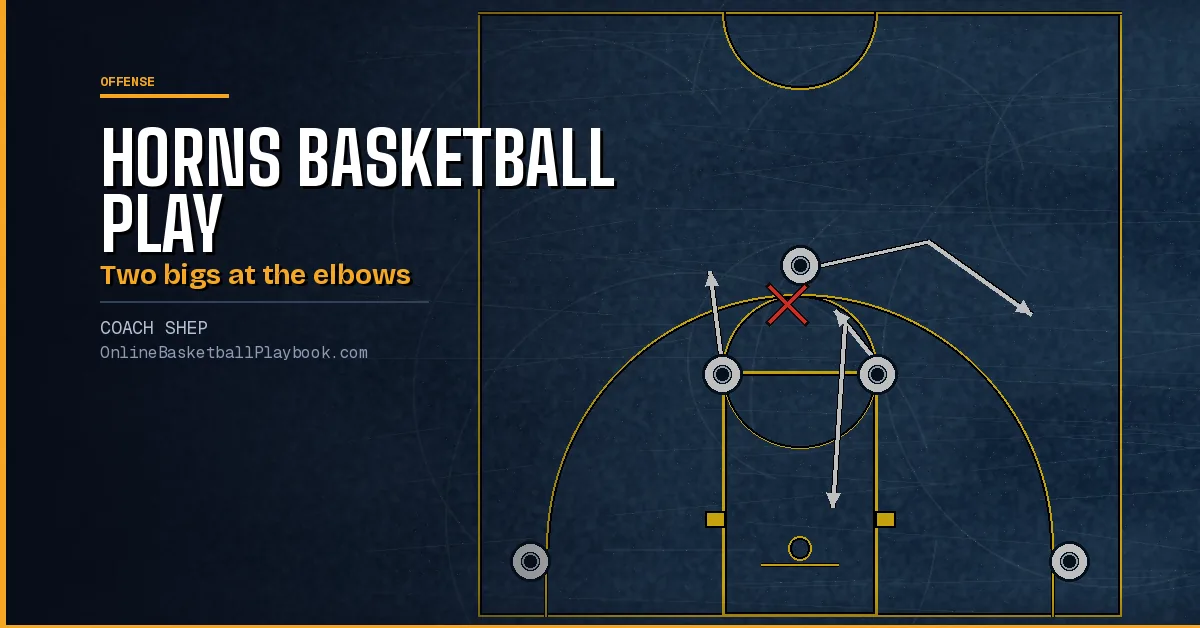
Horns Basketball Play: The Horns Set, Actions and Reads
The horns basketball play explained: the horns set, the elbow pick and roll, roll and pop rules, hi-lo, flex and shooter actions, the reads and the install.
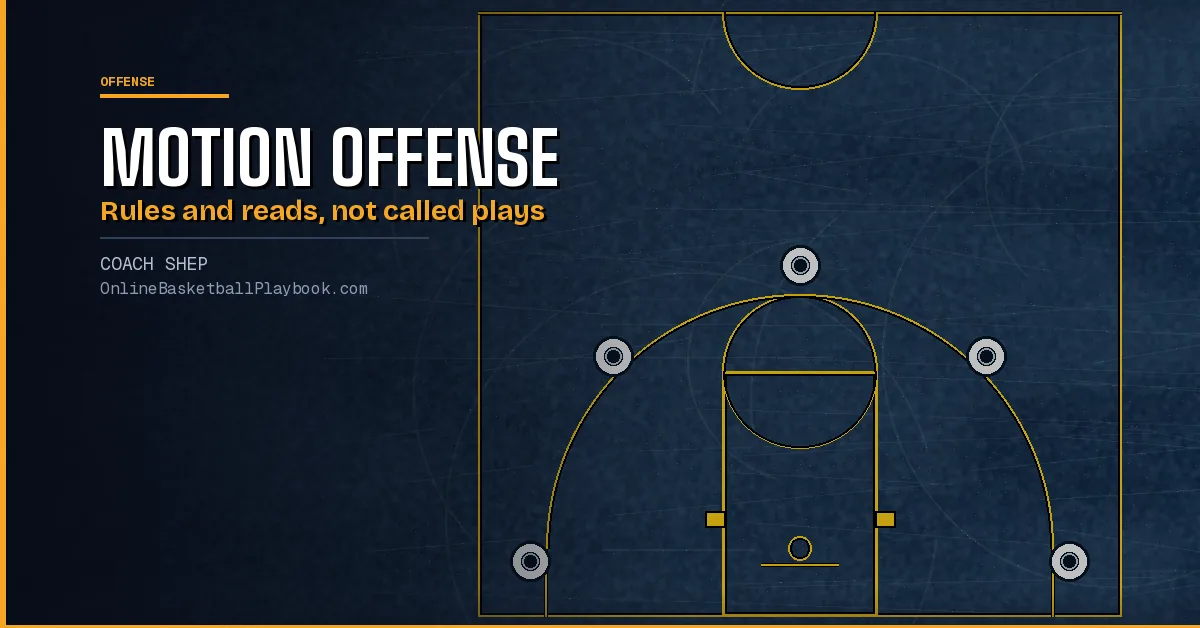
Motion Offense: Spacing, Rules, Actions and How to Install It
Motion offense runs on rules, not called plays. See the spacing, four core actions, 5-out versus 4-out 1-in, the install order, drills and where it struggles.