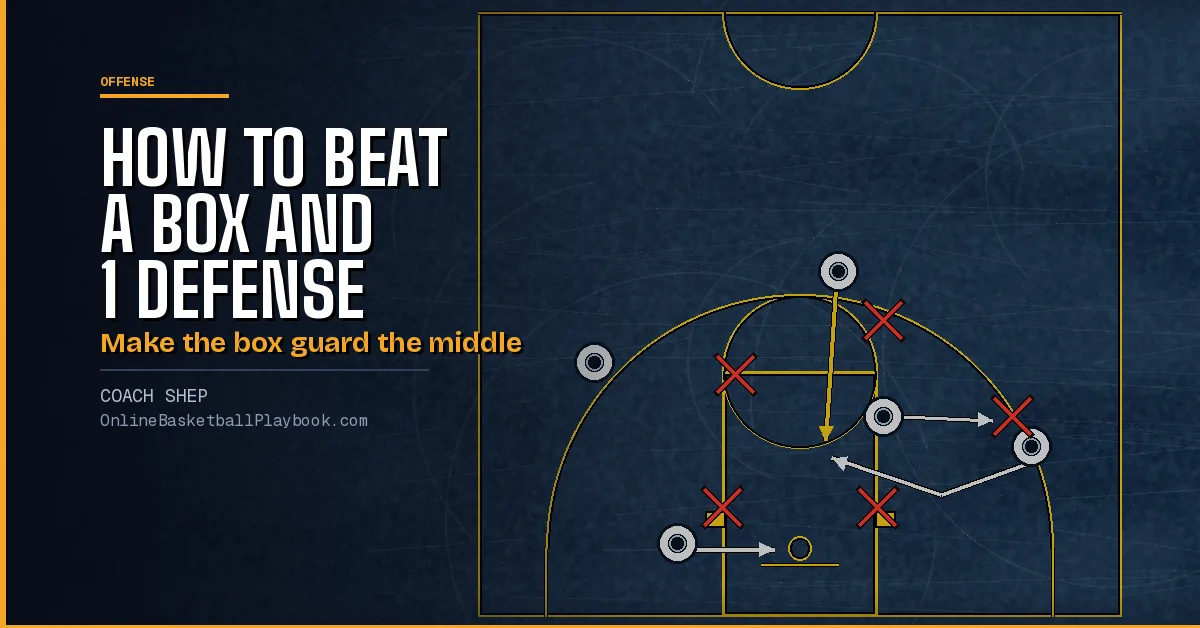
How to beat a box and 1 defense in basketball starts with seeing what it is: one defender, the chaser, denies your best scorer everywhere on the floor, and the other four play a box zone, two at the elbows and two on the blocks.
The defense is betting that the star never touches the ball and that his teammates cannot score. The answers fall into a few groups: run your zone offense, attack the soft middle of the box, set screens for the star, isolate him in the post, use him as a decoy, or run a set built for this defense.
This guide covers each one, the reads inside them and how to practice the counter.
How the defense itself is built, and when coaches call it, is on the junk defense hub, and the whole offense section is on offense.
Read It Before You Attack It
The family of junk defenses looks alike for a possession or two: box and 1, diamond and 1, triangle and 2, and zone-man hybrids. The tell for the box and 1 is one defender who ignores the ball and follows a single player while four others hold a box. A triangle and 2 shows two of those defenders and three in a triangle behind them, and it is covered on what is a triangle and 2.
Knowing the defense's rules helps the offense pick its spot. In a well-documented box:
- Two tallest low. They play low and own the post, the corner, weak-side help and the glass.
- Two quickest high. They guard the high post and their side of the arc.
- Collapse on the catch. When the star catches, all four collapse toward him so he has to give the ball up.
- Long closeouts. Two high defenders cover the whole perimeter outside the corners, so every skip pass asks for a long closeout.
The defense's side of all this, with its rotations by ball spot, is on what is a box and 1.
Know the rules of the box before you pick your spot.
How to Beat a Box and 1: Start With Your Zone Offense
The simplest rule: run your regular zone offense against a box and 1, and your regular man offense against a triangle and 2. Four of the five defenders are playing zone, so the principles of any zone attack apply.
- Find the gaps. Look for the gaps and get into them.
- Move the ball quickly. It gets the zone out of position.
- Keep the wings wide. Use skip passes and dribble penetration.
- Be ready to shoot. The four players who are not being denied must be ready to take their shots.
The general zone attack is on how to beat a zone defense.
There is also a shape trick. If the star runs the baseline and always stays on the ball side, in either corner, the defense ends up playing what looks like a 2-3 zone, and the team can run its usual 2-3 zone offense. A corner-runner zone set, built for one-guard-front zones, is also said to work against the box and 1 when the runner is the player being guarded man-to-man.
Frame the counter as a secondary offense: keep it simple and make it resemble an offense the team already runs, because the whole purpose of the defense is to deny touches to the main scorer and the counter has to be designed to free him. The big problem is that most coaches never set aside enough time to get their team ready for it.
Keep it simple and make it look like your regular offense.
Offense Against a Box and 1: Isolate the Star or Not
Any offense against a box and 1 has to decide what the star does, and coaches split. The post-isolation plan ranks a one-on-one isolation of the star in the middle of the box among the simplest and best ways to beat it.
Its reason is the chaser. He is usually very good at denying passes and poorly prepared to guard the post, and even a strong post defender has a hard time with four players around the arc looking to feed the star.
The defense's own view describes the other side. When the star catches, all four box defenders collapse back into the box, which gives help all over the floor if he decides to attack, and a frustrated star tends to take bad shots when he finally gets the ball.
- Post isolation. The star gets the ball one on one in the post or the middle, often off a base screen. The chaser is a denial specialist, not a post defender.
- The defense's view. The star is denied everywhere, and the box collapses into help when he catches. The box gives help all over the floor against a star who attacks.
- Clear-out on a read. A point guard star in a 1-4 low goes one on one only when the high defenders drop to the corners. Until then he passes to the open corner shooter or inside.
- Decoy. A post star sits in the weak-side corner while the other four attack. His chaser is taken out of the picture.
The post isolation is drawn later on this page under base screens, the point guard clear-out sits in the table of answers by the star's position, and the decoy has its own section next.
Pick one answer for the star and rep it.
Use the Star as a Decoy
The decoy plan uses the star when he is a post player. In its 1-3-1 play he sits below the low defenders in the weak-side corner while the other four attack the box, and in one variation he moves far out to a corner or wing to pull his chaser out of the picture. The point guard passes to a wing and cuts to the ball-side short corner, and the wing feeds the high post, who can shoot if open.

The same plan adds that the star can set a screen himself, then seal the man he screened and roll to the hoop for the pass. It calls this an easy way for him to get open that often confuses the defense or creates a mismatch. The mechanics of that are on setting screens in basketball.
Hubie Brown described an offense against a box and 1. Its center had nothing to do with the set and roamed, using the back of the zone as screens while the others reversed the ball. His two answers to any good defense were to reverse the ball, and to leave an area and replace it.
Take the star out of the picture, and the other four attack.
Attack the Soft Middle of the Box
The middle of the box is called its soft spot. With the star on a wing, his chaser is also pulled out of the way, which opens the action below.
Put the star on one wing in a 3-out, 2-in set. The other wing slides down to the corner or short corner. The post on that side cuts into the middle of the box and catches from the point guard. On the catch he has three reads, and they must happen quickly so he does not pick up a three-second violation:
- Nobody steps up: turn and shoot the short shot.
- The low defender on the near side steps up: pass to the wing who slid to the corner, now cutting back door.
- The low defender on the other side steps up: pass inside to the other post.
- The chaser drops to help on that post: pass out to the star for the outside shot.


The middle can also be attacked by flashing a baseline post into the gap while the ball handler splits the defense off the dribble.
- Shoot or cut. The post looks for his own shot, or for the wing cutting back door when the post's defender comes up to challenge the shot.
- High-low. If the other low defender picks up the flash instead, the drop pass goes to the post underneath, a high-low read off the same flash.
- Continuity. When neither works, the action flows into a single and double screen continuity rather than resetting.
More on catching in this area is on attacking a zone from the high post.
Read the low defenders, and shoot or pass at once.
Screens for the Star
The team does not have to do anything fancy: good screens for the star, such as flare screens and dribble hand-offs, work and keep him part of the offense.
The reason is confusion. When the star's defender is screened, he calls for help or a switch, and the zone defender next to him cannot tell whether to follow the man or hold his area. The chaser may also lose track of where his zone spot would be.
Flare screen
The point guard dribbles a little to one side as the star comes up high, to the lane line extended. The star must get high so there is room for the flare.
- Screen high. A teammate comes up and sets the flare screen on the chaser, as high as possible, and the star waits for the screen to be set.
- Cut to the wing. Then he cuts hard to the open wing for a two-handed overhead skip pass and a three.
- If the point guard is small. If he cannot make that skip pass over the defense, another player cuts to the top of the key for the pass and makes the skip instead, while the point guard cuts through to the corner. A taller player often makes that pass more easily.
The action is broken down on flare screen basketball.

Dribble hand-off
Here the star starts in a corner. The point guard passes to the wing and fades to the other wing, and the wing dribbles at the star for the hand-off. At the same time a post back-screens the box defender in that area and keeps inside position, sealing him. The star reads his chaser:
- The chaser overplays the hand-off: the star goes back door, catches and takes a mid-range shot from the corner. If the low defender comes out, the post dives inside for a pass from the star.
- The hand-off is clean: the star attacks the seam for a shot, or kicks out to the point guard.
- The defense stops him outside: the post slips for a pass and a shot.
Hand-offs could be used anywhere on the perimeter to get the star the ball and let him create.
A Big Screener Along the Lane
The big-screener idea normally parks a big at the high post mainly as a screener for the denied star, with scoring a bonus if nobody guards him. Against the box, the big sets up along the lane on the star's side instead.
- Engage the high defender. The point guard engages the high defender on that side while the star slides about halfway to the corner.
- Back-screen the chaser. The big back-screens the chaser, and the star comes around the screen, above or below depending on where the chaser is, into the middle of the box for a catch and pull-up jumper.
- Second option. The other post ducks in underneath.
- A counter to the counter. If the low defender on that side steps up to the star, the big seals the chaser and cuts to the rim for a pass from the star or a lob from the point guard.

Get the next coaching guide in your inbox
One email when a new guide or diagram set goes up. Free.
Base screens and Horns
Another set of counters isolates the star in the post or the middle, on the logic that the chaser is usually good at denying passes and unprepared to defend the post.
- Come off either baseline screen. In the base-screen plan, the star can drop toward the basket and come off either post's baseline screen, depending on which side the chaser is playing.
- Double screen to the far side. Because the far post defender is zoning rather than guarding a man, breaking to that side works like a double screen.
- Chain a second screen. After one base screen, the action can chain into a second on the other side while the point guard fakes a pass to the star and reverses the ball.
For a ball-handling star, Horns puts two screens at the elbows, one on each side, so no chaser position commits the defense and the star has a lane to at least one side.
- Feed or kick. If he cannot get to the rim, he feeds the roller or kicks to a corner shooter.
- Drop it off. When the post defender on the ball side steps up to help, the star drops the ball off to the shooter on that side as he cuts to the rim.
- Pop. The screener pops out while the other screener rolls.
Screen the chaser and make the zone defenders decide.
Run the Star Along the Baseline
This counter is a little more complicated and needs practice time. The star starts in a corner, the wings set wide at the three-point line, and a post sets up on the block on the star's side.
- Dribble away. The point guard dribbles away from the star's side and hits the wing there.
- Back screen and run. At the same time the post sets a back screen for the star, who runs around it, under both low defenders, to the far corner or short corner.
- Seal and roll. The screener seals and rolls to the middle of the paint, and both are looking for the pass.
- Rotate. The other wing rotates a short way toward the top of the key.

If nothing comes:
- Cut to the elbow area. A wing cuts to the elbow area of the paint looking for a pass, then moves out to the opposite wing.
- Rotate to the top. Another player rotates to the top of the key.
- Point guard cuts. The point guard waits for that cut and then cuts hard into the lane just under the free-throw line before going out to the ball-side wing.
- Start again. The ball swings back out to the wing and up to the top of the key, and the play starts again the other way.
The 1-3-1 keeps the star running the baseline on the ball side and puts a good offensive player in the middle. On a pass to either wing, the middle player steps to the elbow on the ball side, catches, and penetrates into the paint for a short pull-up. The base alignment is on 1-3-1 offense.
Rep the baseline run until the timing is automatic.
Answers by Where the Star Plays
The box and 1 is said to be used more against perimeter stars, because a star post player can be double-teamed in other ways. The answers change with the star's position:
| Star plays | Set | Main action |
|---|---|---|
| Shooting guard | 3-out, 2-in, star on a wing | A post cuts into the middle of the box and reads the low defenders. Or flare screens and hand-offs for the star. |
| Post | 1-3-1, star running the baseline as a decoy in the weak-side corner | Point guard to wing to the high post, which can shoot if open. If a box defender comes up to him, he dumps it to the point guard, who has cut to the short corner. If a different box defender comes up instead, the weak-side wing cuts to the low block. |
| Post, at the weak-side elbow | Same 1-3-1 | The point guard dribbles at the elbow defender, the star screens him, and the point guard comes around for a 10 to 12 foot pull-up. If the low defender comes up, the point guard passes to the player underneath for a layup. |
| Point guard | 1-4 low, shooters in both corners | He dribbles either way and hits the open corner shooter, dumps inside if the low defender comes out, or goes one on one if the elbow defenders drop to the corners. |
Some set plays also work against a star point guard too, such as a post back-screening for him to free a three from the wing. A motion offense cites attacking a box and 1 with its post exchange alignment. The motion side is on motion offense.
Pick the answer by where your star plays.
Set Plays Built for the Box
Two set plays are built for it.
Back screen and step-out. It starts in a 2-1-2 with the guarded star in one of the slots. The point guard dribbles down until he is picked up. The high post back-screens for the star, who cuts down the middle, and the two low players step out on the baseline to pull the defense out and open the middle. Its options as written:
- A baseline player. He can take a pass for a shot, or drive or pass to the star on his cut.
- The star is covered. The screener opens to the ball for a pass and has a jump shot or a drive while the star clears to the far side.
- Both are covered. The star continues to the wing and the screener rolls and screens for the other low player, who cuts across the lane.
- The cut is stopped. The screener can go down the middle on the point guard's dribble.
- Everything is covered. The point guard rolls back and screens for the star, who comes around for a catch and shoot.

When the star has the ball out front, the same set brings a post up to screen for him, and he dribbles down for the jumper or passes to the high post rolling to the basket.
Double-stack step-out. It starts from a double stack: both baseline players step out behind screens from the top players and the ball can go to either side. More quick sets are on zone offense quick hitters.
Rep the one set that fits your star.
The Chaser's Reads Off a Screen
The base screen counter teaches four reads for how the chaser plays the screen:
- Curl: he chases out over the screen, so the star curls for a quick jumper or cuts all the way to the rim.
- Fade: he goes over the screen, so the star fades for a baseline shot.
- Back cut: he cheats out early, so the star back-cuts and runs off the base screen on the other side, with that screener stepping up the lane to meet him.
- Post slip: the baseline defender switches onto the screen or steps out to show, so the screener slips and rolls to the basket.
Most defenses carry only a primary and a secondary technique for screens and post-ups, so the scout should find which one this chaser and box use (chase, over, cheat or switch and show), and vary alignments and entries during the game so the defense cannot settle on one set. Drills for those reads are on drills to teach off-ball screens.
Read the chaser, then use the screen.
Practicing Against the Box and 1
Teach the counters as secondary offenses and keep them simple, with the skills they need named in advance: mid screens, base screens and strong post-ups, and on-ball screens, double screens and offensive rebounding. Use whole, part, whole:
- 2-on-2. An entries drill.
- 3-on-3. A drill that puts the entry, the base screen and the reversal together.
- 3-on-3 Horns. A Horns drill.
- 4-on-4 shell. A shell for the single and double screens, before scrimmaging against the box.
The earlier point about coaches who do not take the time to prepare for it applies here. Ideas for scout team work are on drills to teach zone offense, and skip-pass shooting work is on basketball shooting drills.
Prepare for it before you see it in a game.
A related team page covers the rest of the family: how to score against junk defenses.
Want the printable playbook packs?
OBP Pro members get the premium playbook packs: the zone attack, out of bounds and practice plan PDFs, plus each new pack as it is finished. The membership page lists what is in each one. Or draw your own version free in PlayDraw.
See what OBP Pro includesQuestions Coaches Ask
What is the best offense against a box and 1?
The simplest rule is to run your regular zone offense, because four of the five defenders are zoning. Add screens for the star. Whether to isolate him splits coaches: posting him up in the middle is one answer, where a denial chaser is weakest, while the defense is built to collapse all four box defenders into help when the star catches and attacks.
Should you isolate your star against a box and 1?
Coaches split. Isolate him one on one in the post or the middle, because the chaser is a denial specialist who is poorly prepared to guard the post. The defense's own design expects a star who attacks to run into four box defenders collapsing into help. A middle ground gives a point guard star a one-on-one clear-out only when the high defenders drop to the corners.
How do you get your best player the ball against a box and 1?
Screen his chaser. Flare screens, dribble hand-offs, a big at the high post back-screening the chaser, or base screens from the posts all force the zone defenders to decide whether to help, and the star reads how the chaser plays the screen.
Where is the box and 1 weakest?
In the middle of the box and on skip passes. Two high defenders cover the whole arc outside the corners, so ball reversal and skips stretch them, and a post cutting into the middle puts the low defenders in a bind.
Should my star stand in the corner against a box and 1?
That is one answer. The decoy plan parks a post star below the low defenders in the weak-side corner so his chaser leaves the action, and a baseline run keeps a star on the ball side so the defense ends up looking like a 2-3 zone. Other answers keep him moving through screens.
How do you beat a box and 1 in youth basketball?
Keep it to what the team already runs. Recognize it, move the ball, keep the wings wide, have the other four ready to shoot, and screen for the star. Practice against it before you see it in a game.
More Guides From This Batch
- Man to Man Defense Drills: Ladders From 1 on 1 to 5 on 5
- Basketball Drills for 12 Year Olds: Dribbling, Passing and Games
- Basketball Team Culture: Standards, Roles and Daily Habits
Back to How to Beat a Zone Defense and every Offense page.
Keep Building
Related breakdowns
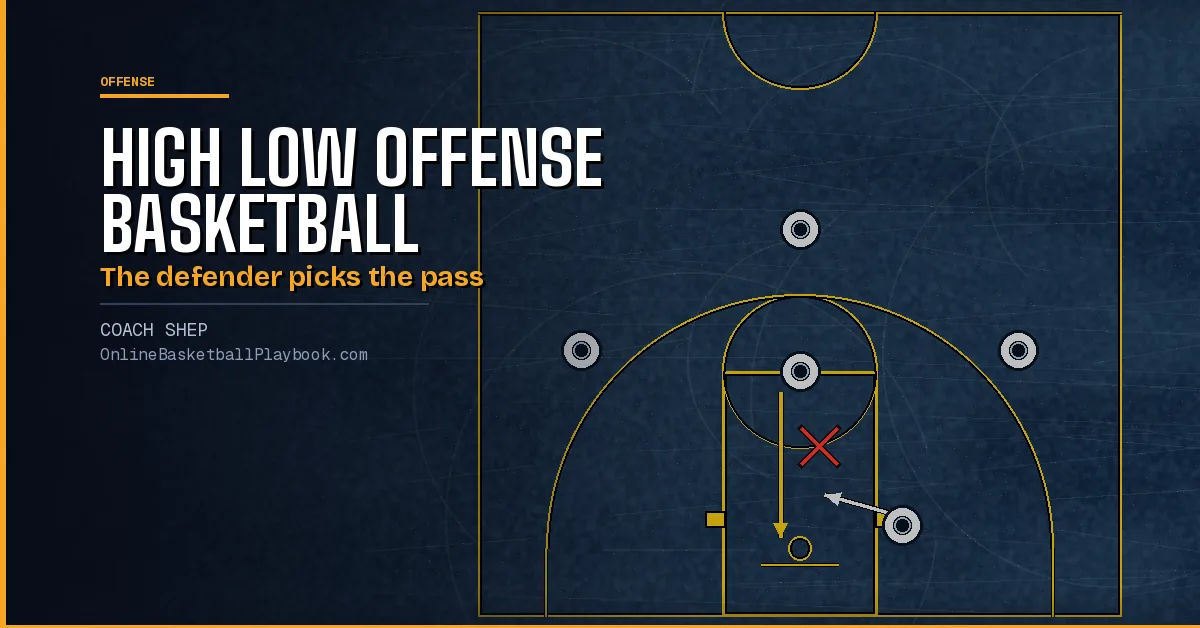
High Low Offense Basketball: Reads, Counters and Zone Rules
High low offense basketball explained: the two-post shell, the lob and bounce reads, answers to a front, down-screen reads, 1-4 low sets and the hi-lo against zones.
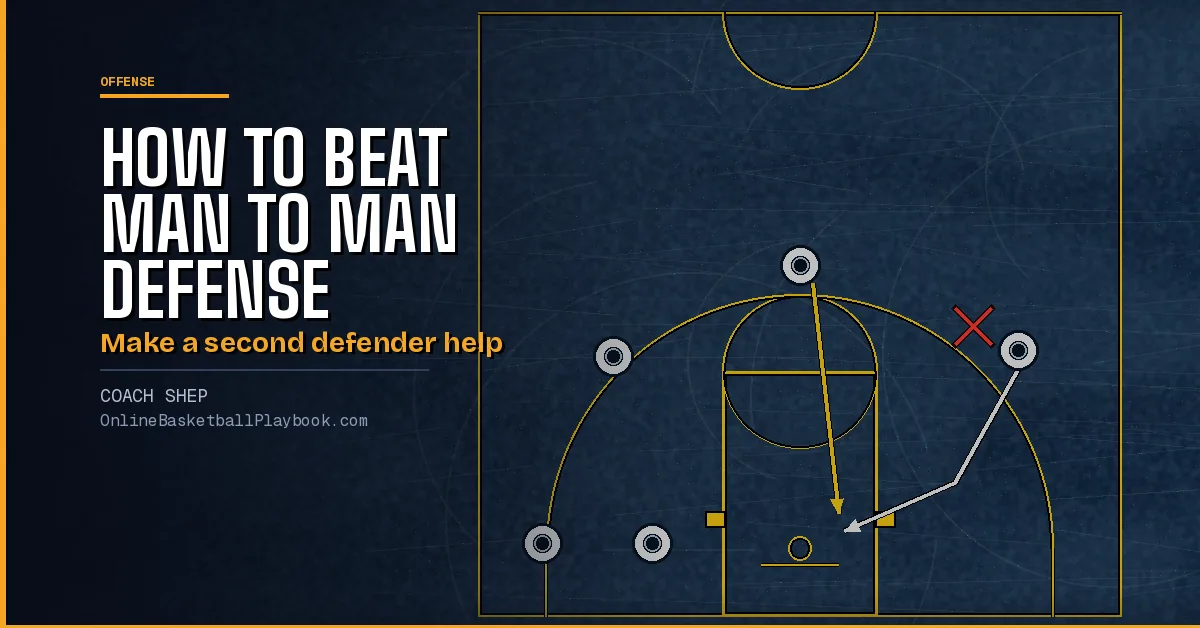
How to Beat Man to Man Defense in Basketball: Reads and Drills
How to beat man to man defense in basketball: spacing, catch reads, beating denial, drives, off-ball and ball screens, post feeds, the Pack Line and drills.
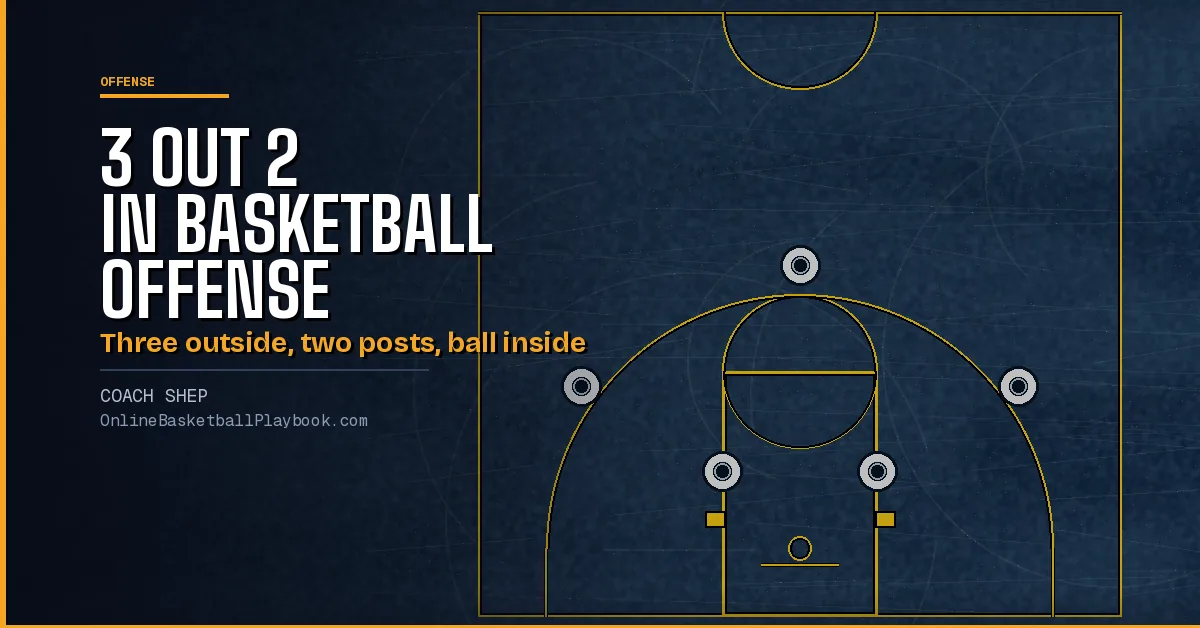
3 Out 2 In Basketball Offense: Spacing, Actions and Reads
The 3 out 2 in basketball offense explained: alignment, actions off every pass, the high-low counter, drive rules for the posts, add-on plays and who fits it.