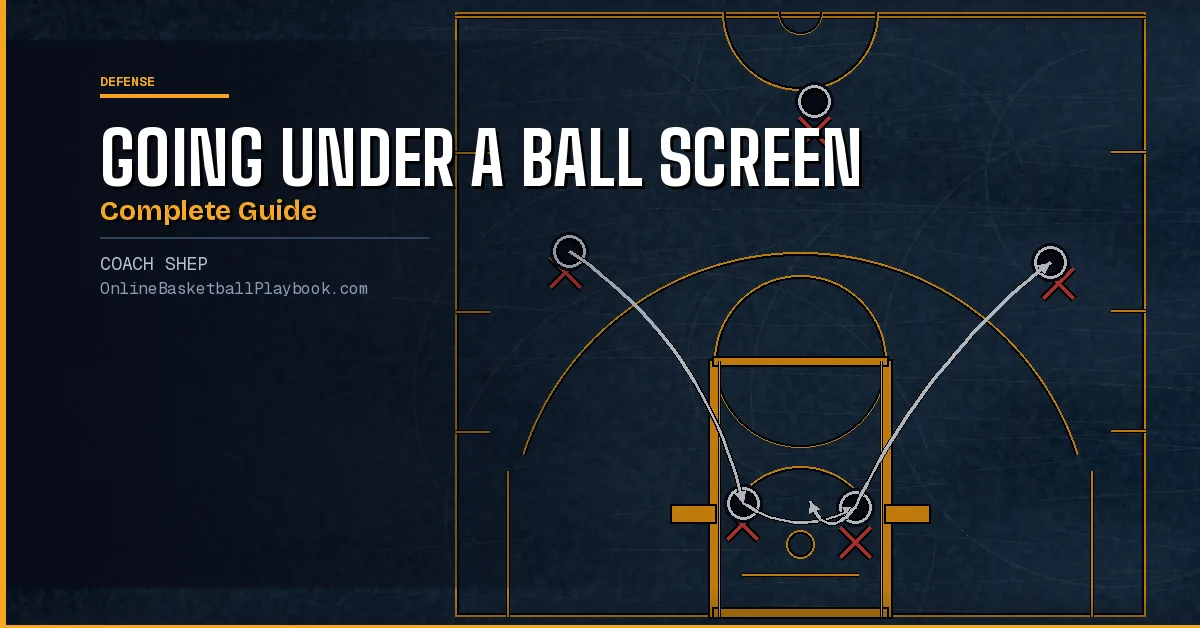
Going under a ball screen is the right call when your man cannot shoot. Done correctly, it cuts off the drive path, keeps you attached to the ball-handler, and neutralizes the screen without burning your big's positioning.
What It Means to Go Under a Ball Screen
When a ball-handler uses a screen set by their teammate, the on-ball defender has a decision to make: fight over the top of the screen, go under it, trap the ball-handler, or switch. Each coverage has a specific purpose, and going under (ducking behind the screener's body as the ball-handler turns the corner) is the coverage built to stop a non-shooter from getting clean mid-range or three-point looks.
Going under a ball screen means the defender intentionally passes behind the screener rather than fighting through contact on the high side. The ball-handler loses a step or two of separation, but the defender surrenders a brief gap between themselves and the ball. The tradeoff is acceptable when the offensive player has little to no shooting threat from the perimeter because the gap created by going under is exactly where you want a non-shooter to catch the ball. You're inviting a pull-up attempt that the offense doesn't want to take.
This is one of several coverage options within a broader man-to-man defense system. Picking the wrong coverage for the wrong player is one of the most common defensive errors at every level of basketball. Going under on a 40% three-point shooter, for example, gives him a clean step-back and that is exactly what modern offenses are hunting for.
The under coverage is most common at the youth and high school level where fewer ball-handlers can punish mid-range pull-ups. At higher levels, coaches typically reserve the "under" call for specific personnel matchups, a point guard who scores almost exclusively at the rim, or a backup guard known for poor perimeter shooting.
When to Go Under vs. Other Coverages
The most important rule about going under a ball screen is this: the coverage must be earned by the offensive player's shooting percentage, not by the defender's comfort level. Defenders who go under because they don't want to fight through contact are making a comfort choice, not a basketball choice. That's the wrong reason.
Go under when:
- Your man shoots below 30% from three and has limited mid-range pull-up ability.
- The primary offensive threat is the screener. Your priority is to stay connected to your man and not help on the roll.
- Scouting confirms the ball-handler hasn't punished under coverages all season.
- You are playing a drag screen situation in transition where the screener is not a roll threat.
Do NOT go under when:
- The ball-handler is a legitimate perimeter shooter. Under coverage hands him a clean catch-and-shoot.
- The screener is a skilled pop shooter. Under coverage means your big has to fly out to a pop, which collapses your paint.
- The offense has been attacking your under coverage all game. Adjust.
Understanding how to defend the pick and roll at a system level means understanding that no single coverage works against every personnel grouping. Under coverage is one tool in a multi-tool kit. Great defensive teams can execute three or four coverages depending on who has the ball, who set the screen, and what the game situation demands.
The other common coverages (hedge/show, hard hedge (trap), switch, and ice) all have specific personnel and game-situation triggers. Going under is the most passive of the group, which is why it works best when you are genuinely comfortable conceding the ball-screen pull-up. If you have any doubt about the offensive player's shooting ability, default to going over the top.
Footwork and Mechanics
The footwork for going under a ball screen separates defenders who execute the coverage cleanly from those who get caught and lost. This section is the most technical in the guide, and it matters because sloppy mechanics turn a clean "under" into a blown coverage. Your man gets four feet of separation and catches cleanly at the arc.
Step 1: Read the Screen Early
You must identify the screen before it arrives. Watch the screener's hips and feet as he approaches. A defender caught flat-footed when the screen comes cannot go under cleanly. He has no angles left. Pre-read the screen and begin shading your positioning to the low side (underneath the screen) a half-count before contact.
Step 2: Communicate to Your Big
The moment you read the ball screen, call "Under! Under!" so your big man knows you are coming through. He needs to stay put (or minimally show) and create a lane for you to duck through. If the big hedges hard without knowing you're going under, he cuts off your path and the ball-handler gets a clean crack between two confused defenders.
Step 3: Drop the Inside Hip
As the screen arrives, drop your inside hip (the hip closest to the screener's body) and dip below his waist. You are not running around the back of the screener from five feet away. That creates too much space. You want to skim through the gap as close to the screener as possible. The tighter the path, the less time the ball-handler has to get a clean look at the basket.
Step 4: Accelerate Out the Other Side
The biggest error defenders make going under is decelerating as they pass behind the screener. That pause is where the pull-up window opens. You should be accelerating as you exit the screen and closing back onto your man immediately. Sprint out of the under, not into it.
Step 5: Recover Position
Once you clear the screener, your goal is to reestablish between the ball and the basket. One to two feet of gap is acceptable against a non-shooter. Do not give up three feet or more because that converts your "under" into a free mid-range catch. Solid basketball footwork drills run in practice can dramatically speed up your recovery times in games.
The Big Man's Role in Under Coverage
Going under a ball screen is not just a guard's assignment. It requires a coordinated read from the big man defending the screener. When the coverage is "under," the big's job changes significantly compared to a hedge or switch call.
In an under coverage, the big should show minimally (perhaps a half-step toward the ball-handler to make him hesitate) and then immediately recover back to his man (the screener). The big is not trying to stop the ball-handler. That's the guard's responsibility. The big's priority is to stay attached to the screener, particularly if the screener is a roll or pop threat.
If the big man over-hedges while the guard goes under, two problems occur simultaneously: the guard's under path gets cut off, and the screener gets a free roll to the basket with no help. This is the most common breakdown in under coverage and it almost always traces back to a big man acting on instinct (hedge!) rather than executing the called coverage (show and recover).
This is why coverage communication must happen before the screen arrives. At practice, run your shell drill repetitions specifically calling "Under!" so both the guard and the big are executing the right assignment on the same rep. Isolated defensive reps, where the guard goes under while the big over-hedges, create bad habits that show up in games at the worst moments.
If the screener is a dangerous roll man (a dunker-spot big who can receive the roll and finish), your under coverage also needs a weakside helper identified before the screen is set. Even with clean under mechanics from the guard, a live roller with no help is a layup. Assign a weakside defender to be ball-side lane-line help on the roll as part of your team coverage scheme.
Common Mistakes and How to Fix Them
Coaching under-coverage defense means constantly correcting the same four or five errors. Naming them clearly in practice and having players call them out when they see them builds the kind of defensive awareness that transfers to live game situations.
Mistake 1: Going Under on a Shooter
This is the most damaging error. When a defender goes under on a player with a legitimate shot, the offense gets exactly what it wants, a clean pull-up or step-back three with daylight. Fix: scout shooters before the game and make the coverage call explicit. "Under on #5, over on #3." No gray area.
Mistake 2: Going Around the Screener Too Wide
Defenders who give the screener two or three feet of space when going under create a massive lane for the ball-handler to catch and attack. The under path should be as tight as possible, almost grazing the screener's back. Fix: run tight-path reps in your defensive basketball practice plan where defenders physically tag the screener's jersey as they go under.
Mistake 3: Decelerating Through the Screen
Slowing down behind the screener is instinctive because there's a body in the way and the defender naturally pumps the brakes. But this is where the pull-up window opens. Fix: use a verbal cue ("Go! Go!") at the exit point of the screen to remind defenders to sprint out, not into, the under.
Mistake 4: Big Man Over-Hedging
Already covered above, but worth repeating: if the big steps out hard while the guard goes under, both defenders lose. Fix: drill the "show and recover" specifically on under calls, separate from hedge calls, so the big's instincts are calibrated to the coverage type.
Mistake 5: No Weak-Side Help Identified
Under coverage can leave the screener's roll lane open. Without a pre-assigned helper, the roll becomes a layup. Fix: before the possession, the defensive coach or point guard identifies the weak-side helper. Every player on the floor should know the help assignment before the ball is inbounded. This connects directly to strong help defense principles that must be installed team-wide before you can execute any ball-screen coverage reliably.
If your under coverage is getting exploited (the ball-handler keeps catching clean and attacking), do not wait until halftime to adjust. Call timeout, switch to an over or ice coverage for that matchup, and revisit the under call only when the personnel changes. Defensive flexibility is a skill that must be practiced, and players need to hear the adjustment called clearly to execute it in a live game.
Drills and Reps to Lock It In
Under coverage is a technique, and like all techniques it must be built through repetition before it shows up correctly in live games. The following drill sequence progressively loads the skill from individual footwork to full team execution.
1. Mirror Drill (Individual)
One defender, one screener (stationary). The screener holds position and the defender practices the dip-and-go motion: dropping the inside hip, skimming tight through the gap, and accelerating out. Ten reps each side. This is footwork only. No ball-handler yet.
2. Two-Man Under Drill (Guard + Big)
Add a ball-handler. The ball-handler dribbles into the screen, the guard calls "Under!" and executes, while the big practices the show-and-recover. The ball-handler gets two dribbles after clearing the screen and must pull up or drive. The defender must contest. Run 15 reps from both sides of the floor.
3. Three-Man Shell (Guard + Big + Weak-Side Helper)
Add a weak-side helper defender and a screener who now rolls to the basket. The guard goes under, the big shows and recovers, and the helper rotates to cut off the roll lane. Run this at half speed first to establish spacing habits, then at game speed. This is where coverage breakdowns get identified and fixed.
4. 5-on-5 Coverage Calls
The final stage is live 5-on-5 where the coach calls coverage before each possession ("Under on 5!") and the defense must execute that specific call regardless of what the offense runs. This trains communication, decision-making, and adherence to the called coverage under game-like pressure.
Consistent defensive execution at the team level requires installing your coverages early in the preseason and revisiting them regularly throughout the year. Weaving ball-screen defensive work into every practice (even five or ten minutes per session) produces far better results than a once-a-week deep dive. The players who earn the right to defend ball-screens in games are the ones who have logged the reps in practice.
- Scout first: Identify shooters vs. non-shooters before tip-off and assign coverage explicitly, under on non-shooters only.
- Communicate early: The on-ball defender calls "Under! Under!" before the screen arrives so the big knows to show and recover, not hedge.
- Skim, don't arc: Go through the gap as tight as possible, grazing the screener's back, not three feet wide around his body.
- Accelerate out: Sprint through and out the other side; slowing down behind the screen creates the pull-up window you're trying to close.
- Big recovers immediately: Show one step, recover to the screener. Never hard-hedge when the coverage is "under" or both defenders lose.
- Identify the helper: Assign a weak-side helper to the roll lane before every possession so a live roller doesn't become a free layup.
- Adjust if it's failing: If the ball-handler is catching clean and scoring, switch coverage mid-game. Don't repeat a failing scheme.
Get free play diagrams, drills, and coaching guides delivered weekly.
Draw this play free in the play drawer →
Membership: the full library, playbook packs, and Pro drawing tools →
Keep Building
Related breakdowns
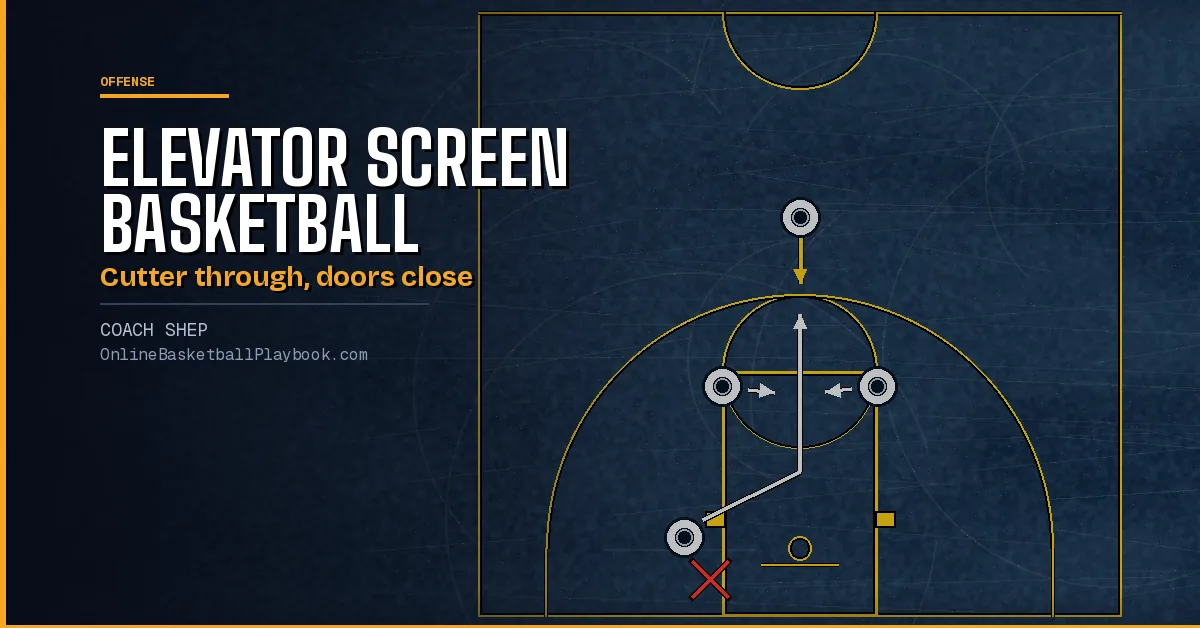
Elevator Screen Basketball: How It Works, Plays and Counters
Elevator screen basketball explained: how two screeners close on a cutter, the plays that use it, how to time it legally, and the counters when the defense reads it.
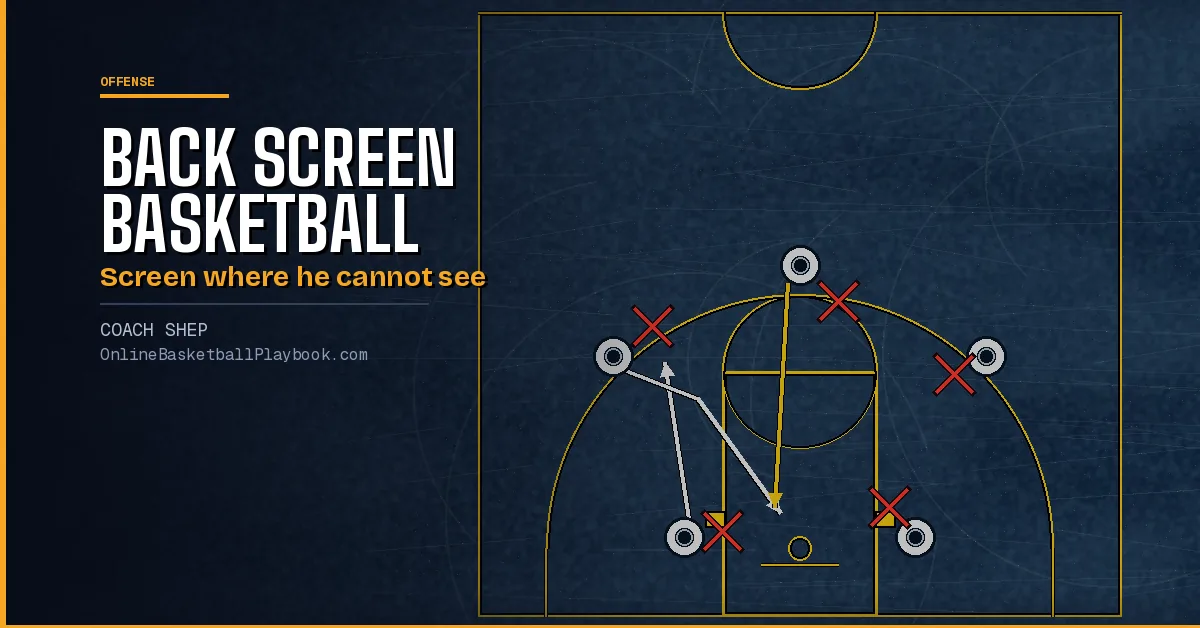
Back Screen Basketball: How to Set, Use and Defend It
Back screen basketball guide: what a back or rip screen is, setting it legally, the cutter's and screener's reads, the UCLA cut, chained actions and defending it.
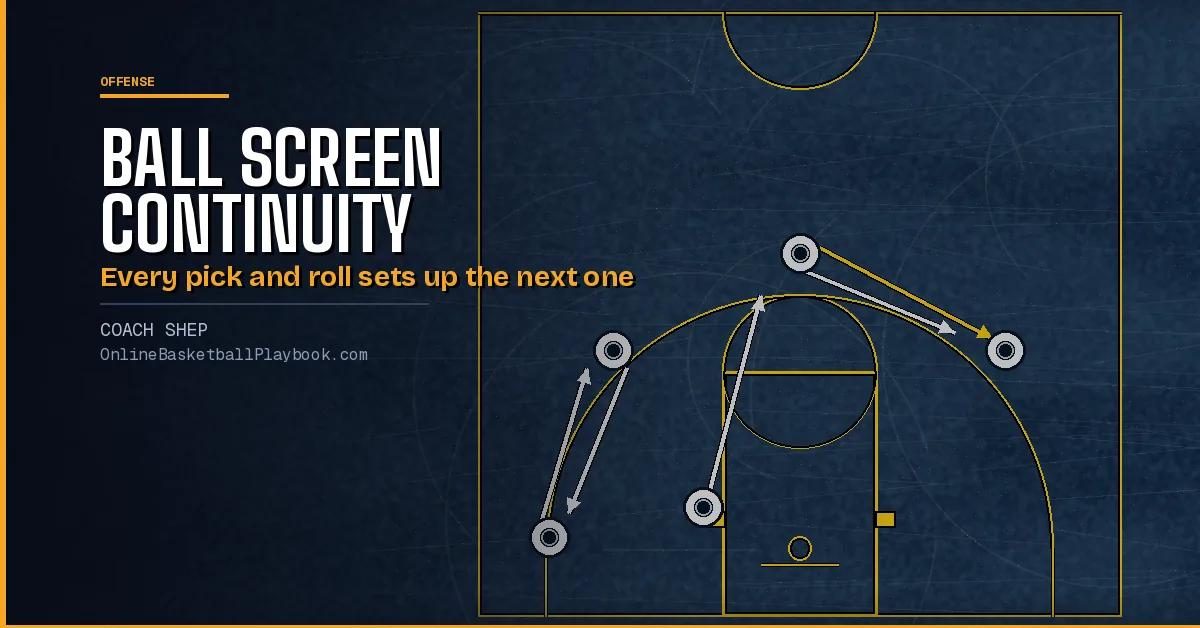
Ball Screen Continuity Offense: Pick and Roll Rules and Reads
Ball screen continuity offense in full: the 4-out and two-big engines, reload rules, spacing, angles, reads, counters, Spain, Ram, double drag and zone sets.