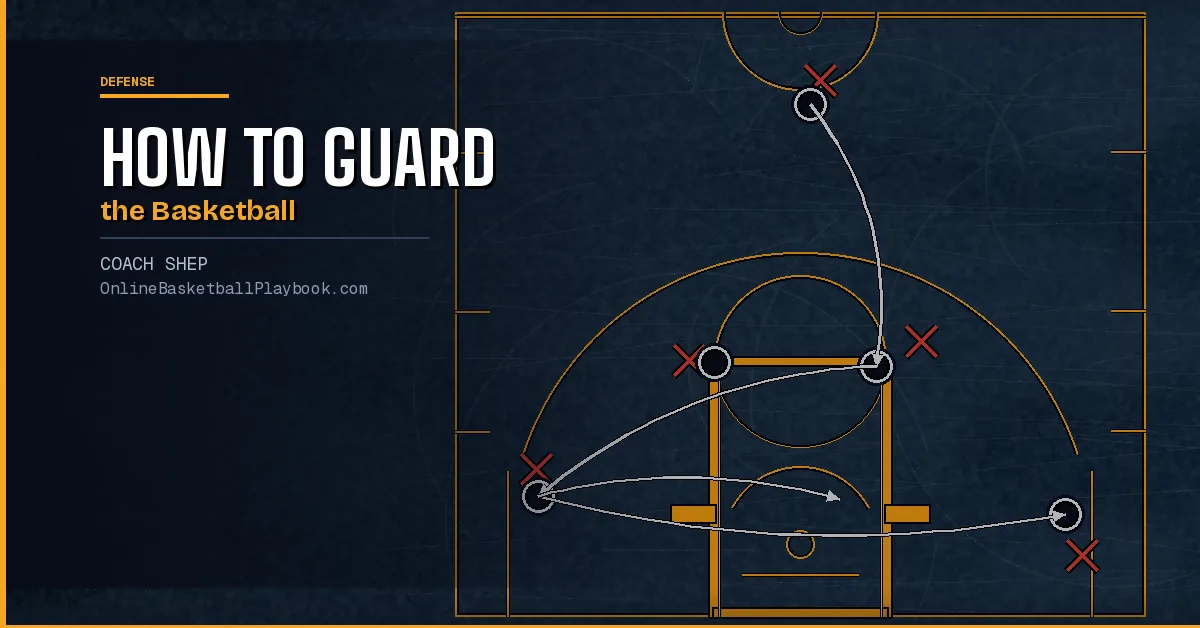
Guarding the basketball is the foundation of every team defense. Before any scheme makes sense, individual on-ball defense must be sound. This guide breaks down stance, footwork, pressure angles, and technique so any player can guard at a higher level.
The Defensive Stance
Every rep of on-ball defense begins with the same starting point: the stance. Get the stance wrong and the footwork, pressure, and angles all fall apart before the possession even develops. This is not a preference. It is a prerequisite.
The base position is what coaches call "bucket down."Knees bent deeply, weight balanced on the balls of the feet, never the heels. Chest out. Hands and feet roughly shoulder-width apart. The body should feel athletic and loaded, like a coiled spring, not passive or upright. If a defender can be pushed backward without shifting their feet, they are not in a real defensive stance.
Hand position matters just as much as the lower body. The inside hand (the one nearest the ball) mirrors the ball at all times, trying to touch it as often as possible. This creates psychological pressure on the ball-handler and puts the defender in a position to get deflections without fouling. The outside hand stays out as a deflector, ready to disrupt passes to the wing.
A critical mistake young defenders make is treating the defensive stance as a rest position. It is the opposite. Stance is an active, energized posture that must be maintained through every dribble, every jab step, and every hesitation move the offensive player throws at you. Defenders who relax in their stance are the ones who get blown by before the play even starts.
The body itself takes up space deliberately. By staying wide and low, a defender can influence the ball-handler's decisions before a single foot moves. That space (that presence) is the first layer of defensive pressure.
Footwork: Three Essential Movements
Athleticism can cover for poor footwork at lower levels. It cannot cover for it at higher levels. The players who consistently guard quicker opponents are not always the fastest defenders on the floor. They are the defenders whose footwork is technically sound. Three movements form the entire foundation of on-ball defensive footwork.
The Retreat Step
When the dribbler attacks, the natural instinct is to backpedal. That instinct is wrong. Backpedaling flat exposes the defender's hips and makes it nearly impossible to change direction efficiently. The retreat step corrects this: when the dribbler attacks, drop the threatened foot back and open the angle. The defender stays in a position to mirror the drive without crossing their feet or giving up leverage.
The Advance Step
Waiting for the offense to set up is a defensive disadvantage. The advance step flips the script. The defender attacks first, forcing the dribbler before they can get comfortable. This pressures the ball before the offense establishes a rhythm and pushes them into less favorable positions on the floor. Great defenders use the advance step to take the initiative away from the offense.
The Swing Step
When a ball-handler attacks toward the defender's front foot, the swing step cuts off the angle. The opposite foot swings around to take away the drive lane. Executed correctly, this movement seals off the gap without crossing the feet, which would leave the defender vulnerable to a counter move.
These three movements (retreat, advance, swing) are best learned in isolation before they are applied in live situations. Coaches who use the Slide and Hey! drill progressions teach each movement separately until it becomes automatic. Only then does it translate under pressure. For more structured ways to develop these movement patterns, see basketball footwork drills that isolate each step and build from there.
Pressure Angles and Ball Direction
Where the ball goes on the floor is not random. Defenders who understand this can use the court itself as a co-defender. The baseline and sideline do not move. They are built-in traps for any ball-handler who is pushed toward them. The defender's job is to funnel the dribbler into those boundaries.
The cardinal rule: no straight-line drives, no lob passes. Those are the two outcomes the defense cannot allow. A straight-line drive to the basket gives the offense an uncontested path. A lob pass over the top invites easy layups or drop-off opportunities. Every other outcome (a mid-range pull-up, a contested three-pointer, a pass that takes an extra second to develop) represents a defensive win.
Rick Pitino's framing captures this well: "If you allow an offensive player to set up in the middle of the floor where they can shoot, pass, and drive, you are giving them too many options." The middle of the floor is where offenses live. A ball-handler positioned in the middle has every option available. Force them baseline or to the sideline and you eliminate choices before the offense can exploit them.
The nose-on-the-ball principle makes this possible. The defender's nose stays pointed at the ball-handler's ball hand, not their hip, not their chest. This positioning accomplishes two things simultaneously: it keeps the defender in the dribbler's sightline, creating constant psychological pressure, and it places the defender in position to deflect without reaching. Reaching is a foul. Nose-on-the-ball is a technique. There is a difference.
Understanding pressure angles connects directly to help defense principles. When the on-ball defender forces the dribbler into a predictable direction, help defenders can anticipate and rotate before the drive develops rather than reacting after it happens. On-ball defense and help defense are not separate systems. They are the same system operating at different distances from the ball.
When the Dribble Is Dead
The moment the dribbler picks up the ball, the entire defensive calculus changes. A ball-handler with an active dribble has multiple threats: drive, pull-up, pass. A ball-handler without a dribble has one threat: pass. That shift in options should trigger an immediate defensive adjustment.
When the dribble dies, the defender closes the gap. This is not optional. It is required. A defender who stays at arm's length while the dribbler is dead gives the offense time to survey the floor comfortably, find a cutter, or pump-fake into a foul. Close the gap aggressively. Force the offensive player to use their body to protect the ball rather than reading the defense at their leisure.
The hands come up. The voice activates. Calling "ball" alerts teammates that the dribble is dead and help rotation rules may change. The defender gets into the ball-handler's space without fouling, using active hands to threaten the passing lanes without reaching across the body.
Many defenders make the mistake of relaxing when the dribble stops because they feel the immediate drive threat has disappeared. The opposite mindset is more productive: a dead-ball situation is an opportunity to create a five-second call, force a bad pass, or generate a turnover through ball pressure. This is where disciplined on-ball defenders separate themselves.
When the dribble stops, your defenders must close the gap instantly and apply two-hand live-ball pressure. Passive defenders in dead-ball situations let offenses reset and find open shooters but aggressive defenders force bad passes and create transition opportunities going the other way.
How On-Ball Defense Fits Team Defense
Individual on-ball defense does not exist in isolation. Every 1-on-1 decision a defender makes either supports or undermines the entire team defensive structure. As Steve Hawkins puts it: "Everything you do 1 on 1 should fit your 5 on 5." That principle should be posted in every gym where individual defense is being taught.
A defender who forces the ball baseline on purpose (because the team's help rotation covers baseline) is playing team defense through their individual technique. A defender who forces the ball to the middle because that is where they feel comfortable shutting down the drive is working against the rotation and creating chaos for their teammates. Individual decisions have team consequences on every single possession.
This is why man-to-man defense systems spend as much time on individual on-ball technique as on rotation rules. The rotations only work if the on-ball defender controls where the ball goes. If the on-ball defender is getting beat to their left when the team wants to funnel right, no rotation system can compensate for that consistently.
The same principle applies to special situations. Defending pick-and-roll actions requires the on-ball defender to execute correctly before any secondary coverage can take over. For a detailed breakdown of that specific read, see defending the pick and roll. The on-ball piece is always step one.
Zone defenses like the 2-3 zone defense reduce individual on-ball pressure responsibilities by design, using zone principles and help from adjacent defenders. But even in zone schemes, the defender nearest the ball must apply enough pressure to prevent comfortable catches, easy pump-fakes, and uncontested mid-range attempts. On-ball technique matters in every defensive system.
The best way to internalize how on-ball defense functions within a team structure is through the shell drill. The shell drill teaches all five defenders to move simultaneously (on-ball pressure, wing denial, help positioning) and it starts with the on-ball defender setting the correct stance and angle before anything else can function.
Drills to Build On-Ball Defense
Technique without repetition does not stick. The following drills build the stance, footwork, and ball pressure habits that transfer into live game situations. None of these require a full team. Most can be run with pairs or small groups at any point in practice.
Zig-Zag Drill
The classic on-ball footwork drill. The ball-handler dribbles at game speed from one corner to the other diagonally across the court while the defender uses retreat steps and swing steps to stay in front. The goal is keeping the nose on the ball hand through every direction change. The defender cannot touch the ball-handler. This is a footwork drill, not a contact drill.
Slide and Hey! Drill
Isolates the retreat step and advance step in a stationary context before adding the dribbler. The defender slides laterally on command, drops into a retreat step when "Hey!" is called, and recovers. This builds muscle memory for the two most important individual footwork tools without the cognitive load of reading an actual ball-handler.
One-on-One, No Middle
A live 1-on-1 drill with one constraint: the offensive player cannot go middle. This forces both players to execute their technique toward the sideline and baseline. The defense learns to funnel; the offense learns to operate in tight spaces. Removing the middle option makes the drill game-realistic for teams that funnel baseline in their system.
Dead Ball Pressure
The ball-handler starts with the ball held (dribble already dead). The defender must apply two-hand live-ball pressure for a five-count without fouling. Progress to a five-second call or a forced lob pass as success criteria. This drill builds composure in one of the most important and most neglected moments in on-ball defense.
For defenders who want to develop their full skill set alongside their defensive technique, pair this work with basketball player development principles that address both ends of the floor together. Defense is a skill, and it should be trained with the same intentionality as shooting or ball-handling.
Building these habits in practice requires structured, purposeful reps. A well-designed basketball practice plan should carve out dedicated time for individual on-ball defense work, not just scrimmage where technique gets swallowed by competition. Isolation reps in controlled drills are how the habits get wired in before the game speeds everything up.
- Stance first: bucket down, weight on the balls of the feet, inside hand mirroring the ball before the first step is taken.
- Retreat step over backpedal: drop the threatened foot back and open the angle when the dribbler attacks, never back-pedal flat.
- Force baseline or sideline: use the court boundaries as help defenders; never allow a comfortable catch in the middle of the floor.
- Nose on the ball hand: stay pointed at the dribbling hand, not the hip or chest, to stay in position for deflections without reaching.
- Close the gap when the dribble dies: step in immediately, two hands active, voice on, never relax when the ball-handler picks up the dribble.
- One 1-on-1 decision affects all five defenders: force the ball where your help rotation is set, not where your instinct takes you.
Get free play diagrams, drills, and coaching guides delivered weekly.
Draw this play free in the play drawer →
Membership: the full library, playbook packs, and Pro drawing tools →
Keep Building
Related breakdowns
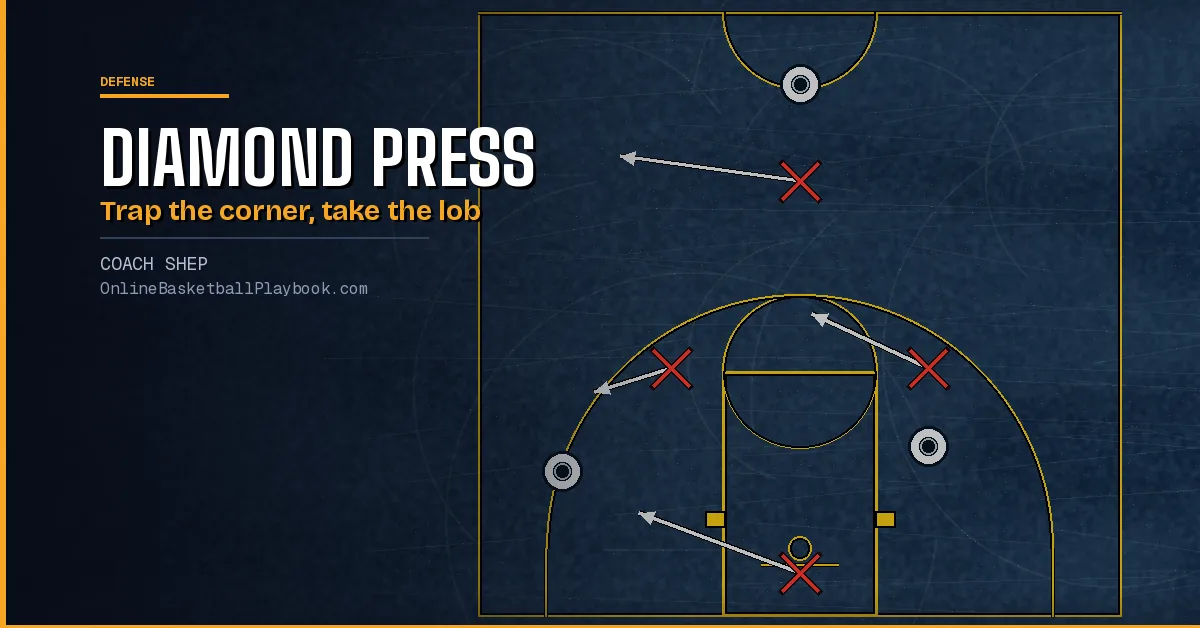
1-2-1-1 Diamond Press Basketball: Roles, Traps and Install
How to run the diamond press in basketball: who plays each role, how to trap the corner, what to do on the reversal and the lob, and how to install it step by step.
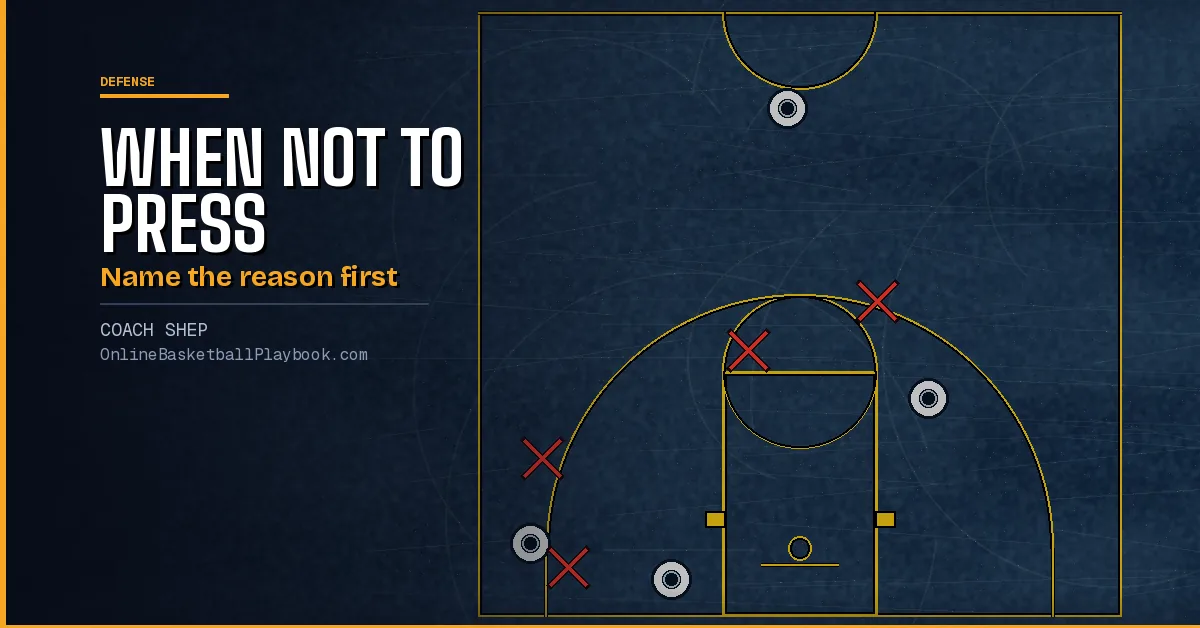
When Not to Press: Bad Reasons, Thin Benches, Poised Guards
When not to press in basketball: the bad reasons, the roster you need first, the opponents who beat it, the moments to drop it and the youth limits.
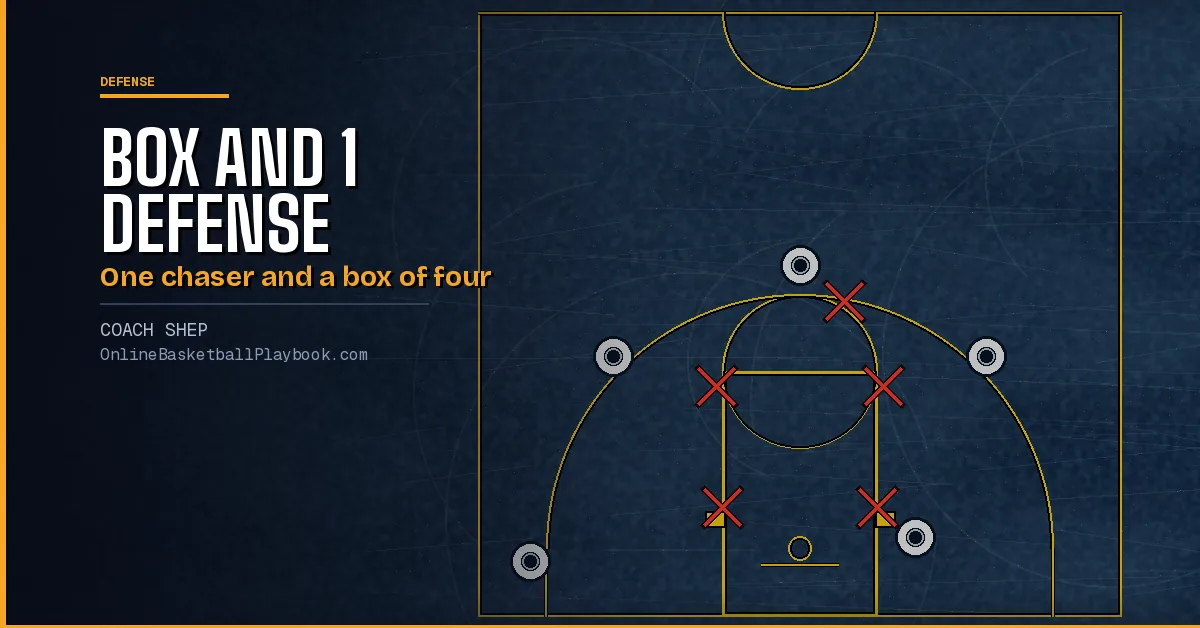
Box and 1 Defense: How It Works and How to Beat It
What the box and 1 defense is, how the chaser and the box play, when coaches call it, where it leaks, and how an offense beats it with a decoy star.