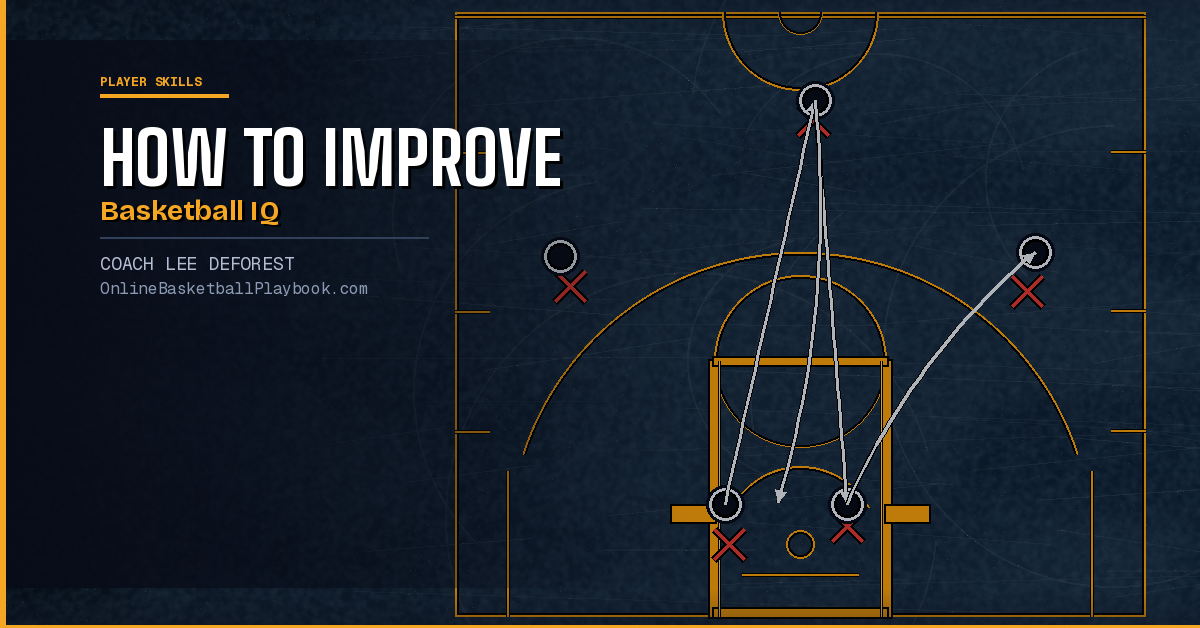

Basketball IQ separates players who look good in drills from players who make the right play when it counts. It is coachable, developable, and more important than athleticism once competition gets serious.
What Basketball IQ Actually Means
Most players assume basketball IQ is something you either have or you do not. A natural gift, born into certain players and absent in others. That assumption is wrong, and coaches who operate from it leave enormous development on the table.
Basketball IQ is the ability to read a situation correctly and apply the right skill at the right moment. The key word is apply. A player can have excellent footwork, a reliable jump shot, and a tight handle — and still make the wrong decision repeatedly. Possessing a tool and knowing when to use it are two completely different things. Basketball player development programs that skip the "when" and "why" produce athletes who look sharp in warmups and disappear in close games.
The good news: reading the game is teachable. It requires deliberate instruction, repetition in game-like conditions, and a coach who knows how to frame decisions — not just demonstrate techniques. Every player on your roster can develop a higher basketball IQ with the right approach.
High IQ players share a few visible traits: they move before the ball does, they help before the drive reaches the paint, they call out the screen before it comes, and they know exactly what they want to do with the ball before they catch it. None of those behaviors happen by accident. They are the product of trained recognition.
Why, When, and How — The Three Layers of Every Skill
The standard way to teach a basketball skill is to break it into steps. Show the footwork, demonstrate the technique, drill it to repetition. That teaches the HOW. The problem is that a player who only knows HOW will execute perfectly in a drill and freeze in a game, because the game does not set up the same way the drill does.
High IQ basketball teaching adds two layers on top of HOW: the WHY and the WHEN.
The WHY explains the force the skill is designed to exploit. A back cut does not exist because it looks nice. It exists because a defender who denies the catch has turned their hips toward the ball, creating a clear path to the basket behind them. When a player understands the WHY, they can recognize the condition in real time and act on it — even if the drill never set it up exactly that way.
The WHEN is the read. What must be true before this skill is the right choice? A drive into traffic is not the same skill as a drive into space. A skip pass against a run-at closeout creates a different read than a skip pass against a player already in position. Teaching the WHEN means teaching players to scan, identify the condition, and match the right action to it.
A player taught all three layers — WHY, WHEN, and HOW — develops a skill that transfers. It works in new situations, against different defenses, and under pressure, because the player is reading a principle rather than recalling a script. This is what separates basketball IQ development from basic skill work.
"IQ cuts both ways — points prevented are just as important as points scored — read offense and defense; the intelligent defender anticipates as much as the intelligent scorer."
— Basketball Vault
Film Study and Live Observation
The fastest way to build pattern recognition is repetition — but not all repetition has to happen with a ball in your hands. Film study and live observation accelerate the development of basketball IQ more than almost any on-court drill, because they expose a player to hundreds of reads in the time it would take to generate a fraction of them in practice.
The goal of film study for IQ development is not to memorize plays. It is to build a library of situations. You want a player to watch film and start recognizing: the defense is in help position here, which means the corner is open; the ball handler turned their back to the help, which means the drive is coming; the wing caught with feet set and the defender is late — that is a shot.
Start with short clips that isolate one decision. Show the clip before the action resolves. Pause it and ask the player what they would do. Then show what happened and discuss whether that was the right read — and why. This active, question-based film approach builds the habit of reading before reacting, which is exactly what you want on the floor.
Live observation works the same way. Watching college or pro basketball with intention — stopping to predict what should happen before it happens — trains the brain to process sequences rather than just watch highlights. Players who watch basketball passively absorb aesthetics. Players who watch basketball analytically absorb reads.
Even watching practice from the sideline during non-playing reps can build IQ, if the player is thinking about the situation rather than waiting for their turn. Coaches should encourage it explicitly. Tell the players who are off the floor what to look for. Give them a specific read to track.
Building Reads in Practice
Film study builds the library. Practice is where players learn to access it at game speed. The challenge is that most practice drills are designed to isolate technique, not decision-making. Running the same action from the same setup against no resistance develops physical habit but does not build IQ.
The shift is simple: add a read to every drill. Even a basic two-man shooting drill can include a defender whose positioning tells the offensive player whether to catch-and-shoot or attack. A three-man passing drill can include one player making the wrong cut, forcing the passer to redirect. The physical action is the same. The mental demand is entirely different.
Constraint-based training takes this further. Instead of telling a player what to do, restrict one option and let them figure out the alternative. If the pull-up is taken away, they have to finish at the rim. If the drive is cut off, they have to pass. These forced decisions under pressure teach players to read and respond — the core of basketball IQ.
The shell drill is one of the best examples of read-building baked into a traditional format. When run correctly, it teaches defensive players to identify help rotations, talk through coverage, and react to ball movement — all in real time. Run it with enough reps and the reads become automatic. That automation under pressure is what high basketball IQ looks like from the outside.
Small-sided games — 3-on-3, 4-on-4 — also develop IQ faster than full 5-on-5 work because the spacing is tighter, the decisions come faster, and every player is involved in every possession. Fewer players means more reads per rep. Structure these games with specific rules or scoring bonuses that reward the reads you want to emphasize.
A well-structured basketball practice plan builds IQ development into every segment rather than treating it as a separate add-on. When reads are embedded in drills from the first whistle, players spend the entire practice training their decision-making — not just their mechanics.
Situational Mastery and Special Situations
Most teams prepare for the main game. The 40 minutes of regulation action, the primary offense, the primary defense. But basketball is also decided by the moments that fall outside those 40 minutes: the last-second inbounds, the jump ball alignment, the free throw box-out rotation, the press break when the game is on the line.
High IQ teams have prepared for all of it. Low IQ teams are figuring it out when it happens. That gap does not come from talent — it comes from preparation. Coaches who deliberately teach the special situations give their team a genuine competitive advantage, because most opponents have not done the same work.
Special situations to cover explicitly include: late-game inbounds plays under your own basket, late-game inbounds plays in the frontcourt, free throw offensive and defensive alignments, jump ball possessions, how to attack a press and how to run a press, and what to do when fouling intentionally or protecting a lead. Each of these is a distinct skill set that requires instruction and repetition, not on-the-fly improvisation.
Situational mastery extends to rule knowledge. Players who understand the rules of the game have an edge. Knowing exactly when the shot clock resets, how to use a timeout to advance the ball, when a defender can legally take a charge — these details matter in close games, and they are teachable. Make rules education a part of your program, not an afterthought.
Even individual player tendencies are part of situational IQ. Knowing that a specific opponent always drives right, that the opposing point guard telegraphs the skip pass, that the center drops off on pick coverage — these reads come from study and film, and they give an intelligent player a head start on every possession.
Basketball IQ on the Defensive End
Basketball IQ is discussed almost entirely in offensive terms. Who made the right pass. Who read the pick-and-roll correctly. Who found the open man. But defensive IQ is just as trainable and often has a bigger impact on outcomes, because defense wins when the right reads happen before the offense can score — not after.
Defensive IQ starts with anticipation. An intelligent defender does not react to what happened — they predict what is about to happen based on body position, ball location, and the offensive player's habits. The moment a ball handler picks up their dribble, the intelligent defender closes the gap and anticipates the pass direction. The moment a cutter clears the lane, the intelligent defender sinks into the gap before the drive comes.
Help defense is almost entirely an IQ skill. Knowing when to leave your assignment to stop a drive, how far to rotate, when to recover, and when to fully commit — these decisions happen in fractions of a second and require trained recognition to execute correctly. A player can be physically fast and athletically gifted but helpless in a help scheme if they have not developed the reads. Quality help defense principles give players the framework to make those decisions consistently rather than instinctively.
Defending ball screens requires especially high IQ. The read changes based on the offensive player's shooting ability, the screener's roll tendencies, the position on the floor, and the game situation. Players who understand the why behind each coverage option — go over the top, under, hedge, switch, drop — can adjust when the offense surprises them, rather than breaking down entirely. Understanding how to defend the pick and roll is one of the clearest expressions of defensive IQ at every level of the game.
Communication is both a symptom of defensive IQ and a driver of it. High IQ defenders talk constantly — calling screens before they arrive, identifying the ball handler, calling rotations before they are needed. That communication keeps the whole defense in the right position and creates a shared mental model of the situation. Players who communicate well on defense develop their own IQ faster because the verbal processing reinforces the visual reads.
Keep the System Simple Enough to Think
There is a direct relationship between system complexity and basketball IQ. The more a player has to remember, the less mental bandwidth they have to read and react. Coaches who run 20-play playbooks and complex motion systems with 15 actions often find that their players look robotic rather than intelligent — because they are recalling, not reading.
The simplest systems, deeply understood, produce the highest IQ play. When a player knows exactly what the offense is trying to accomplish, what read triggers each action, and why each spacing principle exists, they can operate in any situation — including ones the play did not anticipate. Improvisation is a product of deep understanding, not creative talent.
This does not mean running a simple offense. It means teaching the offense simply. Build one action at a time. Introduce the WHY before you install the HOW. Demand that players can explain what they are doing and why before you expect them to do it at speed. A motion offense in basketball built on clear principles — space the floor, read the defense, cut to open gaps — gives players a framework that handles every situation the defense throws at them, without requiring a new play call for each scenario.
Simplicity also reduces hesitation. A player who is unsure what to do takes an extra half-second to decide, and half a second in basketball is the difference between an open shot and a contested one. The player with fewer decisions to make — because the system is clear and the reads are automatic — moves faster, plays more confidently, and makes smarter choices under pressure. That is what a high basketball IQ looks like in real time.
Before every drill, tell your players exactly what read to look for. One specific thing. Not "play smart" — but "if the defender's hips turn toward the ball, cut back door immediately." Specificity is what turns drill reps into IQ development.
- Teach WHY and WHEN alongside HOW for every skill — not just the steps
- Use short film clips paused before the action resolves to build anticipation and prediction habits
- Add at least one read to every drill — even basic shooting and passing work
- Dedicate practice time to special situations: late-game inbounds, press breaks, jump balls, and free throw alignments
- Teach defensive IQ explicitly — help rotations, screen coverage rules, and communication protocols are all trainable
- Keep the offensive system simple enough that players have mental bandwidth left to read the defense in real time
- Use small-sided games (3-on-3, 4-on-4) to increase decision-making reps per player per minute
Get free play diagrams, drills, and coaching guides delivered weekly.
Keep Building
Related breakdowns
How to Improve Your Vertical Jump for Basketball
How to Improve Your Vertical Jump for Basketball
How to Use Technology to Improve Basketball Coaching
How to Use Technology to Improve Basketball Coaching