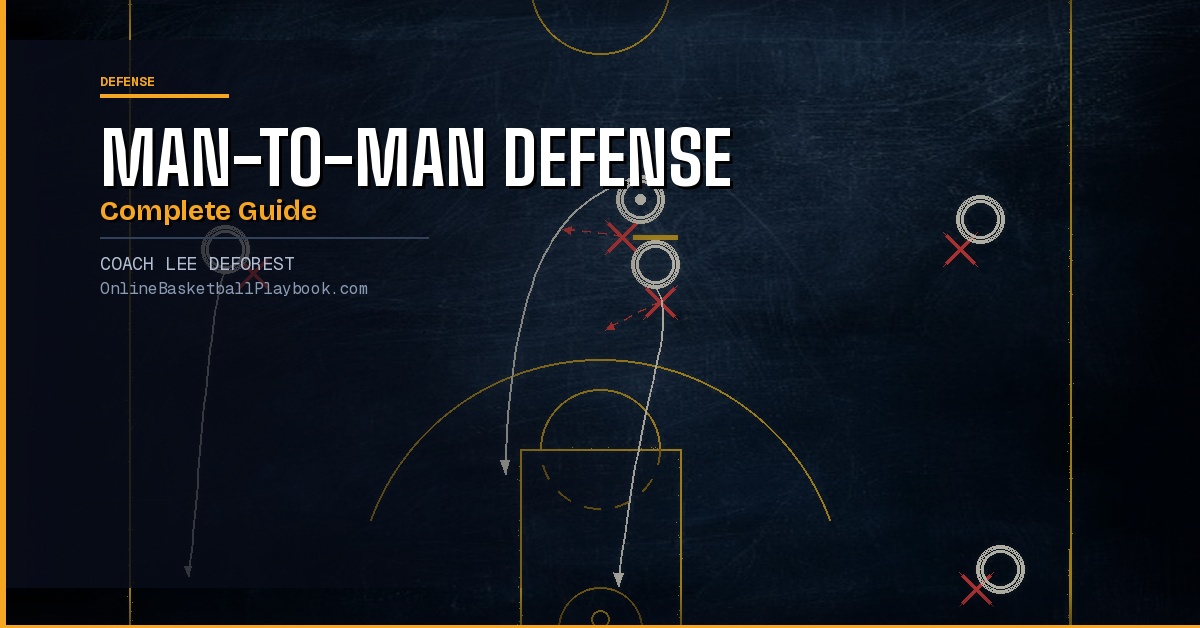

Man-to-man defense is the foundation every serious program builds on. This guide covers the core principles, teaching progressions, and daily drills you need to build a defense your players trust and opponents struggle to solve.
The Ball-You-Man Fundamentals
The phrase "ball-you-man" describes the single most important concept in man-to-man defense. Every off-ball defender must position themselves on the imaginary line that connects the ball to their assigned man — not standing next to their man, not watching the play from a comfortable spot, but actively working to stay on that line at all times.
What makes this principle so powerful is how it changes with ball movement. The farther your man is from the ball, the farther you can move off your man and into help position. A defender whose man is on the weak-side corner — two passes away — should be nearly at the lane, able to see both the ball and their assignment. A defender whose man is one pass away should form a flat triangle: one point on the ball, one point on their man, and themselves positioned to deny or help depending on the defensive scheme.
This is not passive positioning. It requires constant, active adjustment every time the ball moves. Defenders who learn to read ball movement — not just watch their man — become dramatically better teammates. They can take away drives, intercept skip passes, and rotate to help before a breakdown happens rather than reacting to it after the fact.
The ball-you-man principle also answers one of the most common questions in man defense: should I follow my man everywhere? The answer is no. You guard a man in relation to where the ball is. When the ball is far away and your man cuts across the lane, you don't trail them blindly — you maintain your position on the ball-you-man line and pick them up when they arrive in your zone of responsibility. This is what separates disciplined man-to-man from chaotic scramble defense.
For deeper reading on building this foundation at practice, the shell drill is the essential teaching vehicle — it puts all five defenders in motion simultaneously and exposes every positioning error in real time.
On-Ball Defense and Pressure
On-ball defense is the most visible part of man-to-man, but it's also the most frequently misunderstood. The goal is not to steal the ball. The goal is to influence the dribbler, take away the middle, and force them into situations where the offense has to work harder than it wants to.
"Guard Your Yard" is the concept that clarifies the on-ball defender's job. You are responsible for the space between your man and the basket. You do not gamble into the passing lanes. You do not lunge for steals. You stay between your man and the basket, maintain a low stance with active hands, and make the dribbler uncomfortable by being right in front of them at all times.
Hand position matters. Hands up and active — not waving wildly, but present — forces the ball-handler to make higher, slower passes. A higher pass gives your help defenders more time to rotate and recover. This is the mechanical link between on-ball pressure and team defense. Your pressure on the ball directly affects how much time your teammates have to help.
The moment a dribbler picks up their dribble, your job intensifies. "Belly up" immediately — close the gap and get as close as you can without fouling, taking away any clear passing angle. The ball-handler with a live dribble is a threat; the ball-handler who has used their dribble is trapped. Make them feel that.
One of the most consistent teaching errors is allowing dribble penetration into the middle of the lane. The baseline is a natural help; the sideline is an ally. When you influence dribblers toward the sideline or baseline, you cut the court in half. Keep the ball on the outside. No middle.
The Zig-Zag drill, where defenders shadow a ball-handler from baseline to half court — angling them left and right without allowing the middle — is the single best tool for teaching on-ball stance and footwork. Run it at the start of every defensive practice. Pair it with footwork drills to build the lateral quickness defenders need to stay in front without fouling.
"On-ball pressure without fouling. Force the dribbler outside; stay between man and basket — 'Guard Your Yard.'"
— Basketball Vault
Help Side Positioning and Rotations
Help defense is where man-to-man either holds together or falls apart. The best individual defender in the world cannot protect a team that doesn't rotate. Help-side discipline is a collective responsibility — every player off the ball must be active, aware, and positioned to support.
The first rule of help defense: jump to the ball on air time. The moment a pass leaves the passer's hands — not when it arrives — every off-ball defender repositions. This is crucial. Defenders who wait for the catch are always a step late. Defenders who move on air time cut off basket cuts before they develop, shrink the passing gaps, and make the entire defense look faster than it actually is.
Help positions exist on a spectrum based on where your man is relative to the ball. One pass away, you're in a flat triangle — able to deny if the scheme calls for it, or sag toward the lane to help on drives. Two passes away, you drop to the weak-side lane area, maintaining ball-man vision. When penetration happens, weak-side help must be ready to step up and take the charge or force a difficult pass.
Rotations after a help stop are equally important. When a help defender steps up to stop the drive, the remaining defenders must rotate to cover the vacated man. This chain reaction — help, rotate, recover — is the backbone of sound team defense. A breakdown at any point in the chain creates open shots.
Coaches building this concept should start with help defense principles before asking players to execute full rotations under pressure. Walk before you run: static positioning drills first, then shell drill with ball movement, then live 5-on-5 execution.
Teaching Progressions and Drills
The biggest mistake coaches make when installing man-to-man defense is skipping the progressions and going straight to 5-on-5. Players develop bad habits without a foundation. Build it layer by layer.
Step 1: Stance and Footwork
Before you teach positioning, teach the stance. Feet shoulder-width, knees bent, weight on the balls of the feet, back straight. Teach players to slide without crossing their feet. The Zig-Zag drill covers this immediately and reveals who can't stay in a defensive stance for more than five seconds. Address it early — defensive fitness is a prerequisite for defensive execution.
Step 2: 1-on-1 Positioning
Teach ball-you-man in simple 1-on-1 reps. Put a defender and an offensive player on the floor with a coach holding the ball. Move the ball. The defender adjusts. Move the ball again. This single exercise — sometimes called "ball movement mirror" — builds the habit of reading the ball rather than watching the man.
Step 3: Shell Drill
The shell drill is the cornerstone teaching vehicle for man-to-man defense at every level. Four offensive players spaced at the perimeter, four defenders adjusting to ball movement — no dribbles, just passes and repositioning. Add a dribble penetration read, then live defense. This is the progression every practice should work through at least twice a week early in the season.
Step 4: Defending Cuts
Once positioning is established, teach defenders how to handle cuts. A player cutting through the lane is trying to exploit the ball-you-man principle. Defenders must front cutters near the ball and open up to see the ball-side when they're on the weak side. The key is body position, not chasing — get to the next stop on the ball-you-man line before the cutter does.
Step 5: Live 5-on-5
Now go 5-on-5. But don't play loose — demand the principles. Stop play every time a defender is not on the ball-you-man line. Stop play every time someone doesn't jump on air time. Early in installation, a five-minute defensive segment might take fifteen minutes because of corrections. That's the right ratio. The habits built in those corrections pay off for the entire season.
Build your defensive teaching into every practice segment — not just dedicated defensive periods. Competitive shooting drills, transition work, and team scrimmages all reinforce habits when coaches demand the principles consistently throughout. A structured practice plan ensures defensive reps appear in the right dose every day without crowding out offensive development.
Defending Ball Screens and Pick-and-Roll
Ball screens are the most common action in modern basketball at every level. A man-to-man defense that cannot defend the pick-and-roll will be attacked relentlessly. Every program needs a clear, communicated plan for how they handle screens — and every player needs to understand their role in that plan.
The three main options are hedge-and-recover, switch, and drop coverage. Each has tradeoffs.
Hedge and recover is the most aggressive option. The big man steps out hard to cut off the dribbler's path after the screen, while the guard fights over the top and recovers to their man. This takes away the middle drive but requires precise timing and excellent communication. A late hedge leaves the guard isolated in space; an early hedge tips off the action before it begins.
Switching keeps everything simple at the cost of mismatches. When teams switch every ball screen, they eliminate confusion and keep both defenders attached to a man — but they create the exact mismatches offenses are hunting. Switching works best when your roster is versatile enough that a mismatch after a switch isn't a layup.
Drop coverage invites the mid-range pull-up but protects the rim. The big sags back and the guard fights over the top. At the youth and high school level, where consistent mid-range shooting is rare, drop is often the most efficient choice. It keeps the big in position to protect the paint and limits the dribble-drive penetration that breaks most team defenses.
Whatever coverage you choose, the communication has to be automatic. "Screen!" is called by the man being screened before it happens. "Switch!" or "Stay!" is called immediately. Defensive breakdowns on ball screens are almost always communication failures, not physical failures. For a full breakdown of techniques and drills, defending the pick-and-roll covers every coverage option in detail.
Building a Defensive Identity
The most underrated part of teaching man-to-man defense is not the X's and O's — it's the culture. Effort, communication, and discipline are not skills you coach; they are standards you establish and protect every day.
Players who commit to defense do so because they believe it matters. Your job as a coach is to make defense feel as important as offense — in how you practice, how you praise, and how you evaluate playing time. If a player who scores 12 points but gives up 14 on defense keeps playing while a plus-two defender comes off the bench, you have communicated the wrong priority.
Defensive identity also requires a clear set of non-negotiables. Pick three or four principles — no middle, jump on air time, belly up on live-ball pick-up, communicate on screens — and hold them to the standard every single possession in practice. The most common coaching mistake is demanding the principles in walkthroughs and letting them slide in competitive live reps. The principles matter most under pressure. Hold them there or players learn that they're optional.
Building accountability on defense starts with naming what you're asking for and measuring it. If you track deflections, charges taken, contested shots, and opponent field goal percentage by game — and share those numbers with your team — players understand the measurable value of their defensive effort. Building accountability into your program's culture makes defense something players compete for, not endure.
A well-built man-to-man system also opens the door to pressure packages. Once your players understand ball-you-man positioning and help rotations, you can layer in half-court traps, ball-line trapping, and full-court pressure actions like the full-court press without rebuilding the foundation. The principles translate directly — the postures, the rotations, the communication. All of it carries over.
Finally, defense connects directly to transition. Teams that are disciplined in their man-to-man positioning are already positioned to get back on defense. The habits — staying between your man and the basket, not gambling, keeping your assignment in vision — protect you in transition the same way they protect you in the half court. Transition defense is a direct extension of the same principles you build in your half-court man-to-man system.
- Ball-you-man first: Every off-ball defender must stay on the line between the ball and their man — adjust every pass.
- No middle: Influence every dribbler to the sideline or baseline; never let the ball split the defense.
- Jump on air time: Reposition the moment a pass leaves the passer's hands, not when it arrives — this kills cuts and restores help.
- Belly up on pick-up: The instant the dribble is stopped, close the gap immediately and eliminate every passing angle without fouling.
- Communicate on screens: The man being screened calls "Screen!" before it happens; the helper responds "Stay!" or "Switch!" — every single time.
- Hands up, not out: Active hands force higher passes; higher passes give help defenders more time to rotate and steal.
- Shell drill twice a week: Run it early in the season every practice — there is no better tool for teaching positioning and rotation at game speed.
Get free play diagrams, drills, and coaching guides delivered weekly.
Keep Building
Related breakdowns
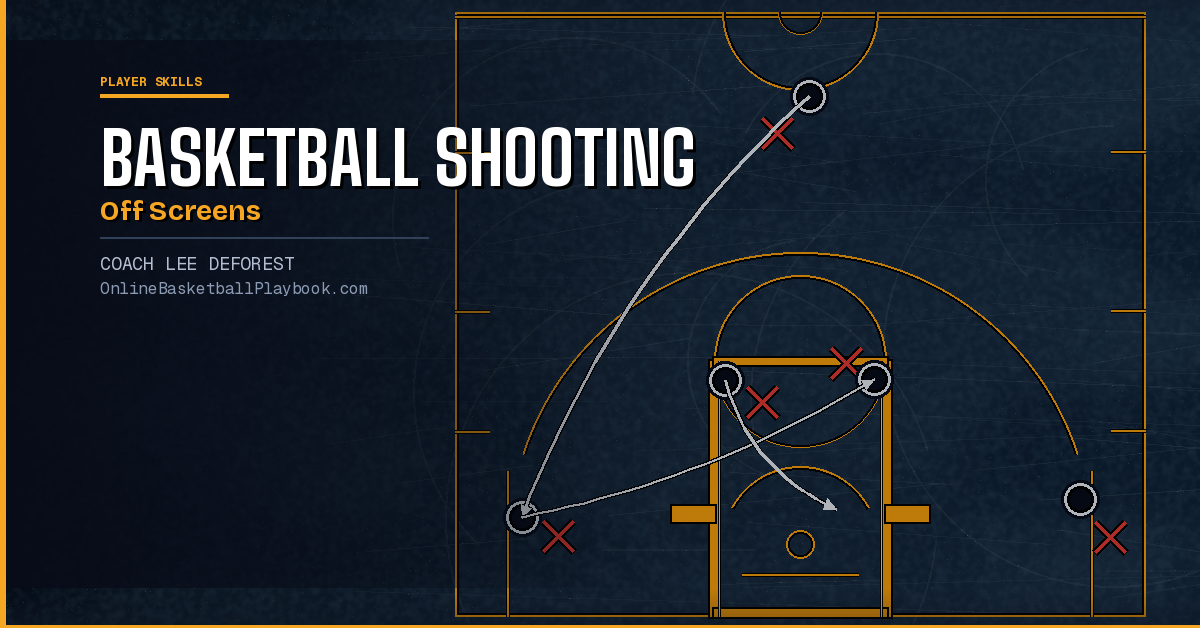
Basketball Shooting Off Screens: Complete Guide
Basketball Shooting Off Screens: Complete Guide
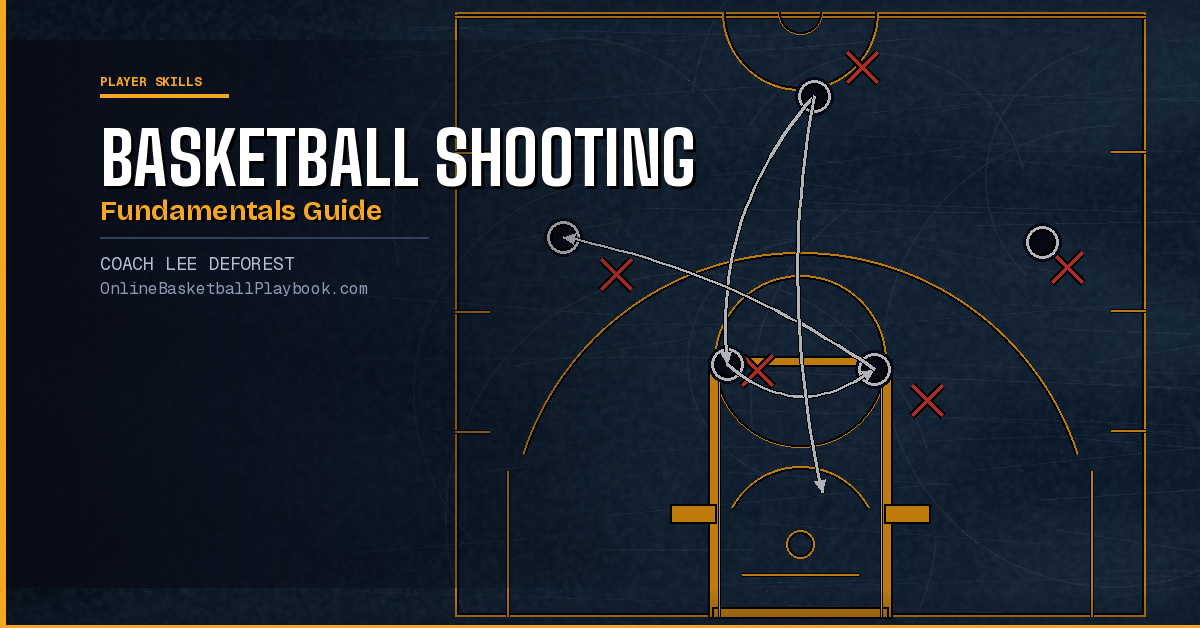
Basketball Shooting Fundamentals: Complete Coach Guide
Basketball Shooting Fundamentals: Complete Coach Guide