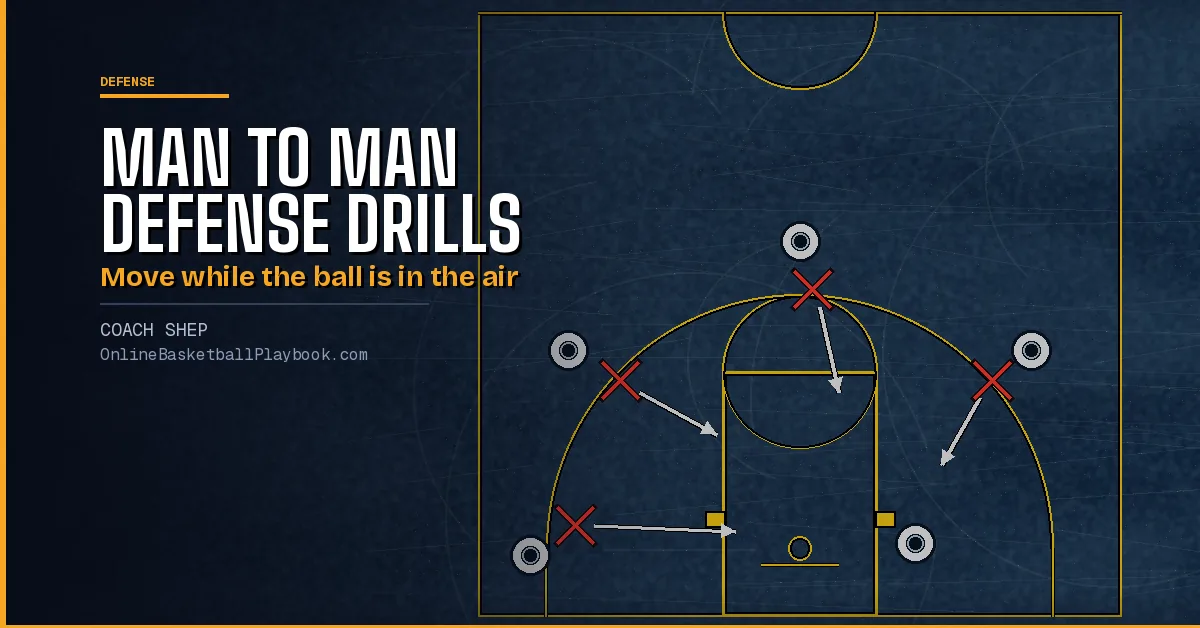
Man to man defense basketball drills are taught as a ladder. The coach shows the whole defense, breaks it into small pieces, from one on one up to four on four, that each train one habit at game speed, then rebuilds it 5 on 5 with a score. This page lays out the complete ladders some coaches use from the first day to the last, then the drills that fill each rung: on the ball, denial and cutters, help and recover, the post and screens, and scored team games. It ends with the youth versions. The general drill library (stance, slides, closeouts, box-outs) is on defensive basketball drills, the staged shell is on shell drill basketball, and the principles behind the drills are on man-to-man defense.
Full Man to Man Ladders Side by Side
Every complete install here runs small to large, but each coach fills the rungs differently. Three of them are written out start to finish:
| Plan | The order | What ties it together |
|---|---|---|
| Ettore Messina, 13 drills | Zig-zag, sprint-recover, crossover drive, closeout, drag-screen 2v2, side pick and roll 2v2, 3v2 curl, baseline drive help, duck-in, 3v3 shell, 4v4 shrink and spread, 5v5 Stop-Score-Stop, 5v5 Defensive Validation | Several drills end in a 3v2 or 2v2 the other way, so transition defense gets daily reps inside skill drills |
| Steal-or-rebound pressure ladder, 7 drills | 1-on-1 building blocks, jump to the ball, post defense, wing denials, guard cuts, 2-on-2 guard cuts, 3-on-3 and 4-on-4 no-dribble cut-throat | Each drill folds in the rules of the drills before it, and a drill ends only on a steal or a rebound |
| Three-block youth ladder, 14 stages | Buy-in, on-ball, closeout, box-out, one and two pass positioning, shell, then transition defense, hustle plays, post defense, then down and back screens, ball screens and hand-offs, cross screens, inbounds, free-throw rebounding, then live scrimmage | Foundational, intermediate and advanced blocks, in that order |
Shorter orders inside the shell itself are compared on the shell drill page. The common thread is whole, part, whole: show the defense, drill the pieces, then play it live.
Messina's 13-Drill Ladder
Messina builds the whole ladder on one philosophy, do not let the opponent do what it wants, and three commitments: no fast-break layups, no offensive rebounds, no open threes. Off the ball he plays up the line, ball, you, man, rather than between the man and the basket, and when a defender drops off a pass he drops along the passing line, never straight back. His ladder, in order:
- 2-man zig-zag to half court and back. It opens every defensive practice and covers sliding, the crossover and closeout footwork.
- Sprint-recover into zig-zag. Two players start shoulder to shoulder and the ball handler dribbles straight. The defender sprints ahead, recovers into his stance and keeps zig-zagging the length of the floor.
- Defending the crossover drive. The handler drives to the elbow and shot-fakes. The defender puts a hand up on the fake, and when the ball comes down for the crossover he takes a step back and stays in front without opening the gate.
- Closeout. The coach passes to the corner and the defender closes out to a no-middle stance, live from the catch if the coach wants.
- Drag-screen 2v2. Pick the handler up early, far from the three-point line, so the defender can go under the drag screen. The screener's defender shows a little to push the handler away from the basket and calls "under." Messina also suggests a silent period when the staff does not speak, so players must talk.
- Side pick and roll 2v2, usually switched, then 10 seconds live.
- 3v2 defend the curl with weak-side rebounding, then 3v2 the other way.
- Baseline drive help and recover. A wing drives baseline and pulls up, and the weak-side post defender shows on the drive depending on how deep it goes. If both players end up under the rim, push your man farther out of bounds and let the guards rebound.
- Duck-in. The ball goes to a coach on the wing and the defender on the player at the top of the key jumps to the ball, forcing his man to catch farther out. On the air time of the return pass to the top of the key, the post ducks in and his defender battles to stay top-side. No entry means live 2v2.
- 3v3 shell with movement: a cut all the way through with no face cut allowed, a flash to the ball-side post, the top of the key filled, then live on any coach's pass.
- 4v4 shrink and spread. When the coach in the post calls for the ball, the whole defense shrinks to it. When he passes out, it spreads again and plays live through the box-out. A progression has the receiver pass to a teammate who must drive.
- 5v5 Stop-Score-Stop. The game ends only when a team chains a stop, a score and another stop.
- 5v5 Defensive Validation. Play to 5 or 7, and a basket counts only if the scoring team gets a stop on the next possession.

For a coach running the shell alone, Messina watches only two things from under the basket: one defender in the paint at all times, and whether ball and defender arrive together. His defensive philosophy is on Messina's three commitments, and his scoring games are on Messina's 5-on-5 validation.

On-Ball Drills Beyond the Zig-Zag
Many ladders open with the zig-zag, and coaches split on it. Bob Knight runs it every day for a few minutes as a toughness test. Billy Donovan and a press system say their 1-on-1 is not a zig-zag: one keeps the handler on the short side and, if beaten, sprints to a spot and turns him, the other plays the handler straight up and keeps him out of the middle. The basic slide and zig-zag drills are on drills to teach on-ball defense. These add something the zig-zag does not:
- One-on-three relay. One defender guards three ball handlers down the floor in a row: defend one, hand off, defend back, hand off, defend a third time. It trains open-court containment, turning and sprinting to recover, and conditioning together.
- 1-on-1 to 3-on-3 full court. A full-court 1-on-1 goes live 3-on-3 past half court. Its rule is help across, not up: if the handler beats his man, the helper helps from his own man's level, not up the floor, because helping up leaves a lob ahead for an easy basket. The goal is a contested jump shot as far from the basket as possible.
- Driving-line closeout. This version closes out top-side with the chest on the driver's shoulder, beats him to the baseline with the hands off, gives the offense three dribbles and allows no middle.
- No-middle closeouts. A no-middle closeout and a no-middle 1-on-1 teach containment away from the middle.
Technique for the closeout itself is on basketball closeout technique.
Denial and Cutter Drills
Man to man defense lives off the ball, so build a single drill that sends one defender through every off-ball job in turn:
- Six point drill. A defender moves quickly through six situations: deny the wing, open up and help on the drive, front the post, help on the drive, deny the flash and close out on a skip. A version attributed to Mike Krzyzewski runs it at as many baskets as possible so nobody stands around.
- All-jobs 1-on-1. One defender cycles through deny one pass away, a three-quarter front in the post, help two passes away, a flash cut, a backdoor cut, then live 1-on-1.
- Wing deny and front. This drill covers wing denial, fronting the post with a swim on the high side, and jumping to the ball on the flight of the pass.
The pressure ladder above splits the same work into steps. Jump to the ball is 3-on-3, with three big steps on reversal, a huge first step, the ball-side foot up rather than parallel feet, and talk that is early, loud and continuous. It finishes with a charge. Wing denials keep a hand in the passing lane, and once the wing catches it becomes a 1-on-1. The guard-cut drill teaches a lane rule: on a guard cut the defender stays ball-side a beat and does not get face-cut, while keeping vision and help on middle drives. Then 2-on-2 guard cuts are played live from a two-guard front.
Two drills keep score on denial itself. In a catch-count drill, five on five play for 90 seconds with no dribbling and no screening, each player counts how often his man catches the ball, and the defender whose man caught it least does not run. A 2v2 deny-and-face-guard game allows three passes and three dribbles per possession, then the team that just defended face-guards the next inbound, and a steal on the inbound is worth 5. More cutter work is on drills to teach defending cutters, and a jump to the ball drill with cutters, a bump and a replace is on transition first program model.
Get the next coaching guide in your inbox
One email when a new guide or diagram set goes up. Free.
Help and Recover Drills
Disadvantage drills put the defense a player short so somebody is always open and the rotation has to be real:
- 4v3 overload. Three defenders against four offensive players. It is called the best drill for scramble situations, with communication and full-effort closeouts on every rotation.
- 4v4 with baseline drivers. Two extra unguarded attackers in the corners make it 6 on 4. Defenders see man and ball at all times, help early on a straight-line drive, and learn when not to help: when they are already between their man and the basket, or when the drive is not a straight line to the rim.
- 5v2 weak side. Two defenders against five so the coach can watch two players closely: talk, sprint to areas, move with the pass rather than the catch, head on a swivel for skips, cut off flash cutters.
- 3 on 4 shell. Tubby Smith's version asks the defense to contest every shot and get stops on two of three possessions, with the same deny, sag and trap rules as his 3 on 3 and 4 on 4. Those rules allow only passes that do not penetrate, sag below the ball line when jumping to the ball, and trap every time the ball reaches the lane, post pass included, with the closest defender from the top.
- Breakdown possessions. A breakdown version uses 1-on-2, 4-on-3 and 5-on-4 to teach getting a stop when a possession breaks down. An NBA version runs a 4-on-3 shell and a 3-on-3 drop and bump.


Help depth (how far into the lane at two and three passes away) differs by coach and is compared on help defense principles. Rotation drills are on drills to teach help and rotation.
Post and Screen Drills
The post rung in the pressure ladder fronts fully on the wing and plays a three-quarter front with the ball at the top of the key, runs the same drill at the high post, calls for one slide and a snap of the head on reversal, and ends with a screen-out and a fight for the rebound. Messina's duck-in drill above trains the top-side battle, and his shrink and spread drill trains the team's collapse on a post catch.

For ball screens, one 2v2 drill plays with no help at all, so the hedge, over and under are practiced without a safety net. Hedge tight so the ball handler cannot split it, fight over the top, and give the screener no straight line. The progression runs from a hedge drill to switching dribble hand-offs. Coverages and their drills are on drills to teach ball screen defense, and off-ball screens are on defending screens.
Man to Man Defense Drills With a Score
The last rung is a live game that pays the defense. Each of these scores it a different way:
| Plan | Format | How the defense wins |
|---|---|---|
| Messina | 5v5 Stop-Score-Stop | Chain a stop, a score and a stop |
| Messina | 5v5 Defensive Validation | A basket counts only with a stop on the next trip |
| Plus-minus shell | Shell to 20 | Plus 1 for a stop or forced turnover, minus 1 for a score, an offensive rebound or a foul |
| Three-block youth ladder | No Paint Game | The offense scores only by getting the ball into the lane, and the defense flips possession with a turnover or rebound |
| The pressure ladder | 3-on-3 and 4-on-4 no-dribble cut-throat | A 3-minute game where the offense scores 3 for each caught pass and 2 for a basket, a game that teaches cutting, getting open and passing |
Messina's point about validation is that the scrimmage puts the emphasis on defense without the coach announcing that today is about defense. More formats are on competitive defense drills.
How Long and How Often
Drill length is its own split. Hubie Brown never runs a drill longer than 5 minutes and always runs it on the clock. Bob Knight caps individual drills at 5 minutes and team drills at 10. A version attributed to Krzyzewski says to practice technique and form drills at least every other day, to turn drills into contests to keep players eager, and to use the overplay and contest drills the day before or the day of a game to set a defensive frame of mind. A stance-first version spends the first week of camp on stance, footwork and on-ball defense only. Jerry Tarkanian spends the first three weeks of his preseason, which runs five or six weeks, on defense. How defense fits into the rest of practice is on basketball practice plans.
Man to Man Defense Drills for Youth
Youth versions agree on man to man first. Two say to teach it first and leave junk defenses alone, and the stage model's Learn to Train stage (boys 9 to 12, girls 8 to 11) plays player-to-player defense. Its defense lesson teaches the ready position, slides with a drop step, and three stances called ball, help and deny. Its deny drills go from stance work to 2-on-2, 3-on-3 and a 4-on-4 shell where the offense may shoot only after six passes, and players talk the whole time with calls of "ball," "help" and "deny."
An under-12 version gives under-12 teams 2-on-2 defensive triangles and no full-court man defense until the shell, help and rotation are understood. The same version moves to a 4-on-4 closeout drill only after team defense, split-line help and denial have been taught. A six-to-eight version uses the pistol cue: one finger points at the ball, one at your player. Age-based choices are on the best defense for youth basketball, and the youth coaching rules are on coaching youth basketball.
Want the printable playbook packs?
OBP Pro members get the premium playbook packs: the zone attack, out of bounds and practice plan PDFs, plus each new pack as it is finished. The membership page lists what is in each one. Or draw your own version free in PlayDraw.
See what OBP Pro includesQuestions Coaches Ask
What are the best man to man defense drills?
The ones that fit a ladder. The complete ladders here start with the zig-zag or a 1-on-1 closeout, add denial and jump-to-the-ball work, move to 3-on-3 and 4-on-4 shell and disadvantage drills, and finish with a scored 5-on-5. Messina's 13 drills are one complete example.
How do you practice help defense in man to man?
Put the defense a player short. A 4v3 overload, a 4v4 with two extra baseline drivers, and a 3 on 4 shell all leave someone open, so every rotation and closeout has to be real.
How do you teach denial in man to man defense?
Drill one defender through every off-ball job in turn, as in the six point drill, then score it. A catch-count drill counts how often each defender's man catches the ball during 90 seconds of no-dribble 5 on 5.
How long should a defensive drill last?
Coaches differ. Hubie Brown runs no drill longer than 5 minutes, on the clock, and Bob Knight allows at most 5 for individual and 10 for team drills.
What man to man defense drills work for youth teams?
Ball, help and deny stances, then deny drills from 2-on-2 up to a 4-on-4 shell where the offense must make six passes before a shot. An under-12 version adds 2-on-2 defensive triangles for under-12 teams.
More Guides From This Batch
- How to Beat a Box and 1 Defense in Basketball: Sets and Reads
- Basketball Drills for 12 Year Olds: Dribbling, Passing and Games
- Basketball Team Culture: Standards, Roles and Daily Habits
Back to Man-to-Man Defense and every Defense page.
Keep Building
Related breakdowns
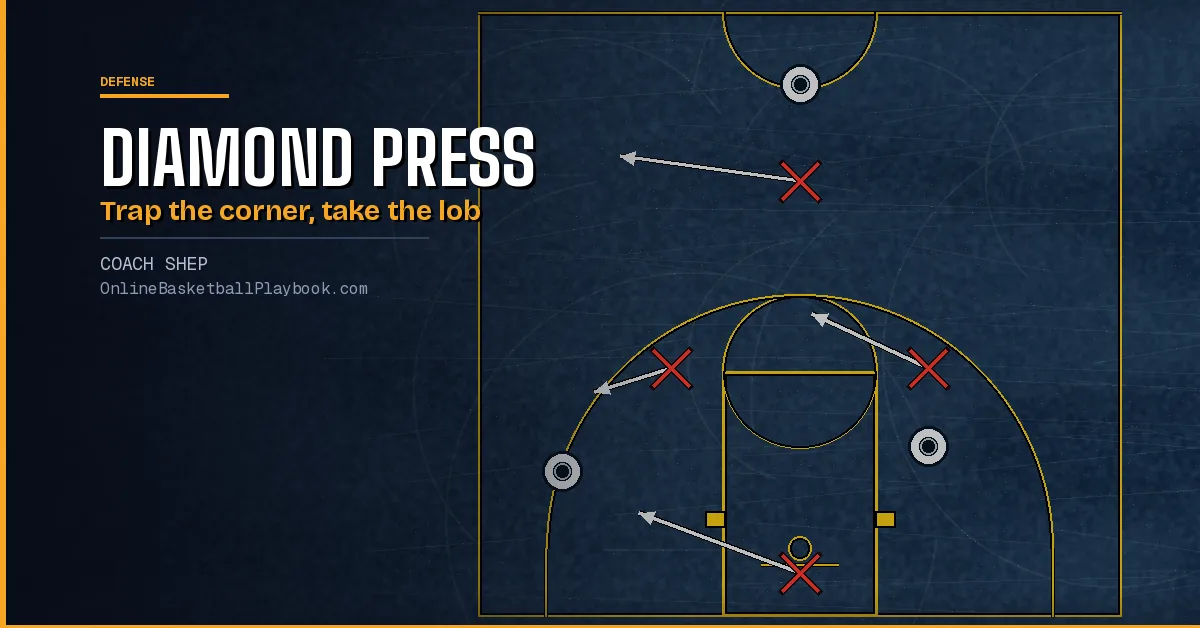
1-2-1-1 Diamond Press Basketball: Roles, Traps and Install
How to run the diamond press in basketball: who plays each role, how to trap the corner, what to do on the reversal and the lob, and how to install it step by step.
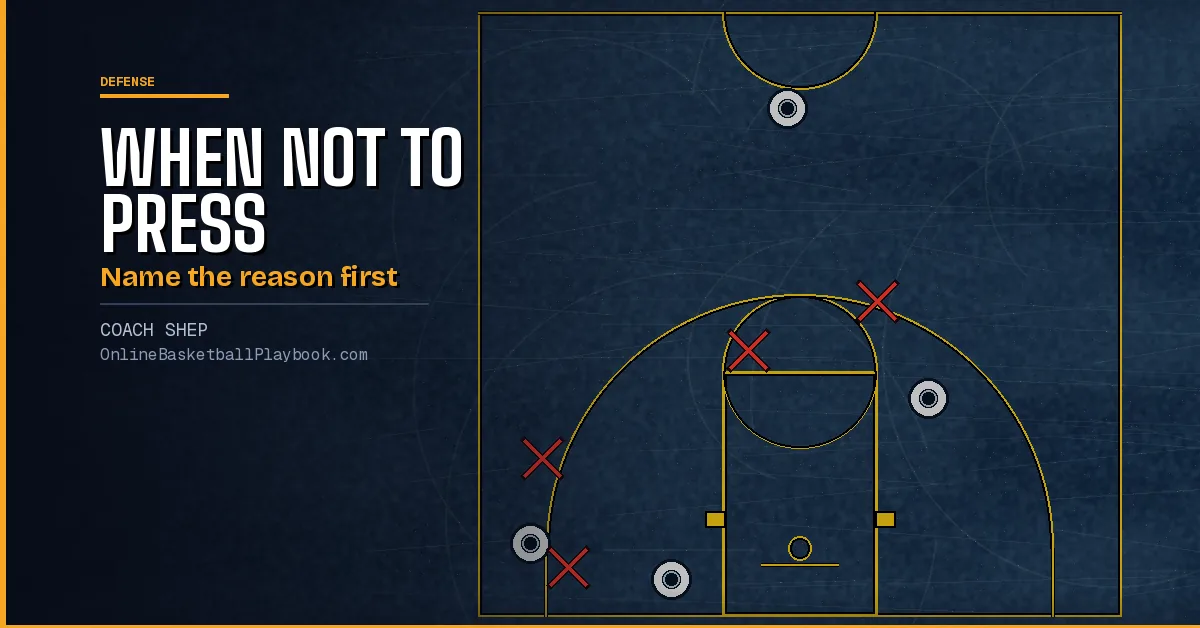
When Not to Press: Bad Reasons, Thin Benches, Poised Guards
When not to press in basketball: the bad reasons, the roster you need first, the opponents who beat it, the moments to drop it and the youth limits.
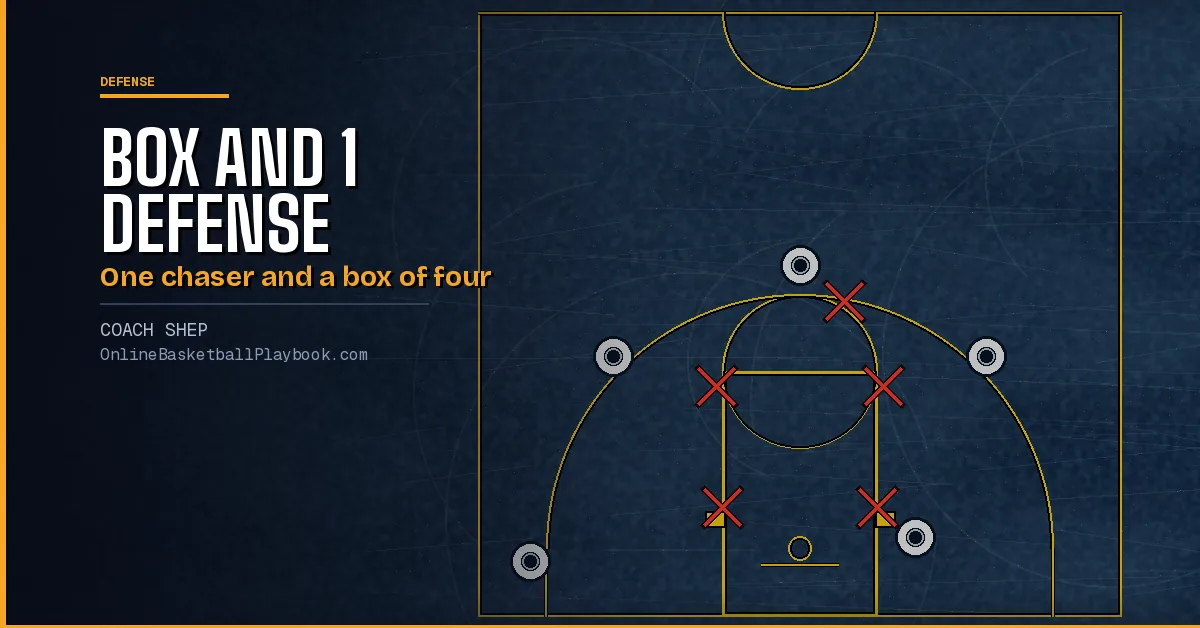
Box and 1 Defense: How It Works and How to Beat It
What the box and 1 defense is, how the chaser and the box play, when coaches call it, where it leaks, and how an offense beats it with a decoy star.