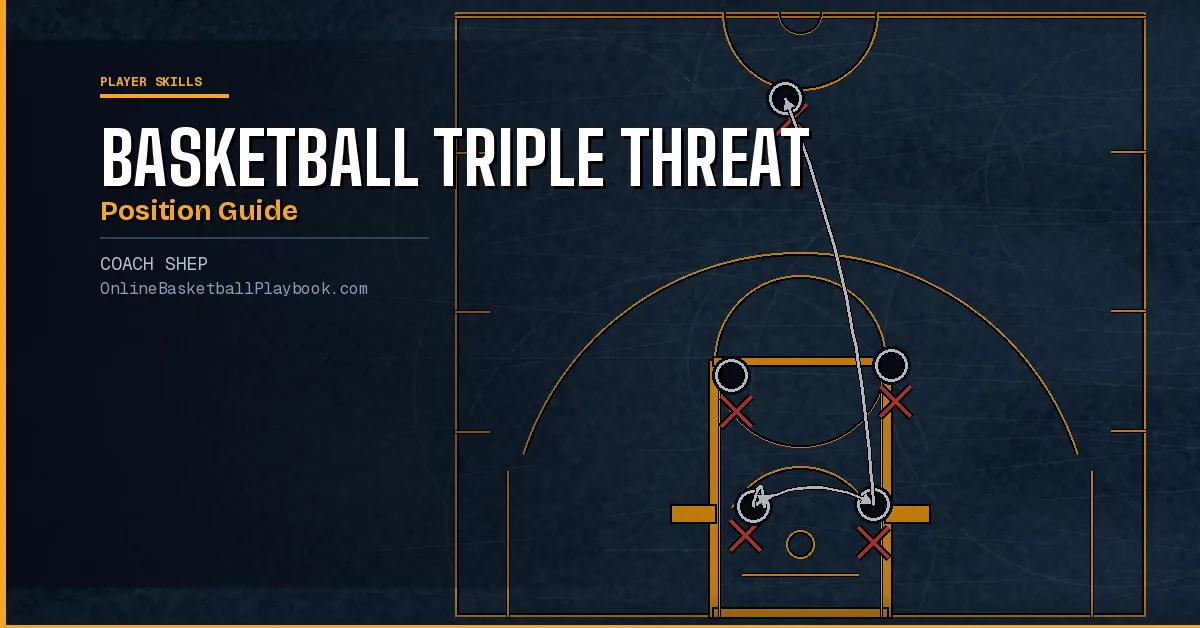
The triple threat position is the foundation of every offensive action in basketball. From here, a player can shoot, drive, or pass, and a defender cannot stop all three. Learn the stance, footwork, and reads that make it work.
What Is the Triple Threat Position?
The triple threat is the body position a player assumes after catching the ball before making any decision. The name comes from the three options it keeps alive simultaneously: shoot, pass, or drive. A defender who cannot eliminate at least two of those options is at a serious disadvantage, because a hesitant defender is a beaten defender.
Every other skill in your offensive toolkit (pick-and-roll reads, post entries, spot-up shooting) connects back to this moment. When a player receives a pass and immediately becomes a threat rather than a statue, the offense flows. When they catch and stand straight up with the ball at their hip, the offense stalls. The triple threat is that foundational.
Think about it from the defender's perspective. If you know a player can only shoot (they never drive, never pass), you can play them straight up, almost daring them. But when every player who catches the ball is in a ready stance, balanced, ball protected, eyes up? Now you have to guard all three options on every single possession. That stress compounds over 32 minutes. It creates breakdowns. It creates open shots.
Understanding the triple threat is also the first step toward developing true basketball IQ. Players who understand why this position matters start making better decisions off it. They are not just learning a stance, they are learning how to read and attack a defense.
Stance and Setup
The physical position of the triple threat is not complicated, but the details matter. Get them wrong and the position loses its effectiveness. A defender will read your intentions before you move.
Feet
Feet should be shoulder-width apart with a slight stagger, your shooting-side foot (or dominant-side foot) slightly back. This creates the natural launch point for both the drive and the shot. Weight is on the balls of your feet, not your heels. Never stand flat-footed in triple threat. A flat-footed player is slow off the first step and telegraphs hesitation.
Knees
Knees bent, hips low. You should feel athletic, like you could explode in any direction in the next half second. Coaches often use the cue "sit into it," meaning drop your center of gravity without bending forward at the waist. Your chest stays up. Your eyes are on the defense, not the floor.
Ball Position
The ball sits on your hip, below the defender's reach, protected by your body. Do not hold it high above your waist where a defender can slap or deflect it. Do not hold it at your knees where it takes too long to shoot. Hip-high on your dominant side. That is the sweet spot. One hand underneath, one hand to the side: shooting-ready but secure.
Eyes Up
This is the most overlooked element. If your eyes are down, you cannot see the defense, cannot read whether they are playing up for the shot or giving you the drive. Eyes should be level, scanning the floor in front of you. Good players develop this habit through repetition so that even during ball handling drills, they never lose their vision.
The Three Options: Shoot, Drive, Pass
Each option in the triple threat carries a specific read and a specific trigger. A player who knows what they are looking for can execute faster, because they are not deciding on the fly, they are reacting to what the defense gives them.
Option 1: Shoot
The shot is available when a defender gives cushion, when they are sagging off to take away the drive or helping off you to stop a teammate. If there is space between you and your defender and you are within your range, the shot is the right call. The key is shot-readiness: the ball is already in position, your feet are staggered correctly, and you can go directly into your shooting motion without a wasted setup step. Review proper mechanics in this guide on basketball shooting form.
Option 2: Drive
The drive is available when a defender is close and playing up for the shot. They have committed to stopping the pull-up, which means they are weight-forward, and a hard first step past them gets you to the lane. The dominant-side drive off your stagger foot is the most natural, but developing a counter drive to the weak side makes you nearly unguardable. The first step must be explosive and low, not a lunge upward.
Option 3: Pass
The pass opens when the defense collapses on you, either they double or a help defender rotates. Reading the pass out of triple threat requires seeing the floor, knowing where your teammates are before you catch the ball. A skip pass to a shooter on the weak side, a dump-off to a cutter, a quick reversal to reset the offense, all of these start from this moment of receiving the ball in triple threat and scanning for what the defense is giving up.
Footwork, Jabs, and Fakes
The triple threat becomes a weapon when you combine it with purposeful footwork. A static stance is readable. Add movement (jabs, shot fakes, rocker steps) and you force the defender to react, which creates the advantage you exploit.
The Jab Step
The jab step is a short, sharp step toward the defender with your non-pivot foot, not a full step, but enough to make the defender flinch or shift their weight. It tests their response. If they lunge back on your jab, pull back and shoot the pull-up. If they hold position, use the jab to set up a sweep-through drive. The jab should be low and quick, not a wide sweep that takes you off balance. This is the core of basketball footwork drills at every level.
The Shot Fake
A convincing shot fake starts from your actual shooting motion (same lift, same eyes, same ball path). A lazy fake with just the arms and no leg bend fools no one. When the defender bites and goes up, you go by them with one dribble. The key is patience: players often fake and then move too quickly before the defender is actually in the air. Let the fake register.
The Rocker Step
The rocker step combines the jab and the shot fake in sequence. Jab toward the lane, read the defender's reaction, rock back into your shot fake, then drive when they commit. It is a rhythm move. It works because it mimics real game actions and forces the defender to make two consecutive correct reads. Most cannot. The rocker step is one of the most effective tools in a wing player's arsenal within a motion offense in basketball.
Pivot Options
From triple threat you can also use your pivot foot to create new driving angles without dribbling. A front pivot opens a direct drive lane. A reverse pivot turns your back momentarily to the defender, protecting the ball, before swinging into a drive or a pass. These are live-ball pivots (you have not dribbled yet), so they carry no violation risk and give you full court options.
Reading the Defender
The triple threat is only as good as the reads coming out of it. A player who knows the stance but cannot read their defender is still guessable. The reads are what separate players who look good in drills from players who produce in games.
Watch the Defender's Weight
Before you make a move, observe where the defender's weight is. If they are on their heels (scared of the drive), the shot is there. If they are up on their toes, leaning forward to contest the shot, one hard dribble gets you past them. This read happens in less than a second but it determines what decision you make.
Watch the Defender's Eyes
Experienced defenders will try to hide their weight shift. But their eyes betray them. If a defender is peeking at the ball, trying to steal, the drive is wide open and you may get to the free throw line. If they are locked on your hips (proper defensive position), you will need to use fakes to get them moving before making your play.
Watch the Help Defense
Part of the read involves knowing where the help is coming from. If you drive and there is a help defender standing in the lane, driving without a plan gets you a charge or a tough finish. Knowing the help position tells you whether to pull up for the mid-range, kick to the corner, or attack the rim and draw the foul. This connects to understanding help defense principles: Knowing what defenders are taught helps you predict their rotations.
Drills to Build Triple Threat Habits
You cannot think your way through the triple threat in a game. The stance and reads have to become automatic. That requires purposeful repetition in practice, not just standing in the stance, but making decisions out of it at game speed.
Catch-and-Read Drill
A passer at the top of the key fires the ball to a wing. The wing catches into triple threat, reads a passive defender, and attacks based on what the defender gives (shoot if they sag, drive if they close, pass if they help). Run at half speed first to ingrain the reads, then at game speed. The goal is a consistent catching motion and immediate recognition.
One-Dribble Pullup Series
Player catches on the wing in triple threat. One dribble hard to the elbow, stop, shoot the pull-up. Then one dribble the other direction. Then a jab-step to set up the pull-up without the drive. This builds the connection between the stance and the most common game actions that follow it. Keep the reps tight and purposeful.
Jab-Series Progression
Run the full jab series: jab and shoot, jab and drive, jab and crossover drive. A coach or passer calls the option as the player receives the ball, or a passive defender shows one option to remove. This forces real reads under mild pressure. Increase the defender's activity over time until the player is making reads against a live closeout.
Two-Ball Reads
Advanced players can add two-ball dribbling to triple threat warmup circuits, developing the handle required to make quick live-ball moves. The connection to handle work is direct: the better a player handles the ball under pressure, the more freely they can read from triple threat without worrying about their dribble.
Build triple threat reads into your basketball practice plan at least three times per week, not as a standalone drill, but attached to every wing catch action in your offense. Make the position automatic before layering in the reads.
Coaching Tips and Common Mistakes
Coaches at every level can identify the triple threat quickly in warm-ups and early drills. The players who do it correctly without being reminded are the players who have internalized the position. Here is what to look for and what to correct.
Most Common Mistakes
Standing straight up after catching the ball is the most common error, especially in youth basketball. Players go from the catch directly into dribbling, which is a wasted possession if no read has been made. The habit to build is: catch, establish the stance, read, then act.
Holding the ball too high is the second most common mistake. Players who hold the ball at chest level are easy to deflect and telegraph their shot before they start their motion. Ball on the hip, protected and ready.
Dribbling before reading is the third mistake. This is sometimes called "wasting the dribble." Once you dribble, you lose the pass-drive-shoot triangle. The pause in triple threat (even a half second) is where the read happens. Players who skip it are just reacting, not playing.
Coaching Cues That Work
Simple, repeatable cues outperform long explanations. "Catch low": players know to land in the stance, not stand up into it. "Ball on the hip" (instant reminder of position). "Eyes up, what do you see?" forces the read before movement. Use these cues consistently across your coaching staff so players hear the same language from everyone.
Connecting to Team Concepts
The triple threat works best when players understand the offensive system around it. In a 5-out motion offense, every player catching the ball is a threat on the perimeter, which means the triple threat position is not just a skill. It is the foundation the entire offense is built on. Players who understand the system make better reads because they know where teammates will be when they attack.
- Catch into the stance every time. Do not stand up and then sit back down into triple threat.
- Ball protected on the hip, below the defender's reach, one hand under and one hand to the side.
- Knees bent, weight on the balls of your feet, ready to explode in any direction.
- Eyes up before you move. Read the defender's weight, feet, and eyes before committing to an action.
- Use jab steps to test the defender, not to commit to a direction. The jab creates the read.
- Do not dribble until you have made a decision. The dribble is used to execute a read, not to replace one.
- Connect every triple threat action to the offense. Know where your teammates are before you receive the pass.
Get free play diagrams, drills, and coaching guides delivered weekly.
Draw this play free in the play drawer →
Membership: the full library, playbook packs, and Pro drawing tools →
Keep Building
Related breakdowns
Power Forward Position in Basketball: Complete Guide
The power forward has split into two distinct tracks: the traditional interior scorer and the modern stretch four. Here's the physical tools, key skills, and development priorities for the position.
Small Forward Position in Basketball: Complete Guide
The small forward blends guard skills with forward size and usually draws the toughest defensive assignment on the floor. Here's what the role actually requires and how positionless basketball has reshaped it.
Center Position in Basketball: Complete Guide
The center anchors the paint on both ends, but the position has evolved with the rise of the stretch five. Here's the physical tools, core skills, and pick-and-roll coverages every center needs.