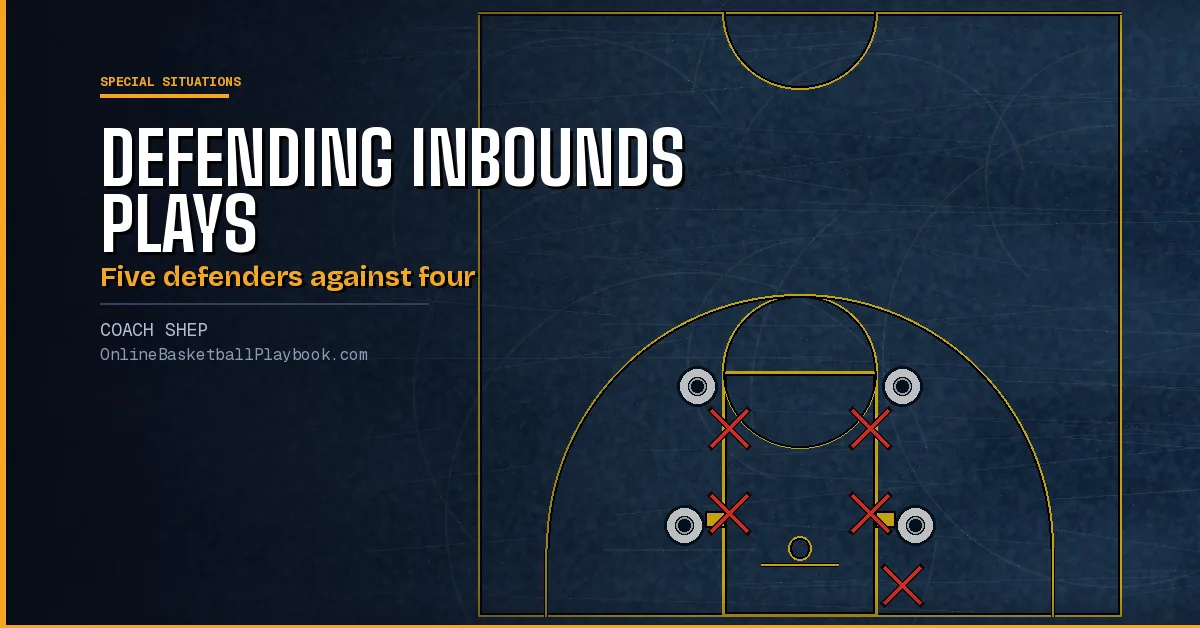
To defend inbounds plays, start with the numbers. The thrower is stuck behind the line with a five-second count, so a dead-ball throw-in is the one moment in a game when the defense plays five against four. Yet many coaches drill their own out-of-bounds plays and spend little time defending an opponent's, so the prepared offense gets easy baskets. This page covers how to defend inbounds plays from the baseline and the sideline: the base rules before the ball is live, what the inbounder's defender does, the four baseline options, the mirror defense, zone and combination looks, the sideline answers, the full-court inbound after a score, the late-game calls and how to practice it, with each version side by side. It sits under basketball inbound plays in the special situations section.
How to Defend Inbounds Plays: The 5 on 4 Edge
There are two reasons plain half-court man defense does not carry over to a baseline inbound. The ball starts behind the defense instead of in front of it. And the cuts go straight at the rim instead of away from it, so there is no room for a mistake. Most baseline plays are built on screens that ordinary screen-defense technique can break up.
The payoff is real points. Taking away an opponent's baseline sets can be worth 6 to 8 points a game. By one estimate out-of-bounds plays are about 10 percent of a team's offense and about 20 percent of each game.
The count matters, and it differs by level. NCAA men and NCAA women give the thrower five seconds from the start of the throw-in to release the ball, the NBA five seconds from when he controls it, and FIBA five seconds to release it. For high school, check your state association rulebook. In NCAA men's and women's play the three-second lane rule is not in effect while a team holds the ball for a throw-in.
Base Rules Before the Ball Is Live
- Be set and matched up. Alert cutters go straight to the rim off any defender who is out of position or has his back turned when the official puts the ball in play. Gary Williams writes "match up before you press" for the inbound after a free throw.
- Sit in a stance with an arm bar. Bob McKillop's defenders off the ball wait in a stance with an arm bar, ready to blow the play up. His note on the throw-in is short: the defense wants the first pass to be bad, the offense wants it good.
- Build from the inside out. Bruce Pearl's under-the-basket defense exists so the ball cannot go inside. Its five rules: the ball-side block may not duck in, no clean screens, everyone stays inside his man, the defender on the ball keeps his hands up, and defenders come together on screens.
- Make them throw it out top. The base man-to-man goal is making the offense inbound to the top of the key.
- Body up and jump the first pass. The list: body up and stay with your man, switch all screens, and jump the first pass.
Guarding the Inbounder: Every Version
The biggest split is what the defender on the ball does. Each row is a real option.
| Approach | What the inbounder's defender does | Situation |
|---|---|---|
| 1. Leave him | Sean Miller does not guard the inbounder. That defender helps on cutters into the scoring area, then sprints back to the passer with high hands. | Under the basket |
| 2. Help the first cut | The pack line defender helps toward the first cut and yells "ball in" when the ball is in. | Under the basket |
| 3. One-man zone | He plays a one-man zone in the paint until the ball goes outside. | Under the basket |
| 4. Lane line | He sits on the lane line near the rim while everyone switches. | Under the basket |
| 5. Sag, then smother | He sags off for a three count, then he smothers the inbounder with both hands up. | Baseline and sideline |
| 6. Pressure the pass | One 1-3-1 baseline zone puts its longest defender on the ball going for a deflection on every pass. | Baseline |
| 7. Attack the right hand | The 4 man goes at the inbounder after a score: body on the ball, hands up, attacking the right hand. | Full court |
| 8. Steer him | The front defender sets at 45 degrees, never squared up, to steer the pass to the near sideline. | Full court |
| 9. Play long | Vance Walberg's big plays long and opposite the ball to bait the long pass, and moves when the inbounder's arm cocks back. | Full court |
| 10. Drop as a safety | One deny press drops him to at least half court against the long pass. Another plays him in centerfield, reading the inbounder's eyes. | Full court |
Four Baseline Options
There are four ways to defend a baseline inbound, and all four open the same way. Before the official hands over the ball, the four defenders off the ball sag to protect the rim against a quick lob or cut, and the inbounder's defender plays off and reads the pass for a three count. After the count he releases and smothers the inbounder with both hands up. A team can teach that one start and add the endings to it.

Jam
The site rates Jam its most effective baseline option. Every cutter gets hard, in-your-face denial, nobody switches, and the aim is a five-second call or an offensive foul.

Jump Switch
Built for late-clock baseline inbounds with under five seconds left. One pair jump switches the screen along the baseline and another pair the screen at the elbows, and the newly switched defenders step over at once to take away the screeners. Once the ball is caught on the wing, the defense denies the return pass to the inbounder, pushes the ball toward the baseline and fronts the low post. A team that will not attack the passing lanes after the switch should not switch at all.

Trap
The same opening as the Jump Switch, but when the inbound pass is caught, the defender who guarded the inbounder follows it and locks up a hard double team while the other three take help spots in a triangle. On the pass out of the trap the nearest defender closes out, one rotates across to deny the post, one denies the reversal, and the two trappers drop to help. The site says it pays most against a play that needs more than one pass.

Combination
A chaser face-guards the best scorer chest to chest before the ball is live while the other four play a box zone with arms out. Against a two-guard front it is a box and one, against a one-guard front a diamond and one. The case for it is surprise: an offense ready only for man or zone can lose the ball or burn a timeout. Box out every shot. The half-court rules for the chaser and the box are on box and 1 defense.
Get the next coaching guide in your inbox
One email when a new guide or diagram set goes up. Free.
Mirror and Stay Home
The under-the-basket defense can instead be built around the four men off the ball.

Mirror
Sean Miller leaves the inbounder alone. His defender mirrors the ball and helps on cutters into the scoring area. Shooters and anyone near the rim are guarded with an arm bar so the defender can trail screens, while non-shooters get space so their defender can beat back screens on the ball side. A back screen between the 1 and the 3 toward the rim is an automatic switch.
Four stay home
The pack line version keeps four defenders on their matchups with no switching, helping or hedging, while the inbounder's defender helps toward the first cut. When the ball comes in, the team goes back to its pack.
Zone and Combination Looks
Three zone answers show up for the baseline.
- A 1-3-1 built for the inbound. Vanderbilt is credited with a 1-3-1 used only on baseline inbounds. It packs the paint, makes the inbounder afraid to throw it in and baits a lob toward half court. Any deep pass toward the backcourt counts as a win. The five jobs are on 1-3-1 baseline out of bounds defense.
- A 2-3 for the inbound. Sit in a 2-3 zone for the inbound and convert back to man once the ball is in.
- A combination. Box and one, diamond and one, or triangle and two, all used as inbound options.
Do not zone by habit: a zone still has to adjust to a ball behind the basket, and it is exposed to the screen-and-roll and the overloads most inbounds plays use. The offensive side is on inbound plays against a zone.
Sideline Out of Bounds
Sideline throw-ins carry the same five-on-four edge and usually get even less practice. Gary Williams notes that most teams rehearse their press setups on the baseline and not on the sideline. There are four sideline answers:
- Invert and jump switch. Two pairs invert and switch the down screens on contact while a third defender smothers the inbounder. Then the defender on the ball pushes the receiver to a sideline spot.
- Jam. Every receiver is jammed the instant the official hands over the ball, and a defender takes a charge instead of switching.
- The half-court X trap. A 1-2-2 shape traps the receiver on the catch and reads the pass out.
- Combinations. Deny before the throw-in, then become the named zone the instant the ball is live.
Intercepting a late sideline inbound is one of the really big plays, because it usually becomes an uncontested layup. Side-specific notes are on how to defend sideline out of bounds and how to defend baseline out of bounds, and the sets you are defending on sideline out of bounds plays and baseline out of bounds plays.
The Full-Court Inbound After a Score
Many presses are really inbounds defenses, because their first job is the throw-in after a score. The versions:
- Funnel the catch to the corner. One 1-2-1-1 always denies the inbound pass to the middle and forces the ball to the corner. Vance Walberg side-fronts receivers from the inside out to force the catch in the corner and onto the weak hand.
- Deny by how many come up. Walberg keys on the offense's alignment: against one up, full denial. Against two up, force it to the corner. Against three up, keep it out of the middle. Against four up, two defenders take two players and one takes the long pass.
- Pre-trap the point guard. One pressure system doubles the primary ball handler before the inbound while the other three deny. Its most aggressive look fronts both guards so the inbounder must throw over the top.
- Disguise it. One pressure system's hard trap and fake trap look the same until the catch. One press version starts every made basket in one shape and changes only the pickup by signal.
When to press off the inbound differs too. Gary Williams calls the moment after a free throw a great time to press and keeps his 5 back on every free throw unless he is the shooter. The press structures themselves are on full court press defense, and the trap on the catch is on trap defense basketball.
Late-Game Inbounds Defense
The late-game calls get made before the timeout ends. Erik Spoelstra said he had lost every possible way up 3, so his answer was to foul, with Dwyane Wade the only player allowed to do it. Larry Brown traps early against a team holding for one shot, worries about the second shot when defending a last play, and wants "no foul" yelled late. Settle switch-everything or stay-on-your-man for a short-clock, up-two possession before it happens. Hubie Brown says you can take away only two of three passing angles on a late inbound, so his teams take away the same two every time and live with the third. Consider switching every ball screen with under 8 seconds left.
The whole up 3, foul or defend decision, with every version, is on basketball clock management, and the broader late-game page is basketball late game situations.
Where Coaches Split
| Choice | The versions |
|---|---|
| Deny the first catch or concede it | Deny everything (Jam, full deny presses). Concede an outside catch and protect the rim (inbound to the top of the key, the one-man zone, the inside-out defense, the 1-3-1). Concede the catch to a chosen spot and attack it (corner funnels, the trap on the catch). Keep it from one player only (pre-trap the point guard, the chaser). Give it to them and attack the receiver (Gary Williams, against a team that likes to set up its press break). The choice is worked through on deny the inbound or concede the catch. |
| Sag first or deny first | Sag for a three count, then go. Deny from the first instant, mostly on full-court pickups. Protect the inside the whole time, with no count. |
| Switch or stay | Switch everything. Switch inside screens only. Switch one named action. Jump switch only if the team will attack the lanes after. Never switch. A staff decision for each game. |
| Man, zone or combination | Man in most base guides. A zone built for the inbound. A combination as a surprise. |
How to Practice It
- Scout every dead ball. Chart every baseline and sideline inbound an opponent runs, not only the late-game sets, to learn who the actions are for and whether the team sets up or looks to score at once.
- Run their sets, not yours. Practice against the opponent's plays, not your own, with a scout team running them.
- Deny past five. One deny-press drill has three offensive players and an inbounder, with the inbounder's defender in centerfield and the other three in full deny, and stretches the count past five seconds toward eight, scored as a game to five.
Questions Coaches Ask
How do you defend a baseline out of bounds play?
Match up before the ball is live, protect the rim, decide what the inbounder's defender does and pick one ending: Jam, Jump Switch, a trap on the catch, a combination or a zone built for the inbound.
Should you guard the inbounder?
Coaches split. Some leave him alone and use that defender to help in the lane. Others sag off for a three count and then smother him, or pressure every pass he throws.
Should you play man or zone on inbounds plays?
Most base guides play man because the matchups are set before the whistle. A 1-3-1 or a 2-3 built for the inbound is the zone answer, and zoning by habit is exposed to screens and overloads.
Should you switch screens on inbounds plays?
The versions run from switch everything to never switch. Jump switch only if the team will attack the passing lanes afterward.
How long does the inbounder have?
Five seconds in NCAA men's and women's play, the NBA and FIBA, each counted from a slightly different start. For high school, check your state association rulebook.
Want the printable playbook packs?
OBP Pro members get the premium playbook packs: the zone attack, out of bounds and practice plan PDFs, plus each new pack as it is finished. The membership page lists what is in each one. Or draw your own version free in PlayDraw.
See what OBP Pro includesMore Core Coaching Guides
- Trap Defense Basketball: When, Where and Who to Trap
- Three Quarter Court Press: Pickup, Traps and Rotations
- Transition Defense Basketball: Get Back, Stop the Ball, Match Up
- Basketball Clock Management: Foul Up 3, Two for One, Last Shot
Back to Basketball Inbound Plays and every Special Situations page.
Keep Building
Related breakdowns
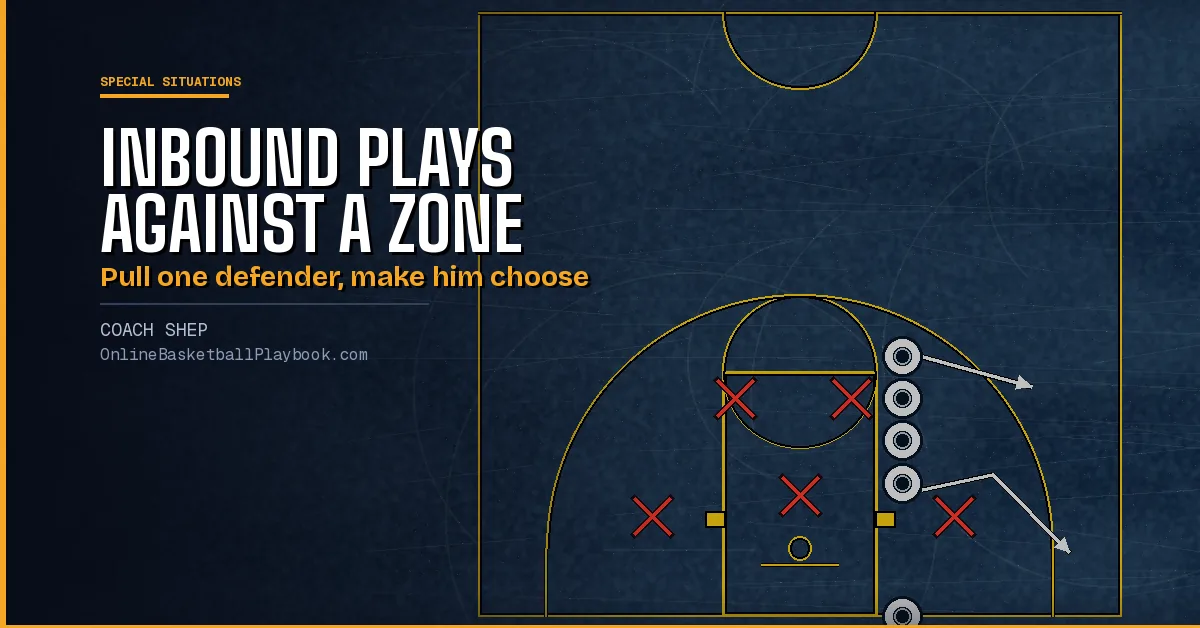
Inbound Plays Against a Zone: Baseline and Sideline Sets
Inbound plays against a zone from the baseline and sideline: the read, the stack near the elbow, short-corner pulls, split cuts, two-part sets and sideline answers.
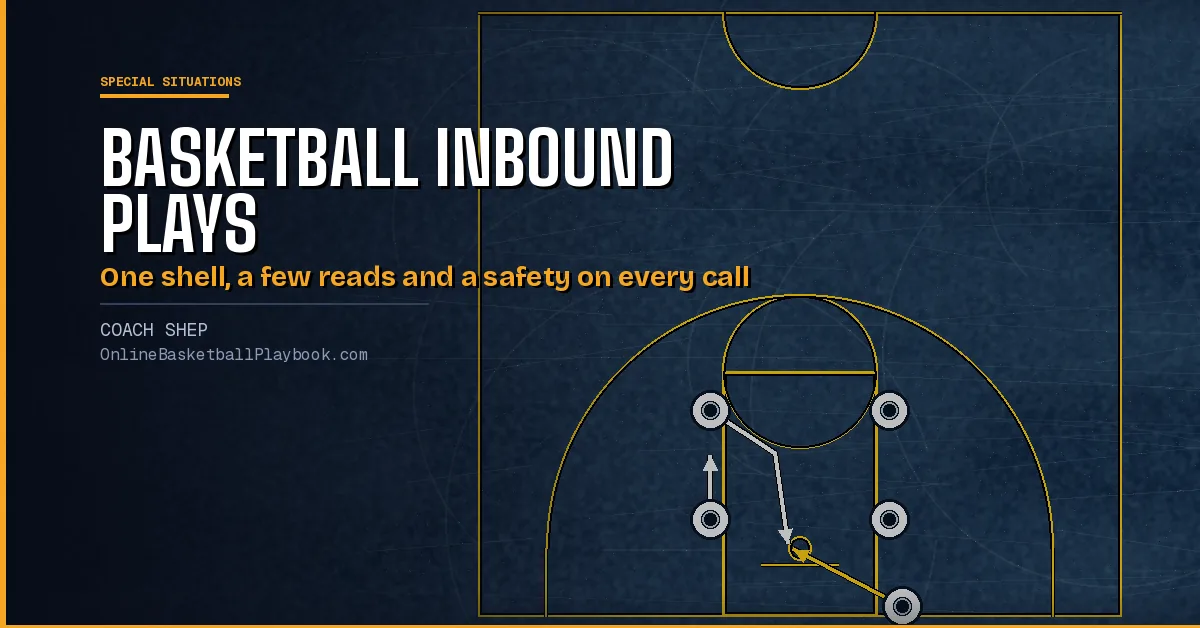
Basketball Inbound Plays: Baseline and Sideline Sets to Run
Basketball inbound plays for baseline and sideline throw-ins, with six drawn sets, simple plays for youth teams, zone looks and where coaches disagree.
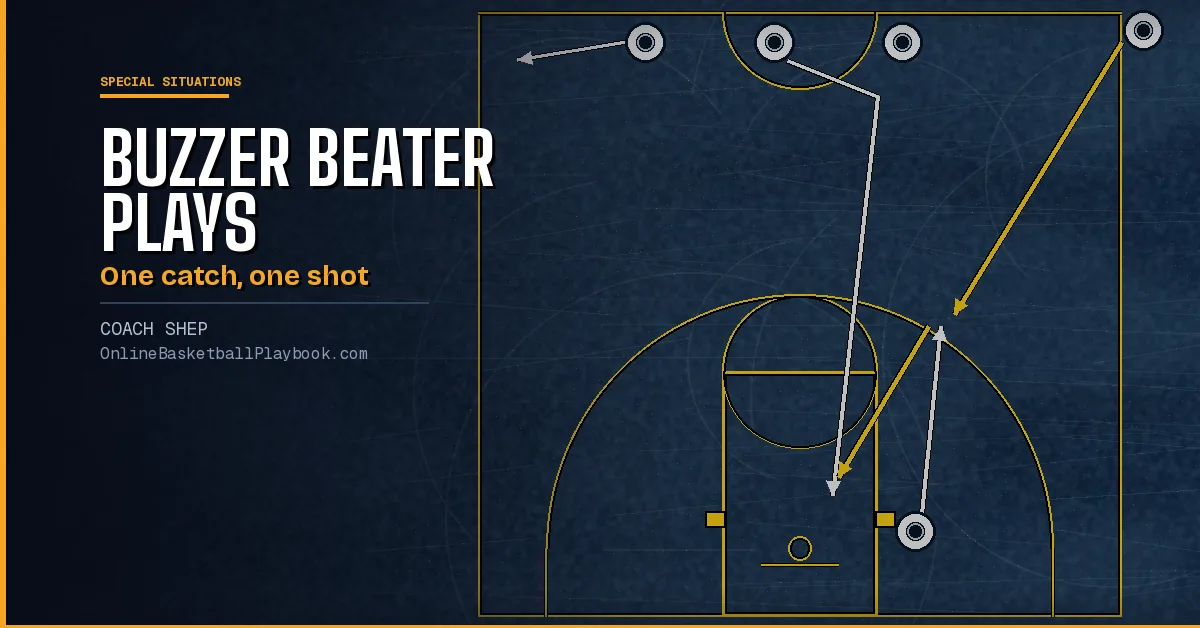
Buzzer Beater Plays From Half Court: Sideline and Baseline
Buzzer beater plays from half court for one catch and one shot: sideline sets at the half-court line, baseline lobs for one second, the reads and the rules.