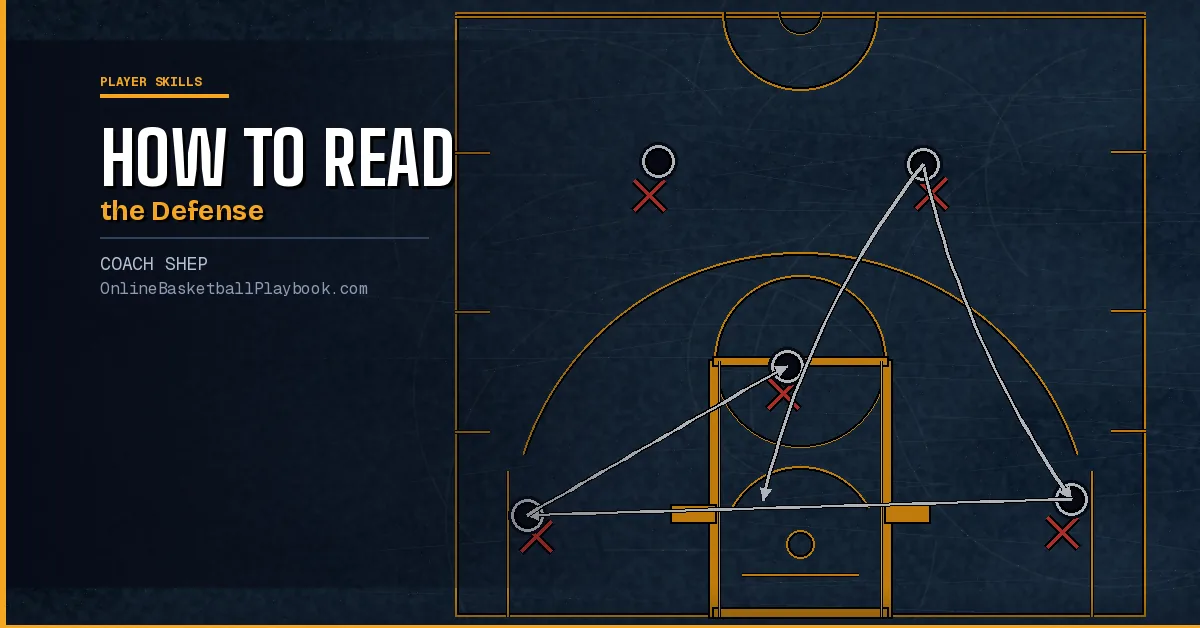
Reading the defense is the skill that separates smart players from physical ones. Before any dribble or cut, players must identify the coverage, locate gaps, and decide on the right action, all in under a second.
Why Reading the Defense Matters
Basketball rewards intelligence as much as athleticism. Two teams can have nearly identical physical talent, and the one that reads situations faster and times actions more accurately wins more games. This is the core insight behind Basketball IQ development: The idea that knowing why and when to use a skill matters as much as knowing how to execute it.
A player who can catch the ball, immediately identify whether the defense is in man or zone, spot the defensive player cheating off a corner shooter, and fire an on-time pass has a competitive advantage that no amount of conditioning can replicate. Reading the defense is not a talent you are born with. It is taught, trained, and sharpened through deliberate repetition and a clear system of cues.
The problem with most player development programs is that they teach the HOW (the footwork, the shot mechanics, the dribble moves) but leave out the WHY and WHEN. A player drilled exclusively on a step-back jumper knows the motion but has no framework for recognizing when the coverage creates the space for it. Teaching reads closes that gap. It turns isolated skills into deployable weapons.
Coaches who want to build a truly intelligent offense need to prioritize this. Whether you run a motion offense or a structured system, every action in the offense depends on players making correct real-time reads. The plays are just the starting point. The reads are what make them work.
Identify the Coverage Before You Touch the Ball
The first read happens before the ball arrives. An intelligent offensive player is already scanning the defense as the play develops, watching for alignment, depth, and stance cues that tell them what coverage they are operating against.
Man-to-Man Reads
Against man-to-man defense, the first cue is where the defenders are looking. A defender locked onto their assignment with their back to the ball is playing tight man. A defender with a foot in the lane, head on a swivel, watching both ball and man is playing help-side. The offensive player needs to know which one they are getting because the attack is different in each case.
Against tight man, the action of choice is usually a back-cut, a pin screen, or dribble penetration that forces the defender to navigate traffic. Against a defender cheating toward help position, the read flips. The offensive player looks to catch and attack the space the defender vacated, often with a quick face cut or a catch-and-shoot.
Zone Reads
Zone defenses announce themselves through alignment. The classic 2-3 zone shows two guards in the slots and three defenders along the baseline, a formation immediately visible to any prepared offensive player. The reads against a 2-3 center on seams, attack from the short corners, skip passes to the weakside wing to move the zone, and high-low combinations that stretch the bottom three defenders beyond their range.
The trap players fall into against zone is forcing the same action they would use against man coverage. Zone gaps are specific. The seam between the top guard and the wing defender, the space in front of the baseline defenders, the lane entry when both top guards follow ball movement. These are the attack points, and they only open if the offensive player first identifies the zone correctly and then attacks the right gap.
Press and Trap Reads
Full-court pressure adds another layer. A well-executed press break is built on reads: the inbounder reading whether the trapper is playing the line or giving baseline; the outlet receiver reading the second defender's angle; the middle man reading whether to catch and advance or relay the ball wide. Players who panic against pressure have not been trained on what to look for. Players who break it consistently have.
Read the Help Defense and Rotation
Most defenses rely on help-and-recover principles. Understanding those principles lets the offense attack what happens after the initial coverage breaks down.
When a ball-handler drives middle, the nearest help defender must step up. That rotation leaves someone open. The read is identifying who rotates and where they leave from. A guard who drives baseline and draws the corner defender creates a kick-out opportunity to the corner. A post player who catches in the mid-post and faces up forces the weakside forward to help, opening a dump-down to the opposite post or a skip to the weakside wing.
Understanding help defense principles from the offensive side gives players a map of where the defense has to be and, more usefully, where it cannot be. The shell drill teaches defenders to maintain proper positioning and rotate correctly. That same drill, viewed from the offensive perspective, is a diagram of gaps. When the defense is in rotation, one of those gaps is always open. The offensive player's job is to find it before the recovery closes.
The Read After the Drive
Drive-and-react is one of the highest-leverage skill sets in basketball. A player who can create off the dribble and then read the defense response (kick out, pull up, dump to the roll man, or continue to the rim) is functionally running the offense on every possession. The reads chain together: beat the first line of defense, read the help, read the recovery. Each decision is a response to what the defense gives up.
Training this requires reps at game speed with live defenders, not just walk-through instruction. Players need to feel the defensive pressure and make the pass before the help arrives. Scripted drills set the foundation; competitive small-sided games build the timing.
Off-Ball Reads: Cuts, Spacing, and Movement
The most overlooked reads in basketball are made by players without the ball. Off-ball IQ (knowing when to cut, when to hold spacing, when to set a screen, and when to relocate) determines how much pressure any offense can generate.
Reading Your Defender's Position
Every off-ball player should be tracking two things: where the ball is and where their defender is. If the defender is between the ball and the player (denying), a back-cut to the basket is available. If the defender is sagging toward the lane to help, the player should step up to the three-point line and signal for the ball. If the defender is helping on a drive, the player should hold the spot and be ready to shoot the moment the kick-out arrives.
None of these reads require the ball. They require awareness, a practiced habit of checking position before deciding to move or stay. In a motion offense, this awareness is what makes the offense flow. Without it, players bunch, cuts get clogged, and the spacing the offense depends on collapses.
Screen-and-Roll Reads
The pick-and-roll is one of the most widely used actions in basketball at every level. Defending the pick and roll is challenging precisely because it creates two simultaneous reads for the offense: the ball-handler reading the coverage (hedge, drop, switch, blitz) and the screener reading the defensive response to roll, pop, or slip.
A ball-handler who ignores the defensive alignment and runs the action the same way every time is easy to defend. A ball-handler who reads whether the big is hedging or dropping and adjusts accordingly (turning the corner on a drop, pulling up on a hedge, throwing the lob on a switch) becomes a genuine problem for the defense.
Reading Defenses in Special Situations
End-of-game situations, inbound plays, and free-throw alignment sequences each carry their own defensive reads. Teams that prepare these scenarios have a significant edge over teams that improvise under pressure.
On inbound plays, the defense's alignment tells the inbounder what is available before the play begins. A defense in man on an under-the-basket inbound is vulnerable to a specific cut based on where each defender is standing. A zone alignment changes everything. Cuts must hit seams, not create contact. Reading the defense before calling the play, or signaling the right variation, is what separates well-prepared teams from ones that run scripted plays blindly.
Free-throw alignment is another area where reads matter. The defensive team has rules about who boxes out whom and how lane violations are enforced. The offensive team should know which gaps in the lane present live-ball opportunities on a miss. Transition reads begin the moment the shot is released, with offensive rebounders reading the blocking-out angles, guards reading whether to sprint ahead or trail for a potential outlet into early offense.
Beating pressure requires the full press-break read sequence described earlier, but also the ability to read whether the defense is in a full-court trap, a three-quarter press, or a half-court trap disguised as press. Each has different attack points, and a player who misidentifies the coverage will execute the wrong action at the wrong time.
How to Teach Defensive Reads in Practice
Defensive reads are not taught through film alone, though film is valuable. They are built through deliberate practice structures that force players to make real decisions under realistic defensive pressure.
The shell drill is the foundational tool. Run from the offensive side: players identify their spacing position relative to the ball, read their defender's position, and respond accordingly. The shell drill becomes a read-training exercise rather than just a defensive positioning drill. This dual-purpose approach makes better defenders and smarter offensive players simultaneously.
Small-sided games (three-on-three, four-on-four half court) compress decision-making and force reads on every possession. Players cannot hide in a five-on-five. They touch the ball more, face more reads per minute, and get corrected in a context closer to game conditions. A well-structured basketball practice plan builds in these competitive environments rather than relying exclusively on scripted repetition.
Verbal confirmation is a powerful teaching tool. Stop play and ask the player: what did you see? What was your read? What should you have done? This metacognitive layer, teaching players to articulate their decision-making, accelerates learning. Players who can explain their reads understand them at a deeper level than players who only replicate them by feel.
Film use is most effective when it is specific and attached to a teaching point. Showing a player the exact moment their defender cheated off them, the gap that opened, and the pass that went somewhere else creates a mental image they can reference in the next live rep. General film sessions rarely change behavior. Targeted clips attached to individual reads do.
For younger players, simplify the read structure. Start with one cue per situation. Against man defense: check whether your defender is above or below you. Above = cut backdoor. Below = cut to the ball. One read, practiced until it is automatic, then layer the next read on top. Trying to teach too many reads simultaneously produces paralysis rather than intelligence.
During three-on-three drills, require players to call out the coverage before catching the ball. Verbal identification locks in the read and trains the habit of scanning before receiving, a prerequisite for good decision-making in live game situations.
- Before catching, identify: man or zone, help position of nearest defender, and where the gap is.
- Against tight man-to-man, look for back-cuts when the defender turns their head toward the ball.
- Against zone, attack seams and use skip passes to move the defense further than it can recover.
- On dribble penetration, read the first help defender. Kick out to whoever they leave open.
- Off-ball: if your defender is denying, back-cut; if sagging to help, step up and call for the ball.
- In pick-and-roll, the ball-handler reads hedge vs. drop first, then decides to turn the corner or pull up.
- In special situations, identify the defensive alignment before the play starts, not after the whistle blows.
Get free play diagrams, drills, and coaching guides delivered weekly.
Draw this play free in the play drawer →
Membership: the full library, playbook packs, and Pro drawing tools →
Keep Building
Related breakdowns
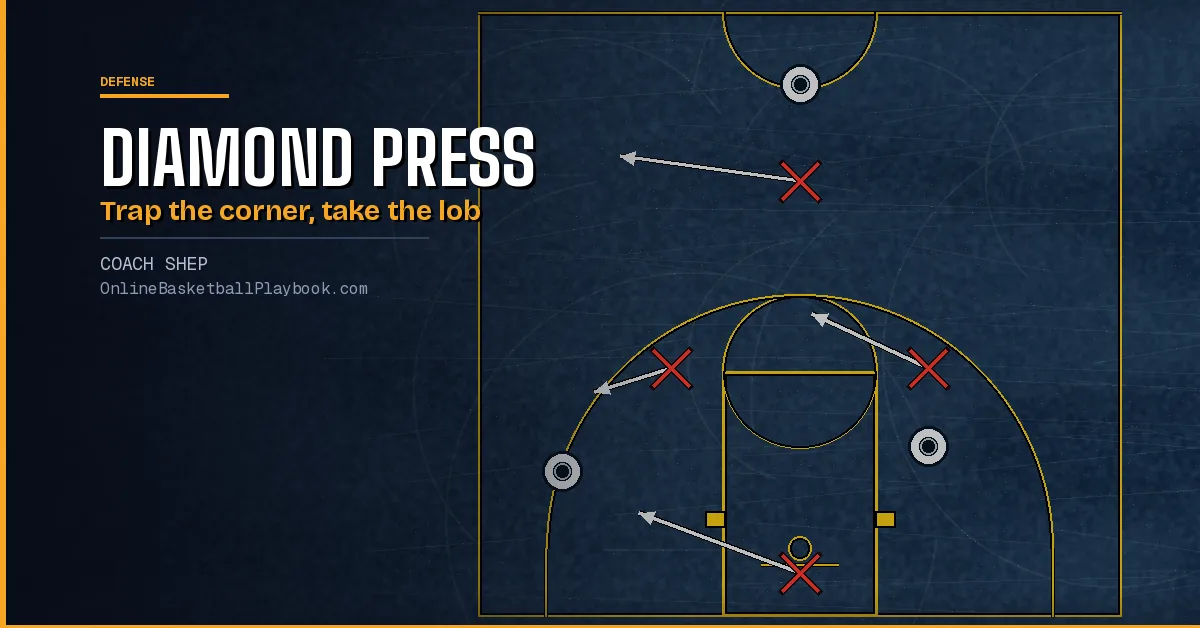
1-2-1-1 Diamond Press Basketball: Roles, Traps and Install
How to run the diamond press in basketball: who plays each role, how to trap the corner, what to do on the reversal and the lob, and how to install it step by step.
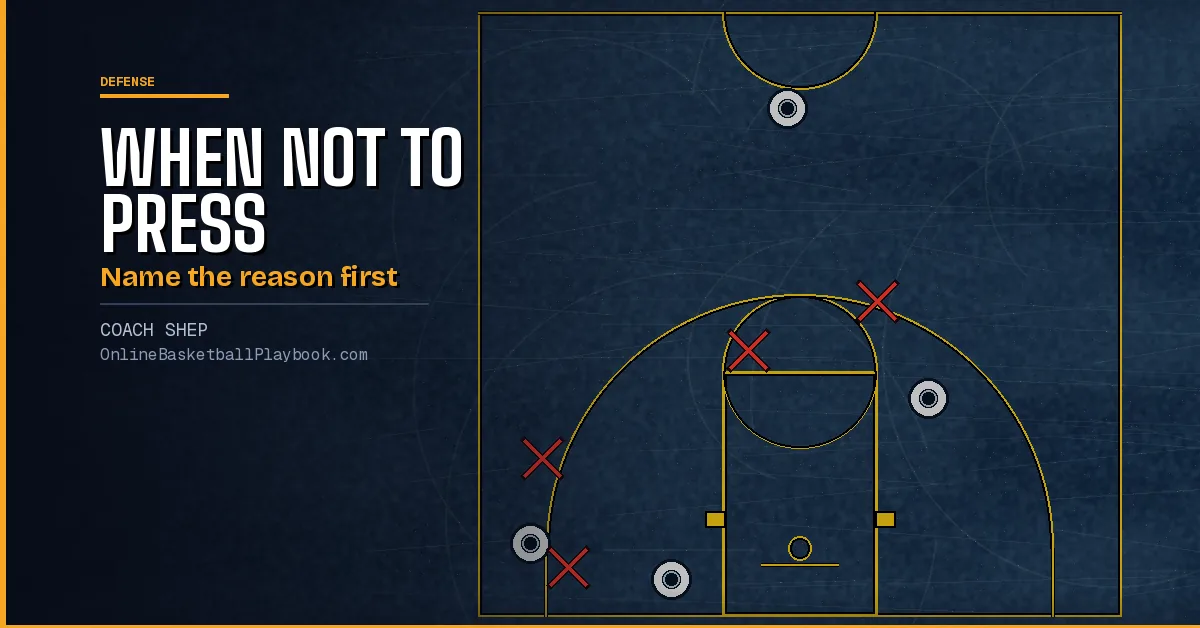
When Not to Press: Bad Reasons, Thin Benches, Poised Guards
When not to press in basketball: the bad reasons, the roster you need first, the opponents who beat it, the moments to drop it and the youth limits.
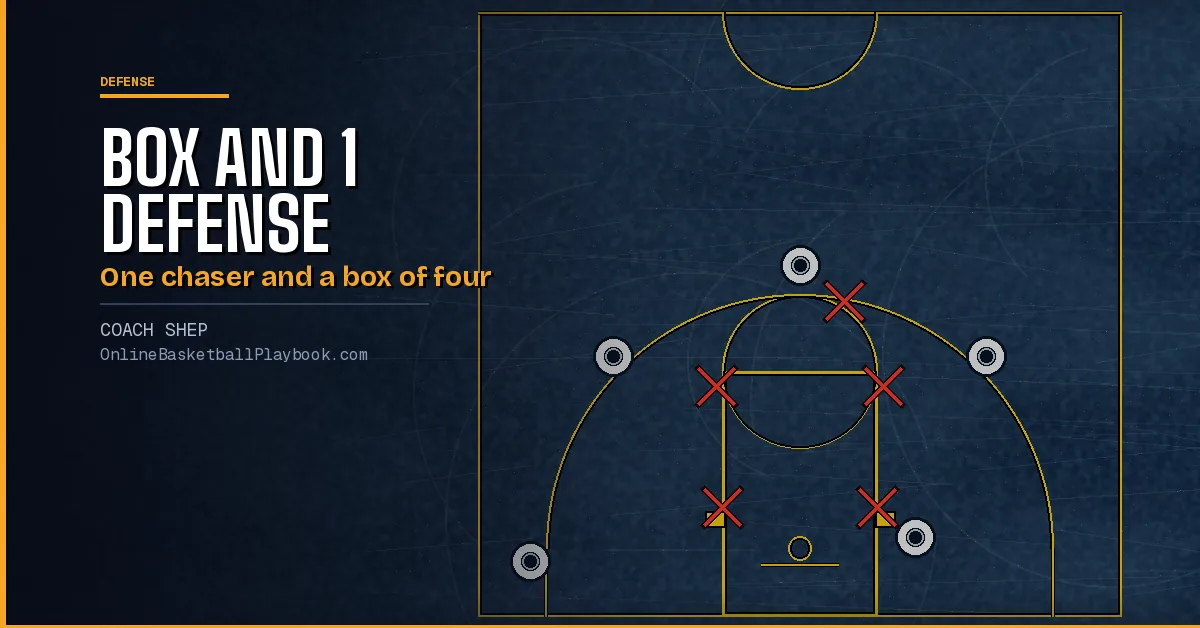
Box and 1 Defense: How It Works and How to Beat It
What the box and 1 defense is, how the chaser and the box play, when coaches call it, where it leaks, and how an offense beats it with a decoy star.